More than $5,000! Bank of America predicts gold prices will surge to $6,000 by spring 2026.
2026-01-24 01:51:19
While the market widely expects gold prices to reach the previously unattainable $5,000/ounce mark, Bank of America has raised its short-term gold price target to $6,000/ounce—the most aggressive forecast given to this precious metal by major institutions.
In a report to clients, Bank of America analyst Michael Hartnett wrote, "While history cannot predict the future, a review of four gold bull markets shows that prices surged by an average of about 300% within 43 months. Based on this, gold could potentially reach $6,000 per ounce by the spring of 2026." If this target is achieved, the price of gold would be more than 20% higher than its current all-time high.
Back on January 5th, Michael Widmer, Head of Metals Research at Bank of America, stated that gold will remain a core asset in investors' portfolios in 2026. "Gold has consistently been a standout hedging tool and a source of alpha returns," Widmer noted. Bank of America believes that the tightening market environment and significant earnings sensitivity make gold a key hedging instrument and potential return driver in 2026.
Bank of America's optimistic outlook for the gold market in 2026 is based on its prediction of declining supply and rising costs in the gold industry. Michael Widmer expects the 13 largest gold mining companies in North America to produce 19.2 million ounces of gold this year, a 2% decrease from 2025, adding that most market forecasts for production are overly optimistic.
Meanwhile, the average total cost of gold (including sustainable operating costs) will rise by 3% to approximately $1,600 per ounce, slightly above market consensus. However, mining companies' profitability is expected to improve significantly. Michael Widmer predicts that the industry's total EBITDA will grow by 41% to around $65 billion by 2026.
Bank of America previously stated that it expects the average real price of gold to reach $4,538 per ounce in 2026, with silver, platinum, and palladium prices also rising in tandem. This assessment reflects the bank's positive outlook on the entire precious metals sector.
Michael Widmer suggests that silver may be more attractive to investors willing to take on higher risks in pursuit of excess returns. Currently, the gold-to-silver ratio is around 59, suggesting that silver still has room to outperform gold. He cites historical data, noting that in 2011, the ratio fell to a low of 32, corresponding to a silver price peak of $135 per ounce; while in 1980, when the ratio hit a historic low of 14, the silver price could theoretically reach $309 per ounce.
At his annual outlook webinar last December, Michael Widmer pointed out that the peak of a gold bull market typically occurs only when the core drivers that triggered the bull market fade, rather than simply ending due to price increases. "I have previously emphasized that while the gold market is overbought, there is still a problem of underinvestment," said Michael Widmer. "As a diversification tool in an asset portfolio, gold still has huge room for allocation."
Michael Widmer further added that there are currently no signs of the bull market ending anytime soon. He estimates that investment demand only needs to grow by 14% to push gold to its target of $6,000 per ounce, a level that has been the average growth rate for the past few quarters. Meanwhile, to push gold prices to $8,000 per ounce next year, investment demand would need to grow by 55%.
In recent months, demand for gold investment, especially from retail investors, has surged, with inflows into gold ETFs (exchange-traded funds) reaching their highest level since 2020 in 2025. However, Michael Widmer points out that a key group remains largely on the sidelines regarding the gold market, a situation that is expected to change in 2026.
Data shows that gold currently accounts for approximately 4% of the total global financial market, but in the professional investment field, high-net-worth investors allocate only 0.5% of their assets to gold. This allocation gap supports the growth in gold demand.
The surge in gold investment enthusiasm reflects widespread skepticism among investors regarding the reliability of the traditional 60/40 asset allocation model (60% stocks, 40% bonds). Michael Widmer states that recent research indicates allocating 20% of a portfolio to gold is an effective strategy. "Analysis of data since 2020 shows that retail investors can certainly allocate far more than 20% to gold," Widmer says. "Given the current market environment, a 30% allocation is also reasonable."
Retail investors are not the only ones benefiting from the diversification value of gold. Michael Widmer predicts that even if central bank gold reserves reach a milestone high in 2025, central banks will continue to increase their gold holdings in 2026. He points out that central bank gold reserves currently exceed their holdings of US Treasury bonds, with gold accounting for an average of about 15% of total central bank reserves. However, his model analysis shows that the optimization of central bank reserve portfolios is highest when the gold allocation reaches around 30%.
“Regardless of the investment portfolio, whether it’s a central bank reserve portfolio or an institutional portfolio, there are benefits to diversifying risk by increasing gold allocations,” Michael Widmer emphasized. He added that the significant rise in gold prices in 2025 means that by 2026 most portfolio managers will find it difficult to ignore this asset.
“Looking at market benchmarks alone, gold has been one of the best-performing assets over the past few years. We often hear the question: ‘Gold is a non-yielding asset, it incurs costs to hold, and it doesn’t generate interest income, so what’s the point of allocating to it?’” Michael Widmer said. “But looking at price movements alone, gold has actually contributed considerable returns to portfolios, and the data speaks for itself.”
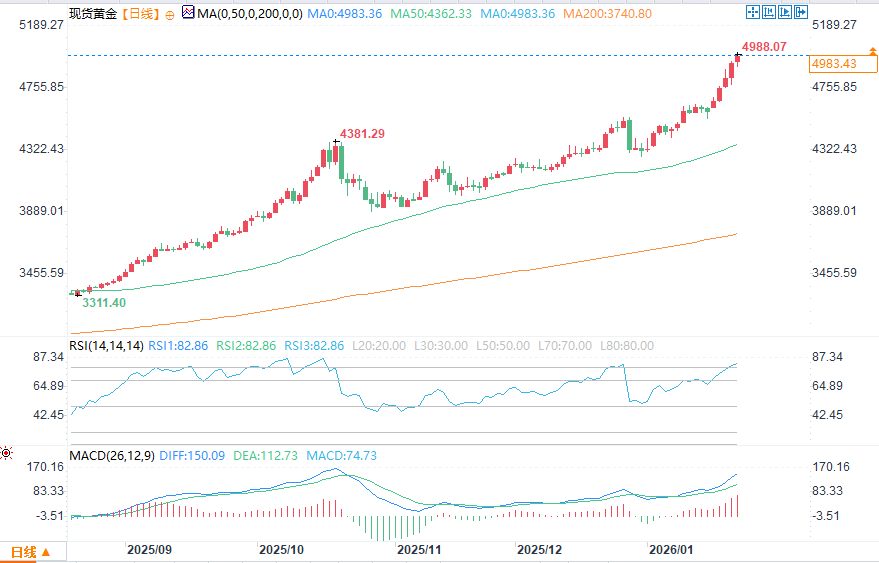
(Spot gold daily chart source: FX678)
Regarding the factors that will trigger another influx of funds into the gold market, Michael Widmer believes that US monetary policy in 2026 will be a key variable. His model shows that during a period of loose monetary policy (when the inflation rate is above 2%), gold prices can rise by an average of 13%. "It doesn't even need to cut rates at every policy meeting," Michael Widmer said. "As long as the market clearly sees interest rates on a downward trend, that's enough to support a rise in gold prices."
In a report to clients, Bank of America analyst Michael Hartnett wrote, "While history cannot predict the future, a review of four gold bull markets shows that prices surged by an average of about 300% within 43 months. Based on this, gold could potentially reach $6,000 per ounce by the spring of 2026." If this target is achieved, the price of gold would be more than 20% higher than its current all-time high.
Back on January 5th, Michael Widmer, Head of Metals Research at Bank of America, stated that gold will remain a core asset in investors' portfolios in 2026. "Gold has consistently been a standout hedging tool and a source of alpha returns," Widmer noted. Bank of America believes that the tightening market environment and significant earnings sensitivity make gold a key hedging instrument and potential return driver in 2026.
Bank of America's optimistic outlook for the gold market in 2026 is based on its prediction of declining supply and rising costs in the gold industry. Michael Widmer expects the 13 largest gold mining companies in North America to produce 19.2 million ounces of gold this year, a 2% decrease from 2025, adding that most market forecasts for production are overly optimistic.
Meanwhile, the average total cost of gold (including sustainable operating costs) will rise by 3% to approximately $1,600 per ounce, slightly above market consensus. However, mining companies' profitability is expected to improve significantly. Michael Widmer predicts that the industry's total EBITDA will grow by 41% to around $65 billion by 2026.
Bank of America previously stated that it expects the average real price of gold to reach $4,538 per ounce in 2026, with silver, platinum, and palladium prices also rising in tandem. This assessment reflects the bank's positive outlook on the entire precious metals sector.
Michael Widmer suggests that silver may be more attractive to investors willing to take on higher risks in pursuit of excess returns. Currently, the gold-to-silver ratio is around 59, suggesting that silver still has room to outperform gold. He cites historical data, noting that in 2011, the ratio fell to a low of 32, corresponding to a silver price peak of $135 per ounce; while in 1980, when the ratio hit a historic low of 14, the silver price could theoretically reach $309 per ounce.
At his annual outlook webinar last December, Michael Widmer pointed out that the peak of a gold bull market typically occurs only when the core drivers that triggered the bull market fade, rather than simply ending due to price increases. "I have previously emphasized that while the gold market is overbought, there is still a problem of underinvestment," said Michael Widmer. "As a diversification tool in an asset portfolio, gold still has huge room for allocation."
Michael Widmer further added that there are currently no signs of the bull market ending anytime soon. He estimates that investment demand only needs to grow by 14% to push gold to its target of $6,000 per ounce, a level that has been the average growth rate for the past few quarters. Meanwhile, to push gold prices to $8,000 per ounce next year, investment demand would need to grow by 55%.
In recent months, demand for gold investment, especially from retail investors, has surged, with inflows into gold ETFs (exchange-traded funds) reaching their highest level since 2020 in 2025. However, Michael Widmer points out that a key group remains largely on the sidelines regarding the gold market, a situation that is expected to change in 2026.
Data shows that gold currently accounts for approximately 4% of the total global financial market, but in the professional investment field, high-net-worth investors allocate only 0.5% of their assets to gold. This allocation gap supports the growth in gold demand.
The surge in gold investment enthusiasm reflects widespread skepticism among investors regarding the reliability of the traditional 60/40 asset allocation model (60% stocks, 40% bonds). Michael Widmer states that recent research indicates allocating 20% of a portfolio to gold is an effective strategy. "Analysis of data since 2020 shows that retail investors can certainly allocate far more than 20% to gold," Widmer says. "Given the current market environment, a 30% allocation is also reasonable."
Retail investors are not the only ones benefiting from the diversification value of gold. Michael Widmer predicts that even if central bank gold reserves reach a milestone high in 2025, central banks will continue to increase their gold holdings in 2026. He points out that central bank gold reserves currently exceed their holdings of US Treasury bonds, with gold accounting for an average of about 15% of total central bank reserves. However, his model analysis shows that the optimization of central bank reserve portfolios is highest when the gold allocation reaches around 30%.
“Regardless of the investment portfolio, whether it’s a central bank reserve portfolio or an institutional portfolio, there are benefits to diversifying risk by increasing gold allocations,” Michael Widmer emphasized. He added that the significant rise in gold prices in 2025 means that by 2026 most portfolio managers will find it difficult to ignore this asset.
“Looking at market benchmarks alone, gold has been one of the best-performing assets over the past few years. We often hear the question: ‘Gold is a non-yielding asset, it incurs costs to hold, and it doesn’t generate interest income, so what’s the point of allocating to it?’” Michael Widmer said. “But looking at price movements alone, gold has actually contributed considerable returns to portfolios, and the data speaks for itself.”
(Spot gold daily chart source: FX678)
Regarding the factors that will trigger another influx of funds into the gold market, Michael Widmer believes that US monetary policy in 2026 will be a key variable. His model shows that during a period of loose monetary policy (when the inflation rate is above 2%), gold prices can rise by an average of 13%. "It doesn't even need to cut rates at every policy meeting," Michael Widmer said. "As long as the market clearly sees interest rates on a downward trend, that's enough to support a rise in gold prices."
- Risk Warning and Disclaimer
- The market involves risk, and trading may not be suitable for all investors. This article is for reference only and does not constitute personal investment advice, nor does it take into account certain users’ specific investment objectives, financial situation, or other needs. Any investment decisions made based on this information are at your own risk.