Oil production risks intensified, but a stronger dollar limited gains.
2026-01-29 01:22:06
On Wednesday (January 28), the US crude oil market witnessed a classic battle between bulls and bears. Boosted by EIA inventory data, WTI crude oil briefly broke through the key resistance level of $62.50, seemingly poised for a breakout. However, this upward momentum was precisely suppressed by a sudden rebound in the US dollar index, significantly narrowing the gains. This struggle, driven by supply-side positives and monetary pressures, not only reshaped short-term oil price trends but also made the subsequent upward path highly uncertain.

I. Tight supply continues to solidify supporting logic.
The core support for the current crude oil market remains firmly rooted in the structural tensions on the supply side. The winter storms sweeping across the south-central and northeastern United States have not subsided as quickly as initially expected, instead continuing to disrupt crude oil production and export chains. Data from ship tracking agency Vortexa shows that crude oil exports from U.S. Gulf Coast ports briefly fell to zero on Sunday. Although there was a slight recovery on Monday, port handling efficiency and the recovery of shipping routes are still constrained by the cold weather, making it difficult for export capacity to fully return to normal in the short term.
The EIA inventory report released today (covering the week ending January 23) further confirms the pressure on the supply side. Data shows that U.S. commercial crude oil inventories unexpectedly fell by 1.2 million barrels (market expectations were for an increase of 800,000 barrels), gasoline inventories fell slightly by 300,000 barrels, and distillate fuel inventories continued their downward trend to 118 million barrels, a five-year low for this time of year. This data breaks market expectations of "limited storm impact and gradual inventory accumulation," directly reflecting the substantial impact of extreme weather on U.S. domestic crude oil production and refinery operating rates—it is estimated that the storm caused a temporary reduction of approximately 350,000 barrels per day in U.S. crude oil production, accounting for 3.2% of total U.S. production.
Disruptions on the overseas supply side are also significant. Since an equipment failure last month, the Tengiz oil field in Kazakhstan has experienced continued delays in its recovery process, with daily production currently 200,000 barrels below normal levels, and no clear timetable for full resumption of production in the short term. As one of the world's important crude oil export hubs, the production shortfall at this oil field, coupled with supply disruptions in the Gulf of Mexico, has created a tight balance in the current crude oil market.
II. A strong dollar attack suppresses upward momentum in oil prices.
Just as the market was basking in the positive supply news that was driving oil prices higher, monetary policy suddenly became the dominant factor. US Treasury Secretary Scott Bessant's public remarks during the US trading session directly ignited a dollar rebound – he explicitly emphasized that "the United States will always adhere to a strong dollar policy, relying on sound economic fundamentals to attract global capital inflows, rather than adjusting exchange rates through market intervention."
This statement precisely addressed the current market's divergent expectations regarding the US dollar. Previously, influenced by pricing in at least two interest rate cuts by the Federal Reserve this year, the dollar index had been weakening, indirectly supporting dollar-denominated crude oil. However, Bessant's remarks not only reinforced the US government's stance on a strong dollar but also alleviated market concerns about a continued depreciation of the dollar during a rate-cutting cycle, pushing the dollar index to rebound quickly by 0.79% from its intraday low, returning above the 103.5 level.
For crude oil, the strong rebound of the US dollar is undoubtedly a direct negative factor. As a core global commodity priced in US dollars, the negative correlation between crude oil and the US dollar index was fully demonstrated today—a stronger dollar means lower purchasing power for non-US currencies, which in turn suppresses global crude oil demand expectations and reduces speculative funds' willingness to allocate to crude oil. As of 01:07 Beijing time, WTI crude oil was trading at $62.69, with the increase narrowing from 1.06% after the data release to 0.48%. Oil prices have fallen from the intraday high of $63.20, highlighting the significant impact of the dollar's pressure.
III. Target Price Revision: Anchoring a Reasonable Range in a Balance Between Bulls and Bears
Considering the current market situation, I have lowered my short-term core target price range for WTI crude oil to $63.50-$65.50. This adjustment does not negate the upward trend in oil prices, but rather represents a rational adjustment after the interplay of bullish and bearish forces.
The core logic behind the downward revision lies in the substantial suppression of bullish momentum by the strengthening US dollar. From a technical perspective, although WTI crude oil broke through the $62.50 resistance level and stabilized above the 200-day moving average at $62.23 (forming solid support), profit-taking triggered by the dollar's rebound has resulted in a "high-low" doji pattern on the daily chart, suggesting that short-term bullish momentum has been somewhat depleted. If the dollar's strength continues, oil prices will likely fluctuate repeatedly within the $62.50-$63.00 range, making a rapid push towards previous highs unlikely.
However, we also retain some upside potential, primarily due to lingering supply risks. The impact of winter storms on US crude oil production continues, and geopolitical risks persist—US warships have arrived near Iran, and the Trump administration's tough stance on Iran's nuclear negotiations further increases the potential risk of supply disruptions from the Middle East. If subsequent negative supply-side factors emerge (such as an escalation of the Iranian situation or slower-than-expected production recovery in the Gulf of Mexico), oil prices could still break through dollar resistance and approach the $65.50 target.
IV. Market Outlook: Focusing on Two Core Variables
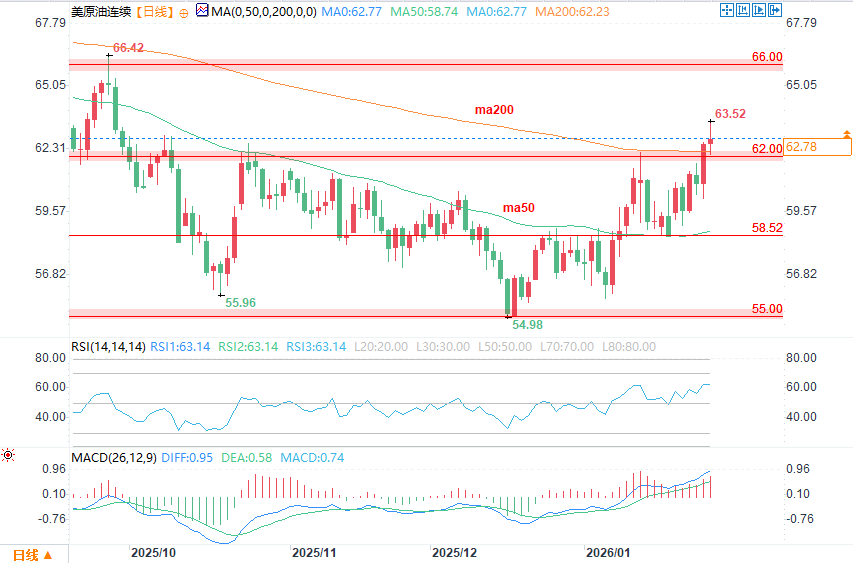
(WTI crude oil daily chart source: FX678)
The current trend of the crude oil market has entered a stage of dual constraints between "supply support" and "dollar suppression". To judge the future direction, we need to focus on these two core variables.
First, the sustainability of the dollar's trend. While Bessant's remarks provided a short-term boost to the dollar, the Federal Reserve's monetary policy remains the key factor determining its medium- to long-term direction. Today, the Fed announced it would maintain interest rates, and market pricing in two rate cuts this year has not changed significantly. If subsequent US economic data shows signs of weakness, and expectations for rate cuts rise again, the dollar's rebound momentum may quickly weaken, easing monetary pressure on oil prices. Conversely, if economic data shows stronger-than-expected resilience, the strong dollar stance will be reinforced, and oil prices will continue to face upward pressure.
Secondly, the pace of the fading supply-side disturbances is crucial. Whether the impact of the winter storms will further expand, when production and exports in the Gulf of Mexico will fully recover, and whether the resumption of production at Kazakhstan's Tengiz oil field will exceed expectations—these factors will directly determine the sustainability of the tight supply situation. Furthermore, OPEC+'s attitude towards the current market is also worth noting—if oil prices fall too sharply, the possibility of OPEC+ signaling production cuts to stabilize prices cannot be ruled out, thus providing additional support for oil prices.
Overall, oil prices remain in a medium-term upward trend, but the short-term upward momentum has been disrupted by the rebound of the US dollar. Within the new target range of $63.50-$65.50, the battle between bulls and bears may intensify. It is recommended to closely monitor the effectiveness of the $62.23 support level, as well as real-time changes in the US dollar index and supply-side dynamics, and adjust position strategies flexibly accordingly.
I. Tight supply continues to solidify supporting logic.
The core support for the current crude oil market remains firmly rooted in the structural tensions on the supply side. The winter storms sweeping across the south-central and northeastern United States have not subsided as quickly as initially expected, instead continuing to disrupt crude oil production and export chains. Data from ship tracking agency Vortexa shows that crude oil exports from U.S. Gulf Coast ports briefly fell to zero on Sunday. Although there was a slight recovery on Monday, port handling efficiency and the recovery of shipping routes are still constrained by the cold weather, making it difficult for export capacity to fully return to normal in the short term.
The EIA inventory report released today (covering the week ending January 23) further confirms the pressure on the supply side. Data shows that U.S. commercial crude oil inventories unexpectedly fell by 1.2 million barrels (market expectations were for an increase of 800,000 barrels), gasoline inventories fell slightly by 300,000 barrels, and distillate fuel inventories continued their downward trend to 118 million barrels, a five-year low for this time of year. This data breaks market expectations of "limited storm impact and gradual inventory accumulation," directly reflecting the substantial impact of extreme weather on U.S. domestic crude oil production and refinery operating rates—it is estimated that the storm caused a temporary reduction of approximately 350,000 barrels per day in U.S. crude oil production, accounting for 3.2% of total U.S. production.
Disruptions on the overseas supply side are also significant. Since an equipment failure last month, the Tengiz oil field in Kazakhstan has experienced continued delays in its recovery process, with daily production currently 200,000 barrels below normal levels, and no clear timetable for full resumption of production in the short term. As one of the world's important crude oil export hubs, the production shortfall at this oil field, coupled with supply disruptions in the Gulf of Mexico, has created a tight balance in the current crude oil market.
II. A strong dollar attack suppresses upward momentum in oil prices.
Just as the market was basking in the positive supply news that was driving oil prices higher, monetary policy suddenly became the dominant factor. US Treasury Secretary Scott Bessant's public remarks during the US trading session directly ignited a dollar rebound – he explicitly emphasized that "the United States will always adhere to a strong dollar policy, relying on sound economic fundamentals to attract global capital inflows, rather than adjusting exchange rates through market intervention."
This statement precisely addressed the current market's divergent expectations regarding the US dollar. Previously, influenced by pricing in at least two interest rate cuts by the Federal Reserve this year, the dollar index had been weakening, indirectly supporting dollar-denominated crude oil. However, Bessant's remarks not only reinforced the US government's stance on a strong dollar but also alleviated market concerns about a continued depreciation of the dollar during a rate-cutting cycle, pushing the dollar index to rebound quickly by 0.79% from its intraday low, returning above the 103.5 level.
For crude oil, the strong rebound of the US dollar is undoubtedly a direct negative factor. As a core global commodity priced in US dollars, the negative correlation between crude oil and the US dollar index was fully demonstrated today—a stronger dollar means lower purchasing power for non-US currencies, which in turn suppresses global crude oil demand expectations and reduces speculative funds' willingness to allocate to crude oil. As of 01:07 Beijing time, WTI crude oil was trading at $62.69, with the increase narrowing from 1.06% after the data release to 0.48%. Oil prices have fallen from the intraday high of $63.20, highlighting the significant impact of the dollar's pressure.
III. Target Price Revision: Anchoring a Reasonable Range in a Balance Between Bulls and Bears
Considering the current market situation, I have lowered my short-term core target price range for WTI crude oil to $63.50-$65.50. This adjustment does not negate the upward trend in oil prices, but rather represents a rational adjustment after the interplay of bullish and bearish forces.
The core logic behind the downward revision lies in the substantial suppression of bullish momentum by the strengthening US dollar. From a technical perspective, although WTI crude oil broke through the $62.50 resistance level and stabilized above the 200-day moving average at $62.23 (forming solid support), profit-taking triggered by the dollar's rebound has resulted in a "high-low" doji pattern on the daily chart, suggesting that short-term bullish momentum has been somewhat depleted. If the dollar's strength continues, oil prices will likely fluctuate repeatedly within the $62.50-$63.00 range, making a rapid push towards previous highs unlikely.
However, we also retain some upside potential, primarily due to lingering supply risks. The impact of winter storms on US crude oil production continues, and geopolitical risks persist—US warships have arrived near Iran, and the Trump administration's tough stance on Iran's nuclear negotiations further increases the potential risk of supply disruptions from the Middle East. If subsequent negative supply-side factors emerge (such as an escalation of the Iranian situation or slower-than-expected production recovery in the Gulf of Mexico), oil prices could still break through dollar resistance and approach the $65.50 target.
IV. Market Outlook: Focusing on Two Core Variables
(WTI crude oil daily chart source: FX678)
The current trend of the crude oil market has entered a stage of dual constraints between "supply support" and "dollar suppression". To judge the future direction, we need to focus on these two core variables.
First, the sustainability of the dollar's trend. While Bessant's remarks provided a short-term boost to the dollar, the Federal Reserve's monetary policy remains the key factor determining its medium- to long-term direction. Today, the Fed announced it would maintain interest rates, and market pricing in two rate cuts this year has not changed significantly. If subsequent US economic data shows signs of weakness, and expectations for rate cuts rise again, the dollar's rebound momentum may quickly weaken, easing monetary pressure on oil prices. Conversely, if economic data shows stronger-than-expected resilience, the strong dollar stance will be reinforced, and oil prices will continue to face upward pressure.
Secondly, the pace of the fading supply-side disturbances is crucial. Whether the impact of the winter storms will further expand, when production and exports in the Gulf of Mexico will fully recover, and whether the resumption of production at Kazakhstan's Tengiz oil field will exceed expectations—these factors will directly determine the sustainability of the tight supply situation. Furthermore, OPEC+'s attitude towards the current market is also worth noting—if oil prices fall too sharply, the possibility of OPEC+ signaling production cuts to stabilize prices cannot be ruled out, thus providing additional support for oil prices.
Overall, oil prices remain in a medium-term upward trend, but the short-term upward momentum has been disrupted by the rebound of the US dollar. Within the new target range of $63.50-$65.50, the battle between bulls and bears may intensify. It is recommended to closely monitor the effectiveness of the $62.23 support level, as well as real-time changes in the US dollar index and supply-side dynamics, and adjust position strategies flexibly accordingly.
- Risk Warning and Disclaimer
- The market involves risk, and trading may not be suitable for all investors. This article is for reference only and does not constitute personal investment advice, nor does it take into account certain users’ specific investment objectives, financial situation, or other needs. Any investment decisions made based on this information are at your own risk.