Crude oil trading alert: OPEC+ holding rates steady and geopolitical uncertainties support bullish fluctuations in oil prices.
2026-02-02 09:46:57
On Monday during Asian trading hours, US crude oil continued its decline, briefly breaking through resistance before retesting moving average support and trading around $63. On the fundamental front, OPEC+ decided at its latest meeting to maintain its current crude oil production policy in March and reiterated its commitment to continuously assessing market conditions and retaining flexibility in adjusting production.
The decision itself did not send a new supply signal to the market, but against the backdrop of declining global crude oil inventory elasticity and tightening marginal supply and demand, it provided a relatively stable policy anchor for oil prices.
With the production cut policy continuing, the market pricing focus has rapidly shifted from OPEC+ internal factors to external variables, with geopolitics and unexpected supply and demand disruptions becoming the dominant factors. Recent signals from the United States regarding Venezuela have significantly altered market expectations.

The United States has proposed sharing oil revenues with Venezuela and promoting the gradual recovery of its energy exports, while also suggesting that India increase its purchases of Venezuelan crude oil to replace some of the supplies from Iran and Russia.
Following the easing of restrictions on private investment, Venezuela is expected to see a recovery in production capacity and exports. However, given the limitations in infrastructure, funding, and implementation, it is unlikely to generate a large-scale increase in supply in the short term, and the expectation is more of an adjustment to the future supply structure.
Meanwhile, India is accelerating its diversification of crude oil imports, which has shrunk the market share of Russian crude oil, forcing it to sell at significant discounts and exacerbating fiscal pressure. This restructuring of the energy trade structure, during the transition phase, has actually increased supply chain frictions, reducing market confidence in short-term supply stability.
Geopolitical risks have also been a significant driver of the recent oil price rebound. The increasingly stringent military and political stance of the United States towards Iran has led the market to reassess potential supply disruptions. Given that Iranian crude oil production accounts for a substantial proportion of global supply, even without actual supply cuts, the associated risks have quickly translated into a risk premium in prices.
Funds chose to position themselves early during this phase to mitigate potential asymmetric upside risks. Meanwhile, the extreme cold wave covering a large area of the United States had a substantial impact on the energy system. The severe weather forced several refineries along the Gulf Coast to reduce or shut down production, and some domestic crude oil production was also affected, with peak production losses approaching 2 million barrels per day.
While supply contracted, heating demand rose rapidly, driving up demand for refined oil products, with the diesel market leading the way into a net bullish structure. The simultaneous disruptions to both supply and demand significantly increased expectations of tight immediate supply in the spot market.
Driven by the combined effects of these factors, money management institutions and hedge funds have significantly accelerated their long position building, with net long positions in Brent and WTI crude oil rising to multi-month highs. The derivatives market also signaled a bullish bias, with implied volatility for call options consistently higher than for put options, indicating that traders are paying a premium for potential upside risk.
The steepening futures curve and the widening premium of near-month contracts reflect a strengthening of the market's pricing logic regarding tight short-term supply.
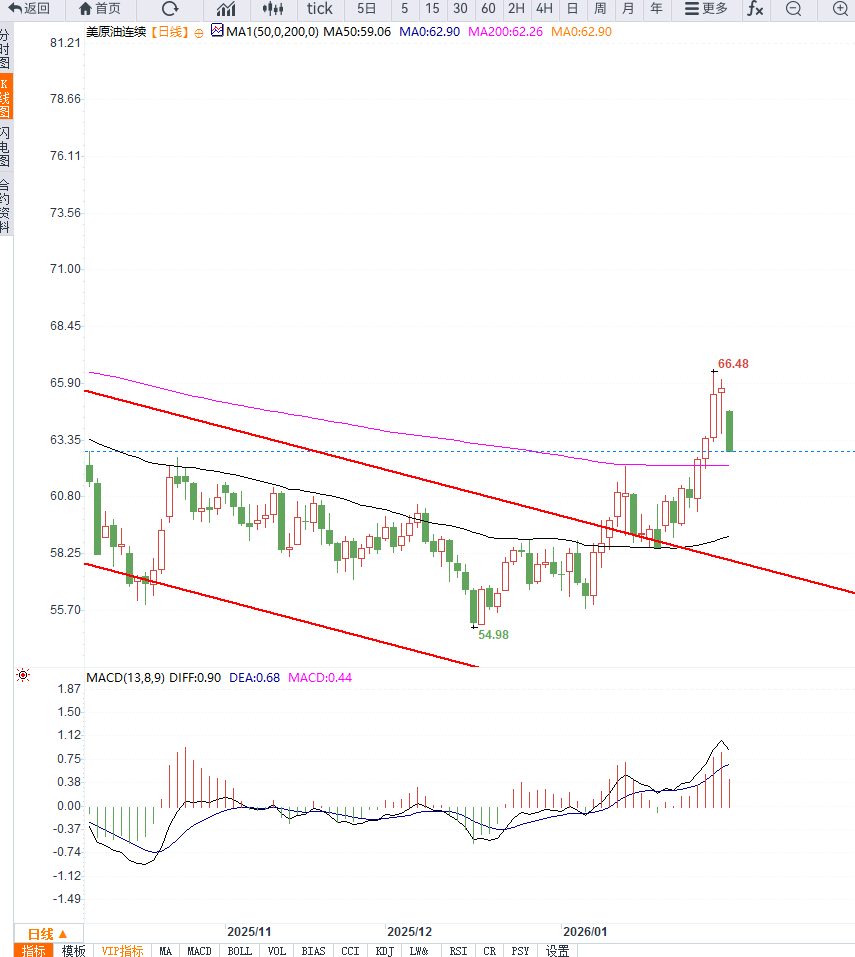
From the daily chart of US crude oil, prices have gradually stabilized after the previous pullback and have returned to the area of the medium-term moving average. The daily chart structure shows a corrective pattern with rising lows. Short-term moving averages have turned upwards and formed support for the price, indicating that the bulls have regained the initiative. However, the medium- and long-term moving averages still need to follow, and trend confirmation is still underway.
Momentum indicators have rebounded to the neutral-to-strong range and have not yet entered a clearly overbought state, indicating that prices still have some room to rise, but a subsequent breakout will require the support of trading volume and fundamental events.
From a key perspective, the $65 to $67 range above forms an important resistance zone. If it breaks through and holds, oil prices are expected to extend further towards $70. On the downside, the $62 level is an important short-term support. If it falls below this level, it means that this rebound may turn into a technical correction within a range.
Editor's Note:
The current rise in oil prices reflects more the concentrated pricing of uncertainty than a single, clear supply-demand gap. OPEC+'s policy stability has compressed the market's buffer, energy substitution in Venezuela and India remains in the expectation stage, the Iranian risk provides a significant tail premium, and the cold wave has brought a real but temporary supply contraction.
With multiple variables converging, funds have chosen to increase long positions, driving prices up rapidly. The short-term bullish logic remains supported, but once the impact of weather weakens and geopolitical risks do not escalate further, oil prices may return to a phase of reassessment of fundamentals and inventory changes, and medium-term volatility should not be ignored.
The decision itself did not send a new supply signal to the market, but against the backdrop of declining global crude oil inventory elasticity and tightening marginal supply and demand, it provided a relatively stable policy anchor for oil prices.
With the production cut policy continuing, the market pricing focus has rapidly shifted from OPEC+ internal factors to external variables, with geopolitics and unexpected supply and demand disruptions becoming the dominant factors. Recent signals from the United States regarding Venezuela have significantly altered market expectations.
The United States has proposed sharing oil revenues with Venezuela and promoting the gradual recovery of its energy exports, while also suggesting that India increase its purchases of Venezuelan crude oil to replace some of the supplies from Iran and Russia.
Following the easing of restrictions on private investment, Venezuela is expected to see a recovery in production capacity and exports. However, given the limitations in infrastructure, funding, and implementation, it is unlikely to generate a large-scale increase in supply in the short term, and the expectation is more of an adjustment to the future supply structure.
Meanwhile, India is accelerating its diversification of crude oil imports, which has shrunk the market share of Russian crude oil, forcing it to sell at significant discounts and exacerbating fiscal pressure. This restructuring of the energy trade structure, during the transition phase, has actually increased supply chain frictions, reducing market confidence in short-term supply stability.
Geopolitical risks have also been a significant driver of the recent oil price rebound. The increasingly stringent military and political stance of the United States towards Iran has led the market to reassess potential supply disruptions. Given that Iranian crude oil production accounts for a substantial proportion of global supply, even without actual supply cuts, the associated risks have quickly translated into a risk premium in prices.
Funds chose to position themselves early during this phase to mitigate potential asymmetric upside risks. Meanwhile, the extreme cold wave covering a large area of the United States had a substantial impact on the energy system. The severe weather forced several refineries along the Gulf Coast to reduce or shut down production, and some domestic crude oil production was also affected, with peak production losses approaching 2 million barrels per day.
While supply contracted, heating demand rose rapidly, driving up demand for refined oil products, with the diesel market leading the way into a net bullish structure. The simultaneous disruptions to both supply and demand significantly increased expectations of tight immediate supply in the spot market.
Driven by the combined effects of these factors, money management institutions and hedge funds have significantly accelerated their long position building, with net long positions in Brent and WTI crude oil rising to multi-month highs. The derivatives market also signaled a bullish bias, with implied volatility for call options consistently higher than for put options, indicating that traders are paying a premium for potential upside risk.
The steepening futures curve and the widening premium of near-month contracts reflect a strengthening of the market's pricing logic regarding tight short-term supply.
From the daily chart of US crude oil, prices have gradually stabilized after the previous pullback and have returned to the area of the medium-term moving average. The daily chart structure shows a corrective pattern with rising lows. Short-term moving averages have turned upwards and formed support for the price, indicating that the bulls have regained the initiative. However, the medium- and long-term moving averages still need to follow, and trend confirmation is still underway.
Momentum indicators have rebounded to the neutral-to-strong range and have not yet entered a clearly overbought state, indicating that prices still have some room to rise, but a subsequent breakout will require the support of trading volume and fundamental events.
From a key perspective, the $65 to $67 range above forms an important resistance zone. If it breaks through and holds, oil prices are expected to extend further towards $70. On the downside, the $62 level is an important short-term support. If it falls below this level, it means that this rebound may turn into a technical correction within a range.
Editor's Note:
The current rise in oil prices reflects more the concentrated pricing of uncertainty than a single, clear supply-demand gap. OPEC+'s policy stability has compressed the market's buffer, energy substitution in Venezuela and India remains in the expectation stage, the Iranian risk provides a significant tail premium, and the cold wave has brought a real but temporary supply contraction.
With multiple variables converging, funds have chosen to increase long positions, driving prices up rapidly. The short-term bullish logic remains supported, but once the impact of weather weakens and geopolitical risks do not escalate further, oil prices may return to a phase of reassessment of fundamentals and inventory changes, and medium-term volatility should not be ignored.
- Risk Warning and Disclaimer
- The market involves risk, and trading may not be suitable for all investors. This article is for reference only and does not constitute personal investment advice, nor does it take into account certain users’ specific investment objectives, financial situation, or other needs. Any investment decisions made based on this information are at your own risk.