A thought-provoking question: With gold prices plummeting overnight, do you see it as a risk or a once-in-a-decade opportunity?
2026-02-02 20:04:37
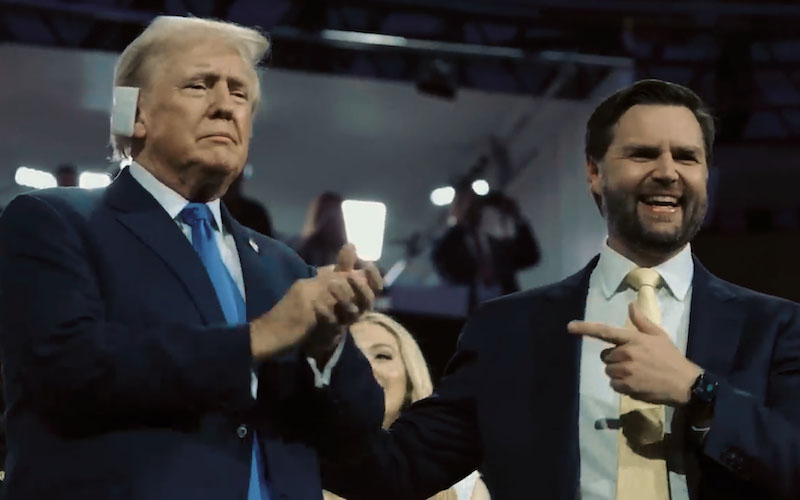
From the perspective of the core trading logic, the market's optimistic expectations for US easing were directly offset by the reassessment of expectations for the Fed leadership triggered by Trump's nomination of Kevin Warsh, a former Fed governor who firmly supported tightening policies, to succeed Powell as chairman after his term expired in May. This became the key trigger for the market reversal.
As mentioned in previous articles, this expectation directly undermines the "sell US" trading logic and brings back the previous view of buying the US dollar and a strong US dollar to the market. The change in expectations behind this trading is the core bullish logic that previously supported the one-sided surge in gold and silver prices, but this logic is now gradually disintegrating.
Christopher Forbes, head of Asia Pacific and the Middle East at Gain Capital, stated that the recent sharp drop in gold prices was a typical technical correction after an extreme one-sided rally, not a substantial breakdown of the long-term bullish logic. In essence, it was a "typical sharp drop after an extreme surge."
Multiple factors: Capital, the US dollar, and geopolitical sentiment all exert pressure <br />The recent sharp drop in gold prices is the result of multiple negative factors working together.
Warsh's nomination became one of the core drivers of the dollar's strength. As a staunch supporter of tight monetary policy, he fueled market expectations of a hawkish stance for the Fed's future policy direction. Previously, the market believed that Reid, who represented easing and tolerance for inflation, would become the Fed chairman. This shift created a huge expectation gap in the market.
Meanwhile, the US government shutdown also changed from a de facto shutdown to a nominal shutdown during this period. Although the government is nominally shut down again this time, key agencies have received their budgets, so it has not actually stopped.
Furthermore, Trump's remarks about potentially reaching an agreement with Iran significantly eased geopolitical risk aversion in the market. West Texas Intermediate crude oil futures fell by about 4% on Monday, which also weakened the safe-haven buying support for gold. Multiple factors combined to burst the market bubble in this crowded trade.
In terms of funding, CME Group raised the margin requirements for gold and silver futures, increasing the margin for gold futures from 6% to 8% and the margin for silver futures from 11% to 15%. Coupled with the large amount of profit-taking accumulated in the previous one-sided surge, some investors chose to take profits, and the concentrated exit of profit-taking directly caused the market to fall.
The US dollar index also continued to strengthen, rising by about 0.8% since Thursday. As a result, the attractiveness of dollar-denominated gold to overseas buyers has decreased, directly suppressing gold prices.
Despite the significant short-term pullback, the precious metals market has demonstrated strong resilience, and the long-term upward trend has not been altered by this technical correction.
Looking at the annual performance in 2026, the price of silver has risen by about 16% year-to-date, while gold has also recorded an increase of about 8% during the same period, maintaining positive returns despite short-term corrections.
Looking back at the market in 2025, gold and silver experienced a record-breaking one-sided surge, with annual gains of approximately 65% and 145% respectively. These huge annual gains confirmed the long-term strength of the precious metals market and laid the foundation for the market in 2026. Short-term technical corrections did not shake this long-term trend.
The long-term bullish logic for gold is solidified by multiple underlying factors, including geopolitics, central bank gold purchases, and market capital structure, and these core supports have not changed substantially.
At the geopolitical level, although the situation in the Middle East has eased recently, global uncertainties persist: the diplomatic standoff between the US and Europe over the status of Greenland has disrupted the traditional stable pattern among Western allies.
The resurgence of global tariff sanctions has exacerbated the risk of global economic fragmentation. These potential risks will continue to inject a long-term "risk premium" into gold prices, highlighting its status as the ultimate safe-haven asset.
In terms of central bank gold purchases, the global wave of de-dollarization is in full swing, becoming the most disruptive structural support for the gold market. From 2025 to early 2026, central banks in emerging markets such as China, India, Poland, and Turkey will embark on a record-breaking gold purchase program, marking the first time in modern financial history that the gold reserves of several major economies have surpassed those of US Treasury bonds.
Central banks' demand for gold is stable over the long term, with very few panic sell-offs. This buying behavior by "official departments" has built a solid bottom support for gold prices, becoming the "ballast" of the gold market.
In terms of funding and investor structure, the number of participants in the gold market is constantly expanding, with new funds continuously entering the market.
By the end of 2025, physical gold ETFs recorded a record inflow of over $26 billion. These modern financial instruments allow institutional and retail investors to participate in gold investment as easily as trading stocks, significantly lowering the market entry barrier.
Meanwhile, retail demand has shown remarkable resilience, with major gold-consuming countries like India maintaining historically high demand for physical gold bars and coins. Young investors in Western markets are also increasingly incorporating gold into their diversified digital investment portfolios, viewing it as an essential hedge against market volatility.
After gold prices broke through the psychological barrier of $5,000 per ounce, the fear of missing out (FOMO) effect drove trend traders to enter the market, further amplifying the capital momentum in the gold market.
Industry institutions have given a clear assessment of the future trading trend of gold, with a consensus that it will be volatile in the short term but bullish in the long term.
Forbes believes that in the short term, gold prices will remain in a high range, but volatility will increase significantly. The core reason is that the market is in a wait-and-see state, waiting for further clear signals from Warsh's policy direction. The policy tone of the Federal Reserve leadership will be an important guide for the short-term market.
In the long term, Forbes maintains its bullish outlook on gold for the next 12 months, primarily because the core drivers supporting gold's rise—geopolitical tensions, massive global debt pressure, and the weakening of the dollar's hegemony—show no clear signs of abating.
If the US dollar weakens again, or if Warsh's policy stance is confirmed to be dovish, funds that bought on dips will quickly flow back into the market, driving a rebound in gold prices. If the Federal Reserve continues its loose monetary policy, and economic growth and inflation continue to diverge, gold prices are expected to retest recent historical highs.
For modern gold traders, gold has long since transformed from an ancient store of value into a core hedging tool in volatile market environments. This short-term technical correction is merely a phase in the market game driven by multiple factors, and it does not change the core logic of its long-term upward trend. The subsequent trading game surrounding Federal Reserve policy, geopolitics, and central bank gold purchases will continue to dominate the gold market's trajectory.
The recent plunge in gold prices presents numerous opportunities to buy on the dip. Why? Because the main declines in the recent market have occurred during the Asian session, while previous articles have mentioned that gold rallies primarily occur during the European and American sessions, with trading volume also concentrated in those sessions. Recently, during the Asian session, gold prices have fallen sharply with low trading volume, and such a drop without volume is easily corrected by capital inflows.
The characteristic of a sharp drop is that the price falls very quickly, but once the rate of decline slows down, the price of gold quickly begins to rebound. In other words, each trading window is often only a few seconds long, because funds can feel the slowdown in the rate of price decline within a few seconds.
Although the window for each gold price rebound is very short, gold prices will experience many sharp drops throughout the day, with multiple rebound opportunities.
From a technical perspective, spot gold has retraced to between 0.236 and 0.382 of the recent upward move, and is currently stabilizing around 0.500. Note that the low point is far from the key support level of 0.382 and close to the lower channel line, making it a point with a high safety margin. A similar point also appeared at the low point on January 30, which was far from the key support level of 0.500 and close to the lower channel line.
A key price level doesn't mean the price will definitely stop at that position, but rather that this position is likely to become a key price center. Prices always fluctuate around the price center. If a price moves away from a price center and is close to a key support level, it is likely to attract funds from the perspective of the deviation rate and support and resistance, resulting in short-term gains. At the same time, it is also a relatively cost-effective point for medium- and long-term funds to allocate.
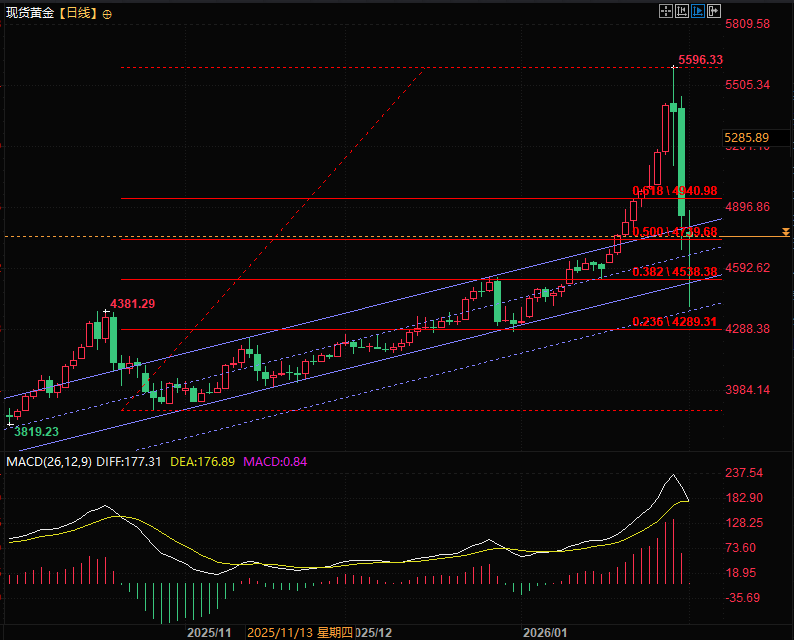
(Spot gold daily chart, source: FX678)
At 20:01 Beijing time, spot gold is currently trading at $4762.64 per ounce.
As mentioned in previous articles, this expectation directly undermines the "sell US" trading logic and brings back the previous view of buying the US dollar and a strong US dollar to the market. The change in expectations behind this trading is the core bullish logic that previously supported the one-sided surge in gold and silver prices, but this logic is now gradually disintegrating.
Christopher Forbes, head of Asia Pacific and the Middle East at Gain Capital, stated that the recent sharp drop in gold prices was a typical technical correction after an extreme one-sided rally, not a substantial breakdown of the long-term bullish logic. In essence, it was a "typical sharp drop after an extreme surge."
Multiple factors: Capital, the US dollar, and geopolitical sentiment all exert pressure <br />The recent sharp drop in gold prices is the result of multiple negative factors working together.
Warsh's nomination became one of the core drivers of the dollar's strength. As a staunch supporter of tight monetary policy, he fueled market expectations of a hawkish stance for the Fed's future policy direction. Previously, the market believed that Reid, who represented easing and tolerance for inflation, would become the Fed chairman. This shift created a huge expectation gap in the market.
Meanwhile, the US government shutdown also changed from a de facto shutdown to a nominal shutdown during this period. Although the government is nominally shut down again this time, key agencies have received their budgets, so it has not actually stopped.
Furthermore, Trump's remarks about potentially reaching an agreement with Iran significantly eased geopolitical risk aversion in the market. West Texas Intermediate crude oil futures fell by about 4% on Monday, which also weakened the safe-haven buying support for gold. Multiple factors combined to burst the market bubble in this crowded trade.
In terms of funding, CME Group raised the margin requirements for gold and silver futures, increasing the margin for gold futures from 6% to 8% and the margin for silver futures from 11% to 15%. Coupled with the large amount of profit-taking accumulated in the previous one-sided surge, some investors chose to take profits, and the concentrated exit of profit-taking directly caused the market to fall.
The US dollar index also continued to strengthen, rising by about 0.8% since Thursday. As a result, the attractiveness of dollar-denominated gold to overseas buyers has decreased, directly suppressing gold prices.
Price resilience: Impressive annual gains, long-term trend remains unchanged.
Despite the significant short-term pullback, the precious metals market has demonstrated strong resilience, and the long-term upward trend has not been altered by this technical correction.
Looking at the annual performance in 2026, the price of silver has risen by about 16% year-to-date, while gold has also recorded an increase of about 8% during the same period, maintaining positive returns despite short-term corrections.
Looking back at the market in 2025, gold and silver experienced a record-breaking one-sided surge, with annual gains of approximately 65% and 145% respectively. These huge annual gains confirmed the long-term strength of the precious metals market and laid the foundation for the market in 2026. Short-term technical corrections did not shake this long-term trend.
Core Support: Multiple Underlying Logics Solidify Gold's Long-Term Uptrend
The long-term bullish logic for gold is solidified by multiple underlying factors, including geopolitics, central bank gold purchases, and market capital structure, and these core supports have not changed substantially.
At the geopolitical level, although the situation in the Middle East has eased recently, global uncertainties persist: the diplomatic standoff between the US and Europe over the status of Greenland has disrupted the traditional stable pattern among Western allies.
The resurgence of global tariff sanctions has exacerbated the risk of global economic fragmentation. These potential risks will continue to inject a long-term "risk premium" into gold prices, highlighting its status as the ultimate safe-haven asset.
In terms of central bank gold purchases, the global wave of de-dollarization is in full swing, becoming the most disruptive structural support for the gold market. From 2025 to early 2026, central banks in emerging markets such as China, India, Poland, and Turkey will embark on a record-breaking gold purchase program, marking the first time in modern financial history that the gold reserves of several major economies have surpassed those of US Treasury bonds.
Central banks' demand for gold is stable over the long term, with very few panic sell-offs. This buying behavior by "official departments" has built a solid bottom support for gold prices, becoming the "ballast" of the gold market.
In terms of funding and investor structure, the number of participants in the gold market is constantly expanding, with new funds continuously entering the market.
By the end of 2025, physical gold ETFs recorded a record inflow of over $26 billion. These modern financial instruments allow institutional and retail investors to participate in gold investment as easily as trading stocks, significantly lowering the market entry barrier.
Meanwhile, retail demand has shown remarkable resilience, with major gold-consuming countries like India maintaining historically high demand for physical gold bars and coins. Young investors in Western markets are also increasingly incorporating gold into their diversified digital investment portfolios, viewing it as an essential hedge against market volatility.
After gold prices broke through the psychological barrier of $5,000 per ounce, the fear of missing out (FOMO) effect drove trend traders to enter the market, further amplifying the capital momentum in the gold market.
Institutional forecast: High-level consolidation awaiting signals; long-term bullish outlook remains unchanged.
Industry institutions have given a clear assessment of the future trading trend of gold, with a consensus that it will be volatile in the short term but bullish in the long term.
Forbes believes that in the short term, gold prices will remain in a high range, but volatility will increase significantly. The core reason is that the market is in a wait-and-see state, waiting for further clear signals from Warsh's policy direction. The policy tone of the Federal Reserve leadership will be an important guide for the short-term market.
In the long term, Forbes maintains its bullish outlook on gold for the next 12 months, primarily because the core drivers supporting gold's rise—geopolitical tensions, massive global debt pressure, and the weakening of the dollar's hegemony—show no clear signs of abating.
If the US dollar weakens again, or if Warsh's policy stance is confirmed to be dovish, funds that bought on dips will quickly flow back into the market, driving a rebound in gold prices. If the Federal Reserve continues its loose monetary policy, and economic growth and inflation continue to diverge, gold prices are expected to retest recent historical highs.
For modern gold traders, gold has long since transformed from an ancient store of value into a core hedging tool in volatile market environments. This short-term technical correction is merely a phase in the market game driven by multiple factors, and it does not change the core logic of its long-term upward trend. The subsequent trading game surrounding Federal Reserve policy, geopolitics, and central bank gold purchases will continue to dominate the gold market's trajectory.
Summary and Technical Analysis:
The recent plunge in gold prices presents numerous opportunities to buy on the dip. Why? Because the main declines in the recent market have occurred during the Asian session, while previous articles have mentioned that gold rallies primarily occur during the European and American sessions, with trading volume also concentrated in those sessions. Recently, during the Asian session, gold prices have fallen sharply with low trading volume, and such a drop without volume is easily corrected by capital inflows.
The characteristic of a sharp drop is that the price falls very quickly, but once the rate of decline slows down, the price of gold quickly begins to rebound. In other words, each trading window is often only a few seconds long, because funds can feel the slowdown in the rate of price decline within a few seconds.
Although the window for each gold price rebound is very short, gold prices will experience many sharp drops throughout the day, with multiple rebound opportunities.
From a technical perspective, spot gold has retraced to between 0.236 and 0.382 of the recent upward move, and is currently stabilizing around 0.500. Note that the low point is far from the key support level of 0.382 and close to the lower channel line, making it a point with a high safety margin. A similar point also appeared at the low point on January 30, which was far from the key support level of 0.500 and close to the lower channel line.
A key price level doesn't mean the price will definitely stop at that position, but rather that this position is likely to become a key price center. Prices always fluctuate around the price center. If a price moves away from a price center and is close to a key support level, it is likely to attract funds from the perspective of the deviation rate and support and resistance, resulting in short-term gains. At the same time, it is also a relatively cost-effective point for medium- and long-term funds to allocate.
(Spot gold daily chart, source: FX678)
At 20:01 Beijing time, spot gold is currently trading at $4762.64 per ounce.
- Risk Warning and Disclaimer
- The market involves risk, and trading may not be suitable for all investors. This article is for reference only and does not constitute personal investment advice, nor does it take into account certain users’ specific investment objectives, financial situation, or other needs. Any investment decisions made based on this information are at your own risk.