Despite positive data across Germany and the Eurozone, why isn't the euro happy?
2026-02-02 21:41:36
Despite a series of positive economic data releases from the Eurozone and Germany providing slight support for the euro, it remained under pressure and weakened due to the strong dollar and rising market risk aversion, failing to achieve an effective rebound. The market is now awaiting clear guidance from the US manufacturing PMI data.

Positive signals from Eurozone data are among the few supporting factors for the euro. The final readings of the January HCOB Manufacturing PMI released by Hamburg Commercial Bank were all revised upwards, indicating initial signs of industry recovery.
The Eurozone manufacturing PMI was revised upward to 49.5 from the initial value of 49.4, a further rebound from 48.8 in December; the German manufacturing PMI was also revised upward, from the initial value of 48.7 to 49.1, higher than the initial value and an improvement from the previous month's value of 48.8.
German retail sales data for December, released Monday morning, was also strong, showing a moderate recovery in consumer spending. The month-on-month increase was 0.1%, reversing the 0.5% decline in November and exceeding market expectations of a 0.2% drop; the year-on-year growth rate accelerated to 1.5% from 1.3% in November.
Unfortunately, the dual positive factors in the European economy failed to provide an effective boost and did not change the weak trend of the euro against the US dollar.
Kevin Warsh's nomination as the next Federal Reserve Chairman has become a key factor supporting the dollar and a major driver suppressing the euro's performance.
Last Friday, US President Trump officially confirmed that Warsh will succeed Powell as Chairman of the Federal Reserve after his term ends in May. Although investor sentiment calmed down slightly after the news, market expectations that his policy will lean towards tightening continued to push up the dollar, helping it hold key support levels.
In terms of policy inclination, Warsh had previously advocated for reducing the size of the Federal Reserve's balance sheet. Although he recently expressed support for lowering market borrowing costs, the market generally believes that he still maintains a cautious stance on inflation.
The CME FedWatch Tool shows that while the market is pricing in the probability of at least two rate cuts in 2026, Warsh's high sensitivity to inflation risks during his tenure as a Fed governor has led the market to anticipate that his actual policy path may lean towards a hawkish stance.
Furthermore, policy disagreements within the Federal Reserve have further strengthened the short-term support for the US dollar.
Atlanta Fed President Bostic has consistently resisted interest rate cuts, and just last week stated that the current size of the Fed's balance sheet is "roughly appropriate." These remarks have become another positive catalyst for the dollar, further consolidating its strong position.
The market's focus has now shifted to the US January ISM Manufacturing PMI data, which will be released later today and will be an important indicator of the euro's short-term movement against the dollar.
The market expects the US manufacturing PMI to rise moderately from 47.9 in December to 48.3, with the price paid index potentially rising to a four-month high of 60.5. However, the risk of sticky inflation remains a concern.
In addition to this manufacturing data, this week will also see a flurry of important economic events and data releases, including the European Central Bank's monetary policy decision on Thursday and the US non-farm payrolls report on Friday.
Before multiple key pieces of information are released, investors will likely remain on the sidelines and avoid betting too early on the direction of the exchange rate, which makes it difficult for the euro to break its narrow trading range against the dollar in the short term.
From a technical perspective, the euro is in a downward correction cycle against the US dollar. After hitting a four-year high near 1.2100, it has fallen back under pressure and is currently hovering around 1.1850. After the exchange rate broke below 1.1850, the level of January 27, the short-term bearish signal is relatively clear.
On the support level, the exchange rate found initial support near the January 26 low of 1.1835 and the 50% Fibonacci retracement level of the rebound in late January at 1.1830. If this range is broken, the next target will be near the 61.8% Fibonacci retracement level of this rebound at 1.1770.
From a resistance perspective, the upward rebound of the exchange rate will most likely encounter resistance near the 50% retracement level of last Friday's decline at 1.1906. Only by breaking through this level will it be possible to challenge the psychological resistance of the 1.2000 psychological level.
It is worth noting that the current overall pressure on non-US currencies has further exacerbated the weakness of the euro.
Following Japanese Prime Minister Sanae Takaichi's comments supporting a weaker yen, the yen's exchange rate continued to be under pressure, while the collective weakening of non-US currencies left the euro without an external environment for a rebound.
In the short term, the euro's exchange rate against the dollar will still depend on the dollar's performance. The release of key economic data and policy announcements will be crucial in breaking the current range-bound pattern.
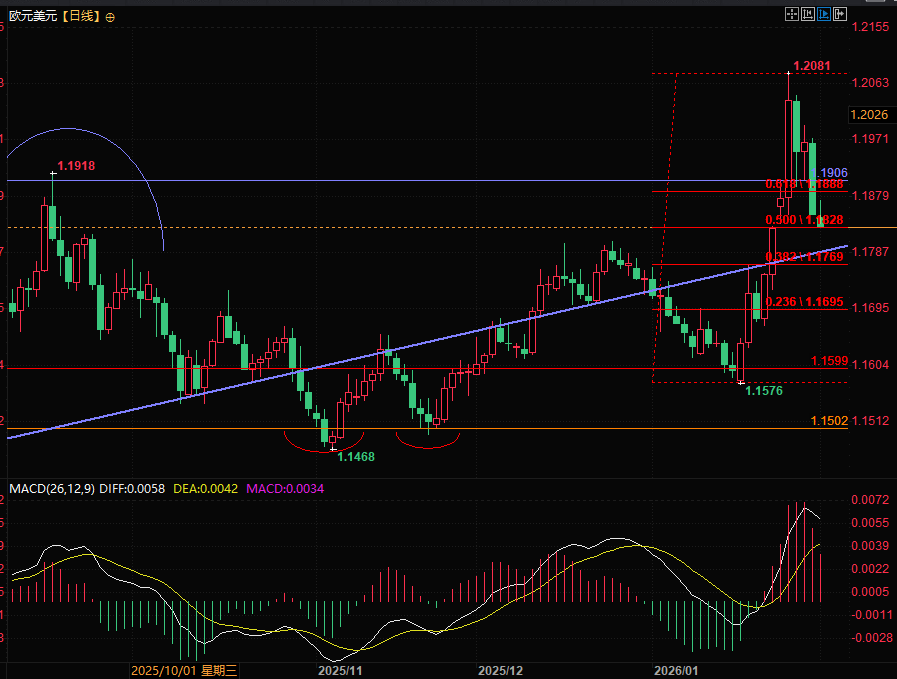
(Euro/USD daily chart, source: FX678)
At 21:32 Beijing time, the euro was trading at 1.1825 against the US dollar.
Eurozone: The positive impact of both PMI and retail sales data on the economy appears limited.
Positive signals from Eurozone data are among the few supporting factors for the euro. The final readings of the January HCOB Manufacturing PMI released by Hamburg Commercial Bank were all revised upwards, indicating initial signs of industry recovery.
The Eurozone manufacturing PMI was revised upward to 49.5 from the initial value of 49.4, a further rebound from 48.8 in December; the German manufacturing PMI was also revised upward, from the initial value of 48.7 to 49.1, higher than the initial value and an improvement from the previous month's value of 48.8.
German retail sales data for December, released Monday morning, was also strong, showing a moderate recovery in consumer spending. The month-on-month increase was 0.1%, reversing the 0.5% decline in November and exceeding market expectations of a 0.2% drop; the year-on-year growth rate accelerated to 1.5% from 1.3% in November.
Unfortunately, the dual positive factors in the European economy failed to provide an effective boost and did not change the weak trend of the euro against the US dollar.
On the US dollar front: Warsh nomination becomes a core positive factor, highlighting policy divergence within the Federal Reserve.
Kevin Warsh's nomination as the next Federal Reserve Chairman has become a key factor supporting the dollar and a major driver suppressing the euro's performance.
Last Friday, US President Trump officially confirmed that Warsh will succeed Powell as Chairman of the Federal Reserve after his term ends in May. Although investor sentiment calmed down slightly after the news, market expectations that his policy will lean towards tightening continued to push up the dollar, helping it hold key support levels.
In terms of policy inclination, Warsh had previously advocated for reducing the size of the Federal Reserve's balance sheet. Although he recently expressed support for lowering market borrowing costs, the market generally believes that he still maintains a cautious stance on inflation.
The CME FedWatch Tool shows that while the market is pricing in the probability of at least two rate cuts in 2026, Warsh's high sensitivity to inflation risks during his tenure as a Fed governor has led the market to anticipate that his actual policy path may lean towards a hawkish stance.
Furthermore, policy disagreements within the Federal Reserve have further strengthened the short-term support for the US dollar.
Atlanta Fed President Bostic has consistently resisted interest rate cuts, and just last week stated that the current size of the Fed's balance sheet is "roughly appropriate." These remarks have become another positive catalyst for the dollar, further consolidating its strong position.
Market Focus: Awaiting a flurry of key US manufacturing PMI data this week
The market's focus has now shifted to the US January ISM Manufacturing PMI data, which will be released later today and will be an important indicator of the euro's short-term movement against the dollar.
The market expects the US manufacturing PMI to rise moderately from 47.9 in December to 48.3, with the price paid index potentially rising to a four-month high of 60.5. However, the risk of sticky inflation remains a concern.
In addition to this manufacturing data, this week will also see a flurry of important economic events and data releases, including the European Central Bank's monetary policy decision on Thursday and the US non-farm payrolls report on Friday.
Before multiple key pieces of information are released, investors will likely remain on the sidelines and avoid betting too early on the direction of the exchange rate, which makes it difficult for the euro to break its narrow trading range against the dollar in the short term.
Technical Analysis: Clear Bearish Signals and Well-defined Key Support and Resistance Levels
From a technical perspective, the euro is in a downward correction cycle against the US dollar. After hitting a four-year high near 1.2100, it has fallen back under pressure and is currently hovering around 1.1850. After the exchange rate broke below 1.1850, the level of January 27, the short-term bearish signal is relatively clear.
On the support level, the exchange rate found initial support near the January 26 low of 1.1835 and the 50% Fibonacci retracement level of the rebound in late January at 1.1830. If this range is broken, the next target will be near the 61.8% Fibonacci retracement level of this rebound at 1.1770.
From a resistance perspective, the upward rebound of the exchange rate will most likely encounter resistance near the 50% retracement level of last Friday's decline at 1.1906. Only by breaking through this level will it be possible to challenge the psychological resistance of the 1.2000 psychological level.
It is worth noting that the current overall pressure on non-US currencies has further exacerbated the weakness of the euro.
Following Japanese Prime Minister Sanae Takaichi's comments supporting a weaker yen, the yen's exchange rate continued to be under pressure, while the collective weakening of non-US currencies left the euro without an external environment for a rebound.
In the short term, the euro's exchange rate against the dollar will still depend on the dollar's performance. The release of key economic data and policy announcements will be crucial in breaking the current range-bound pattern.
(Euro/USD daily chart, source: FX678)
At 21:32 Beijing time, the euro was trading at 1.1825 against the US dollar.
- Risk Warning and Disclaimer
- The market involves risk, and trading may not be suitable for all investors. This article is for reference only and does not constitute personal investment advice, nor does it take into account certain users’ specific investment objectives, financial situation, or other needs. Any investment decisions made based on this information are at your own risk.