Why could gold prices still reach $6,000?
2026-02-02 23:42:14
On Monday (February 2nd), after global financial markets opened, gold and silver prices initially saw a slight rebound, but by the morning close, the gains had narrowed to a moderate range. Looking back to last Friday (January 31st), these two core precious metals experienced their first historic plunge of the year, with gold falling by over 5% at one point and silver hitting a record intraday drop of 8%. Even so, this correction only erased about 30% of the significant gains made over the past three months.
In its latest commodities research report released Monday, Deutsche Bank analysts, a top global investment bank, reiterated their medium- to long-term target price of $6,000 per ounce for gold. The analyst team pointed out that this precious metals sell-off is fundamentally different from those in 2012 and 2018, which repeatedly signaled a long-term peak in precious metals prices. Previous sell-offs were often accompanied by trend reversal signals such as aggressive interest rate hikes by the Federal Reserve, a significant strengthening of the US dollar index, and a rapid decline in inflation. However, the current environment of "weak recovery + low interest rates" in major global economies, the challenges facing the US dollar's credit system, and the core logic driving this round of gold price increases remain solid. There are currently no clear signs that these trends are reversing.
Is the reaction to Trump's nomination of a Federal Reserve chairman an overreaction?
On Thursday evening (January 30), leaked information from within the White House revealed that the Trump administration planned to nominate former Federal Reserve Governor Kevin Warsh as the next Federal Reserve Chairman after Jerome Powell's term ends on May 15. This news immediately caused a market shock, as it significantly deviated from previous market expectations. Prior to this, market forecasting data showed that Rick Rieder, Chief Investment Officer of Fixed Income at BlackRock, had a 62% approval rating, far exceeding other candidates. Rieder had repeatedly advocated for more innovative use of the Federal Reserve's balance sheet, including targeted asset purchases to support the real economy and optimizing the structure of Treasury bond issuance, and was considered a representative of the "dovish" camp in the market.
The global monetary system is currently facing multiple uncertainties: US debt has surpassed $35 trillion, the Eurozone economy is in a technical recession, and emerging market currencies are experiencing increased volatility. Against this backdrop, the market views Warsh's nomination as a short-term stabilizing force. Driven by this expectation, the US dollar index strengthened rapidly after the news broke, breaking through the 105 mark, while the surge in gold and silver prices suddenly encountered resistance, triggering profit-taking and a sharp correction on Friday.
From Warsh's policy stance, his style exhibits a clear "phased shift": during his tenure as a Federal Reserve Governor from 2006 to 2011, he repeatedly voted to raise interest rates to curb inflation, explicitly opposed quantitative easing, and established a staunch hawkish image; however, after leaving office in 2011, especially since Trump's first election as president, Warsh's position gradually changed, and he began to publicly support interest rate cuts, aligning with Trump's consistent advocacy of "low interest rates promoting growth." Nevertheless, among the four Federal Reserve Chair candidates ultimately chosen by Trump, Warsh remains the only one who explicitly criticized the Fed's large-scale use of its balance sheet. In a public speech in 2023, he stated that "the Fed's excessively expanded balance sheet is distorting market pricing mechanisms and sowing the seeds of long-term financial risks."
In a forward-looking analysis report released on December 15, Deutsche Bank's chief U.S. economist, Matthew Luzzetti, had already predicted Warsh's policy inclinations. He wrote: "Warsh's recent public statements indicate that he is likely to support lowering policy interest rates to complement the U.S. government's economic stimulus plan, but at the same time, he may balance the inflationary pressures brought about by the loose policy by gradually reducing the balance sheet. However, this combination of 'interest rate cuts + balance sheet reduction' policy preference is only feasible if regulatory reforms reduce the demand for bank reserves—currently, the U.S. banking industry's reliance on excess reserves is still at a historically high level, and it is extremely difficult to promote relevant regulatory reforms in the short term. Therefore, even if Warsh takes office, his room for policy adjustment is relatively limited, and it is unrealistic to achieve substantial policy changes in the short term."
In a report on Monday, Deutsche Bank commodities analyst Michael Hsueh further elaborated, giving the core conclusion: "Considering Warsh's past remarks, the current US economic fundamentals, and the real constraints on policy implementation, his policy stance may not be as hawkish as the market initially perceived. The recent strengthening of the dollar and the pullback in precious metals triggered by the nomination news are likely short-term overreactions."
Gold Price Movement: Not a Repeat of the 1980s or 2013
To support the claim that the current gold price correction is temporary, Michael Xue reviewed two historical periods of significant gold price corrections in his report. He pointed out that the largest single-day drops in gold occurred in January 1980 (down 13%) and February 1983 (down 12%). He analyzed in detail: "The market context at that time was completely different from the present. In the early 1980s, under the leadership of Paul Volcker, the Federal Reserve pushed the federal funds rate to over 20% through aggressive interest rate hikes, successfully curbing double-digit hyperinflation. This hard-won achievement in combating inflation became a key factor leading to the weakening of gold—gold, as a traditional hedge against inflation, saw its attractiveness decline significantly against the backdrop of rapidly falling inflation; at the same time, between 1981 and 1984, the US dollar index rose by 77% cumulatively due to the strong recovery of the US economy and the advantage of high interest rates, further exacerbating the downward trend of gold."
Looking ahead, Michael Xue clearly stated that he expects the US dollar to enter a long-term depreciation phase, rather than a sustained appreciation after a short-term strengthening. His core reasoning is that the US current account deficit has exceeded the critical threshold of 4% of GDP for six consecutive quarters—historically, once this ratio surpasses 4%, it often signifies a worsening imbalance between dollar supply and demand, with a probability of depreciation exceeding 80%. Furthermore, the US government's continuously expanding fiscal deficit and the accelerating global trend of "de-dollarization" will also be significant factors suppressing the dollar's performance, and dollar depreciation is precisely one of the core drivers of rising gold prices.
In addition to comparing it to the 1980s, Michael Xue also emphasized that the current market situation is fundamentally different from the "taper tantrum" of 2013. In 2013, the Federal Reserve implemented an extremely loose monetary policy for five years after the global financial crisis, and then suddenly signaled a reduction in the scale of asset purchases, triggering violent fluctuations in global financial markets. Gold prices fell sharply as a result, with a year-to-date drop of more than 28%. Now, the market has fully priced in the Fed's policy adjustments, and the expectations are relatively mild—according to the CME FedWatch Tool, the market expects the Fed to cut interest rates by only 75 basis points in the next 12 months, far less than the tightening measures taken during the tapering of quantitative easing in 2013. Therefore, Michael Xue believes that given the market's mild and sufficient expectations for interest rate cuts, the current rise in gold prices does not rely on "unconventional dovish policy shocks," but is based on a more solid long-term logic, with limited room for a correction.
Movements of institutional investors and central banks around the world
The continued accumulation of gold holdings by institutional investors and central banks worldwide is another important pillar supporting the medium- to long-term rise in gold prices. Michael Xue, in his report, cited the latest data, stating: "Large global institutional investors, including sovereign wealth funds, pension funds, and hedge funds, have clearly indicated through public statements or asset allocation adjustments that they may gradually diversify their asset allocations over the next 3-5 years. The core direction is to reduce the proportion of dollar-denominated assets and increase the allocation to precious metals, commodities, and non-dollar currency assets. According to our latest monitoring data, as of January 2026, these institutions' asset allocation adjustments are still ongoing, and no change in this stance has been observed so far." According to incomplete statistics, global sovereign wealth funds added more than 500 tons of gold in 2025, a record high.
Furthermore, the gold-buying spree by central banks around the world shows no signs of abating. Michael Xue added, "Both public statements and actual gold-buying activities by central banks indicate that reserve managers still plan to continue increasing their gold holdings. Unlike in the past, current central bank gold purchases are no longer limited to 'risk diversification,' but also carry strategic considerations of 'enhancing the credibility of their own currencies and hedging against dollar risks.' Therefore, there may be no clear upper limit to the proportion of gold in foreign exchange reserves—according to our calculations, as of the fourth quarter of 2024, global central bank gold reserves accounted for 28% of total foreign exchange reserves, more than doubling from 10% in 2010, and the growth rate of gold purchases by emerging market central banks far exceeds that of developed economies."
Gold and silver price dynamics
In terms of specific price performance, on Monday morning, the price of near-month gold futures on the New York Mercantile Exchange (COMEX) rebounded after opening, ultimately rising slightly by 0.9% to close at $4,786 per ounce. Last Thursday (January 30), the contract price reached a historical high of $5,613, marking the highest level since 2020. Silver futures prices performed relatively strongly, rebounding 4.5% in the morning to $82.09 per ounce, but still significantly lower than the high of over $121 last Thursday. This was mainly due to the drag from short-term weak industrial demand—silver possesses both precious metal and industrial attributes. Currently, the global manufacturing PMI remains below the expansion/contraction threshold, and demand for silver in core industrial sectors such as photovoltaics and electronics has not fully recovered, which to some extent limits its rebound.
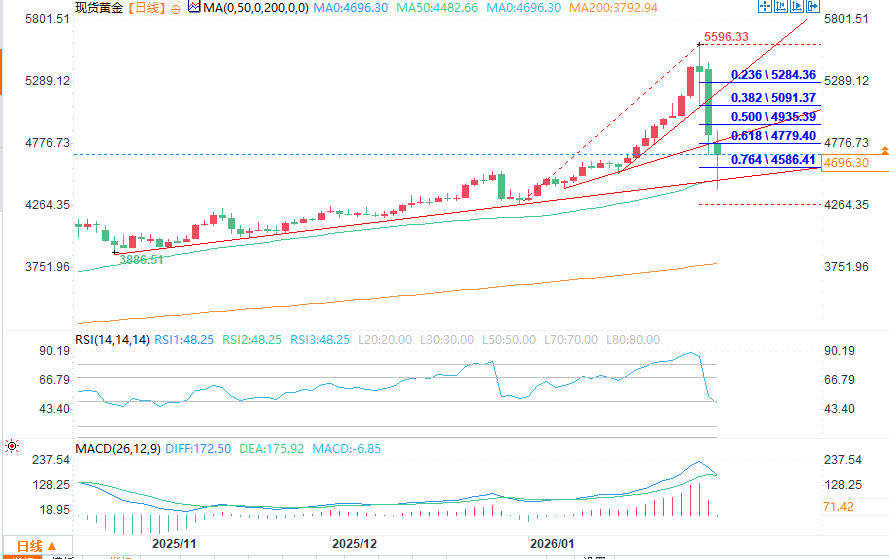
(Spot gold daily chart source: FX678)
Despite the sharp pullback last Friday, gold's year-to-date gain is still around 9%, standing out among major global assets. Silver, on the other hand, has seen a cumulative gain of 15% this year, far exceeding gold's performance, thanks to its previous strong rally. Industry analysts generally believe that with weakening global economic recovery momentum, the gradual implementation of central bank easing policies, and continued geopolitical risks, the long-term upward trend in the precious metals market will continue. The short-term pullback, in fact, provides a rare entry opportunity for medium- to long-term investors.
In its latest commodities research report released Monday, Deutsche Bank analysts, a top global investment bank, reiterated their medium- to long-term target price of $6,000 per ounce for gold. The analyst team pointed out that this precious metals sell-off is fundamentally different from those in 2012 and 2018, which repeatedly signaled a long-term peak in precious metals prices. Previous sell-offs were often accompanied by trend reversal signals such as aggressive interest rate hikes by the Federal Reserve, a significant strengthening of the US dollar index, and a rapid decline in inflation. However, the current environment of "weak recovery + low interest rates" in major global economies, the challenges facing the US dollar's credit system, and the core logic driving this round of gold price increases remain solid. There are currently no clear signs that these trends are reversing.
Is the reaction to Trump's nomination of a Federal Reserve chairman an overreaction?
On Thursday evening (January 30), leaked information from within the White House revealed that the Trump administration planned to nominate former Federal Reserve Governor Kevin Warsh as the next Federal Reserve Chairman after Jerome Powell's term ends on May 15. This news immediately caused a market shock, as it significantly deviated from previous market expectations. Prior to this, market forecasting data showed that Rick Rieder, Chief Investment Officer of Fixed Income at BlackRock, had a 62% approval rating, far exceeding other candidates. Rieder had repeatedly advocated for more innovative use of the Federal Reserve's balance sheet, including targeted asset purchases to support the real economy and optimizing the structure of Treasury bond issuance, and was considered a representative of the "dovish" camp in the market.
The global monetary system is currently facing multiple uncertainties: US debt has surpassed $35 trillion, the Eurozone economy is in a technical recession, and emerging market currencies are experiencing increased volatility. Against this backdrop, the market views Warsh's nomination as a short-term stabilizing force. Driven by this expectation, the US dollar index strengthened rapidly after the news broke, breaking through the 105 mark, while the surge in gold and silver prices suddenly encountered resistance, triggering profit-taking and a sharp correction on Friday.
From Warsh's policy stance, his style exhibits a clear "phased shift": during his tenure as a Federal Reserve Governor from 2006 to 2011, he repeatedly voted to raise interest rates to curb inflation, explicitly opposed quantitative easing, and established a staunch hawkish image; however, after leaving office in 2011, especially since Trump's first election as president, Warsh's position gradually changed, and he began to publicly support interest rate cuts, aligning with Trump's consistent advocacy of "low interest rates promoting growth." Nevertheless, among the four Federal Reserve Chair candidates ultimately chosen by Trump, Warsh remains the only one who explicitly criticized the Fed's large-scale use of its balance sheet. In a public speech in 2023, he stated that "the Fed's excessively expanded balance sheet is distorting market pricing mechanisms and sowing the seeds of long-term financial risks."
In a forward-looking analysis report released on December 15, Deutsche Bank's chief U.S. economist, Matthew Luzzetti, had already predicted Warsh's policy inclinations. He wrote: "Warsh's recent public statements indicate that he is likely to support lowering policy interest rates to complement the U.S. government's economic stimulus plan, but at the same time, he may balance the inflationary pressures brought about by the loose policy by gradually reducing the balance sheet. However, this combination of 'interest rate cuts + balance sheet reduction' policy preference is only feasible if regulatory reforms reduce the demand for bank reserves—currently, the U.S. banking industry's reliance on excess reserves is still at a historically high level, and it is extremely difficult to promote relevant regulatory reforms in the short term. Therefore, even if Warsh takes office, his room for policy adjustment is relatively limited, and it is unrealistic to achieve substantial policy changes in the short term."
In a report on Monday, Deutsche Bank commodities analyst Michael Hsueh further elaborated, giving the core conclusion: "Considering Warsh's past remarks, the current US economic fundamentals, and the real constraints on policy implementation, his policy stance may not be as hawkish as the market initially perceived. The recent strengthening of the dollar and the pullback in precious metals triggered by the nomination news are likely short-term overreactions."
Gold Price Movement: Not a Repeat of the 1980s or 2013
To support the claim that the current gold price correction is temporary, Michael Xue reviewed two historical periods of significant gold price corrections in his report. He pointed out that the largest single-day drops in gold occurred in January 1980 (down 13%) and February 1983 (down 12%). He analyzed in detail: "The market context at that time was completely different from the present. In the early 1980s, under the leadership of Paul Volcker, the Federal Reserve pushed the federal funds rate to over 20% through aggressive interest rate hikes, successfully curbing double-digit hyperinflation. This hard-won achievement in combating inflation became a key factor leading to the weakening of gold—gold, as a traditional hedge against inflation, saw its attractiveness decline significantly against the backdrop of rapidly falling inflation; at the same time, between 1981 and 1984, the US dollar index rose by 77% cumulatively due to the strong recovery of the US economy and the advantage of high interest rates, further exacerbating the downward trend of gold."
Looking ahead, Michael Xue clearly stated that he expects the US dollar to enter a long-term depreciation phase, rather than a sustained appreciation after a short-term strengthening. His core reasoning is that the US current account deficit has exceeded the critical threshold of 4% of GDP for six consecutive quarters—historically, once this ratio surpasses 4%, it often signifies a worsening imbalance between dollar supply and demand, with a probability of depreciation exceeding 80%. Furthermore, the US government's continuously expanding fiscal deficit and the accelerating global trend of "de-dollarization" will also be significant factors suppressing the dollar's performance, and dollar depreciation is precisely one of the core drivers of rising gold prices.
In addition to comparing it to the 1980s, Michael Xue also emphasized that the current market situation is fundamentally different from the "taper tantrum" of 2013. In 2013, the Federal Reserve implemented an extremely loose monetary policy for five years after the global financial crisis, and then suddenly signaled a reduction in the scale of asset purchases, triggering violent fluctuations in global financial markets. Gold prices fell sharply as a result, with a year-to-date drop of more than 28%. Now, the market has fully priced in the Fed's policy adjustments, and the expectations are relatively mild—according to the CME FedWatch Tool, the market expects the Fed to cut interest rates by only 75 basis points in the next 12 months, far less than the tightening measures taken during the tapering of quantitative easing in 2013. Therefore, Michael Xue believes that given the market's mild and sufficient expectations for interest rate cuts, the current rise in gold prices does not rely on "unconventional dovish policy shocks," but is based on a more solid long-term logic, with limited room for a correction.
Movements of institutional investors and central banks around the world
The continued accumulation of gold holdings by institutional investors and central banks worldwide is another important pillar supporting the medium- to long-term rise in gold prices. Michael Xue, in his report, cited the latest data, stating: "Large global institutional investors, including sovereign wealth funds, pension funds, and hedge funds, have clearly indicated through public statements or asset allocation adjustments that they may gradually diversify their asset allocations over the next 3-5 years. The core direction is to reduce the proportion of dollar-denominated assets and increase the allocation to precious metals, commodities, and non-dollar currency assets. According to our latest monitoring data, as of January 2026, these institutions' asset allocation adjustments are still ongoing, and no change in this stance has been observed so far." According to incomplete statistics, global sovereign wealth funds added more than 500 tons of gold in 2025, a record high.
Furthermore, the gold-buying spree by central banks around the world shows no signs of abating. Michael Xue added, "Both public statements and actual gold-buying activities by central banks indicate that reserve managers still plan to continue increasing their gold holdings. Unlike in the past, current central bank gold purchases are no longer limited to 'risk diversification,' but also carry strategic considerations of 'enhancing the credibility of their own currencies and hedging against dollar risks.' Therefore, there may be no clear upper limit to the proportion of gold in foreign exchange reserves—according to our calculations, as of the fourth quarter of 2024, global central bank gold reserves accounted for 28% of total foreign exchange reserves, more than doubling from 10% in 2010, and the growth rate of gold purchases by emerging market central banks far exceeds that of developed economies."
Gold and silver price dynamics
In terms of specific price performance, on Monday morning, the price of near-month gold futures on the New York Mercantile Exchange (COMEX) rebounded after opening, ultimately rising slightly by 0.9% to close at $4,786 per ounce. Last Thursday (January 30), the contract price reached a historical high of $5,613, marking the highest level since 2020. Silver futures prices performed relatively strongly, rebounding 4.5% in the morning to $82.09 per ounce, but still significantly lower than the high of over $121 last Thursday. This was mainly due to the drag from short-term weak industrial demand—silver possesses both precious metal and industrial attributes. Currently, the global manufacturing PMI remains below the expansion/contraction threshold, and demand for silver in core industrial sectors such as photovoltaics and electronics has not fully recovered, which to some extent limits its rebound.
(Spot gold daily chart source: FX678)
Despite the sharp pullback last Friday, gold's year-to-date gain is still around 9%, standing out among major global assets. Silver, on the other hand, has seen a cumulative gain of 15% this year, far exceeding gold's performance, thanks to its previous strong rally. Industry analysts generally believe that with weakening global economic recovery momentum, the gradual implementation of central bank easing policies, and continued geopolitical risks, the long-term upward trend in the precious metals market will continue. The short-term pullback, in fact, provides a rare entry opportunity for medium- to long-term investors.
- Risk Warning and Disclaimer
- The market involves risk, and trading may not be suitable for all investors. This article is for reference only and does not constitute personal investment advice, nor does it take into account certain users’ specific investment objectives, financial situation, or other needs. Any investment decisions made based on this information are at your own risk.