With the election approaching, the impossible triangle is tearing the yen apart.
2026-02-03 17:32:01
On Wednesday (Asian and European sessions), the USD/JPY pair held onto its gains from the three major rallies of the past four days, currently trading up 0.03% around 155.62.
Japanese Prime Minister Sanae Takaichi announced a snap election for the House of Representatives on February 8, a political development that has multiple impacts on the yen and the stock and bond markets.
Market expectations surrounding this election have made "high-priced trading" the core logic of current Japanese asset transactions.
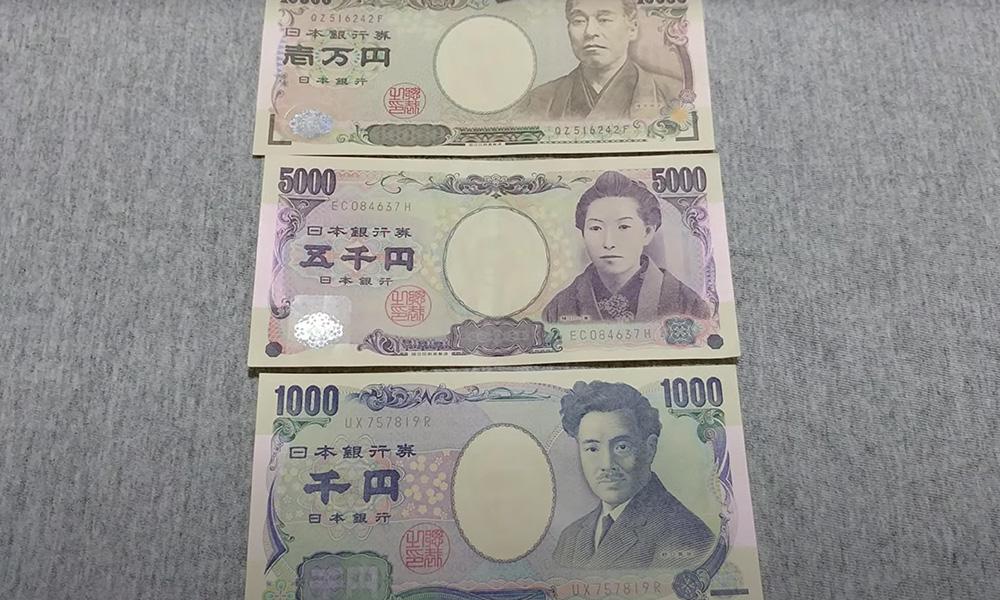
The Liberal Democratic Party (LDP) pushed for an early general election just three or four months after the new cabinet took office. The core motivation for this was the adjustment of the party cooperation pattern. After the last election, the LDP changed its allies and formed a new ruling coalition with the Japan Innovation Party. This time, it hoped to test public opinion through the general election and further expand its majority in the House of Representatives.
Currently, the Liberal Democratic Party holds 233 seats in the 465-seat House of Representatives, a slim majority, and its seat advantage is not secure.
This political landscape has also presented other political parties with an opportunity to compete for seats. Former allies of the Liberal Democratic Party have formed a “centrist reform alliance” with the Constitutional Democratic Party of Japan in an attempt to take away some seats.
To mitigate this potential risk, the Liberal Democratic Party deliberately shortened its election preparation period, allocating only a few weeks until the February 8th election day. This was done to suppress the opposition's window of opportunity to build a large-scale campaign offensive and to control the pace of the election.
In terms of timing, the Liberal Democratic Party (LDP) seized two favorable conditions by pushing for this snap election. This is also the core logic behind the common snap election in Japanese politics: first, to seek public authorization for major policy measures such as fiscal expansion, so that the implementation of subsequent policies has a stronger public support.
Secondly, take advantage of the current high support rate for Kaohsiung's Zao Meng to expand its seat advantage.
According to multi-channel polling data, Sanae Kaohsiung's personal approval rating is in the high range of 60%-80%. The Liberal Democratic Party hopes to rely on these two factors to expand its seats and gain stronger initiative in policy-making and implementation.
From the initial rumors to the official confirmation, the signals of Japan's snap election have consistently sent a positive response to the market, and the Japanese stock market has been steadily rising since the election news broke.
The core support for this trend lies in the market's expectations for the policies following the Liberal Democratic Party's (LDP) victory: if the LDP achieves a favorable result in the general election, its decision-making freedom in promoting fiscal expansion and subsequent budget formulation will be greatly enhanced. This expectation directly boosts the market's well-known "high-market trading" strategy—the classic trading logic of going long on stocks, shorting bonds, and shorting the yen. This logic has also become the key thread for interpreting the trends of various Japanese assets.
On Monday and Tuesday, precious metals led a correction in global equity markets, while for the Japanese stock market it was a once-in-a-lifetime opportunity to rebound.
The first and foremost impact of this election is felt in the bond market.
Earlier this week, the yield on Japan's 10-year government bonds touched 2.3%, while the yield on 30-year government bonds climbed to 3.7%, a multi-decade high.
The market generally expects that if the Liberal Democratic Party wins the election and implements its plan to expand fiscal spending, it will inevitably have to issue more government bonds. The expansion of bond supply will drive yields into a sustained upward trend, meaning that the market will continue to sell off Japanese government bonds.
Meanwhile, the Liberal Democratic Party has signaled a policy of reducing the consumption tax, planning to lower the consumption tax on some goods from 8%-10% to 0% for two years. This move may not only exacerbate Japan's fiscal pressure but also directly boost residents' consumption power.
The expansion of consumer spending may push Japan's inflation rate to remain above 2%, exceeding the Bank of Japan's benchmark expectations, which may force the central bank to break its original policy pace and start the interest rate hike cycle ahead of schedule.
Despite the recent slight rebound in the yen exchange rate, the market consensus is that the USD/JPY exchange rate will continue to show a relatively weak yen. This answers investors' core question: why has the yen not strengthened as theoretically expected despite the narrowing of the USD/JPY interest rate differential?
Ultimately, the core reason lies in the significant divergence in the high correlation between the US-Japan interest rate differential and the yen exchange rate over the past few years. This phenomenon can be explained by the Mundell-Fleming trilemma in macroeconomics: a country cannot simultaneously achieve the three goals of free capital flow, independent monetary policy, and stable exchange rate; it can only choose two.
Japan chose to prioritize the free flow of capital and an independent monetary policy, which meant it voluntarily sacrificed exchange rate stability.
The Bank of Japan can artificially suppress interest rates below the market equilibrium level through policy intervention. The longer the central bank maintains low interest rates, the greater the depreciation pressure on the yen.
Even with the narrowing interest rate differential between the US and Japan, the yen is unlikely to gain strong upward momentum, which is the core underlying logic of the current weakness of the yen.
In the stock market, the market's expectation of a Liberal Democratic Party (LDP) victory has become a clear positive factor. If the LDP wins the election, subsequent fiscal stimulus measures will further support the stock market.
Looking back at historical data, the TOPIX stock index recorded varying degrees of positive growth within 3-6 months following the last 7-9 general elections in Japan, demonstrating the significant short-term boost that elections have on the stock market.
From the perspective of sector opportunities, areas that benefit from fiscal expansion will become the main theme of the market: First, the defense sector will directly benefit from the Kaohsiung City Government's plan to expand defense spending and usher in development dividends;
Secondly, the expectation of tax reductions on consumer goods will boost residents' willingness to consume, driving the consumer sector to strengthen.
Third, the upward trend in interest rates will significantly improve the net interest margin of the financial and banking sectors, driving the sector's valuation recovery.
Overall, the essence of Japan's snap election is a political maneuver by the Liberal Democratic Party to seize the initiative in policy implementation. The underlying fiscal expansion plan and expectations of monetary policy adjustments have become the core variables driving the yen's exchange rate and the Japanese stock, bond, and currency markets.
The current market trading logic surrounding Japanese assets remains firmly centered on "high-market trading," and given the Bank of Japan's insistence on independent monetary policy and artificially suppressing interest rates, the yen's weak position is unlikely to change fundamentally in the short term.
At this critical juncture, any pullback in the USD/JPY pair is essentially a golden opportunity for bulls to capitalize on.
The market still needs to pay close attention to two key variables: first, the final result of this snap election will directly determine the pace and intensity of the implementation of Japan's fiscal expansion policy;
Secondly, the Bank of Japan's monetary policy direction is crucial. If persistently high inflation forces the central bank to adjust its pace of interest rate hikes, it will have a chain reaction on the yen's exchange rate and the Japanese stock and bond markets. This is also the core factor affecting the subsequent trend of Japanese assets.
Technically, the USD/JPY pair rebounded rapidly after adjusting to the middle band and trading around the highs, while the Nikkei 225 also hit a new all-time high.
Support is around 154.30, and the middle line of the channel (dotted line) is also the neckline of a small double bottom pattern on the daily chart. If the price retraces to this area, it is likely to trigger a continued rise. Resistance is at the upper channel line at 156 and above at 156.90.
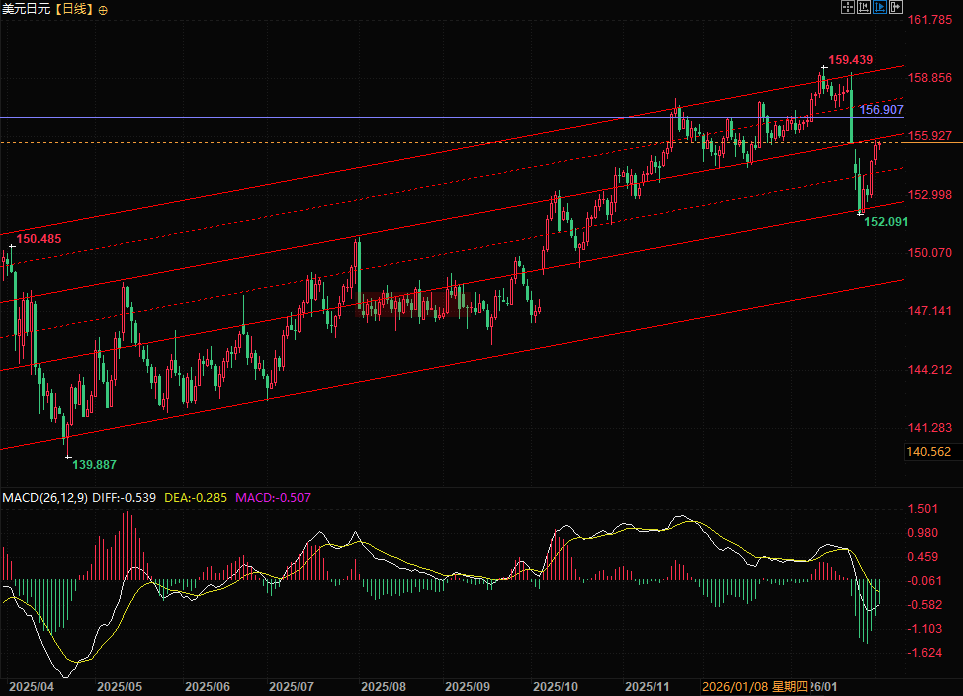
(USD/JPY daily chart, source: FX678)
At 17:28 Beijing time, the US dollar was trading at $155.65 per ounce against the Japanese yen.
Japanese Prime Minister Sanae Takaichi announced a snap election for the House of Representatives on February 8, a political development that has multiple impacts on the yen and the stock and bond markets.
Market expectations surrounding this election have made "high-priced trading" the core logic of current Japanese asset transactions.
Election Background: The Liberal Democratic Party (LDP) pushes through the election in a short window, seeking to expand its seat advantage.
The Liberal Democratic Party (LDP) pushed for an early general election just three or four months after the new cabinet took office. The core motivation for this was the adjustment of the party cooperation pattern. After the last election, the LDP changed its allies and formed a new ruling coalition with the Japan Innovation Party. This time, it hoped to test public opinion through the general election and further expand its majority in the House of Representatives.
Currently, the Liberal Democratic Party holds 233 seats in the 465-seat House of Representatives, a slim majority, and its seat advantage is not secure.
This political landscape has also presented other political parties with an opportunity to compete for seats. Former allies of the Liberal Democratic Party have formed a “centrist reform alliance” with the Constitutional Democratic Party of Japan in an attempt to take away some seats.
To mitigate this potential risk, the Liberal Democratic Party deliberately shortened its election preparation period, allocating only a few weeks until the February 8th election day. This was done to suppress the opposition's window of opportunity to build a large-scale campaign offensive and to control the pace of the election.
Election Motivation: Leveraging high approval ratings and fiscal demands to seek public mandate on two fronts.
In terms of timing, the Liberal Democratic Party (LDP) seized two favorable conditions by pushing for this snap election. This is also the core logic behind the common snap election in Japanese politics: first, to seek public authorization for major policy measures such as fiscal expansion, so that the implementation of subsequent policies has a stronger public support.
Secondly, take advantage of the current high support rate for Kaohsiung's Zao Meng to expand its seat advantage.
According to multi-channel polling data, Sanae Kaohsiung's personal approval rating is in the high range of 60%-80%. The Liberal Democratic Party hopes to rely on these two factors to expand its seats and gain stronger initiative in policy-making and implementation.
Market Signals: Election Expectations Boost Market, High-Market Trading Becomes the Core Theme
From the initial rumors to the official confirmation, the signals of Japan's snap election have consistently sent a positive response to the market, and the Japanese stock market has been steadily rising since the election news broke.
The core support for this trend lies in the market's expectations for the policies following the Liberal Democratic Party's (LDP) victory: if the LDP achieves a favorable result in the general election, its decision-making freedom in promoting fiscal expansion and subsequent budget formulation will be greatly enhanced. This expectation directly boosts the market's well-known "high-market trading" strategy—the classic trading logic of going long on stocks, shorting bonds, and shorting the yen. This logic has also become the key thread for interpreting the trends of various Japanese assets.
On Monday and Tuesday, precious metals led a correction in global equity markets, while for the Japanese stock market it was a once-in-a-lifetime opportunity to rebound.
Increased bond supply pushes up yields, and inflation fuels expectations of interest rate hikes.
The first and foremost impact of this election is felt in the bond market.
Earlier this week, the yield on Japan's 10-year government bonds touched 2.3%, while the yield on 30-year government bonds climbed to 3.7%, a multi-decade high.
The market generally expects that if the Liberal Democratic Party wins the election and implements its plan to expand fiscal spending, it will inevitably have to issue more government bonds. The expansion of bond supply will drive yields into a sustained upward trend, meaning that the market will continue to sell off Japanese government bonds.
Meanwhile, the Liberal Democratic Party has signaled a policy of reducing the consumption tax, planning to lower the consumption tax on some goods from 8%-10% to 0% for two years. This move may not only exacerbate Japan's fiscal pressure but also directly boost residents' consumption power.
The expansion of consumer spending may push Japan's inflation rate to remain above 2%, exceeding the Bank of Japan's benchmark expectations, which may force the central bank to break its original policy pace and start the interest rate hike cycle ahead of schedule.
The impossible trinity dominates exchange rates, making it difficult to reverse the weak trend of the yen.
Despite the recent slight rebound in the yen exchange rate, the market consensus is that the USD/JPY exchange rate will continue to show a relatively weak yen. This answers investors' core question: why has the yen not strengthened as theoretically expected despite the narrowing of the USD/JPY interest rate differential?
Ultimately, the core reason lies in the significant divergence in the high correlation between the US-Japan interest rate differential and the yen exchange rate over the past few years. This phenomenon can be explained by the Mundell-Fleming trilemma in macroeconomics: a country cannot simultaneously achieve the three goals of free capital flow, independent monetary policy, and stable exchange rate; it can only choose two.
Japan chose to prioritize the free flow of capital and an independent monetary policy, which meant it voluntarily sacrificed exchange rate stability.
The Bank of Japan can artificially suppress interest rates below the market equilibrium level through policy intervention. The longer the central bank maintains low interest rates, the greater the depreciation pressure on the yen.
Even with the narrowing interest rate differential between the US and Japan, the yen is unlikely to gain strong upward momentum, which is the core underlying logic of the current weakness of the yen.
A successful election is good for the stock market, and three major sectors present key investment opportunities.
In the stock market, the market's expectation of a Liberal Democratic Party (LDP) victory has become a clear positive factor. If the LDP wins the election, subsequent fiscal stimulus measures will further support the stock market.
Looking back at historical data, the TOPIX stock index recorded varying degrees of positive growth within 3-6 months following the last 7-9 general elections in Japan, demonstrating the significant short-term boost that elections have on the stock market.
From the perspective of sector opportunities, areas that benefit from fiscal expansion will become the main theme of the market: First, the defense sector will directly benefit from the Kaohsiung City Government's plan to expand defense spending and usher in development dividends;
Secondly, the expectation of tax reductions on consumer goods will boost residents' willingness to consume, driving the consumer sector to strengthen.
Third, the upward trend in interest rates will significantly improve the net interest margin of the financial and banking sectors, driving the sector's valuation recovery.
Summary and Technical Analysis
Overall, the essence of Japan's snap election is a political maneuver by the Liberal Democratic Party to seize the initiative in policy implementation. The underlying fiscal expansion plan and expectations of monetary policy adjustments have become the core variables driving the yen's exchange rate and the Japanese stock, bond, and currency markets.
The current market trading logic surrounding Japanese assets remains firmly centered on "high-market trading," and given the Bank of Japan's insistence on independent monetary policy and artificially suppressing interest rates, the yen's weak position is unlikely to change fundamentally in the short term.
At this critical juncture, any pullback in the USD/JPY pair is essentially a golden opportunity for bulls to capitalize on.
The market still needs to pay close attention to two key variables: first, the final result of this snap election will directly determine the pace and intensity of the implementation of Japan's fiscal expansion policy;
Secondly, the Bank of Japan's monetary policy direction is crucial. If persistently high inflation forces the central bank to adjust its pace of interest rate hikes, it will have a chain reaction on the yen's exchange rate and the Japanese stock and bond markets. This is also the core factor affecting the subsequent trend of Japanese assets.
Technically, the USD/JPY pair rebounded rapidly after adjusting to the middle band and trading around the highs, while the Nikkei 225 also hit a new all-time high.
Support is around 154.30, and the middle line of the channel (dotted line) is also the neckline of a small double bottom pattern on the daily chart. If the price retraces to this area, it is likely to trigger a continued rise. Resistance is at the upper channel line at 156 and above at 156.90.
(USD/JPY daily chart, source: FX678)
At 17:28 Beijing time, the US dollar was trading at $155.65 per ounce against the Japanese yen.
- Risk Warning and Disclaimer
- The market involves risk, and trading may not be suitable for all investors. This article is for reference only and does not constitute personal investment advice, nor does it take into account certain users’ specific investment objectives, financial situation, or other needs. Any investment decisions made based on this information are at your own risk.