Carry traders are overwhelming the yen, causing it to retreat steadily: When will the Japanese authorities intervene?
2026-02-04 20:26:58
On Wednesday, February 4th, the USD/JPY pair traded around 156.80 in pre-market trading, with a cumulative gain of over 1% this week, rapidly approaching the 157.00 level. In the short term, although a brief pullback occurred in late January due to rumors of a "currency verification," causing the yen to rebound to near 152.00, this rebound was short-lived, and the exchange rate quickly resumed its upward trend. Now, from its low, the rebound has exceeded 450 points, almost recovering most of the previous losses, and is only about 250 points away from the high of January 23rd. This rapid recovery suggests that the previous decline was more due to position adjustments triggered by news-driven disturbances than a fundamental reversal of the trend.
It's worth noting that whenever the USD/JPY exchange rate approaches 159.00 or even higher, rumors circulate that Japanese authorities might intervene in the market. This action effectively sends a clear signal to global investors: they do not want the exchange rate to easily reach or break the sensitive threshold of 160.00. Historical experience shows that such verbal warnings often precede actual intervention, especially when speculative sentiment is overheated and one-sided betting is rampant. The current exchange rate approaching 157.00 again signifies that the market is once again on the edge of policy tolerance.

The fundamental reason driving the renewed strength of the US dollar against the Japanese yen remains the significant difference in monetary policies between the two countries. Currently, the market widely expects the Federal Reserve to maintain high interest rates for an extended period, while the Bank of Japan, although proceeding with policy normalization, is taking an extremely cautious and gradual approach. Against this backdrop, funds continue to favor the classic carry trade strategy of "borrowing low-interest yen and investing in high-yield assets." As long as this interest rate differential does not narrow significantly, the yen will struggle to escape its passive pressure.
Even with temporary intervention or verbal warnings to suppress the exchange rate in the short term, it's unlikely to reverse the overall direction of capital flows. In other words, once risk sentiment stabilizes, funds shorting the yen will quickly flow back. This explains why the exchange rate tends to resume its upward trend relatively quickly after each decline. The dominant market logic remains unchanged—the combination of a strong dollar and a weak yen will continue to dominate in the absence of a major policy shift.
Furthermore, moderate domestic inflation and limited wage growth in Japan further restrict the central bank's room for significant tightening. Given these multiple factors, analysts believe that unless the US significantly accelerates its interest rate cuts or Japan suddenly accelerates its rate hikes, the current situation is unlikely to be fundamentally shaken.
From a technical chart perspective, the USD/JPY pair is showing a stepped upward trend on the 60-minute chart, with a recent high at 156.852. The current price is trading close to this area, indicating strong upward momentum. The key short-term support level is around 156.300, which is considered a significant dividing line in the near term. If the price breaks below this level, it may enter a period of consolidation; conversely, if it holds and rallies again, the bullish structure remains intact.
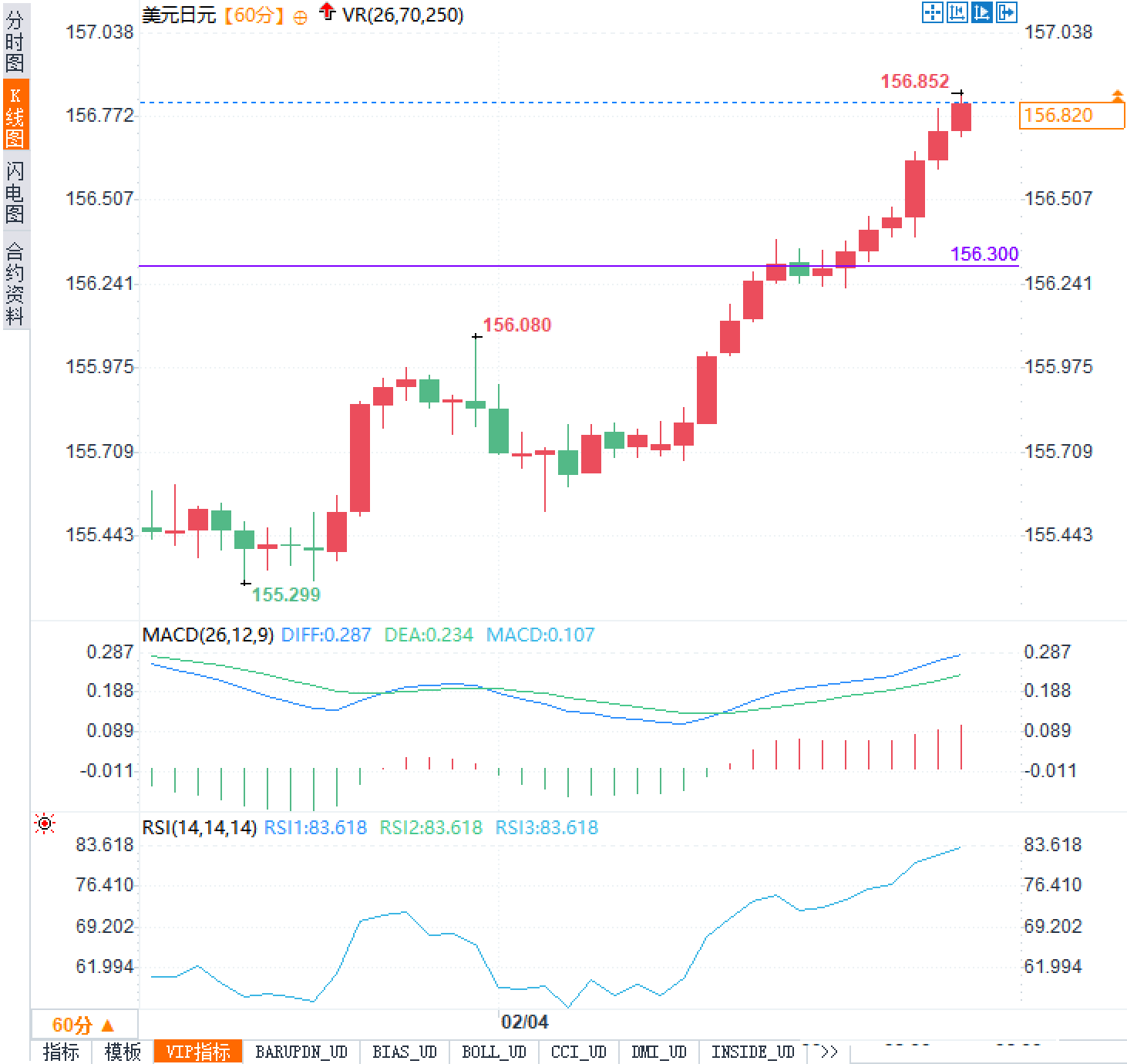
In terms of indicators, the MACD is above the zero line, with the DIFF at approximately 0.287, the DEA at approximately 0.234, and the histogram at approximately 0.107, indicating that the upward momentum is still continuing. More noteworthy is the RSI reading, which has reached 83.618, clearly entering the overbought zone, suggesting that the market is in a state of overheating. This means that although the trend remains upward, the risk of chasing highs is accumulating, and a rapid pullback or consolidation at high levels is possible at any time.
Especially in the current environment, any slight disturbance can be amplified. Past cases show that verification rumors often serve as a "warning signal" before intervention. Once the exchange rate continues to test above 157.00, the probability of actual market intervention increases significantly. Therefore, each breakthrough of a round number level—such as 155.00, 156.00, and then approaching 157.00—triggers a repricing of the "next move" in the market, thereby exacerbating volatility.
The biggest uncertainty at present stems from the specific boundaries of the Japanese authorities' tolerance for exchange rates. While they have historically stabilized the market through verbal intervention or actual yen purchases, their bottom line has always lacked transparency. This leads traders to both follow the trend and remain wary of "black swan" policy shocks. Some analysts suggest that the authorities may prefer to observe domestic political developments around February 8th before deciding whether to take more forceful measures. This window of opportunity further increases the drama of short-term market movements.
Overall, the USD/JPY pair remains strong around 156.80, driven by fundamentals such as interest rate differentials and carry trade dynamics, while technical indicators also support further upside. However, a high RSI and rising risk of policy intervention are limiting upside potential due to "risk premiums." Particularly in the 157.00 to 160.00 range, any sudden signal could trigger a rapid pullback of several hundred pips.
The key question now is not whether the exchange rate can reach 157.00, but rather where and how Japan will draw its true red line as it continues to rise. This exchange rate game is no longer just about fluctuating numbers, but a three-way struggle involving psychology, policy, and capital forces.
It's worth noting that whenever the USD/JPY exchange rate approaches 159.00 or even higher, rumors circulate that Japanese authorities might intervene in the market. This action effectively sends a clear signal to global investors: they do not want the exchange rate to easily reach or break the sensitive threshold of 160.00. Historical experience shows that such verbal warnings often precede actual intervention, especially when speculative sentiment is overheated and one-sided betting is rampant. The current exchange rate approaching 157.00 again signifies that the market is once again on the edge of policy tolerance.
Interest rate differentials remain the core driver, and carry trades continue to heat up.
The fundamental reason driving the renewed strength of the US dollar against the Japanese yen remains the significant difference in monetary policies between the two countries. Currently, the market widely expects the Federal Reserve to maintain high interest rates for an extended period, while the Bank of Japan, although proceeding with policy normalization, is taking an extremely cautious and gradual approach. Against this backdrop, funds continue to favor the classic carry trade strategy of "borrowing low-interest yen and investing in high-yield assets." As long as this interest rate differential does not narrow significantly, the yen will struggle to escape its passive pressure.
Even with temporary intervention or verbal warnings to suppress the exchange rate in the short term, it's unlikely to reverse the overall direction of capital flows. In other words, once risk sentiment stabilizes, funds shorting the yen will quickly flow back. This explains why the exchange rate tends to resume its upward trend relatively quickly after each decline. The dominant market logic remains unchanged—the combination of a strong dollar and a weak yen will continue to dominate in the absence of a major policy shift.
Furthermore, moderate domestic inflation and limited wage growth in Japan further restrict the central bank's room for significant tightening. Given these multiple factors, analysts believe that unless the US significantly accelerates its interest rate cuts or Japan suddenly accelerates its rate hikes, the current situation is unlikely to be fundamentally shaken.
Technically, the market is showing signs of overheating; those chasing the rally at high levels should be wary of sharp fluctuations.
From a technical chart perspective, the USD/JPY pair is showing a stepped upward trend on the 60-minute chart, with a recent high at 156.852. The current price is trading close to this area, indicating strong upward momentum. The key short-term support level is around 156.300, which is considered a significant dividing line in the near term. If the price breaks below this level, it may enter a period of consolidation; conversely, if it holds and rallies again, the bullish structure remains intact.
In terms of indicators, the MACD is above the zero line, with the DIFF at approximately 0.287, the DEA at approximately 0.234, and the histogram at approximately 0.107, indicating that the upward momentum is still continuing. More noteworthy is the RSI reading, which has reached 83.618, clearly entering the overbought zone, suggesting that the market is in a state of overheating. This means that although the trend remains upward, the risk of chasing highs is accumulating, and a rapid pullback or consolidation at high levels is possible at any time.
Especially in the current environment, any slight disturbance can be amplified. Past cases show that verification rumors often serve as a "warning signal" before intervention. Once the exchange rate continues to test above 157.00, the probability of actual market intervention increases significantly. Therefore, each breakthrough of a round number level—such as 155.00, 156.00, and then approaching 157.00—triggers a repricing of the "next move" in the market, thereby exacerbating volatility.
With policy boundaries unresolved, the market has entered a period of high sensitivity.
The biggest uncertainty at present stems from the specific boundaries of the Japanese authorities' tolerance for exchange rates. While they have historically stabilized the market through verbal intervention or actual yen purchases, their bottom line has always lacked transparency. This leads traders to both follow the trend and remain wary of "black swan" policy shocks. Some analysts suggest that the authorities may prefer to observe domestic political developments around February 8th before deciding whether to take more forceful measures. This window of opportunity further increases the drama of short-term market movements.
Overall, the USD/JPY pair remains strong around 156.80, driven by fundamentals such as interest rate differentials and carry trade dynamics, while technical indicators also support further upside. However, a high RSI and rising risk of policy intervention are limiting upside potential due to "risk premiums." Particularly in the 157.00 to 160.00 range, any sudden signal could trigger a rapid pullback of several hundred pips.
The key question now is not whether the exchange rate can reach 157.00, but rather where and how Japan will draw its true red line as it continues to rise. This exchange rate game is no longer just about fluctuating numbers, but a three-way struggle involving psychology, policy, and capital forces.
- Risk Warning and Disclaimer
- The market involves risk, and trading may not be suitable for all investors. This article is for reference only and does not constitute personal investment advice, nor does it take into account certain users’ specific investment objectives, financial situation, or other needs. Any investment decisions made based on this information are at your own risk.