A rebound in the US dollar, coupled with escalating uncertainty surrounding the Japanese yen, supported a continued upward trend in the USD/JPY exchange rate.
2026-02-05 13:34:20
The yen remained weak against the dollar during Thursday's Asian trading session, near a two-week low, with USD/JPY holding steady around the 157 level. The downward trend that has persisted over the past week continues, reflecting growing market concerns about Japan's domestic fiscal and political outlook.
Japanese Prime Minister Sanae Takaichi's expansionary fiscal policy has become a significant factor suppressing the yen recently. With the snap House of Representatives election approaching on February 8th, the market widely expects her Liberal Democratic Party to achieve a relatively solid victory, meaning the government will have more room to push for fiscal stimulus.
However, concerns that such policies could exacerbate the debt burden have made investors cautious about the sustainability of Japan's fiscal policy. Sanae Takaichi's proposal during her campaign to suspend the 8% consumption tax on food for two years was seen as a typical signal of fiscal stimulus and also raised market concerns about debt-financed spending.

Furthermore, its previous statement that "a weak yen is good for the economy," although softened afterward, still weakened market confidence in official intervention in the foreign exchange market to support the yen, further exacerbating the relative weakness of the yen.
On the macroeconomic front, Japan's inflationary momentum has recently shown signs of cooling. Last week's consumer price index for the Tokyo area showed that inflation fell to its lowest level since early 2022, suggesting that demand-driven inflationary pressures have eased.
This result lowered market expectations for further interest rate hikes by the Bank of Japan in the near term, and also put direct downward pressure on the yen. However, the Bank of Japan's internal stance has not completely shifted to a dovish position. The latest policy meeting summary shows that some members remain wary of imported inflation caused by a weak yen.
Meanwhile, private sector survey data showed that Japan's service sector accelerated its expansion in January, marking its fastest growth in nearly a year, meaning that the possibility of the Bank of Japan further tightening its policy in the first half of 2026 cannot be ruled out.
In contrast, the US dollar is supported by policy expectations. Although the market still anticipates two rate cuts by the Federal Reserve this year, the pace has been repeatedly postponed. Fed officials have emphasized that inflation risks remain tilted to the upside, keeping the dollar index at a relatively high level.
Against this backdrop, USD/JPY remained range-bound around 157. US President Trump recently commented on the Federal Reserve's personnel appointments, stating that he would not be nominated for chairman if a candidate supported interest rate hikes, while emphasizing that the US still has room to cut interest rates.
This statement limited market pricing in an extremely hawkish scenario to some extent, but did not reverse the overall strength of the US dollar. In the short term, market focus will shift to US labor market data, including JOLTS job openings and initial jobless claims, which may provide new triggers for volatility in USD/JPY.
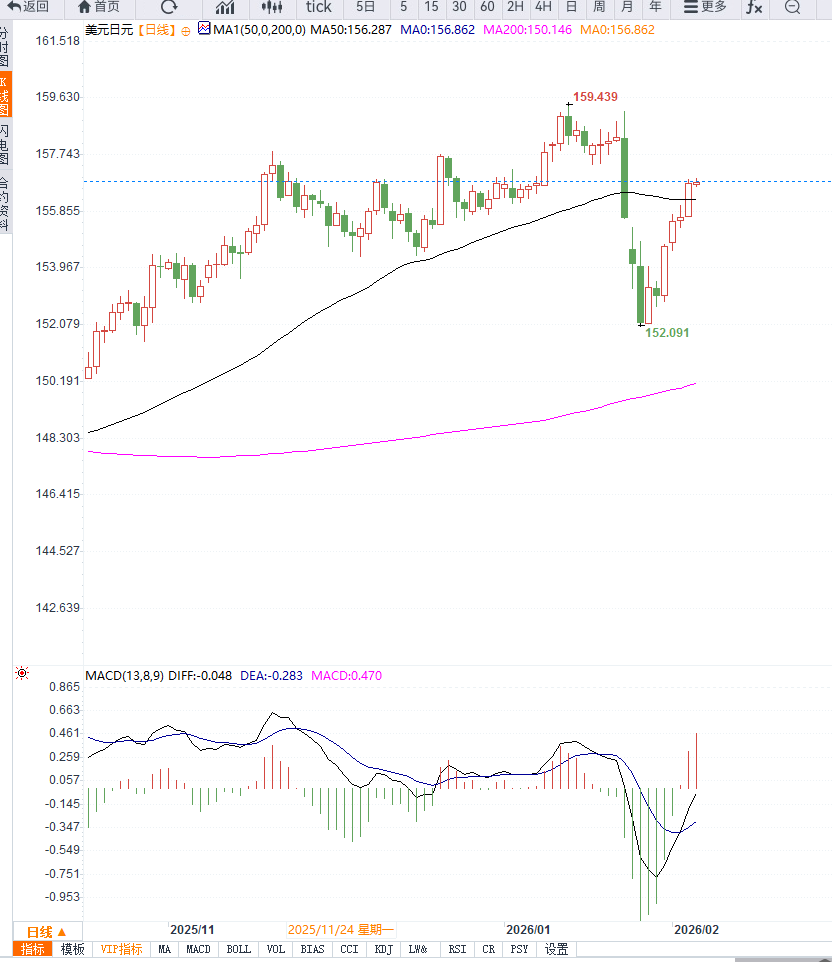
From a technical perspective, USD/JPY has shown a clear strengthening trend after recently breaking through a key resistance level. The upward momentum was released after the exchange rate broke through the 156.50 level, which had previously acted as significant resistance. This breakout itself carries strong trend-guiding significance.
Momentum indicators suggest that short-term upward momentum remains, but signs of a marginal slowdown have begun to emerge. The MACD is running above the zero line, maintaining a bullish pattern, but the histogram momentum has converged, suggesting that the exchange rate may enter a consolidation phase after a rapid rebound.
The Relative Strength Index (RSI) is nearing high levels, indicating short-term buying dominance, but also suggesting that the upside potential is narrowing. From a structural perspective, the 157 level has become a significant psychological and technical resistance zone. If the exchange rate can firmly establish itself above this area, it will technically open up further upside potential.
Conversely, if the price encounters resistance at higher levels and falls back, a retest of the previous breakout area cannot be ruled out. Overall, the current trend leans more towards a "strong consolidation after a breakout" rather than a trend reversal.
Editor's Note:
The current weakness of the yen is essentially a result of a mismatch between fiscal expectations, political uncertainty, and the pace of monetary policy. Until expectations of fiscal expansion in Japan are revised and inflation data strengthens again, the yen will struggle to find sustained fundamental support.
In the short term, USD/JPY will continue to be dominated by the fluctuations of the US dollar, fluctuating repeatedly around the high level of 157. If the expectation of a Fed rate cut continues to be postponed, and Japan lacks clear signals of policy tightening, the weak yen trend may be difficult to reverse quickly. However, it is worth noting that if the exchange rate fluctuates too rapidly, verbal or actual intervention by the Japanese authorities could still become a potential variable.
Japanese Prime Minister Sanae Takaichi's expansionary fiscal policy has become a significant factor suppressing the yen recently. With the snap House of Representatives election approaching on February 8th, the market widely expects her Liberal Democratic Party to achieve a relatively solid victory, meaning the government will have more room to push for fiscal stimulus.
However, concerns that such policies could exacerbate the debt burden have made investors cautious about the sustainability of Japan's fiscal policy. Sanae Takaichi's proposal during her campaign to suspend the 8% consumption tax on food for two years was seen as a typical signal of fiscal stimulus and also raised market concerns about debt-financed spending.
Furthermore, its previous statement that "a weak yen is good for the economy," although softened afterward, still weakened market confidence in official intervention in the foreign exchange market to support the yen, further exacerbating the relative weakness of the yen.
On the macroeconomic front, Japan's inflationary momentum has recently shown signs of cooling. Last week's consumer price index for the Tokyo area showed that inflation fell to its lowest level since early 2022, suggesting that demand-driven inflationary pressures have eased.
This result lowered market expectations for further interest rate hikes by the Bank of Japan in the near term, and also put direct downward pressure on the yen. However, the Bank of Japan's internal stance has not completely shifted to a dovish position. The latest policy meeting summary shows that some members remain wary of imported inflation caused by a weak yen.
Meanwhile, private sector survey data showed that Japan's service sector accelerated its expansion in January, marking its fastest growth in nearly a year, meaning that the possibility of the Bank of Japan further tightening its policy in the first half of 2026 cannot be ruled out.
In contrast, the US dollar is supported by policy expectations. Although the market still anticipates two rate cuts by the Federal Reserve this year, the pace has been repeatedly postponed. Fed officials have emphasized that inflation risks remain tilted to the upside, keeping the dollar index at a relatively high level.
Against this backdrop, USD/JPY remained range-bound around 157. US President Trump recently commented on the Federal Reserve's personnel appointments, stating that he would not be nominated for chairman if a candidate supported interest rate hikes, while emphasizing that the US still has room to cut interest rates.
This statement limited market pricing in an extremely hawkish scenario to some extent, but did not reverse the overall strength of the US dollar. In the short term, market focus will shift to US labor market data, including JOLTS job openings and initial jobless claims, which may provide new triggers for volatility in USD/JPY.
From a technical perspective, USD/JPY has shown a clear strengthening trend after recently breaking through a key resistance level. The upward momentum was released after the exchange rate broke through the 156.50 level, which had previously acted as significant resistance. This breakout itself carries strong trend-guiding significance.
Momentum indicators suggest that short-term upward momentum remains, but signs of a marginal slowdown have begun to emerge. The MACD is running above the zero line, maintaining a bullish pattern, but the histogram momentum has converged, suggesting that the exchange rate may enter a consolidation phase after a rapid rebound.
The Relative Strength Index (RSI) is nearing high levels, indicating short-term buying dominance, but also suggesting that the upside potential is narrowing. From a structural perspective, the 157 level has become a significant psychological and technical resistance zone. If the exchange rate can firmly establish itself above this area, it will technically open up further upside potential.
Conversely, if the price encounters resistance at higher levels and falls back, a retest of the previous breakout area cannot be ruled out. Overall, the current trend leans more towards a "strong consolidation after a breakout" rather than a trend reversal.
Editor's Note:
The current weakness of the yen is essentially a result of a mismatch between fiscal expectations, political uncertainty, and the pace of monetary policy. Until expectations of fiscal expansion in Japan are revised and inflation data strengthens again, the yen will struggle to find sustained fundamental support.
In the short term, USD/JPY will continue to be dominated by the fluctuations of the US dollar, fluctuating repeatedly around the high level of 157. If the expectation of a Fed rate cut continues to be postponed, and Japan lacks clear signals of policy tightening, the weak yen trend may be difficult to reverse quickly. However, it is worth noting that if the exchange rate fluctuates too rapidly, verbal or actual intervention by the Japanese authorities could still become a potential variable.
- Risk Warning and Disclaimer
- The market involves risk, and trading may not be suitable for all investors. This article is for reference only and does not constitute personal investment advice, nor does it take into account certain users’ specific investment objectives, financial situation, or other needs. Any investment decisions made based on this information are at your own risk.