Trump's First Strike on Gold Prices: A Major Wealth Reshuffle in 2026
2026-02-05 17:52:06
It is worth noting that this nomination is not simply a political personnel adjustment, but a key strategic move targeting current market problems and the US economic strategy, the impact of which will extend into 2026 and beyond.

There is a clear consensus in the market regarding Warsh's policy inclinations: compared to the current leadership of the Federal Reserve, he is more hawkish on the management of the balance sheet, his interest rate policy adjustments may be more flexible, and he has a lower tolerance for indefinite liquidity support policies.
However, this superficial understanding does not touch upon the core logic of the nomination—why now, and why Walsh? The answer is not hidden in political maneuvering, but rather rooted in recent market anomalies and the core economic demands of the US government.
Over the past few months, global financial markets have shown a clear divergence: precious metal prices have seen an explosive rise, while the US dollar index has continued to weaken under pressure.
Although the US government has made it clear that a moderate weakening of the dollar is part of the economic rebalancing strategy and not an absolute negative signal, what the market is really worried about is the blurring of the line between "controlled depreciation" and "disorderly collapse" of the dollar.
Behind this concern is a massive economic restructuring being pushed forward by the US government: attempting to simultaneously address trade, industrial structure, and income distribution to absorb the massive debt burden accumulated over the past two decades through nominal growth.
In this context, simply cutting spending is neither economically feasible nor politically realistic; relying on nominal growth is the only way to break the debt crisis.
As I have often mentioned before, the relationship between nominal GDP and 10-year Treasury bond yield is generally considered to be such that debt can only be repaid and the risk of the debt is acceptable when nominal GDP growth (income) is higher than 10-year Treasury bond yield (expenditure).
The core of the current US government's economic strategy is supply-side oriented: to achieve trade rebalancing through tariffs and dollar devaluation, and to promote the transformation of the economy from excessive consumption to investment-driven growth.
By strengthening immigration controls and relaxing industry regulations, the problem of wealth inequality can be alleviated; at the same time, capital allocation should be led by enterprises rather than the government, and residents' income should be increased through substantial wage growth rather than welfare subsidies.
If this strategy is implemented, it is expected to achieve higher quality nominal growth, with growth driven primarily by improvements in total factor productivity, leading to a healthier economic structure.
At the same time, the surge in gold prices also sends a key warning signal – such a large-scale unilateral rise in precious metals only occurs when investors have deep doubts about the ultimate outcome of policies.
This concern about policy stability and the credibility of the US dollar was the direct impetus for Warsh's nomination.
Warsh's nomination is essentially aimed at restoring market credibility to the Federal Reserve's balance sheet policy and curbing market doubts about the dollar and policy direction.
Judging from the market reaction on the first trading day after the nomination was announced (February 1), this move has already taken initial effect: gold and silver prices fell sharply, the US dollar index strengthened slightly, and the stock and interest rate markets remained relatively stable.
This synergistic response across multiple assets has bought the US government a crucial window of opportunity to advance its economic strategy—and time is the core prerequisite for the strategy to take effect.
How can we determine whether the market truly agrees with this logic? Morgan Stanley's chief investment officer, Mike Wilson, points out that the ratio of the S&P 500 index to the price of gold is the simplest and most effective indicator.
The S&P 500/Gold ratio directly reflects market confidence in "productive growth": the recent sharp decline in the ratio is due to the one-sided rise in gold prices; while the significant reversal after the nomination is due to the concentrated sell-off of gold, a drop that has even reached a historically rare level.
However, this does not mean that market doubts have been completely eliminated.
In the short term, for this ratio to continue to rise, it will still depend on a decline in gold prices and rising expectations of tightening liquidity.
In the medium to long term, productivity improvements are needed to drive substantial growth in corporate profits, which also means that risky assets, including the stock market, may still face periodic fluctuations in the short term.
Overall, the current "high-temperature operation" policy framework of the US government is more likely to achieve sustainable growth goals than previous policy combinations. However, the implementation path is destined to be bumpy, and market confidence will fluctuate in stages as the policy progresses. The US will face midterm elections next year, and the controversy over whether AI is a bubble is also a key focus of the market this year.
The United States needs a high nominal GDP growth rate, and the core driver of this growth currently lies in the increased capital expenditures of US AI-related companies. Although some of these investments are considered one-off infrastructure investments such as data centers, they are crucial to US GDP growth.
For investors, it is crucial to closely monitor three key signals: gold prices, the US dollar index, and corporate capital expenditure trends, as these will be the key to determining the ultimate success or failure of this economic strategy.
Despite the potential for increased short-term market volatility, Mike Wilson maintains a clear bullish stance on equity markets and the US dollar index in 2026.
However, a more pointed voice in the market is that the AI narrative has not been widely accepted by large enterprises. The financial reports of Tencent and Intel did not show a rapid expansion of capital expenditure, which is also the reason for their recent stock price adjustment. This may make the story of US GDP relying on the capital expenditure of AI companies untenable. Ultimately, if the US GDP growth rate is weaker than expected, coupled with the difficulty in improving the global debt crisis, gold is a core trading instrument that cannot be ignored in this context.
From a technical perspective, spot gold encountered significant resistance after rebounding to the 0.618 level. Currently, it is supported by the upward channel below and suppressed by the 0.618 level of the rise at 4941. The next resistance level above is 5124, which is close to but below the 0.764 level.
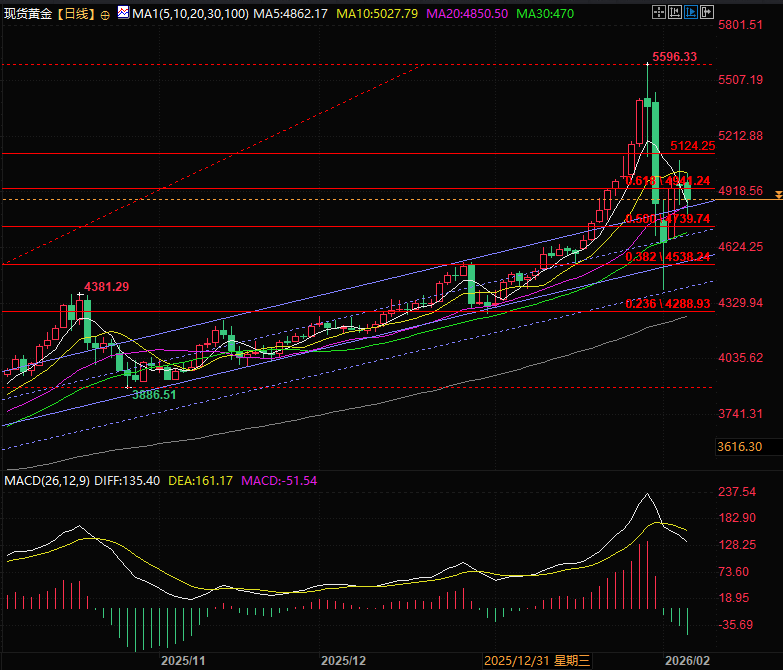
At 17:25 Beijing time, spot gold was trading at $4,875.25 per ounce.
Warsh's Policy Profile: Hawkish Undertones and Core Questions
There is a clear consensus in the market regarding Warsh's policy inclinations: compared to the current leadership of the Federal Reserve, he is more hawkish on the management of the balance sheet, his interest rate policy adjustments may be more flexible, and he has a lower tolerance for indefinite liquidity support policies.
However, this superficial understanding does not touch upon the core logic of the nomination—why now, and why Walsh? The answer is not hidden in political maneuvering, but rather rooted in recent market anomalies and the core economic demands of the US government.
Behind Market Fluctuations: The Dollar Game and Solutions to the Debt Crisis
Over the past few months, global financial markets have shown a clear divergence: precious metal prices have seen an explosive rise, while the US dollar index has continued to weaken under pressure.
Although the US government has made it clear that a moderate weakening of the dollar is part of the economic rebalancing strategy and not an absolute negative signal, what the market is really worried about is the blurring of the line between "controlled depreciation" and "disorderly collapse" of the dollar.
Behind this concern is a massive economic restructuring being pushed forward by the US government: attempting to simultaneously address trade, industrial structure, and income distribution to absorb the massive debt burden accumulated over the past two decades through nominal growth.
In this context, simply cutting spending is neither economically feasible nor politically realistic; relying on nominal growth is the only way to break the debt crisis.
As I have often mentioned before, the relationship between nominal GDP and 10-year Treasury bond yield is generally considered to be such that debt can only be repaid and the risk of the debt is acceptable when nominal GDP growth (income) is higher than 10-year Treasury bond yield (expenditure).
Supply-side orientation: The core path of economic restructuring and market warm-up
The core of the current US government's economic strategy is supply-side oriented: to achieve trade rebalancing through tariffs and dollar devaluation, and to promote the transformation of the economy from excessive consumption to investment-driven growth.
By strengthening immigration controls and relaxing industry regulations, the problem of wealth inequality can be alleviated; at the same time, capital allocation should be led by enterprises rather than the government, and residents' income should be increased through substantial wage growth rather than welfare subsidies.
If this strategy is implemented, it is expected to achieve higher quality nominal growth, with growth driven primarily by improvements in total factor productivity, leading to a healthier economic structure.
Gold Warning: Market Doubts Create Nomination Opportunity
At the same time, the surge in gold prices also sends a key warning signal – such a large-scale unilateral rise in precious metals only occurs when investors have deep doubts about the ultimate outcome of policies.
This concern about policy stability and the credibility of the US dollar was the direct impetus for Warsh's nomination.
Warsh's nomination is essentially aimed at restoring market credibility to the Federal Reserve's balance sheet policy and curbing market doubts about the dollar and policy direction.
Judging from the market reaction on the first trading day after the nomination was announced (February 1), this move has already taken initial effect: gold and silver prices fell sharply, the US dollar index strengthened slightly, and the stock and interest rate markets remained relatively stable.
This synergistic response across multiple assets has bought the US government a crucial window of opportunity to advance its economic strategy—and time is the core prerequisite for the strategy to take effect.
Key Indicator: The Signal Significance of the S&P 500 to Fibonacci Ratio
How can we determine whether the market truly agrees with this logic? Morgan Stanley's chief investment officer, Mike Wilson, points out that the ratio of the S&P 500 index to the price of gold is the simplest and most effective indicator.
The S&P 500/Gold ratio directly reflects market confidence in "productive growth": the recent sharp decline in the ratio is due to the one-sided rise in gold prices; while the significant reversal after the nomination is due to the concentrated sell-off of gold, a drop that has even reached a historically rare level.
However, this does not mean that market doubts have been completely eliminated.
In the short term, for this ratio to continue to rise, it will still depend on a decline in gold prices and rising expectations of tightening liquidity.
In the medium to long term, productivity improvements are needed to drive substantial growth in corporate profits, which also means that risky assets, including the stock market, may still face periodic fluctuations in the short term.
Summary and Technical Analysis:
Overall, the current "high-temperature operation" policy framework of the US government is more likely to achieve sustainable growth goals than previous policy combinations. However, the implementation path is destined to be bumpy, and market confidence will fluctuate in stages as the policy progresses. The US will face midterm elections next year, and the controversy over whether AI is a bubble is also a key focus of the market this year.
The United States needs a high nominal GDP growth rate, and the core driver of this growth currently lies in the increased capital expenditures of US AI-related companies. Although some of these investments are considered one-off infrastructure investments such as data centers, they are crucial to US GDP growth.
For investors, it is crucial to closely monitor three key signals: gold prices, the US dollar index, and corporate capital expenditure trends, as these will be the key to determining the ultimate success or failure of this economic strategy.
Despite the potential for increased short-term market volatility, Mike Wilson maintains a clear bullish stance on equity markets and the US dollar index in 2026.
However, a more pointed voice in the market is that the AI narrative has not been widely accepted by large enterprises. The financial reports of Tencent and Intel did not show a rapid expansion of capital expenditure, which is also the reason for their recent stock price adjustment. This may make the story of US GDP relying on the capital expenditure of AI companies untenable. Ultimately, if the US GDP growth rate is weaker than expected, coupled with the difficulty in improving the global debt crisis, gold is a core trading instrument that cannot be ignored in this context.
From a technical perspective, spot gold encountered significant resistance after rebounding to the 0.618 level. Currently, it is supported by the upward channel below and suppressed by the 0.618 level of the rise at 4941. The next resistance level above is 5124, which is close to but below the 0.764 level.
At 17:25 Beijing time, spot gold was trading at $4,875.25 per ounce.
- Risk Warning and Disclaimer
- The market involves risk, and trading may not be suitable for all investors. This article is for reference only and does not constitute personal investment advice, nor does it take into account certain users’ specific investment objectives, financial situation, or other needs. Any investment decisions made based on this information are at your own risk.