Two major central banks clash, EUR/GBP battle for 0.87.
2026-02-05 19:37:21
On Thursday, February 5th, the euro traded around 0.8670 against the pound during the European session, with a daily gain of over 0.30%. On the surface, the euro seems to have regained some strength, but the underlying reason for this rebound is not pure. The direct cause driving the exchange rate recovery is not the euro's own strength, but rather the short-term selling pressure the pound faced ahead of the Bank of England's interest rate decision, leading to cautious market sentiment and a temporary flow of funds towards the relatively stable currency. This "not because I'm strong, but because the opponent is weak" scenario is not uncommon in the currency market, but it also means that the euro's upward momentum is not yet firmly established.
The deeper issues remain rooted in the Eurozone's fundamentals. The latest December retail sales data was disappointing: a 0.5% month-on-month decline, far worse than the market expectation of a 0.2% drop, and the previous figure was also revised down to a mere 0.1% increase. As a key engine of economic growth, continued weakness in household consumption reflects insufficient domestic demand and has somewhat eased market concerns about a resurgence of inflation. Weak consumption typically limits the central bank's room for further tightening, thus restricting the euro's upside potential. This is why, despite recent occasional rebounds, the euro has struggled to establish a sustained upward trend.
However, another set of data paints a completely different picture. German factory orders surged 7.8% month-on-month in December, not only reversing the previously expected 2.2% contraction but also significantly revising the previous figure upward. This impressive performance sends a positive signal of a manufacturing recovery. Since orders often precede actual output and exports, if subsequent production can catch up, the recovery on the industrial side may partially offset the drag from the consumer side. However, fluctuations in monthly data may be affected by individual large contracts or structural factors in specific industries, and its sustainability remains to be seen. Therefore, given the divergence between the "hot" and "cold" trends in consumption and industry, the euro is exhibiting more of a temporary reaction than a systemic strengthening.
The market focus has shifted from individual economic data to the policy statements from the European Central Bank and the Bank of England later in the day. For the euro against the pound, the real indicator may not be the numbers themselves, but rather every word spoken by the governors of the European Central Bank and the Bank of England at their press conferences. These seemingly vague statements can often reshape market expectations for interest rate paths in a short period, thus triggering sharp fluctuations in the foreign exchange market.
The European Central Bank is expected to keep interest rates unchanged at this meeting. The real focus will be on how President Lagarde describes the relationship between inflation and growth. If she emphasizes the weak economic recovery, the steady decline in inflation, or even hints that a rate cut is imminent, the euro is likely to face a new round of selling pressure. Conversely, if she expresses caution about the resilience of inflation or clearly states that she is not in a hurry to ease policy, the euro is expected to find support and maintain its relative strength against the pound.
On the other hand, the Bank of England is also at a critical crossroads. The market widely predicts it will maintain the 3.75% interest rate, given that it already cut rates at its last meeting. However, what truly influences the market is the monetary policy report and Governor Bailey's comments on the "pacing of future rate cuts" at the press conference. If the government acknowledges a weakening labor market and inflation rapidly approaching the 2% target, the market will quickly raise the probability of a rate cut this year, inevitably putting pressure on the pound. However, if Bailey expresses concern about the stickiness of inflation or emphasizes the need for patience in policy, the pound may see a recovery in sentiment, limiting further appreciation of the euro against the pound.
It can be said that the future trend is no longer a simple data game, but a psychological battle of "expectation repricing." The more hawkish a central bank appears, the more confident its currency will be; whoever first softens their stance on easing is likely to see their currency sold off. Especially against the backdrop of diverging macroeconomic data, the influence of central bank communication even surpasses that of a single indicator.
From a technical chart perspective, the EUR/GBP pair is currently in a typical range-bound trading phase. The exchange rate previously surged to 0.8796 before retreating and finding temporary support around 0.8611. Currently, the price is around 0.8670, precisely at the midpoint of the entire range. The 0.8700 level represents a significant psychological and trading resistance point, having been repeatedly tested in the past. If this level cannot be broken effectively, the exchange rate will likely continue to oscillate between 0.8611 and 0.8700.
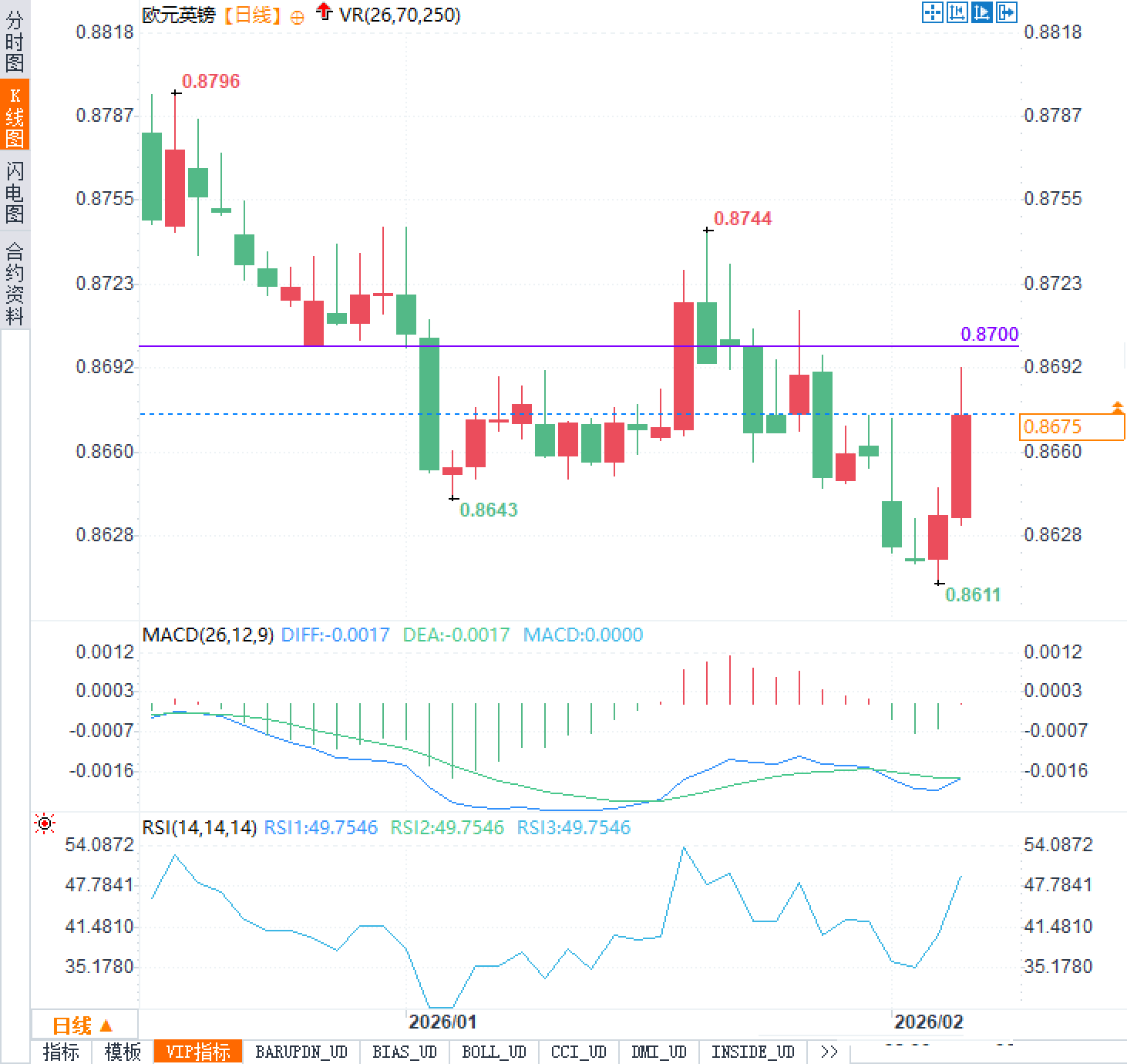
Further observation reveals two key support levels to watch: the previous low near 0.8643 and the recent bottom at 0.8611. If the Bank of England adopts a hawkish stance, or if weak domestic demand data emerges from the Eurozone, the likelihood of breaking these support levels increases, potentially opening up further downside potential. On the upside, a break above the recent rebound high of 0.8744 is needed to retest the 0.8796 area.
In summary, the short-term trend of the euro against the pound will still be dominated by two main factors: first, whether the European Central Bank (ECB) will release dovish signals, weakening the euro's interest rate advantage; and second, whether the Bank of England (BOE) will further hint at interest rate cuts, exacerbating the pound's weakness. If the former is restrained and the latter is accommodative, the euro may attempt to break through 0.8700 or even 0.8744; conversely, if the BOE adopts a hawkish stance, or if Eurozone consumption data deteriorates again, triggering concerns about the economic outlook, the exchange rate may fall back to test 0.8643 or even lower.
The deeper issues remain rooted in the Eurozone's fundamentals. The latest December retail sales data was disappointing: a 0.5% month-on-month decline, far worse than the market expectation of a 0.2% drop, and the previous figure was also revised down to a mere 0.1% increase. As a key engine of economic growth, continued weakness in household consumption reflects insufficient domestic demand and has somewhat eased market concerns about a resurgence of inflation. Weak consumption typically limits the central bank's room for further tightening, thus restricting the euro's upside potential. This is why, despite recent occasional rebounds, the euro has struggled to establish a sustained upward trend.
However, another set of data paints a completely different picture. German factory orders surged 7.8% month-on-month in December, not only reversing the previously expected 2.2% contraction but also significantly revising the previous figure upward. This impressive performance sends a positive signal of a manufacturing recovery. Since orders often precede actual output and exports, if subsequent production can catch up, the recovery on the industrial side may partially offset the drag from the consumer side. However, fluctuations in monthly data may be affected by individual large contracts or structural factors in specific industries, and its sustainability remains to be seen. Therefore, given the divergence between the "hot" and "cold" trends in consumption and industry, the euro is exhibiting more of a temporary reaction than a systemic strengthening.
The central bank's rhetoric will determine the short-term direction.
The market focus has shifted from individual economic data to the policy statements from the European Central Bank and the Bank of England later in the day. For the euro against the pound, the real indicator may not be the numbers themselves, but rather every word spoken by the governors of the European Central Bank and the Bank of England at their press conferences. These seemingly vague statements can often reshape market expectations for interest rate paths in a short period, thus triggering sharp fluctuations in the foreign exchange market.
The European Central Bank is expected to keep interest rates unchanged at this meeting. The real focus will be on how President Lagarde describes the relationship between inflation and growth. If she emphasizes the weak economic recovery, the steady decline in inflation, or even hints that a rate cut is imminent, the euro is likely to face a new round of selling pressure. Conversely, if she expresses caution about the resilience of inflation or clearly states that she is not in a hurry to ease policy, the euro is expected to find support and maintain its relative strength against the pound.
On the other hand, the Bank of England is also at a critical crossroads. The market widely predicts it will maintain the 3.75% interest rate, given that it already cut rates at its last meeting. However, what truly influences the market is the monetary policy report and Governor Bailey's comments on the "pacing of future rate cuts" at the press conference. If the government acknowledges a weakening labor market and inflation rapidly approaching the 2% target, the market will quickly raise the probability of a rate cut this year, inevitably putting pressure on the pound. However, if Bailey expresses concern about the stickiness of inflation or emphasizes the need for patience in policy, the pound may see a recovery in sentiment, limiting further appreciation of the euro against the pound.
It can be said that the future trend is no longer a simple data game, but a psychological battle of "expectation repricing." The more hawkish a central bank appears, the more confident its currency will be; whoever first softens their stance on easing is likely to see their currency sold off. Especially against the backdrop of diverging macroeconomic data, the influence of central bank communication even surpasses that of a single indicator.
Technical analysis reveals that the bulls and bears are still locked in a tug-of-war.
From a technical chart perspective, the EUR/GBP pair is currently in a typical range-bound trading phase. The exchange rate previously surged to 0.8796 before retreating and finding temporary support around 0.8611. Currently, the price is around 0.8670, precisely at the midpoint of the entire range. The 0.8700 level represents a significant psychological and trading resistance point, having been repeatedly tested in the past. If this level cannot be broken effectively, the exchange rate will likely continue to oscillate between 0.8611 and 0.8700.
Further observation reveals two key support levels to watch: the previous low near 0.8643 and the recent bottom at 0.8611. If the Bank of England adopts a hawkish stance, or if weak domestic demand data emerges from the Eurozone, the likelihood of breaking these support levels increases, potentially opening up further downside potential. On the upside, a break above the recent rebound high of 0.8744 is needed to retest the 0.8796 area.
In summary, the short-term trend of the euro against the pound will still be dominated by two main factors: first, whether the European Central Bank (ECB) will release dovish signals, weakening the euro's interest rate advantage; and second, whether the Bank of England (BOE) will further hint at interest rate cuts, exacerbating the pound's weakness. If the former is restrained and the latter is accommodative, the euro may attempt to break through 0.8700 or even 0.8744; conversely, if the BOE adopts a hawkish stance, or if Eurozone consumption data deteriorates again, triggering concerns about the economic outlook, the exchange rate may fall back to test 0.8643 or even lower.
- Risk Warning and Disclaimer
- The market involves risk, and trading may not be suitable for all investors. This article is for reference only and does not constitute personal investment advice, nor does it take into account certain users’ specific investment objectives, financial situation, or other needs. Any investment decisions made based on this information are at your own risk.