The Bank of England's surprise market move sent the pound plunging 60 points! A rate cut is imminent!
2026-02-05 20:11:39
At 8:00 PM Beijing time on Thursday (February 5th), the Bank of England announced its first Monetary Policy Committee (MPC) decision of 2026: the MPC voted 5-4 to maintain the benchmark interest rate at 3.75%. This voting ratio was significantly more divergent than market expectations, with most institutions predicting a 7-2 or 6-3 stable outcome. Governor Bailey stated that if inflation falls back to near the 2% target in the spring and remains stable, there will be room for further interest rate cuts this year, but he emphasized that "this does not mean that a rate cut is expected at any particular meeting." The central bank also significantly revised its inflation path forecast: inflation is expected to return to the 2% target in the third quarter of 2026 on a calendar quarter basis, about a year earlier than predicted last November; inflation expectations are expected to fall to 1.7% one year later, 1.8% two years later, and stabilize at 2.0% three years later.
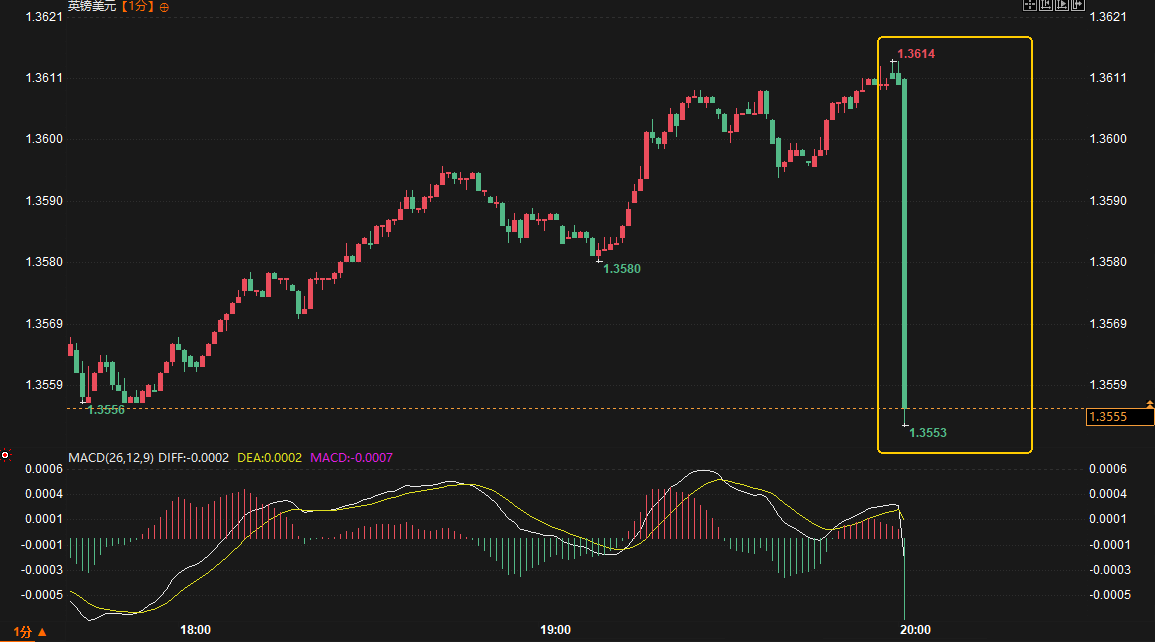
Following the announcement of the decision, the pound sterling plummeted against the dollar. Prior to the data release, the pound had been trading in a narrow range between 1.3620 and 1.3680, with the market largely in agreement that interest rates would remain unchanged at this meeting. The probability of a rate cut in March was close to zero, while the probability in April was approximately 60%. Immediately after the announcement, the pound sterling plunged more than 60 points against the dollar, hitting a low of 1.3548, before recovering slightly. It closed around 1.3567 in the Asian session, a daily decline of approximately 0.4% to 0.5%. This reaction was primarily due to the market interpreting the narrow voting result and the clearer possibility of a rate cut this year as a dovish signal, leading to a significant shift in expectations for a rate cut.
Prior to the decision, the market widely expected the Bank of England to maintain its cautious stance from December of last year. Most analysts believed that while a downward trend in inflation had emerged, stickiness remained, and the voting split was not expected to be too extreme. On social media, discussions among institutional analysts focused on the need for more evidence to confirm the sustainability of the downward trend in inflation, while retail traders were more concerned with the technical correction of the pound after its recent high of 1.3876, generally believing that the decision itself would not cause significant volatility, with more focus on the wording of the governor's press conference.
Following the announcement of the resolution, market sentiment quickly shifted to a dovish stance. On social media platforms, macroeconomic commentators generally pointed out that the 5-4 vote was "far more dovish than expected," with four members supporting an immediate 25 basis point rate cut to 3.5%, indicating that the committee's internal balance regarding the economic slowdown and downside risks to inflation had become more balanced. Some well-known macro strategists stated that "the March meeting suddenly became a real option," with the probability of a March rate cut, which had been almost entirely unpriced in, rapidly rising to over 40% within minutes. Retail traders reacted even more directly, with many mentioning on platforms that "the voting divergence was much more dovish than the expected stable 7-2," and "the short-term decline in the pound is logical; pay attention to whether the 1.35 level will be breached." At the same time, some cautioned that "the governor still emphasized that there were no specific meeting expectations, and one should not over-interpret the situation."
Overall, the market quickly shifted from "stable expectations and focus on communication details" to "voting differences dominating and interest rate cuts being prioritized." The rapid decline in the pound is a direct reflection of this shift in sentiment: the combination of lower inflation forecasts, weaker economic growth expectations, and policy signals has, in the short term, increased expectations of further easing and suppressed the pound's performance.
The current resolution largely aligns with the wording of the December meeting regarding the interest rate path, maintaining the statement that "the benchmark interest rate is very likely to be further lowered," but removing the limitation of "gradual downward path," and adding the statement that "the judgment of further easing policies is becoming closer." This change is seen by the market as a signal of a more open attitude towards the pace of interest rate cuts this year. Combined with updated forecast data, the central bank's assessment that wage growth will slow to 3.25%-3.4% in 2026 is more consistent with the 2% inflation target, further providing a basis for policy easing.
For the British pound, short-term pressure mainly stems from the combined effect of shifted expectations of an interest rate cut and a relatively strong US dollar. Technical and fundamental factors are converging here: this decision accelerated the pound's correction. The current key support zone is between 1.3540 and 1.3550, which coincides with the upward trend line since November of last year and the 38.2% Fibonacci retracement level. If this level holds, a technical rebound may be triggered; if it falls, the next important support level to watch is the psychological level of 1.3500, which is also close to the 200-day moving average and has strong psychological and technical significance.
On the resistance side, 1.3600-1.3620 is the lower edge of the consolidation range that has been repeatedly tested this week. If it can be regained, it will effectively alleviate the short-term downward pressure. Further up, 1.3650-1.3680 is the high point area of this week. A breakthrough would require a significant recovery in risk appetite or a simultaneous pullback in the US dollar index.
From a medium- to long-term perspective, this decision does not change the Bank of England's overall direction of "gradual easing," but merely brings forward the window for policy judgment. Forecast data shows that while economic growth in 2026 has been revised down to 0.9%, it will rebound to 1.5% and 1.9% in 2027 and 2028, respectively. Inflation is expected to return to the 2% target in the third quarter of 2026 and remain relatively stable, while the unemployment rate is expected to peak at 5.3% before gradually declining. These neutral to slightly bearish macroeconomic scenarios provide room for monetary policy maneuvering, but also mean that the pace of easing is highly dependent on subsequent data verification, rather than a predetermined path.
The long-term trading range for GBP/USD still needs to be assessed in conjunction with interest rate differentials among major global economies and overall risk sentiment. Based on the implied volatility of current contracts, a reasonable short-term (1-3 months) trading range is 1.3500-1.3700; in the medium term (3-6 months), after the sustainability of the inflation decline is confirmed, it is expected to gradually recover to the 1.3800-1.4000 range, provided there are no unexpected external shocks. Traders should continue to monitor UK wage data, monthly inflation readings, and concurrent policy communications from the Federal Reserve to avoid excessive volatility caused by a single event.
This decision is essentially an attempt by the Bank of England to balance the window of declining inflation with the pressure of economic slowdown. The market has already priced in some dovish signals, but subsequent price action will depend on whether the April and May data confirm the core assessment that the decline is sustainable. During this process, the pound is likely to maintain a highly volatile range-bound trading pattern, and the aforementioned support and resistance levels will be important references for assessing the effectiveness of the policy signals.
Following the announcement of the decision, the pound sterling plummeted against the dollar. Prior to the data release, the pound had been trading in a narrow range between 1.3620 and 1.3680, with the market largely in agreement that interest rates would remain unchanged at this meeting. The probability of a rate cut in March was close to zero, while the probability in April was approximately 60%. Immediately after the announcement, the pound sterling plunged more than 60 points against the dollar, hitting a low of 1.3548, before recovering slightly. It closed around 1.3567 in the Asian session, a daily decline of approximately 0.4% to 0.5%. This reaction was primarily due to the market interpreting the narrow voting result and the clearer possibility of a rate cut this year as a dovish signal, leading to a significant shift in expectations for a rate cut.
Market sentiment before and after the resolution was announced
Prior to the decision, the market widely expected the Bank of England to maintain its cautious stance from December of last year. Most analysts believed that while a downward trend in inflation had emerged, stickiness remained, and the voting split was not expected to be too extreme. On social media, discussions among institutional analysts focused on the need for more evidence to confirm the sustainability of the downward trend in inflation, while retail traders were more concerned with the technical correction of the pound after its recent high of 1.3876, generally believing that the decision itself would not cause significant volatility, with more focus on the wording of the governor's press conference.
Following the announcement of the resolution, market sentiment quickly shifted to a dovish stance. On social media platforms, macroeconomic commentators generally pointed out that the 5-4 vote was "far more dovish than expected," with four members supporting an immediate 25 basis point rate cut to 3.5%, indicating that the committee's internal balance regarding the economic slowdown and downside risks to inflation had become more balanced. Some well-known macro strategists stated that "the March meeting suddenly became a real option," with the probability of a March rate cut, which had been almost entirely unpriced in, rapidly rising to over 40% within minutes. Retail traders reacted even more directly, with many mentioning on platforms that "the voting divergence was much more dovish than the expected stable 7-2," and "the short-term decline in the pound is logical; pay attention to whether the 1.35 level will be breached." At the same time, some cautioned that "the governor still emphasized that there were no specific meeting expectations, and one should not over-interpret the situation."
Overall, the market quickly shifted from "stable expectations and focus on communication details" to "voting differences dominating and interest rate cuts being prioritized." The rapid decline in the pound is a direct reflection of this shift in sentiment: the combination of lower inflation forecasts, weaker economic growth expectations, and policy signals has, in the short term, increased expectations of further easing and suppressed the pound's performance.
The impact of interest rate cut expectations adjustment on market trends
The current resolution largely aligns with the wording of the December meeting regarding the interest rate path, maintaining the statement that "the benchmark interest rate is very likely to be further lowered," but removing the limitation of "gradual downward path," and adding the statement that "the judgment of further easing policies is becoming closer." This change is seen by the market as a signal of a more open attitude towards the pace of interest rate cuts this year. Combined with updated forecast data, the central bank's assessment that wage growth will slow to 3.25%-3.4% in 2026 is more consistent with the 2% inflation target, further providing a basis for policy easing.
For the British pound, short-term pressure mainly stems from the combined effect of shifted expectations of an interest rate cut and a relatively strong US dollar. Technical and fundamental factors are converging here: this decision accelerated the pound's correction. The current key support zone is between 1.3540 and 1.3550, which coincides with the upward trend line since November of last year and the 38.2% Fibonacci retracement level. If this level holds, a technical rebound may be triggered; if it falls, the next important support level to watch is the psychological level of 1.3500, which is also close to the 200-day moving average and has strong psychological and technical significance.
On the resistance side, 1.3600-1.3620 is the lower edge of the consolidation range that has been repeatedly tested this week. If it can be regained, it will effectively alleviate the short-term downward pressure. Further up, 1.3650-1.3680 is the high point area of this week. A breakthrough would require a significant recovery in risk appetite or a simultaneous pullback in the US dollar index.
Future Trend Outlook
From a medium- to long-term perspective, this decision does not change the Bank of England's overall direction of "gradual easing," but merely brings forward the window for policy judgment. Forecast data shows that while economic growth in 2026 has been revised down to 0.9%, it will rebound to 1.5% and 1.9% in 2027 and 2028, respectively. Inflation is expected to return to the 2% target in the third quarter of 2026 and remain relatively stable, while the unemployment rate is expected to peak at 5.3% before gradually declining. These neutral to slightly bearish macroeconomic scenarios provide room for monetary policy maneuvering, but also mean that the pace of easing is highly dependent on subsequent data verification, rather than a predetermined path.
The long-term trading range for GBP/USD still needs to be assessed in conjunction with interest rate differentials among major global economies and overall risk sentiment. Based on the implied volatility of current contracts, a reasonable short-term (1-3 months) trading range is 1.3500-1.3700; in the medium term (3-6 months), after the sustainability of the inflation decline is confirmed, it is expected to gradually recover to the 1.3800-1.4000 range, provided there are no unexpected external shocks. Traders should continue to monitor UK wage data, monthly inflation readings, and concurrent policy communications from the Federal Reserve to avoid excessive volatility caused by a single event.
This decision is essentially an attempt by the Bank of England to balance the window of declining inflation with the pressure of economic slowdown. The market has already priced in some dovish signals, but subsequent price action will depend on whether the April and May data confirm the core assessment that the decline is sustainable. During this process, the pound is likely to maintain a highly volatile range-bound trading pattern, and the aforementioned support and resistance levels will be important references for assessing the effectiveness of the policy signals.
- Risk Warning and Disclaimer
- The market involves risk, and trading may not be suitable for all investors. This article is for reference only and does not constitute personal investment advice, nor does it take into account certain users’ specific investment objectives, financial situation, or other needs. Any investment decisions made based on this information are at your own risk.