Is silver in a dead end? Gold is also showing a downward trend.
2026-02-05 22:00:39
Since the beginning of February, spot silver prices have fluctuated wildly. On Thursday, February 5th, during North American trading hours, it traded above $76, having fallen by about 13% on the day, currently in a correction phase after its previous rapid rise. Previously, silver had surged to around $121.487, reaching a temporary high, but then quickly reversed course, falling to a low of around $71.166, completing a transformation from frenzied buying to panic selling in just a few days. This dramatic volatility reflects a shift in market sentiment from optimism to caution, with funds prioritizing risk control over further price increases.
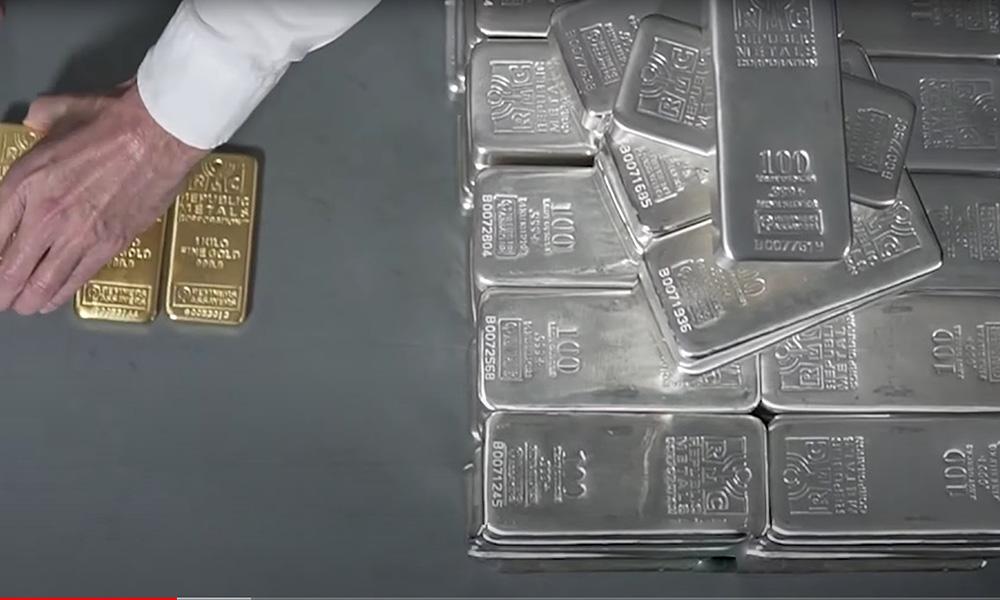
Meanwhile, the entire precious metals sector was not spared. Gold fell back to around $4,840 per ounce, indicating overall pressure on safe-haven assets. Analysts point out that the market's focus is no longer simply on geopolitical conflicts or inflation expectations, but rather on the Federal Reserve's policy direction and the dollar's trajectory. The recent strengthening of the dollar has increased the cost of holding dollar-denominated precious metals, suppressing speculative capital inflows. Furthermore, with some geopolitical tensions easing marginally, funds that initially flowed in due to safe-haven demand have begun to gradually withdraw, resulting in a lack of sustained momentum for any rebound in precious metals.
The recent sharp decline in silver prices appears more like a deleveraging process within a highly volatile environment. Data shows that silver experienced a single-day drop of up to 17%, and even a brief rebound failed to stabilize the price, quickly weakening again. This indicates that selling pressure in the market has not been fully released, and previously accumulated long positions are still being liquidated. Analysts believe that this drastic fluctuation was not triggered by a sudden event, but rather a natural continuation of previous extreme market conditions—when prices rise rapidly but fail to form effective support, a change in market sentiment can trigger a chain reaction.
Silver's inherent characteristics exacerbate this process. It possesses both the safe-haven appeal of precious metals and the demand background of industrial metals, making it more volatile and prone to sharp rises when market sentiment improves; however, it is also more likely to be the first to be sold off when sentiment reverses. Recently, there have been clear signs of profit-taking in the market, especially after a two-day rebound, with a large amount of speculative capital choosing to realize profits, further amplifying the pullback. Furthermore, some observations indicate that concentrated selling during the Asian session, coupled with significant selling pressure in the futures market, prevented prices from holding above key resistance levels, triggering technical stop-loss orders and speculative selling, creating a vicious cycle of "the more it falls, the more people sell."
From a technical chart perspective, the $94,000 level has become a clear resistance zone. Multiple attempts to break through have failed, with prices accelerating their decline after encountering resistance, indicating that sellers still hold the upper hand. On the downside, the recent low of $71.166 needs close attention. A move closer to this level will test whether previous selling pressure has subsided and whether new buying interest is willing to enter the market. Looking further back, $62.145 represents an earlier low range that may re-emerge in investor attention under extreme sentiment, serving as a reference point for medium- to long-term investment.
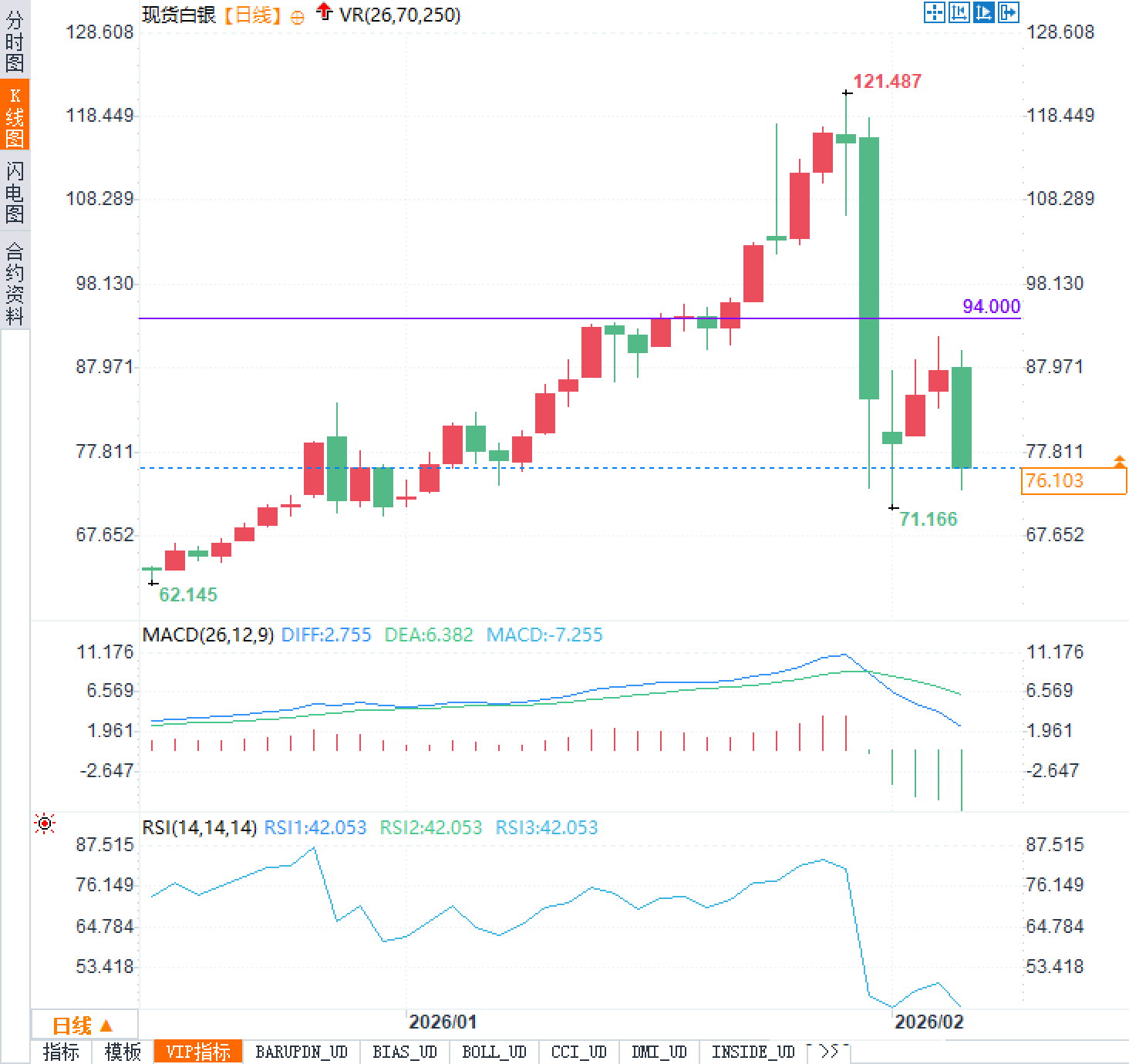
Technical indicators also signal a bearish bias. The MACD shows a DIFF value of 2.755, a DEA value of 6.382, and a MACD histogram of -7.255, indicating that short-term momentum has weakened and the recovery process will take time. The RSI is currently hovering around 42.053, indicating a weak but not yet extremely oversold level, meaning that prices may continue to fluctuate at low levels in the short term without an immediate reversal, but further declines cannot be ruled out. Overall, the technical structure has not yet stabilized, and a trend recovery requires patience.
Looking ahead, silver's price movement will likely revolve around two main themes. The first is the macroeconomic pricing logic: if the US dollar continues to strengthen, and market speculation regarding the Federal Reserve's policy path intensifies, then silver will likely remain highly volatile, with limited upside potential and increased trading difficulty. In this environment, liquidity management and position control are more important than directional judgment; blindly placing large bets can easily lead to being "washed out" by sharp fluctuations.
The second point concerns fundamentals and relative value. Despite short-term volatility, some institutions believe that gold and silver still have room for further upward movement by 2026. Silver, in particular, may benefit from the long-term strong trend in gold prices and the support provided by recent tight supply and demand. This means that the medium-term upward logic has not been completely broken; the current sharp correction is more like the market clearing out sentiment and leverage, using high volatility to facilitate the transfer of shares.
In summary, the current trading of spot silver around $76 reflects the market's digestion of uncertainty through higher volatility. In the short term, close attention should be paid to the effectiveness of the resistance level at $94,000 and the strength of the support level at $71,166. In the medium term, the focus should be on the dollar's performance and changes in policy expectations.
Meanwhile, the entire precious metals sector was not spared. Gold fell back to around $4,840 per ounce, indicating overall pressure on safe-haven assets. Analysts point out that the market's focus is no longer simply on geopolitical conflicts or inflation expectations, but rather on the Federal Reserve's policy direction and the dollar's trajectory. The recent strengthening of the dollar has increased the cost of holding dollar-denominated precious metals, suppressing speculative capital inflows. Furthermore, with some geopolitical tensions easing marginally, funds that initially flowed in due to safe-haven demand have begun to gradually withdraw, resulting in a lack of sustained momentum for any rebound in precious metals.
Why is silver so "crazy"? A double whammy of leverage and emotion.
The recent sharp decline in silver prices appears more like a deleveraging process within a highly volatile environment. Data shows that silver experienced a single-day drop of up to 17%, and even a brief rebound failed to stabilize the price, quickly weakening again. This indicates that selling pressure in the market has not been fully released, and previously accumulated long positions are still being liquidated. Analysts believe that this drastic fluctuation was not triggered by a sudden event, but rather a natural continuation of previous extreme market conditions—when prices rise rapidly but fail to form effective support, a change in market sentiment can trigger a chain reaction.
Silver's inherent characteristics exacerbate this process. It possesses both the safe-haven appeal of precious metals and the demand background of industrial metals, making it more volatile and prone to sharp rises when market sentiment improves; however, it is also more likely to be the first to be sold off when sentiment reverses. Recently, there have been clear signs of profit-taking in the market, especially after a two-day rebound, with a large amount of speculative capital choosing to realize profits, further amplifying the pullback. Furthermore, some observations indicate that concentrated selling during the Asian session, coupled with significant selling pressure in the futures market, prevented prices from holding above key resistance levels, triggering technical stop-loss orders and speculative selling, creating a vicious cycle of "the more it falls, the more people sell."
Technical indicators are flashing red: heavy pressure and weakening momentum.
From a technical chart perspective, the $94,000 level has become a clear resistance zone. Multiple attempts to break through have failed, with prices accelerating their decline after encountering resistance, indicating that sellers still hold the upper hand. On the downside, the recent low of $71.166 needs close attention. A move closer to this level will test whether previous selling pressure has subsided and whether new buying interest is willing to enter the market. Looking further back, $62.145 represents an earlier low range that may re-emerge in investor attention under extreme sentiment, serving as a reference point for medium- to long-term investment.
Technical indicators also signal a bearish bias. The MACD shows a DIFF value of 2.755, a DEA value of 6.382, and a MACD histogram of -7.255, indicating that short-term momentum has weakened and the recovery process will take time. The RSI is currently hovering around 42.053, indicating a weak but not yet extremely oversold level, meaning that prices may continue to fluctuate at low levels in the short term without an immediate reversal, but further declines cannot be ruled out. Overall, the technical structure has not yet stabilized, and a trend recovery requires patience.
What's the outlook for the market? Two main themes will determine the fate of silver.
Looking ahead, silver's price movement will likely revolve around two main themes. The first is the macroeconomic pricing logic: if the US dollar continues to strengthen, and market speculation regarding the Federal Reserve's policy path intensifies, then silver will likely remain highly volatile, with limited upside potential and increased trading difficulty. In this environment, liquidity management and position control are more important than directional judgment; blindly placing large bets can easily lead to being "washed out" by sharp fluctuations.
The second point concerns fundamentals and relative value. Despite short-term volatility, some institutions believe that gold and silver still have room for further upward movement by 2026. Silver, in particular, may benefit from the long-term strong trend in gold prices and the support provided by recent tight supply and demand. This means that the medium-term upward logic has not been completely broken; the current sharp correction is more like the market clearing out sentiment and leverage, using high volatility to facilitate the transfer of shares.
In summary, the current trading of spot silver around $76 reflects the market's digestion of uncertainty through higher volatility. In the short term, close attention should be paid to the effectiveness of the resistance level at $94,000 and the strength of the support level at $71,166. In the medium term, the focus should be on the dollar's performance and changes in policy expectations.
- Risk Warning and Disclaimer
- The market involves risk, and trading may not be suitable for all investors. This article is for reference only and does not constitute personal investment advice, nor does it take into account certain users’ specific investment objectives, financial situation, or other needs. Any investment decisions made based on this information are at your own risk.