Gold Trading Alert: Gold and Silver Both Plunge! Dollar Plus Talks Deal a Double Blow – Buy the Dip or Run for Your Money?
2026-02-06 08:11:26
Gold prices fell nearly 4% to $4,775 per ounce on Thursday (February 5), while silver prices plunged nearly 20% to $70.69 per ounce. A stronger dollar and a broad market crash prompted investors to sell off their precious metal holdings. In addition, the easing of geopolitical tensions between Russia and Ukraine and between the US and Iran also dampened safe-haven demand for precious metals.
Gold and silver continued their decline in Asian trading on Friday (February 5). As of 08:07, spot gold had fallen as much as 1.84% to $4684.71 per ounce, a new low in nearly three trading days, with a cumulative drop of over 5% in the past two trading days. Spot silver also fell below the $70 mark, dropping as much as 8% to $64.73 per ounce, a new low since December 22. In the past two trading days, spot silver has cumulatively fallen by over 25%.
In just a few days, gold and silver prices have plummeted from historical highs. Is this a deep correction within a bull market, or the death knell for a trend reversal? Beneath the fog of panic permeating the market lies a complex interplay of factors: a strong rebound in the US dollar, a rapid de-escalation of geopolitical risks, a shift in overall market risk appetite, and a confluence of technical selling and leveraged liquidation. All of these factors erupted in a short period of time.
The US dollar index surged this week, rising for several consecutive days, and on Thursday it approached the 98 mark, reaching a two-week high. A stronger dollar puts significant pressure on gold, which is priced in US dollars, as a strong dollar increases the cost of gold for holders of non-dollar currencies, thereby suppressing global physical demand and investment enthusiasm.
Meanwhile, the dollar's rebound also reflects a subtle shift in market expectations regarding the Federal Reserve's monetary policy. Despite recent weak US employment data—with initial jobless claims rising more than expected and job openings falling to a five-year low—the market seems more focused on persistently high inflation and the potentially hawkish tone of new Fed Chair nominee Kevin Warsh. Warsh is seen as a "prudent" figure who can maintain the Fed's independence and avoid excessive easing, leading investors to temporarily set aside their expectations of aggressive rate cuts and instead bet on the dollar maintaining its strength or at least remaining range-bound with a slight upward bias.
Against this backdrop, gold's appeal as a non-interest-bearing asset has clearly diminished. Historically, whenever the US dollar index has rebounded significantly, gold has often come under pressure. In this correction, the strength of the US dollar has become the most direct and primary driving factor, and many institutional traders have taken this opportunity to significantly reduce their long positions in precious metals.
The surge in gold and silver prices in recent times was largely driven by escalating geopolitical risks. However, February brought a dramatic turn of events. The Russia-Ukraine conflict made substantial progress under US mediation: the two sides completed their second round of peace talks in Abu Dhabi, achieving a large-scale prisoner exchange (157 each, totaling 314) and agreeing to restart a new round of negotiations soon. Although core disputes such as the status of Donetsk and the Zaporizhia nuclear power plant remain unresolved, the market interpreted this as the first glimmer of peace, and risk aversion quickly subsided.
Meanwhile, negotiations on the US-Iran nuclear issue resumed in Oman. The Iranian Foreign Minister led a delegation to Muscat for indirect talks with the US. Although the two sides had significant differences on the scope of the negotiations (Iran insisted on only discussing the nuclear issue, while the US demanded the inclusion of ballistic missile issues), the White House emphasized that diplomacy was the preferred approach. The Trump administration has repeatedly stated its desire to achieve "zero nuclear capability" through negotiations, while simultaneously retaining the military option. This "talking while pressuring" approach has ironically led the market to believe that tensions are being absorbed through controlled diplomatic channels.
The rapid easing of geopolitical risks directly suppressed safe-haven buying of precious metals. Many investors began to take profits or cut their losses on safe-haven positions established at high levels, accelerating the downward spiral in prices.
Alongside precious metals, the US stock market also experienced a sharp correction. The S&P 500 and Nasdaq indices both fell to recent lows, with technology stocks suffering particularly heavy losses. Giants like Alphabet, Microsoft, and Amazon were pressured by anticipated increases in AI capital expenditures, with market concerns that these massive investments would be difficult to translate into profits in the short term and could even erode demand in the traditional software industry. The AI theme, which was the biggest driver last year, has now become a drag, triggering a significant rotation from growth stocks to value stocks.
In this environment of widespread declines in risky assets, many institutional investors are facing margin calls. Some hedge funds and leveraged traders have been forced to sell highly liquid assets, including gold and silver, to replenish their margin. This phenomenon of "forced liquidation" is particularly evident in the precious metals market, as silver, with its higher leverage and greater volatility, is the first to be sacrificed. Bob Haberkorn, senior strategist at RJO Futures, bluntly stated, "From a fundamental perspective, the market situation has not fundamentally changed, but some investors are forced to liquidate their metal positions due to losses in stocks."
Silver's decline, nearly five times that of gold, is no coincidence. A JPMorgan report points out that silver's valuation was previously relatively high, making it more susceptible to "overcorrection" when safe-haven demand recedes. Silver possesses dual attributes as both a precious and industrial metal, with approximately half of its demand coming from industrial sectors such as solar energy, electronics, and automobiles. When global risk appetite declines and stock markets plummet, industrial demand expectations weaken in tandem, further amplifying the downward pressure on silver.
Despite the significant short-term pressure on silver, many institutions remain optimistic about its medium- to long-term prospects. JPMorgan Chase predicts that short-term support for silver may gradually move up to the $75-80 range, and it is expected to return to above $90 next year, due to the combined effect of industrial recovery potential and the precious metal's inherent properties.
The gold and silver markets remain highly volatile. Analyst Fawad Razaqzada warns that such extreme market conditions won't recover overnight; the market needs time to digest them, often accompanied by further fluctuations or even downward movements. In the short term, if the US dollar continues to be strong and geopolitical negotiations progress positively, precious metals still risk testing lower support levels. However, from a medium- to long-term perspective, global uncertainties have not truly disappeared. Continued central bank gold purchases, the trend of de-dollarization, sticky inflation, and the uncertainty surrounding a potential soft landing for the economy all provide structural support for precious metals.
This sharp drop may be a deep pullback within a super bull market. For long-term investors, the decline actually provides a better window for positioning; for short-term traders, however, they should be wary of leverage risks and wait for clearer directional signals. The story of gold and silver is far from over; after the storm, even greater opportunities often lie hidden.
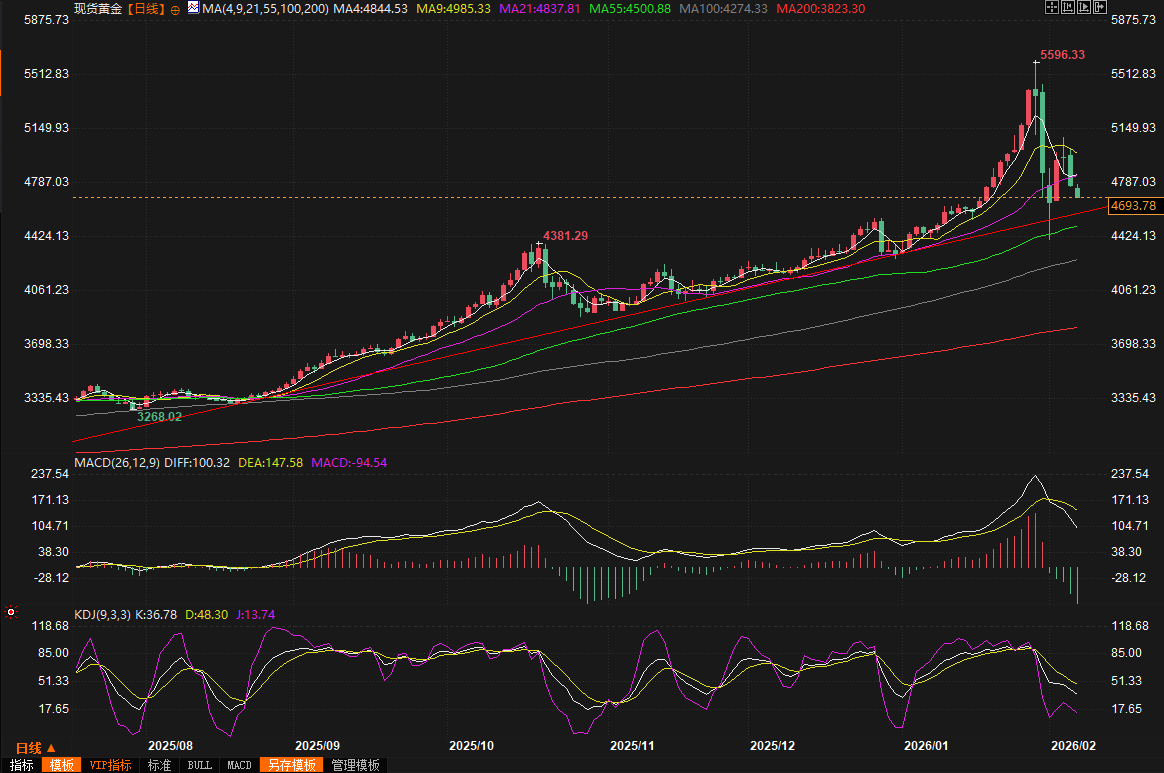
(Spot gold daily chart, source: FX678)
At 08:07 Beijing time, spot gold was trading at $4685.92 per ounce.
Gold and silver continued their decline in Asian trading on Friday (February 5). As of 08:07, spot gold had fallen as much as 1.84% to $4684.71 per ounce, a new low in nearly three trading days, with a cumulative drop of over 5% in the past two trading days. Spot silver also fell below the $70 mark, dropping as much as 8% to $64.73 per ounce, a new low since December 22. In the past two trading days, spot silver has cumulatively fallen by over 25%.
In just a few days, gold and silver prices have plummeted from historical highs. Is this a deep correction within a bull market, or the death knell for a trend reversal? Beneath the fog of panic permeating the market lies a complex interplay of factors: a strong rebound in the US dollar, a rapid de-escalation of geopolitical risks, a shift in overall market risk appetite, and a confluence of technical selling and leveraged liquidation. All of these factors erupted in a short period of time.
The US dollar's strong comeback has made it the biggest killer of gold.
The US dollar index surged this week, rising for several consecutive days, and on Thursday it approached the 98 mark, reaching a two-week high. A stronger dollar puts significant pressure on gold, which is priced in US dollars, as a strong dollar increases the cost of gold for holders of non-dollar currencies, thereby suppressing global physical demand and investment enthusiasm.
Meanwhile, the dollar's rebound also reflects a subtle shift in market expectations regarding the Federal Reserve's monetary policy. Despite recent weak US employment data—with initial jobless claims rising more than expected and job openings falling to a five-year low—the market seems more focused on persistently high inflation and the potentially hawkish tone of new Fed Chair nominee Kevin Warsh. Warsh is seen as a "prudent" figure who can maintain the Fed's independence and avoid excessive easing, leading investors to temporarily set aside their expectations of aggressive rate cuts and instead bet on the dollar maintaining its strength or at least remaining range-bound with a slight upward bias.
Against this backdrop, gold's appeal as a non-interest-bearing asset has clearly diminished. Historically, whenever the US dollar index has rebounded significantly, gold has often come under pressure. In this correction, the strength of the US dollar has become the most direct and primary driving factor, and many institutional traders have taken this opportunity to significantly reduce their long positions in precious metals.
The unexpected easing of geopolitical tensions caused safe-haven demand to evaporate instantly.
The surge in gold and silver prices in recent times was largely driven by escalating geopolitical risks. However, February brought a dramatic turn of events. The Russia-Ukraine conflict made substantial progress under US mediation: the two sides completed their second round of peace talks in Abu Dhabi, achieving a large-scale prisoner exchange (157 each, totaling 314) and agreeing to restart a new round of negotiations soon. Although core disputes such as the status of Donetsk and the Zaporizhia nuclear power plant remain unresolved, the market interpreted this as the first glimmer of peace, and risk aversion quickly subsided.
Meanwhile, negotiations on the US-Iran nuclear issue resumed in Oman. The Iranian Foreign Minister led a delegation to Muscat for indirect talks with the US. Although the two sides had significant differences on the scope of the negotiations (Iran insisted on only discussing the nuclear issue, while the US demanded the inclusion of ballistic missile issues), the White House emphasized that diplomacy was the preferred approach. The Trump administration has repeatedly stated its desire to achieve "zero nuclear capability" through negotiations, while simultaneously retaining the military option. This "talking while pressuring" approach has ironically led the market to believe that tensions are being absorbed through controlled diplomatic channels.
The rapid easing of geopolitical risks directly suppressed safe-haven buying of precious metals. Many investors began to take profits or cut their losses on safe-haven positions established at high levels, accelerating the downward spiral in prices.
The stock market crash and leveraged liquidation triggered a chain reaction.
Alongside precious metals, the US stock market also experienced a sharp correction. The S&P 500 and Nasdaq indices both fell to recent lows, with technology stocks suffering particularly heavy losses. Giants like Alphabet, Microsoft, and Amazon were pressured by anticipated increases in AI capital expenditures, with market concerns that these massive investments would be difficult to translate into profits in the short term and could even erode demand in the traditional software industry. The AI theme, which was the biggest driver last year, has now become a drag, triggering a significant rotation from growth stocks to value stocks.
In this environment of widespread declines in risky assets, many institutional investors are facing margin calls. Some hedge funds and leveraged traders have been forced to sell highly liquid assets, including gold and silver, to replenish their margin. This phenomenon of "forced liquidation" is particularly evident in the precious metals market, as silver, with its higher leverage and greater volatility, is the first to be sacrificed. Bob Haberkorn, senior strategist at RJO Futures, bluntly stated, "From a fundamental perspective, the market situation has not fundamentally changed, but some investors are forced to liquidate their metal positions due to losses in stocks."
Why did silver fall even more sharply? A double squeeze from both valuation and industrial attributes.
Silver's decline, nearly five times that of gold, is no coincidence. A JPMorgan report points out that silver's valuation was previously relatively high, making it more susceptible to "overcorrection" when safe-haven demand recedes. Silver possesses dual attributes as both a precious and industrial metal, with approximately half of its demand coming from industrial sectors such as solar energy, electronics, and automobiles. When global risk appetite declines and stock markets plummet, industrial demand expectations weaken in tandem, further amplifying the downward pressure on silver.
Despite the significant short-term pressure on silver, many institutions remain optimistic about its medium- to long-term prospects. JPMorgan Chase predicts that short-term support for silver may gradually move up to the $75-80 range, and it is expected to return to above $90 next year, due to the combined effect of industrial recovery potential and the precious metal's inherent properties.
Market Outlook: Opportunity or Trap After Sharp Fluctuations?
The gold and silver markets remain highly volatile. Analyst Fawad Razaqzada warns that such extreme market conditions won't recover overnight; the market needs time to digest them, often accompanied by further fluctuations or even downward movements. In the short term, if the US dollar continues to be strong and geopolitical negotiations progress positively, precious metals still risk testing lower support levels. However, from a medium- to long-term perspective, global uncertainties have not truly disappeared. Continued central bank gold purchases, the trend of de-dollarization, sticky inflation, and the uncertainty surrounding a potential soft landing for the economy all provide structural support for precious metals.
This sharp drop may be a deep pullback within a super bull market. For long-term investors, the decline actually provides a better window for positioning; for short-term traders, however, they should be wary of leverage risks and wait for clearer directional signals. The story of gold and silver is far from over; after the storm, even greater opportunities often lie hidden.
(Spot gold daily chart, source: FX678)
At 08:07 Beijing time, spot gold was trading at $4685.92 per ounce.
- Risk Warning and Disclaimer
- The market involves risk, and trading may not be suitable for all investors. This article is for reference only and does not constitute personal investment advice, nor does it take into account certain users’ specific investment objectives, financial situation, or other needs. Any investment decisions made based on this information are at your own risk.