De-escalating geopolitical tensions coupled with dampened bullish sentiment kept gold prices in a wide range of fluctuations.
2026-02-06 09:55:25
Gold prices weakened significantly during Friday's Asian session, with XAU/USD briefly dipping to around $4,680, continuing its previous pullback. Market sentiment shifted from strong safe-haven positioning to risk rebalancing, with some funds adjusting their positions amid heightened stock market volatility, putting pressure on gold prices.
The Chicago Mercantile Exchange (CME) recently raised the initial margin requirements for gold and silver futures contracts again, increasing the amount of capital traders need to open and maintain positions.
Market research shows that, under the combined effects of increased margin requirements and a decline in the technology sector, some traders were forced to close their long gold positions to cope with margin pressures on other assets, resulting in additional selling pressure on gold.
 Meanwhile, geopolitical safe-haven demand also showed signs of cooling. Iranian and US officials confirmed that they will hold talks in Oman on Friday. This news eased market concerns about a rapid escalation of the situation and diminished gold's appeal as a safe-haven asset.
Investors are closely watching the progress of negotiations to determine whether they will further impact the logic of safe-haven asset allocation. However, from a macro perspective, gold has not completely lost support. The US President's latest remarks regarding the Federal Reserve's personnel arrangements have once again sparked discussions in the market about the Fed's independence.
Some market participants interpreted these comments as a potential source of policy uncertainty, which could exert some downward pressure on the US dollar in the medium term, thereby supporting the price of gold denominated in US dollars. Furthermore, the preliminary reading of the University of Michigan Consumer Sentiment Index is about to be released, potentially providing new clues to the market's assessment of the economic outlook and inflation expectations.
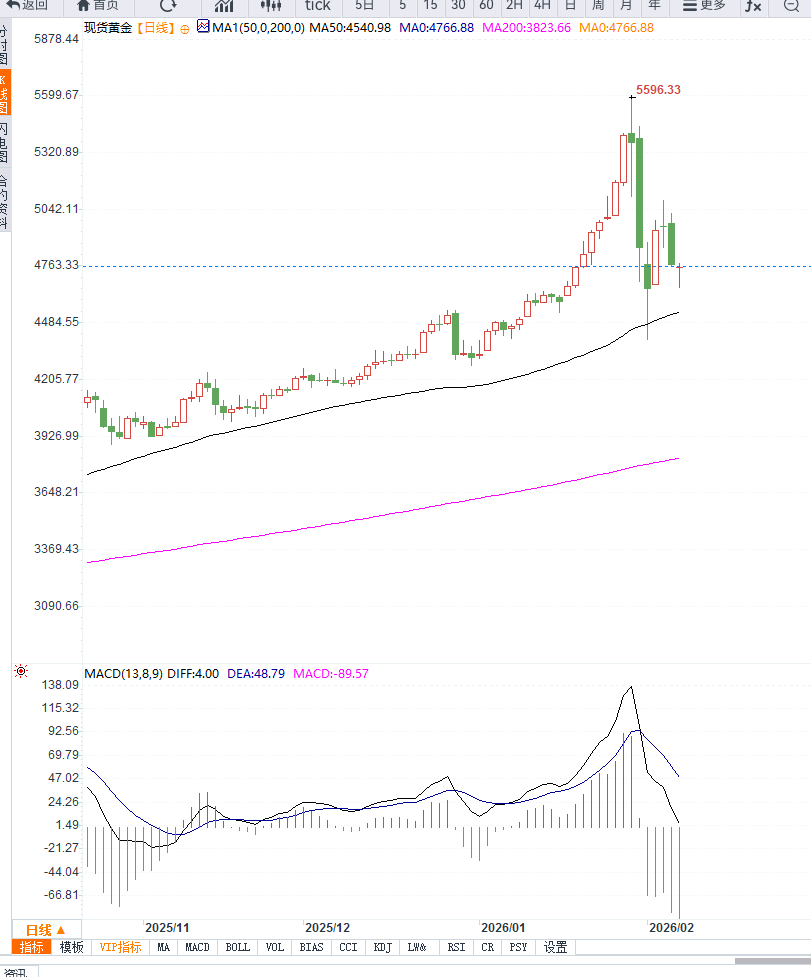
From a daily chart perspective, after a rapid rise and reaching new highs, gold has shown a clear pullback, indicating that bullish momentum is cooling in the short term. Having broken below the previous upward channel, the price has technically entered a correction phase.
The $4,680 level forms the first key support. If this level is breached, gold prices may retreat further to the $4,550-$4,580 range, which also corresponds to the previous consolidation platform and an important daily support zone.
Looking at the upside, the area around $4,800 forms the first significant resistance level. Only by regaining a foothold in this area can gold prices potentially retest $4,900 or even higher.
Overall, against the backdrop of declining margin pressure and safe-haven demand, gold's short-term trend is more likely to be characterized by high-level fluctuations and technical corrections, while the trend direction still awaits guidance from new macroeconomic or policy signals.
Editor's Note:
This round of gold price decline is more like a "cooling down" of high-level sentiment and technical factors, rather than a complete trend reversal. Margin increases and forced liquidations amplified short-term volatility, but did not fundamentally change the medium-term logic of gold.
Given the continued uncertainty surrounding the dollar's outlook and the lingering global risk events, gold is more likely to enter a period of wide-range fluctuations at high levels rather than a one-sided downward trend. The key to its future direction will still depend on changes in expectations regarding Federal Reserve policy and whether there are any substantial breakthroughs in geopolitical negotiations.
The Chicago Mercantile Exchange (CME) recently raised the initial margin requirements for gold and silver futures contracts again, increasing the amount of capital traders need to open and maintain positions.
Market research shows that, under the combined effects of increased margin requirements and a decline in the technology sector, some traders were forced to close their long gold positions to cope with margin pressures on other assets, resulting in additional selling pressure on gold.
Meanwhile, geopolitical safe-haven demand also showed signs of cooling. Iranian and US officials confirmed that they will hold talks in Oman on Friday. This news eased market concerns about a rapid escalation of the situation and diminished gold's appeal as a safe-haven asset.Investors are closely watching the progress of negotiations to determine whether they will further impact the logic of safe-haven asset allocation. However, from a macro perspective, gold has not completely lost support. The US President's latest remarks regarding the Federal Reserve's personnel arrangements have once again sparked discussions in the market about the Fed's independence.
Some market participants interpreted these comments as a potential source of policy uncertainty, which could exert some downward pressure on the US dollar in the medium term, thereby supporting the price of gold denominated in US dollars. Furthermore, the preliminary reading of the University of Michigan Consumer Sentiment Index is about to be released, potentially providing new clues to the market's assessment of the economic outlook and inflation expectations.
From a daily chart perspective, after a rapid rise and reaching new highs, gold has shown a clear pullback, indicating that bullish momentum is cooling in the short term. Having broken below the previous upward channel, the price has technically entered a correction phase.
The $4,680 level forms the first key support. If this level is breached, gold prices may retreat further to the $4,550-$4,580 range, which also corresponds to the previous consolidation platform and an important daily support zone.
Looking at the upside, the area around $4,800 forms the first significant resistance level. Only by regaining a foothold in this area can gold prices potentially retest $4,900 or even higher.
Overall, against the backdrop of declining margin pressure and safe-haven demand, gold's short-term trend is more likely to be characterized by high-level fluctuations and technical corrections, while the trend direction still awaits guidance from new macroeconomic or policy signals.
Editor's Note:
This round of gold price decline is more like a "cooling down" of high-level sentiment and technical factors, rather than a complete trend reversal. Margin increases and forced liquidations amplified short-term volatility, but did not fundamentally change the medium-term logic of gold.
Given the continued uncertainty surrounding the dollar's outlook and the lingering global risk events, gold is more likely to enter a period of wide-range fluctuations at high levels rather than a one-sided downward trend. The key to its future direction will still depend on changes in expectations regarding Federal Reserve policy and whether there are any substantial breakthroughs in geopolitical negotiations.
- Risk Warning and Disclaimer
- The market involves risk, and trading may not be suitable for all investors. This article is for reference only and does not constitute personal investment advice, nor does it take into account certain users’ specific investment objectives, financial situation, or other needs. Any investment decisions made based on this information are at your own risk.