Will the US dollar suddenly weaken and the British pound seize the opportunity to rebound? The outcome will depend on next week's non-farm payrolls.
2026-02-06 19:43:31
On Friday, February 6th, during the European session, the British pound saw a technical recovery against the US dollar after a sharp decline the previous day, trading around 1.3580. The previous day, the pound fell 0.8% against the dollar, hitting a two-week low, mainly due to a more dovish signal from the Bank of England than expected. Although interest rates remained unchanged at 3.75%, the vote was only 5-4, a narrow margin in favor of pausing rate hikes, far below the market's initial expectation of 7 members supporting holding rates steady. This divergence revealed significant disagreements among policymakers regarding the economic outlook and inflation trends, exacerbating market speculation about a rate cut in the near term.
In its statement, the Bank of England reiterated that interest rates are on a "gradual downward trajectory" and hinted that inflation may fall back to the 2% target sooner than expected last November. While this wording did not explicitly announce a timetable for rate cuts, it significantly reinforced market speculation that an easing cycle is imminent. Governor Bailey also did not confirm whether 3.25% was the final interest rate level, only stating that it neither significantly inhibits nor significantly stimulates the economy, further obscuring the future path. Lacking clear guidance, investors quickly adjusted their pricing models, significantly increasing the probability of near-term rate cuts, causing significant pressure on the pound.
On Friday, market focus shifted to a public speech by Bank of England Chief Economist David Peale, who will attend a briefing at 8:00 PM. As one of the five members who voted to keep interest rates unchanged on Thursday, his remarks are seen as a crucial window into the central bank's policy stance. The market is widely watching whether he will emphasize the sustainability of the decline in inflation or offer a more moderate assessment of wage growth and the easing of consumer demand pressures. If his comments continue the "gradual rate cut" tone, the current rebound in the pound is more likely to be seen as a technical correction after the decline; conversely, if he expresses caution regarding the pace of future rate cuts, it could temporarily boost confidence in the pound.
Meanwhile, the dollar's own performance also provided some breathing room for the pound. After a week of consecutive gains, the dollar index saw a slight pullback, falling 0.15% to around 97.80 on Friday. This change is closely related to a shift in market expectations regarding Federal Reserve policy. According to interest rate futures, the probability of the Fed cutting rates by 25 basis points to 3.25%-3.50% at its March meeting has risen to 22.7%, compared to only 9.4% at the beginning of the week. This increase stems from recent weak US employment data: job openings fell to 6.542 million in December, lower than the previous month's 6.928 million; private sector job growth in January was only 22,000, less than December's 37,000. These signals indicate a cooling labor market, strengthening market support for an earlier-than-expected Fed shift.
From a technical perspective, the pound rebounded after touching 1.3508 against the dollar, indicating a slight easing of short-term selling pressure. Currently, the price is trading around 1.3580, with short-term resistance concentrated in the 1.3600 area. If it fails to break through and hold above this level, this rebound is likely a technical correction rather than a trend reversal. Conversely, only a sustained upward move and a break above this level could open up further upside potential.
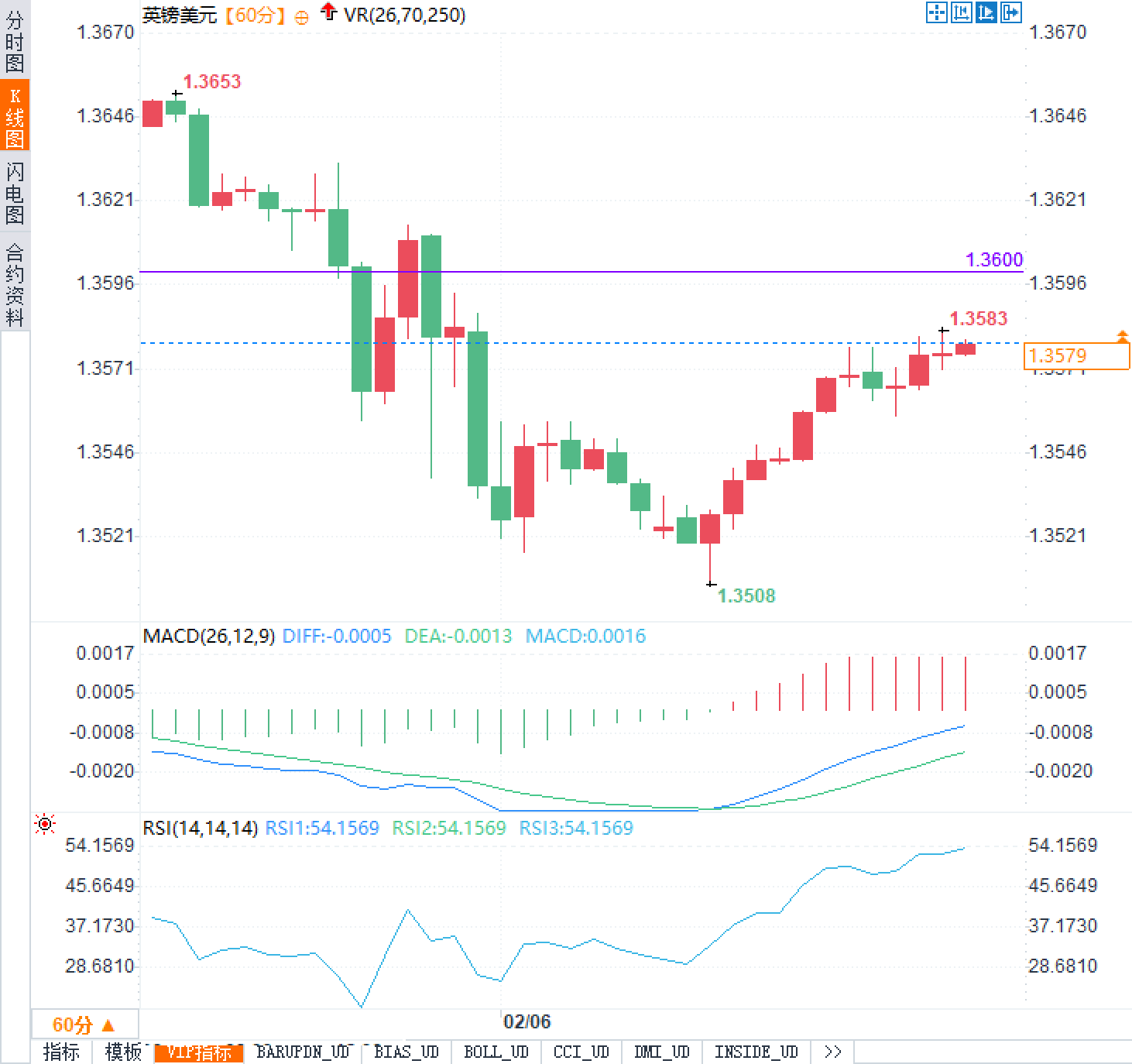
From a technical perspective, momentum on the 60-minute chart is improving. The MACD histogram shows signs of turning from weak to strong, and the RSI has rebounded to 54, indicating a recovery in buying power, but it has not yet entered overbought territory. This suggests that while market sentiment has improved, it remains in a wait-and-see phase. Regarding support levels, 1.3540 is an initial observation level; a break below this level could lead to a retest of the key psychological level of 1.3500. If this level is breached, the market may reprice the scenario of a "faster rate cut by the Bank of England," pushing the exchange rate to lower levels.
The British pound is currently caught in a fierce struggle between two forces. On the one hand, policy disagreements within the Bank of England and optimistic statements about declining inflation have fueled market expectations of a short-term interest rate cut, suppressing the pound's upside potential. On the other hand, the dollar has retreated due to weak US employment data and rising bets on interest rate cuts, objectively creating external conditions for a pound rebound. This "ebb and flow" situation makes it difficult for the exchange rate to form a one-sided trend in the short term.
Next, the market will closely watch the performance of the US non-farm payroll data, which will be released next Wednesday. If employment continues to weaken, it will further solidify expectations of a shift towards easing by the Federal Reserve, potentially putting continued pressure on the dollar and supporting the pound. However, if the data is unexpectedly strong, it could dampen expectations of interest rate cuts, push up the dollar, and in turn suppress any rebound in the pound. Therefore, before the release of this key data, a range-bound trading pattern between 1.3550 and 1.3650 remains a reasonable scenario.
In its statement, the Bank of England reiterated that interest rates are on a "gradual downward trajectory" and hinted that inflation may fall back to the 2% target sooner than expected last November. While this wording did not explicitly announce a timetable for rate cuts, it significantly reinforced market speculation that an easing cycle is imminent. Governor Bailey also did not confirm whether 3.25% was the final interest rate level, only stating that it neither significantly inhibits nor significantly stimulates the economy, further obscuring the future path. Lacking clear guidance, investors quickly adjusted their pricing models, significantly increasing the probability of near-term rate cuts, causing significant pressure on the pound.
Key speeches and data interplay: Market sentiment highly sensitive.
On Friday, market focus shifted to a public speech by Bank of England Chief Economist David Peale, who will attend a briefing at 8:00 PM. As one of the five members who voted to keep interest rates unchanged on Thursday, his remarks are seen as a crucial window into the central bank's policy stance. The market is widely watching whether he will emphasize the sustainability of the decline in inflation or offer a more moderate assessment of wage growth and the easing of consumer demand pressures. If his comments continue the "gradual rate cut" tone, the current rebound in the pound is more likely to be seen as a technical correction after the decline; conversely, if he expresses caution regarding the pace of future rate cuts, it could temporarily boost confidence in the pound.
Meanwhile, the dollar's own performance also provided some breathing room for the pound. After a week of consecutive gains, the dollar index saw a slight pullback, falling 0.15% to around 97.80 on Friday. This change is closely related to a shift in market expectations regarding Federal Reserve policy. According to interest rate futures, the probability of the Fed cutting rates by 25 basis points to 3.25%-3.50% at its March meeting has risen to 22.7%, compared to only 9.4% at the beginning of the week. This increase stems from recent weak US employment data: job openings fell to 6.542 million in December, lower than the previous month's 6.928 million; private sector job growth in January was only 22,000, less than December's 37,000. These signals indicate a cooling labor market, strengthening market support for an earlier-than-expected Fed shift.
Technical indicators show signs of stabilization, but significant resistance lies ahead.
From a technical perspective, the pound rebounded after touching 1.3508 against the dollar, indicating a slight easing of short-term selling pressure. Currently, the price is trading around 1.3580, with short-term resistance concentrated in the 1.3600 area. If it fails to break through and hold above this level, this rebound is likely a technical correction rather than a trend reversal. Conversely, only a sustained upward move and a break above this level could open up further upside potential.
From a technical perspective, momentum on the 60-minute chart is improving. The MACD histogram shows signs of turning from weak to strong, and the RSI has rebounded to 54, indicating a recovery in buying power, but it has not yet entered overbought territory. This suggests that while market sentiment has improved, it remains in a wait-and-see phase. Regarding support levels, 1.3540 is an initial observation level; a break below this level could lead to a retest of the key psychological level of 1.3500. If this level is breached, the market may reprice the scenario of a "faster rate cut by the Bank of England," pushing the exchange rate to lower levels.
Two conflicting logics suggest that volatility may become the dominant theme.
The British pound is currently caught in a fierce struggle between two forces. On the one hand, policy disagreements within the Bank of England and optimistic statements about declining inflation have fueled market expectations of a short-term interest rate cut, suppressing the pound's upside potential. On the other hand, the dollar has retreated due to weak US employment data and rising bets on interest rate cuts, objectively creating external conditions for a pound rebound. This "ebb and flow" situation makes it difficult for the exchange rate to form a one-sided trend in the short term.
Next, the market will closely watch the performance of the US non-farm payroll data, which will be released next Wednesday. If employment continues to weaken, it will further solidify expectations of a shift towards easing by the Federal Reserve, potentially putting continued pressure on the dollar and supporting the pound. However, if the data is unexpectedly strong, it could dampen expectations of interest rate cuts, push up the dollar, and in turn suppress any rebound in the pound. Therefore, before the release of this key data, a range-bound trading pattern between 1.3550 and 1.3650 remains a reasonable scenario.
- Risk Warning and Disclaimer
- The market involves risk, and trading may not be suitable for all investors. This article is for reference only and does not constitute personal investment advice, nor does it take into account certain users’ specific investment objectives, financial situation, or other needs. Any investment decisions made based on this information are at your own risk.