On the eve of a "Seven Sigma" crash: Silver surges parabolically, YOLO gamblers outperform Wall Street veterans.
2026-02-10 09:47:23
The recent extreme volatility in global financial markets, described by industry insiders as a rare "Seven Sigma event" of unprecedented scale and speed, allowed short-term speculators to capitalize on the opportunity, achieving astonishing wealth gains through strategies similar to cryptocurrency trading, even surpassing the returns of many experienced commodity traders. Daniel Pavilonis, senior commodities broker at RJO Futures, provides an in-depth analysis of this phenomenon in an interview, revealing a stark contrast between traditional "smart money" and emerging "YOLO (You Only Live Once) traders," and how market dynamics can shift dramatically in such extreme conditions. This event not only highlights the unpredictability of the precious metals market but also offers valuable lessons for investors, reminding them to carefully manage risk when pursuing high returns.

Silver prices recently surged to over $120 per ounce in a short period, a phenomenon described by Pavilonis as a "six-sigma to seven-sigma level event," almost unprecedented in historical records. From a professional trader's perspective, such extreme volatility is completely beyond conventional expectations and is unbelievable.
Similar to the frenzy in the cryptocurrency market, many new entrants firmly believed that silver prices would rise indefinitely, driving a massive influx of funds into the precious metals sector. This flow of funds not only accelerated the price increase but also altered the overall market structure, making short-term speculation the dominant force. Pavilonis points out that this phenomenon stems from investors' renewed perception of precious metals, viewing silver as a high-growth asset rather than a traditional, slowly appreciating instrument, thus triggering this unprecedented parabolic price movement.
Among the client accounts managed by Pavilonis, there is a stark contrast between seasoned commodity traders and newcomers transitioning from the cryptocurrency space. The former typically employ cautious strategies, focusing on risk control and long-term returns, while the latter enter the market with a bold "YOLO" mentality (meaning "you only live once," emphasizing going all in). While the experienced traders have also profited from this market move, their position sizes are relatively small, as they gradually reduce their holdings according to pre-set targets to avoid excessive risk exposure.
In contrast, emerging speculators often buy deeply out-of-the-money options, such as a call option with a strike price of $100 when silver was only $39. These options were bought at extremely low prices but yielded astronomical returns when prices skyrocketed. Pavilonis illustrates how some people invested as little as $20,000 in such options and eventually turned it into a staggering $5 million in profits—a return far exceeding the expectations of traditional traders. This contrast reflects not only the scale of profits but also the clash of two mindsets: one seeking stability, the other betting on the possibility of extreme price increases.
This surge was not an isolated event, but the result of a confluence of factors. Pavilonis's analysis suggests that the influx of new traders altered the market's supply and demand dynamics. Their buying activity propelled prices rapidly away from rational levels, while seasoned traders gradually sold off during the price increase, further providing liquidity for speculators. This interaction created an unusual market cycle: traditional "smart money" reduced their positions when prices exceeded expectations, effectively transferring their holdings to speculators who firmly believed in "going to the moon."
Meanwhile, Pavilonis noted that the historical pattern in the precious metals market is typically a slow, gradual rise, as seen in gold's performance over the past few years. However, silver's recent parabolic surge has broken this pattern, possibly due to global economic uncertainty, inflation expectations, and the spillover of cryptocurrency funds. Furthermore, as prices climbed above $70, many professional trading desks shifted to options trading rather than futures to manage increasing uncertainty, further amplifying the influence of speculators.
On the other hand, there was a sharp drop on January 30th, a correction that was equally dramatic. Pavilonis speculated that this might have involved large short positions held by major banks, who may have exacerbated the decline by shorting.
However, he also cautiously noted that this claim might just be one of the banks' strategies, perhaps using it to buy more silver at a low price in order to drive up prices further in the future.
Regardless of the truth, this plunge exposed the market's fragility: while speculators profit handsomely during rallies, they often give back significant profits during periods of high volatility. Pavilonis emphasizes that experienced traders in such situations employ profit-taking and risk mitigation measures, such as gradually reducing their positions from full to a quarter, but this sometimes limits their maximum potential gains because they cannot predict the peak price.
In contrast, YOLO traders captured more opportunities during extreme market conditions by continuously adding to their positions in deep out-of-the-money options (such as those with strike prices of $130 or $150), although they also eventually faced the risk of a pullback.
The silver price surge ultimately ended with a correction, but its lessons are profound and enduring. It not only demonstrates the strengths and weaknesses of different market participants' strategies but also reminds investors that while extreme market conditions can create miraculous wealth, they are accompanied by immense uncertainty. Whether seasoned professionals or novice speculators, everyone must balance risk and opportunity when pursuing returns. Pavilonis' analysis suggests that although YOLO traders outperformed many industry veterans in this event, long-term sustainable success still depends on rigorous risk management. This event may herald a new era of greater volatility in the precious metals market, and investors should learn from this and proceed with caution.
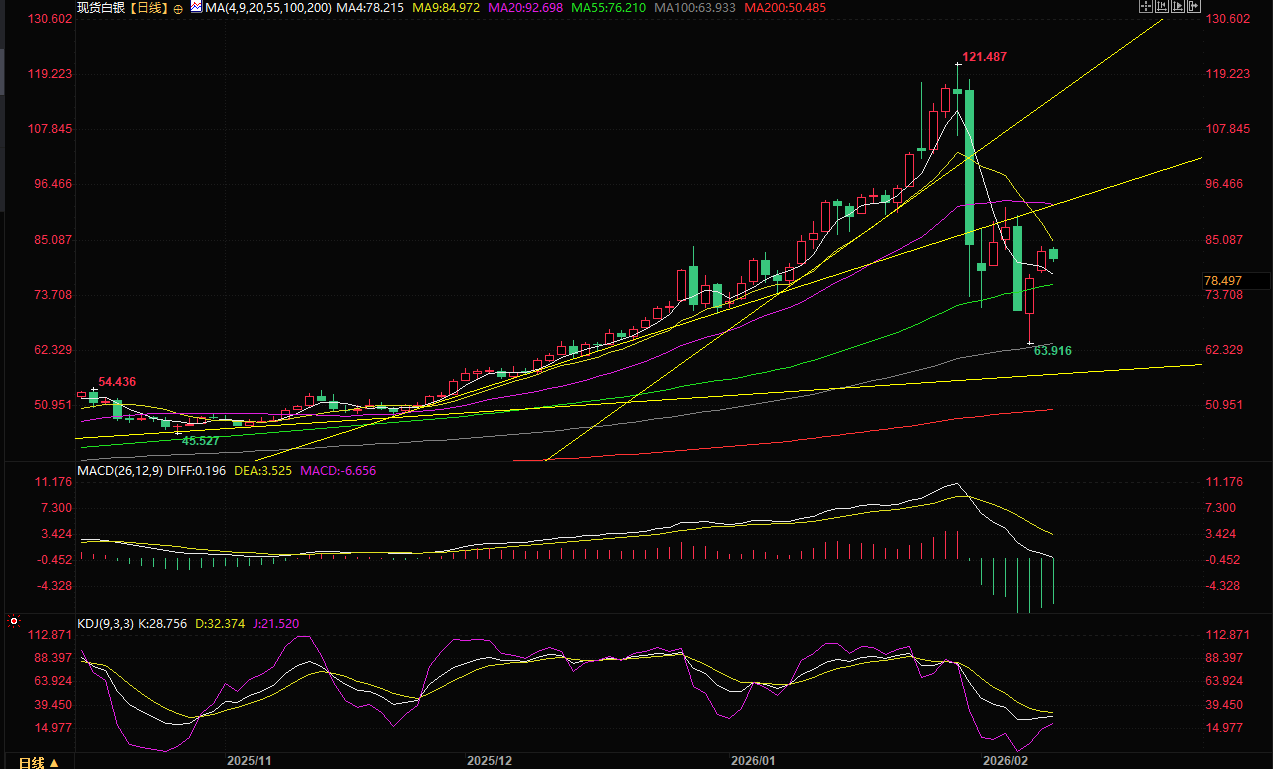
(Spot silver daily chart, source: EasyForex)
At 09:45 Beijing time, spot silver was trading at $81.58 per ounce.
The parabolic surge in silver prices: a rare market anomaly
Silver prices recently surged to over $120 per ounce in a short period, a phenomenon described by Pavilonis as a "six-sigma to seven-sigma level event," almost unprecedented in historical records. From a professional trader's perspective, such extreme volatility is completely beyond conventional expectations and is unbelievable.
Similar to the frenzy in the cryptocurrency market, many new entrants firmly believed that silver prices would rise indefinitely, driving a massive influx of funds into the precious metals sector. This flow of funds not only accelerated the price increase but also altered the overall market structure, making short-term speculation the dominant force. Pavilonis points out that this phenomenon stems from investors' renewed perception of precious metals, viewing silver as a high-growth asset rather than a traditional, slowly appreciating instrument, thus triggering this unprecedented parabolic price movement.
A stark contrast between traditional traders and emerging speculators
Among the client accounts managed by Pavilonis, there is a stark contrast between seasoned commodity traders and newcomers transitioning from the cryptocurrency space. The former typically employ cautious strategies, focusing on risk control and long-term returns, while the latter enter the market with a bold "YOLO" mentality (meaning "you only live once," emphasizing going all in). While the experienced traders have also profited from this market move, their position sizes are relatively small, as they gradually reduce their holdings according to pre-set targets to avoid excessive risk exposure.
In contrast, emerging speculators often buy deeply out-of-the-money options, such as a call option with a strike price of $100 when silver was only $39. These options were bought at extremely low prices but yielded astronomical returns when prices skyrocketed. Pavilonis illustrates how some people invested as little as $20,000 in such options and eventually turned it into a staggering $5 million in profits—a return far exceeding the expectations of traditional traders. This contrast reflects not only the scale of profits but also the clash of two mindsets: one seeking stability, the other betting on the possibility of extreme price increases.
The driving factors and market interactions behind the surge
This surge was not an isolated event, but the result of a confluence of factors. Pavilonis's analysis suggests that the influx of new traders altered the market's supply and demand dynamics. Their buying activity propelled prices rapidly away from rational levels, while seasoned traders gradually sold off during the price increase, further providing liquidity for speculators. This interaction created an unusual market cycle: traditional "smart money" reduced their positions when prices exceeded expectations, effectively transferring their holdings to speculators who firmly believed in "going to the moon."
Meanwhile, Pavilonis noted that the historical pattern in the precious metals market is typically a slow, gradual rise, as seen in gold's performance over the past few years. However, silver's recent parabolic surge has broken this pattern, possibly due to global economic uncertainty, inflation expectations, and the spillover of cryptocurrency funds. Furthermore, as prices climbed above $70, many professional trading desks shifted to options trading rather than futures to manage increasing uncertainty, further amplifying the influence of speculators.
Causes of the plunge and the potential forces behind it
On the other hand, there was a sharp drop on January 30th, a correction that was equally dramatic. Pavilonis speculated that this might have involved large short positions held by major banks, who may have exacerbated the decline by shorting.
However, he also cautiously noted that this claim might just be one of the banks' strategies, perhaps using it to buy more silver at a low price in order to drive up prices further in the future.
Regardless of the truth, this plunge exposed the market's fragility: while speculators profit handsomely during rallies, they often give back significant profits during periods of high volatility. Pavilonis emphasizes that experienced traders in such situations employ profit-taking and risk mitigation measures, such as gradually reducing their positions from full to a quarter, but this sometimes limits their maximum potential gains because they cannot predict the peak price.
In contrast, YOLO traders captured more opportunities during extreme market conditions by continuously adding to their positions in deep out-of-the-money options (such as those with strike prices of $130 or $150), although they also eventually faced the risk of a pullback.
The silver price surge ultimately ended with a correction, but its lessons are profound and enduring. It not only demonstrates the strengths and weaknesses of different market participants' strategies but also reminds investors that while extreme market conditions can create miraculous wealth, they are accompanied by immense uncertainty. Whether seasoned professionals or novice speculators, everyone must balance risk and opportunity when pursuing returns. Pavilonis' analysis suggests that although YOLO traders outperformed many industry veterans in this event, long-term sustainable success still depends on rigorous risk management. This event may herald a new era of greater volatility in the precious metals market, and investors should learn from this and proceed with caution.
(Spot silver daily chart, source: EasyForex)
At 09:45 Beijing time, spot silver was trading at $81.58 per ounce.
- Risk Warning and Disclaimer
- The market involves risk, and trading may not be suitable for all investors. This article is for reference only and does not constitute personal investment advice, nor does it take into account certain users’ specific investment objectives, financial situation, or other needs. Any investment decisions made based on this information are at your own risk.