Gold Trading Alert: Is the $5,000 Level Strong Support or a Major Trap? Non-Farm Payrolls Lead Three Major Storms Ahead.
2026-02-11 08:08:38
International gold prices retreated slightly from their highs, with spot gold closing down 0.7% at $5,023 per ounce on Tuesday (February 10), briefly triggering investor concerns. However, behind this seemingly mild pullback lies a turbulent undercurrent. Ahead of key US employment and inflation data releases, the market is experiencing a brewing "data storm." Simultaneously, escalating geopolitical tensions, a weakening dollar, and expectations of interest rate cuts are intertwined, painting a complex and opportunity-filled picture for gold investment. Is the short-term volatility in gold a healthy consolidation within an uptrend, or a harbinger of a trend reversal? In early Asian trading on Wednesday (February 11), spot gold fluctuated slightly higher, currently trading around $5,040 per ounce. The focus for today's trading session is on the US non-farm payroll report.
The current market calm is precisely the calm before the storm. Tuesday's decline in gold prices was essentially an "event-driven" consolidation. David Meger, head of metals trading at High Ridge Futures, astutely pointed out, this is a natural market reaction ahead of a flurry of key economic data releases. Investors tend to lock in some profits or temporarily step aside to observe the market in the face of uncertainty, putting downward pressure on gold prices.
This week's core focus is undoubtedly on two "data bombs": Wednesday's US January non-farm payrolls report and Friday's January Consumer Price Index (CPI). A Reuters poll shows economists expect only 70,000 new jobs added; if the data meets or falls short of expectations, it will reinforce the narrative of a US economic slowdown. Previously, disappointing December retail sales data (unexpectedly flat) had already cast a shadow over the economic outlook. These data will provide crucial guidance for the Federal Reserve's interest rate policy path. Traders have already priced in two rate cuts this year, and rate cuts reduce the opportunity cost of holding non-yielding assets like gold, thus forming one of the core supporting factors for gold prices. Therefore, the current pullback is not a sign of a downtrend, but rather more like the bulls accumulating energy for the next offensive.
Despite short-term volatility, the fundamental factors supporting the long-term upward trend of gold have remained unshaken, and have even strengthened. Firstly, a weaker US dollar acts as a "headwind barrier" for gold. On Tuesday, due to weak US retail sales data, the dollar weakened against a basket of currencies, with the dollar index falling to a new low since January 30. Shaun Osborne, a strategist at Scotiabank, pointed out that this reflects investors shifting from dollar assets to hedge against US risks. A weaker dollar makes dollar-denominated gold cheaper for overseas buyers, boosting demand.
Secondly, signals from the bond market also favored gold. U.S. Treasury yields fell across the board on Tuesday, with the 10-year Treasury yield dropping to 4.147%, marking its biggest four-day decline in months. This was driven by heightened market concerns about slowing economic growth and rising expectations of a Federal Reserve rate cut. The decline in bond yields increased the relative attractiveness of gold.
Finally, and most importantly, is the continued injection of geopolitical "safe-haven premium." The US-Iran tensions have once again become a focal point. US President Trump not only hinted at potentially sending a second aircraft carrier to the Middle East to pressure Iran into an agreement, but also stated that he would take "very tough measures" if negotiations failed. Any escalation of the Middle East situation instantly ignites market risk aversion, driving funds into gold. Meanwhile, the Russia-Ukraine conflict is far from over, and the EU is actively preparing a new list of concessions to Russia, attempting to gain more initiative in peace negotiations. The ongoing conflict and uncertainty provide solid support for gold prices. As Meger stated, geopolitical tensions and expectations of interest rate cuts, along with the psychological level of $5,000, together constitute important support for gold prices.
This week will see the initial direction of the gold market. The non-farm payroll data will be the first litmus test. If the data is significantly weaker than expected, market bets on an economic recession and faster rate cuts by the Federal Reserve will surge, potentially pushing gold prices quickly back up and challenge higher resistance levels. Conversely, if the job market performs unexpectedly strongly, it may temporarily dampen expectations of rate cuts, putting downward pressure on gold prices, but the decline is expected to be limited due to safe-haven demand.
The subsequent US CPI inflation data is even more crucial, as it directly relates to the effectiveness of the Federal Reserve's efforts to combat inflation. If inflation data continues to show stubbornness, it could shake market confidence in the timing and magnitude of interest rate cuts, leading to a rebound in the dollar and US Treasury yields, thus putting pressure on gold. However, if inflation continues to decline steadily, it will solidify the prospect of interest rate cuts, clearing a major obstacle to rising gold prices.
Furthermore, the sharp fluctuations in silver prices are also noteworthy. Spot silver fell 3% on Tuesday, after surging nearly 7% in the previous trading day. Standard Chartered Bank pointed out that fund flows in silver exchange-traded products exacerbated short-term volatility, but the fundamental issue of insufficient supply suggests potential for a rebound in the medium to long term. Changes in the gold-silver ratio may also provide further insight into gold price movements.
In conclusion, the recent pullback in gold prices is a typical technical consolidation ahead of a major risk event, rather than the end of the bull market. The three pillars supporting gold—a weak dollar, expectations of interest rate cuts, and geopolitical risks—remain solid, and may even have strengthened. The psychological level of $5,000/ounce is both a focal point of contention between bulls and bears and could potentially become a strong support for a new round of upward movement.
For investors, the current market environment presents both opportunities and risks. The key lies in understanding the "expectation gap": the difference between market expectations and the actual data released. Whether it's non-farm payrolls or CPI, if the results are more dovish than the market anticipates (i.e., more supportive of interest rate cuts), gold prices are likely to experience a surge. Conversely, if the data is unexpectedly hawkish, gold prices may face a short-term correction, but against the backdrop of high global uncertainty, any deep pullback could become a valuable window for medium- to long-term investment.
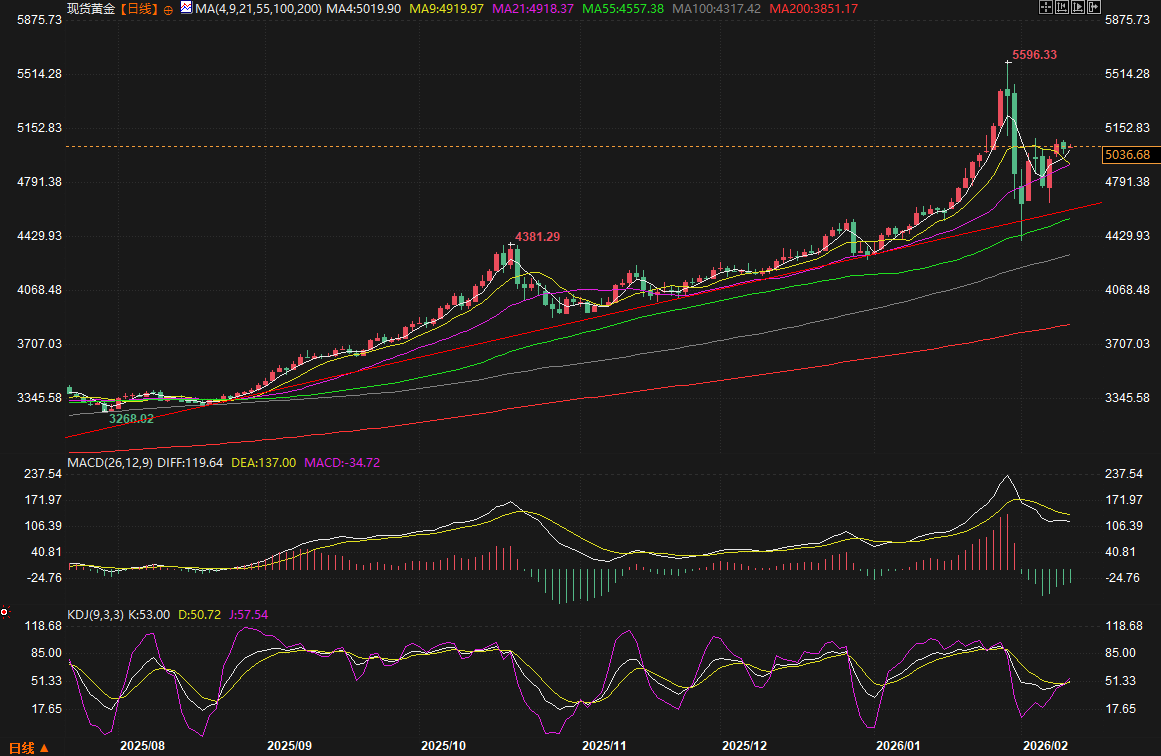
(Spot gold daily chart, source: FX678)
At 08:06 Beijing time, spot gold was trading at $5038.82 per ounce.
The calm before the data storm: What's causing the technical pullback in gold prices?
The current market calm is precisely the calm before the storm. Tuesday's decline in gold prices was essentially an "event-driven" consolidation. David Meger, head of metals trading at High Ridge Futures, astutely pointed out, this is a natural market reaction ahead of a flurry of key economic data releases. Investors tend to lock in some profits or temporarily step aside to observe the market in the face of uncertainty, putting downward pressure on gold prices.
This week's core focus is undoubtedly on two "data bombs": Wednesday's US January non-farm payrolls report and Friday's January Consumer Price Index (CPI). A Reuters poll shows economists expect only 70,000 new jobs added; if the data meets or falls short of expectations, it will reinforce the narrative of a US economic slowdown. Previously, disappointing December retail sales data (unexpectedly flat) had already cast a shadow over the economic outlook. These data will provide crucial guidance for the Federal Reserve's interest rate policy path. Traders have already priced in two rate cuts this year, and rate cuts reduce the opportunity cost of holding non-yielding assets like gold, thus forming one of the core supporting factors for gold prices. Therefore, the current pullback is not a sign of a downtrend, but rather more like the bulls accumulating energy for the next offensive.
Multiple forces at play: The "three pillars" supporting gold prices remain solid.
Despite short-term volatility, the fundamental factors supporting the long-term upward trend of gold have remained unshaken, and have even strengthened. Firstly, a weaker US dollar acts as a "headwind barrier" for gold. On Tuesday, due to weak US retail sales data, the dollar weakened against a basket of currencies, with the dollar index falling to a new low since January 30. Shaun Osborne, a strategist at Scotiabank, pointed out that this reflects investors shifting from dollar assets to hedge against US risks. A weaker dollar makes dollar-denominated gold cheaper for overseas buyers, boosting demand.
Secondly, signals from the bond market also favored gold. U.S. Treasury yields fell across the board on Tuesday, with the 10-year Treasury yield dropping to 4.147%, marking its biggest four-day decline in months. This was driven by heightened market concerns about slowing economic growth and rising expectations of a Federal Reserve rate cut. The decline in bond yields increased the relative attractiveness of gold.
Finally, and most importantly, is the continued injection of geopolitical "safe-haven premium." The US-Iran tensions have once again become a focal point. US President Trump not only hinted at potentially sending a second aircraft carrier to the Middle East to pressure Iran into an agreement, but also stated that he would take "very tough measures" if negotiations failed. Any escalation of the Middle East situation instantly ignites market risk aversion, driving funds into gold. Meanwhile, the Russia-Ukraine conflict is far from over, and the EU is actively preparing a new list of concessions to Russia, attempting to gain more initiative in peace negotiations. The ongoing conflict and uncertainty provide solid support for gold prices. As Meger stated, geopolitical tensions and expectations of interest rate cuts, along with the psychological level of $5,000, together constitute important support for gold prices.
Eye of the storm: How will key data define the next move for gold?
This week will see the initial direction of the gold market. The non-farm payroll data will be the first litmus test. If the data is significantly weaker than expected, market bets on an economic recession and faster rate cuts by the Federal Reserve will surge, potentially pushing gold prices quickly back up and challenge higher resistance levels. Conversely, if the job market performs unexpectedly strongly, it may temporarily dampen expectations of rate cuts, putting downward pressure on gold prices, but the decline is expected to be limited due to safe-haven demand.
The subsequent US CPI inflation data is even more crucial, as it directly relates to the effectiveness of the Federal Reserve's efforts to combat inflation. If inflation data continues to show stubbornness, it could shake market confidence in the timing and magnitude of interest rate cuts, leading to a rebound in the dollar and US Treasury yields, thus putting pressure on gold. However, if inflation continues to decline steadily, it will solidify the prospect of interest rate cuts, clearing a major obstacle to rising gold prices.
Furthermore, the sharp fluctuations in silver prices are also noteworthy. Spot silver fell 3% on Tuesday, after surging nearly 7% in the previous trading day. Standard Chartered Bank pointed out that fund flows in silver exchange-traded products exacerbated short-term volatility, but the fundamental issue of insufficient supply suggests potential for a rebound in the medium to long term. Changes in the gold-silver ratio may also provide further insight into gold price movements.
Overview: Pullbacks may present good buying opportunities; the key to understanding trends lies in the "expectation gap."
In conclusion, the recent pullback in gold prices is a typical technical consolidation ahead of a major risk event, rather than the end of the bull market. The three pillars supporting gold—a weak dollar, expectations of interest rate cuts, and geopolitical risks—remain solid, and may even have strengthened. The psychological level of $5,000/ounce is both a focal point of contention between bulls and bears and could potentially become a strong support for a new round of upward movement.
For investors, the current market environment presents both opportunities and risks. The key lies in understanding the "expectation gap": the difference between market expectations and the actual data released. Whether it's non-farm payrolls or CPI, if the results are more dovish than the market anticipates (i.e., more supportive of interest rate cuts), gold prices are likely to experience a surge. Conversely, if the data is unexpectedly hawkish, gold prices may face a short-term correction, but against the backdrop of high global uncertainty, any deep pullback could become a valuable window for medium- to long-term investment.
(Spot gold daily chart, source: FX678)
At 08:06 Beijing time, spot gold was trading at $5038.82 per ounce.
- Risk Warning and Disclaimer
- The market involves risk, and trading may not be suitable for all investors. This article is for reference only and does not constitute personal investment advice, nor does it take into account certain users’ specific investment objectives, financial situation, or other needs. Any investment decisions made based on this information are at your own risk.