If Warsh were to lead the Federal Reserve: would he tighten monetary policy, or be forced to adopt a dovish stance? The answer might surprise you.
2026-02-10 09:50:49
US President Trump's nomination of former Federal Reserve Governor Kevin Warsh as the next Federal Reserve Chairman has once again drawn market attention back to the direction of monetary policy. The core question on investors' minds is: will Warsh, long considered a hawk, continue his hardline anti-inflation stance, or will he shift to a more dovish, accommodative policy due to the political climate?
However, the answer may be far less extreme. External pressures could very well make Walsh's performance more "normal" than the market expected .
During his tenure as a Federal Reserve governor from 2006 to 2011, Warsh was known for his strong concerns about inflation . Even when unemployment doubled during the 2009 recession, he prioritized price stability. He ultimately resigned in early 2011 due to his dissatisfaction with the continuation of massive monetary stimulus following the crisis. After leaving the Fed, he continued to criticize the Fed's overreaching role in the economy and financial markets, advocating for a return to its traditional functions.
In recent years, some commentators have suggested that Warsh's stance fluctuates with the political cycle: he leans more dovish during Republican administrations and more hawkish during Democratic administrations . However, these "dovish" pronouncements mostly appear in public commentary rather than in actual decision-making positions. Even his recent calls for interest rate cuts emphasized the need to offset this by reducing the Fed's balance sheet to avoid excessively loose financial conditions.
The power of the Federal Reserve Chair is not absolute; the direction of policy is highly dependent on the consensus formed by the Federal Open Market Committee (FOMC). Individual governors may maintain their own hawkish stances, but the Chair is accountable for the Fed's dual mandate —promoting full employment and maintaining price stability. Institutional inertia tends to shape leaders, not the other way around.
Therefore, after Warsh takes over as chairman, monetary policy is likely to remain fairly conventional : the way it responds to economic growth and inflation data will be largely consistent with the traditional path of the Federal Reserve over the past few decades, rather than suddenly shifting dramatically in terms of interest rate path, dollar index trend or inflation expectations due to a change in chairman.
Warsh shares similar views with current U.S. Treasury Secretary Scott Bessant, both advocating that the Federal Reserve should reduce its "footprint" in the economy and markets, with the primary means being accelerated balance sheet reduction. However, interest rates and balance sheets are not entirely interchangeable tools. Attempting to offset interest rate cuts with balance sheet reduction would not only weaken the policy effectiveness of both but could also send conflicting signals to the market.
Quantitative easing (QE) is most effective under market pressure or deflationary risks; conversely, quantitative tightening (QT) has a more marginal and unpredictable impact in normal market conditions. If implemented too aggressively, it could deplete the banking system's reserves, disrupt the short-term financing market, and trigger volatility.
The simultaneous implementation of interest rate cuts and balance sheet reduction is mismatched not only in the direction of their impact on financial conditions but also in the time frame. Any substantial balance sheet reduction requires a gradual approach and coordination with the Treasury Department, which will objectively limit the speed and magnitude of the Federal Reserve's interest rate cuts.
More problematic is that quantitative tightening involves selling mortgage-backed securities (MBS), which will drive up mortgage rates and harm housing affordability—a key policy priority for the Trump administration. Meanwhile, with foreign demand for U.S. Treasuries already weakening, rapid quantitative tightening could push up long-term yields, thereby dampening economic growth and threatening financial stability .
Warsh also mentioned AI-driven productivity gains, arguing that this could alleviate future inflationary pressures and justify interest rate cuts. However, the correct meaning of productivity gains is quite the opposite: the economy can withstand higher real borrowing costs without stalling, and higher potential growth rates point to a higher neutral interest rate, rather than a prolonged low-interest-rate environment.
Relying on long-term factors (such as productivity gains and small balance sheets) to justify short-term easing is unlikely to convince other voting members of the FOMC and is also unlikely to gain market approval.
For investors, Warsh's nomination itself will not significantly alter the current balance of macroeconomic risks. The core forces driving the market have already begun to move, and remaining patient rather than hastily adjusting positions remains the rational choice.
If the Federal Reserve's independence is substantially eroded —for example, by policy clearly yielding to political pressure—it will weaken the credibility of its inflation target, negatively impacting the stock market, bond market, and the dollar . Warning signs won't first come from headlines, but from the markets themselves. Investors should closely monitor long-term inflation expectations indicators, such as 5-year/5-year forward CPI swaps.
Regardless of who leads the Federal Reserve, in the new environment where inflationary shocks may be greater and more frequent, allocating to real assets (including commodities, inflation-linked bonds, and real estate) remains an important means of diversifying risk.
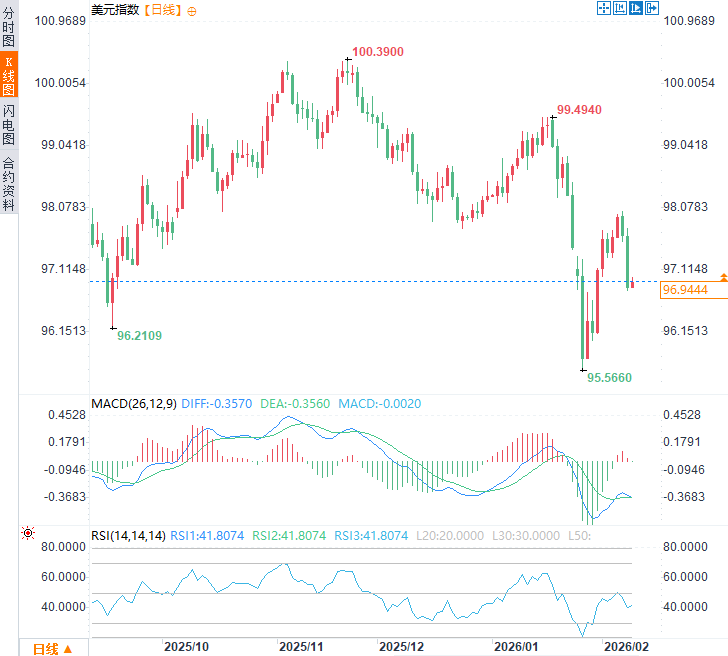
(US Dollar Index Daily Chart, Source: FX678)
At 9:50 AM Beijing time, the US dollar index is currently at 96.90.
However, the answer may be far less extreme. External pressures could very well make Walsh's performance more "normal" than the market expected .
Walsh's hawkish background and recent shift in stance
During his tenure as a Federal Reserve governor from 2006 to 2011, Warsh was known for his strong concerns about inflation . Even when unemployment doubled during the 2009 recession, he prioritized price stability. He ultimately resigned in early 2011 due to his dissatisfaction with the continuation of massive monetary stimulus following the crisis. After leaving the Fed, he continued to criticize the Fed's overreaching role in the economy and financial markets, advocating for a return to its traditional functions.
In recent years, some commentators have suggested that Warsh's stance fluctuates with the political cycle: he leans more dovish during Republican administrations and more hawkish during Democratic administrations . However, these "dovish" pronouncements mostly appear in public commentary rather than in actual decision-making positions. Even his recent calls for interest rate cuts emphasized the need to offset this by reducing the Fed's balance sheet to avoid excessively loose financial conditions.
Institutional inertia outweighs individual style: It's difficult for a chairman to become unconventional.
The power of the Federal Reserve Chair is not absolute; the direction of policy is highly dependent on the consensus formed by the Federal Open Market Committee (FOMC). Individual governors may maintain their own hawkish stances, but the Chair is accountable for the Fed's dual mandate —promoting full employment and maintaining price stability. Institutional inertia tends to shape leaders, not the other way around.
Therefore, after Warsh takes over as chairman, monetary policy is likely to remain fairly conventional : the way it responds to economic growth and inflation data will be largely consistent with the traditional path of the Federal Reserve over the past few decades, rather than suddenly shifting dramatically in terms of interest rate path, dollar index trend or inflation expectations due to a change in chairman.
Simultaneous Interest Rate Cuts and Balance Sheet Reduction: The Inherent Contradictions of Policy Tools
Warsh shares similar views with current U.S. Treasury Secretary Scott Bessant, both advocating that the Federal Reserve should reduce its "footprint" in the economy and markets, with the primary means being accelerated balance sheet reduction. However, interest rates and balance sheets are not entirely interchangeable tools. Attempting to offset interest rate cuts with balance sheet reduction would not only weaken the policy effectiveness of both but could also send conflicting signals to the market.
Quantitative easing (QE) is most effective under market pressure or deflationary risks; conversely, quantitative tightening (QT) has a more marginal and unpredictable impact in normal market conditions. If implemented too aggressively, it could deplete the banking system's reserves, disrupt the short-term financing market, and trigger volatility.
The simultaneous implementation of interest rate cuts and balance sheet reduction is mismatched not only in the direction of their impact on financial conditions but also in the time frame. Any substantial balance sheet reduction requires a gradual approach and coordination with the Treasury Department, which will objectively limit the speed and magnitude of the Federal Reserve's interest rate cuts.
More problematic is that quantitative tightening involves selling mortgage-backed securities (MBS), which will drive up mortgage rates and harm housing affordability—a key policy priority for the Trump administration. Meanwhile, with foreign demand for U.S. Treasuries already weakening, rapid quantitative tightening could push up long-term yields, thereby dampening economic growth and threatening financial stability .
Can AI-driven productivity improvements justify interest rate cuts?
Warsh also mentioned AI-driven productivity gains, arguing that this could alleviate future inflationary pressures and justify interest rate cuts. However, the correct meaning of productivity gains is quite the opposite: the economy can withstand higher real borrowing costs without stalling, and higher potential growth rates point to a higher neutral interest rate, rather than a prolonged low-interest-rate environment.
Relying on long-term factors (such as productivity gains and small balance sheets) to justify short-term easing is unlikely to convince other voting members of the FOMC and is also unlikely to gain market approval.
Implications for investors: Be patient and pay attention to genuine signals.
For investors, Warsh's nomination itself will not significantly alter the current balance of macroeconomic risks. The core forces driving the market have already begun to move, and remaining patient rather than hastily adjusting positions remains the rational choice.
If the Federal Reserve's independence is substantially eroded —for example, by policy clearly yielding to political pressure—it will weaken the credibility of its inflation target, negatively impacting the stock market, bond market, and the dollar . Warning signs won't first come from headlines, but from the markets themselves. Investors should closely monitor long-term inflation expectations indicators, such as 5-year/5-year forward CPI swaps.
Regardless of who leads the Federal Reserve, in the new environment where inflationary shocks may be greater and more frequent, allocating to real assets (including commodities, inflation-linked bonds, and real estate) remains an important means of diversifying risk.
(US Dollar Index Daily Chart, Source: FX678)
At 9:50 AM Beijing time, the US dollar index is currently at 96.90.
- Risk Warning and Disclaimer
- The market involves risk, and trading may not be suitable for all investors. This article is for reference only and does not constitute personal investment advice, nor does it take into account certain users’ specific investment objectives, financial situation, or other needs. Any investment decisions made based on this information are at your own risk.