On the eve of the data showdown, the Australian dollar is taking a wait-and-see approach: Is the direction about to become clear?
2026-02-10 21:21:00
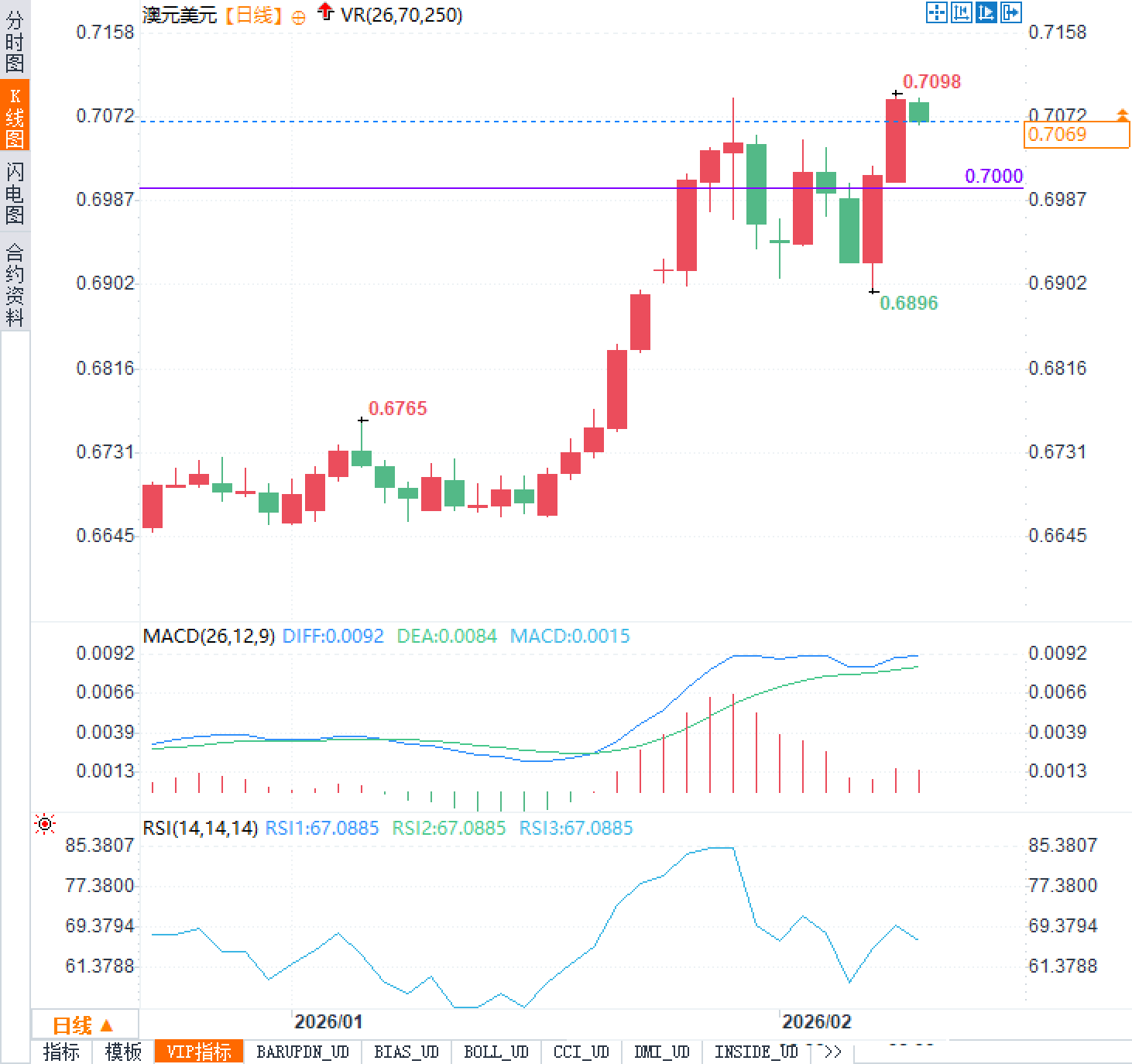
On Tuesday, February 10th, the Australian dollar traded in a range around 0.7070 against the US dollar during the North American session, just shy of its recent high of 0.7100. Although the exchange rate attempted to break through this level, it failed to hold and retreated slightly, indicating significant upward pressure. From a daily chart perspective, the overall trend remains in a high-level consolidation phase within an upward channel, with market sentiment leaning towards caution. The current movement is driven by two main factors: firstly, the interest rate advantage provided by the Reserve Bank of Australia's tightening cycle; and secondly, the fluctuating expectations of a Federal Reserve policy shift, influenced by US economic data, which exerts temporary downward pressure on the US dollar.

This "tug-of-war between the two central banks" gives the Australian dollar both upward momentum and makes a unilateral breakout difficult. Analysts believe the market is currently at a critical juncture, and significant changes in data from either side could disrupt the current equilibrium. In particular, upcoming key indicators such as US retail sales, non-farm payrolls, and the Consumer Price Index may directly determine whether the Federal Reserve maintains high interest rates for a longer period, thus influencing global capital flows and the strength of the US dollar.
Despite the apparent strength of the Australian dollar, domestic economic signals are showing signs of weakness. The latest Westpac Consumer Confidence Index for February declined for the third consecutive month, falling 2.6% month-on-month. About 80% of respondents in the survey believed that interest rates would rise further, with one-third even expecting a possible increase of 100 basis points. This reflects both residents' high sensitivity to financing costs and the accumulating psychological impact of interest rate hikes.
However, weakening consumer confidence does not necessarily mean the Reserve Bank of Australia (RBA) will immediately shift to easing. The central bank's focus remains on sticky inflation and the tightness of the labor market. As long as core inflation does not show a significant decline, this cooling of sentiment is more often seen as a normal side effect of the tightening process than a trigger for a policy shift. Meanwhile, the National Australia Bank's January business survey showed that the business confidence index rose slightly to +3, but the operating conditions index fell from +9 to +7, indicating that the pace of economic expansion is slowing.
Detailed data shows that trading activity and profitability were relatively weak, while employment remained largely flat. However, forward orders rebounded from -1 to +2, suggesting that demand has not completely stalled, but rather that companies are proactively adjusting their pace in a high-cost environment. Capacity utilization fell to 82.9%, a slight decrease, but still 1.5 percentage points higher than the long-term average, indicating that supply remains tight and there is no large-scale idle capacity. Price pressures showed signs of easing: labor cost increases fell to 1.3% (previous value 1.7%), procurement costs were 1.1% (previous value 1.3%), and final product prices rose by only 0.5% (previous value 0.8%). It is worth noting that this survey was completed before the last interest rate hike, and therefore does not fully reflect the impact of the latest interest rate environment on corporate behavior; continued monitoring of subsequent data is necessary.
On the other hand, the US dollar has recently been under some pressure, mainly due to the market's repricing of the Federal Reserve's policy path. With signs of a slowdown in the US labor market, White House economic advisor Kevin Hassett publicly stated that job growth is likely to remain sluggish in the coming weeks due to factors including slowing population growth and productivity gains. This statement exacerbated market expectations of weaker employment data, prompting investors to increase their bets on the magnitude of interest rate cuts this year.
Lower interest rate expectations typically weaken the dollar's interest rate differential appeal. However, if subsequent US retail sales, non-farm payrolls, or CPI data unexpectedly rebound, the market will quickly correct its previous pricing of rate cuts, and the dollar may rebound accordingly, thus limiting the Australian dollar's upside potential. Therefore, the current dollar weakness is strongly driven by sentiment, and its stability remains to be seen.
Against this backdrop, the core contradiction in the Australian dollar against the US dollar can be summarized as the confrontation between "RBA tightening expectations vs. Fed easing expectations." Last week, the RBA officially restarted its interest rate hike cycle, and Governor Michelle Bullock hinted that there is still room for further action in the short term. This has temporarily shifted the interest rate differential structure towards the Australian dollar, providing support from the policy divergence. However, internal feedback suggests that the cost of adapting to higher interest rates for consumers and businesses is gradually increasing. If consumption and investment data show a significant decline in the coming months, the market may prematurely price in the end of the RBA's tightening, weakening the momentum for further appreciation of the Australian dollar.
From a technical chart perspective, the 0.7100 level has become a clear resistance level for the current phase, and the current price is consolidating below it. The 0.7000 level below is not only an important psychological level but also a previous structural support point. If this level holds, the exchange rate still has a chance to retest 0.7100; if it falls below, it could trigger a pullback, targeting the 0.6896 area near the previous low.
Looking ahead, market focus will be on the performance of key US data, which will directly influence the pricing strength of the Federal Reserve's policy path. In Australia, future inflation data will be particularly crucial. If price declines are less than expected, the Reserve Bank of Australia's hawkish stance is likely to continue, providing further support for the Australian dollar. Conversely, if inflation cools coupled with slowing demand, it will be significantly more difficult for the Australian dollar to open up further upside above 0.7100.
This "tug-of-war between the two central banks" gives the Australian dollar both upward momentum and makes a unilateral breakout difficult. Analysts believe the market is currently at a critical juncture, and significant changes in data from either side could disrupt the current equilibrium. In particular, upcoming key indicators such as US retail sales, non-farm payrolls, and the Consumer Price Index may directly determine whether the Federal Reserve maintains high interest rates for a longer period, thus influencing global capital flows and the strength of the US dollar.
Internal pressures are emerging in Australia, but the central bank has not yet softened its stance.
Despite the apparent strength of the Australian dollar, domestic economic signals are showing signs of weakness. The latest Westpac Consumer Confidence Index for February declined for the third consecutive month, falling 2.6% month-on-month. About 80% of respondents in the survey believed that interest rates would rise further, with one-third even expecting a possible increase of 100 basis points. This reflects both residents' high sensitivity to financing costs and the accumulating psychological impact of interest rate hikes.
However, weakening consumer confidence does not necessarily mean the Reserve Bank of Australia (RBA) will immediately shift to easing. The central bank's focus remains on sticky inflation and the tightness of the labor market. As long as core inflation does not show a significant decline, this cooling of sentiment is more often seen as a normal side effect of the tightening process than a trigger for a policy shift. Meanwhile, the National Australia Bank's January business survey showed that the business confidence index rose slightly to +3, but the operating conditions index fell from +9 to +7, indicating that the pace of economic expansion is slowing.
Detailed data shows that trading activity and profitability were relatively weak, while employment remained largely flat. However, forward orders rebounded from -1 to +2, suggesting that demand has not completely stalled, but rather that companies are proactively adjusting their pace in a high-cost environment. Capacity utilization fell to 82.9%, a slight decrease, but still 1.5 percentage points higher than the long-term average, indicating that supply remains tight and there is no large-scale idle capacity. Price pressures showed signs of easing: labor cost increases fell to 1.3% (previous value 1.7%), procurement costs were 1.1% (previous value 1.3%), and final product prices rose by only 0.5% (previous value 0.8%). It is worth noting that this survey was completed before the last interest rate hike, and therefore does not fully reflect the impact of the latest interest rate environment on corporate behavior; continued monitoring of subsequent data is necessary.
The dollar is constrained by bets on interest rate cuts, but the risk of a reversal remains.
On the other hand, the US dollar has recently been under some pressure, mainly due to the market's repricing of the Federal Reserve's policy path. With signs of a slowdown in the US labor market, White House economic advisor Kevin Hassett publicly stated that job growth is likely to remain sluggish in the coming weeks due to factors including slowing population growth and productivity gains. This statement exacerbated market expectations of weaker employment data, prompting investors to increase their bets on the magnitude of interest rate cuts this year.
Lower interest rate expectations typically weaken the dollar's interest rate differential appeal. However, if subsequent US retail sales, non-farm payrolls, or CPI data unexpectedly rebound, the market will quickly correct its previous pricing of rate cuts, and the dollar may rebound accordingly, thus limiting the Australian dollar's upside potential. Therefore, the current dollar weakness is strongly driven by sentiment, and its stability remains to be seen.
Against this backdrop, the core contradiction in the Australian dollar against the US dollar can be summarized as the confrontation between "RBA tightening expectations vs. Fed easing expectations." Last week, the RBA officially restarted its interest rate hike cycle, and Governor Michelle Bullock hinted that there is still room for further action in the short term. This has temporarily shifted the interest rate differential structure towards the Australian dollar, providing support from the policy divergence. However, internal feedback suggests that the cost of adapting to higher interest rates for consumers and businesses is gradually increasing. If consumption and investment data show a significant decline in the coming months, the market may prematurely price in the end of the RBA's tightening, weakening the momentum for further appreciation of the Australian dollar.
Technical analysis confirms high-level consolidation; awaiting data guidance before a breakout.
From a technical chart perspective, the 0.7100 level has become a clear resistance level for the current phase, and the current price is consolidating below it. The 0.7000 level below is not only an important psychological level but also a previous structural support point. If this level holds, the exchange rate still has a chance to retest 0.7100; if it falls below, it could trigger a pullback, targeting the 0.6896 area near the previous low.
Looking ahead, market focus will be on the performance of key US data, which will directly influence the pricing strength of the Federal Reserve's policy path. In Australia, future inflation data will be particularly crucial. If price declines are less than expected, the Reserve Bank of Australia's hawkish stance is likely to continue, providing further support for the Australian dollar. Conversely, if inflation cools coupled with slowing demand, it will be significantly more difficult for the Australian dollar to open up further upside above 0.7100.
- Risk Warning and Disclaimer
- The market involves risk, and trading may not be suitable for all investors. This article is for reference only and does not constitute personal investment advice, nor does it take into account certain users’ specific investment objectives, financial situation, or other needs. Any investment decisions made based on this information are at your own risk.