The surprisingly weak US retail sales data: statistical noise or an economic crack?
2026-02-10 21:58:44
On Tuesday (February 10), during the Asian and European sessions, the euro retreated slightly against the US dollar, holding onto most of its gains since last Friday. After hitting a low of 1.1765 on Friday, the pair staged a strong rebound, briefly breaking through the key level of 1.1900. Currently, the pair is maintaining a narrow range, trading around 1.1891 at the time of writing, holding steady above its one-week high.
However, technical indicators show that the euro's recent upward momentum has weakened, and the upward trend has slowed down, which may lead to a pullback in the future.
Previously, concerns about the US labor market continued to weigh on the dollar's performance, and the negative impact of last week's weaker-than-expected employment data is still unfolding.
White House economic advisor Kevin Hassett further warned on Monday that U.S. job growth is likely to slow in the coming months due to the combined effects of the Trump administration’s immigration policies and productivity gains.
This statement failed to provide effective support for the dollar ahead of Wednesday's January non-farm payrolls (NFP) report, allowing the euro to remain relatively strong.

The market's focus was on the unexpectedly weak US retail sales data for December: the overall retail sales month-on-month increase did not slow to 0.4% as expected, but instead fell sharply to 0%, significantly lower than the previous value of 0.6%;
Excluding automobiles, core retail sales growth also fell significantly short of expectations, recording 0%, which was significantly lower than the expected 0.3% and the previous value of 0.5%.
Following the data release, market expectations quickly adjusted, and the unexpected weakness in the US economy boosted the euro's rebound momentum. The euro rebounded against the US dollar, briefly breaking through the 1.1900 level and reaching a high of around 1.1910.
This trend reflects that significantly lower-than-expected consumption data ignited market concerns about a weak US economy, while also increasing bets on a near-term rate cut by the Federal Reserve, giving the euro, which had previously been supported by safe-haven buying, new momentum.
However, since this is the US retail sales data for December, not January, it is essentially a supplementary report from the US Census Bureau. As a non-core department, the government shutdown has led to job losses, and data collection is also a major problem. But another issue is that December is usually the month with the best US consumer data, and this underperformance compared to November may be a point to be wary of, which could potentially extend the duration of the euro's rebound.
In Europe, European Central Bank (ECB) President Christine Lagarde reiterated her strong confidence that the eurozone's medium-term inflation will remain stable at the 2% target. This statement is consistent with last week's monetary policy statement, which clearly indicates that current interest rates will be maintained for the coming months, providing medium-term policy support for the euro.
Despite short-term pressure from US data, the European Central Bank's prudent stance will remain a key support factor for the euro.
The policy disagreements within the Federal Reserve have become more pronounced, bringing uncertainty to the market.
Stephen Milan, Trump's nominee for Federal Reserve governor, downplayed the transmission effect of tariffs on inflation and reiterated his call for greater interest rate cuts; while Atlanta Fed President Rafael Bostic emphasized that the volatile nature of employment data requires policymakers to remain cautious, and warned that market confidence in the dollar may face potential challenges.
From a market pricing perspective, data from the CME FedWatch tool shows that the probability of a rate cut in March remained at 17%, rose to 34% in April, and approached 75% in June. The probability of at least one more rate cut before the end of the year is over 70%. Although better-than-expected retail sales data temporarily lowered expectations for a rate cut, it did not fundamentally change the market's judgment on the Fed's subsequent easing cycle, which also limited the euro's downside potential.
Despite the euro's short-term pullback triggered by better-than-expected US retail sales data, the market's core focus has gradually shifted to the January non-farm payrolls (NFP) report to be released on Wednesday.
As a key reference indicator for the Federal Reserve's policy-making, this non-farm payroll data will not only include monthly employment figures and unemployment rate data, but will also simultaneously disclose the revised results of the 2025 full-year non-farm payroll data. The market expects the 2025 full-year non-farm payroll growth to be revised down by 900,000, and its performance will directly determine the medium-term trend of the euro against the US dollar.
Currently, the euro is at a critical juncture in the battle between bulls and bears against the US dollar: on the one hand, the technical rebound of the euro is putting downward pressure on it; on the other hand, unexpectedly weak US consumer data, concerns about the labor market, expectations of easing by the Federal Reserve, and the European Central Bank's prudent stance are providing support for the euro.
From a technical perspective, if the euro can hold the support level of 1.1888, there is still a possibility of returning to above 1.1900, which is also the watershed between bulls and bears after this round of correction. If the exchange rate closes above 1.1900, the euro will likely continue to rebound.
If the non-farm payroll data is also strong, the exchange rate may further test the 1.1800 level, but the possibility is small.
Overall, the unexpectedly lower-than-expected US retail sales data, contrary to seasonal trends, triggered a dollar pullback that boosted the euro. However, from a technical perspective, this was more of a profit-taking and expectation correction after the previous rebound, and did not change the euro's medium-term oscillating pattern.
Going forward, we need to pay close attention to the unemployment rate in the non-farm payroll data and the extent of any revisions to the employment data, as these factors will be the core variables driving the euro's movement against the US dollar in the next phase.
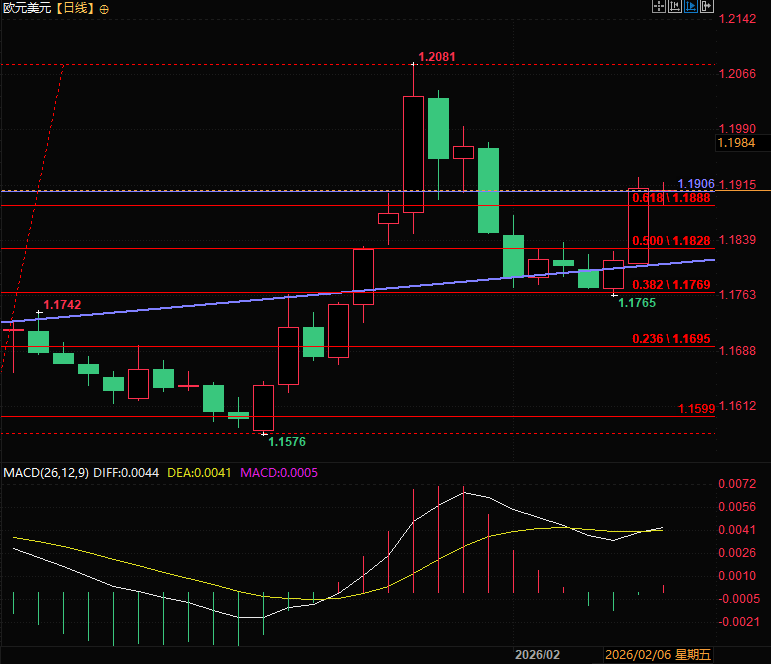
(Euro/USD daily chart, source: FX678)
At 21:55 Beijing time, the euro was trading at 1.1902 against the US dollar.
However, technical indicators show that the euro's recent upward momentum has weakened, and the upward trend has slowed down, which may lead to a pullback in the future.
Previously, concerns about the US labor market continued to weigh on the dollar's performance, and the negative impact of last week's weaker-than-expected employment data is still unfolding.
White House economic advisor Kevin Hassett further warned on Monday that U.S. job growth is likely to slow in the coming months due to the combined effects of the Trump administration’s immigration policies and productivity gains.
This statement failed to provide effective support for the dollar ahead of Wednesday's January non-farm payrolls (NFP) report, allowing the euro to remain relatively strong.
US December retail sales data unexpectedly fell short of expectations, providing short-term support for the euro.
The market's focus was on the unexpectedly weak US retail sales data for December: the overall retail sales month-on-month increase did not slow to 0.4% as expected, but instead fell sharply to 0%, significantly lower than the previous value of 0.6%;
Excluding automobiles, core retail sales growth also fell significantly short of expectations, recording 0%, which was significantly lower than the expected 0.3% and the previous value of 0.5%.
Following the data release, market expectations quickly adjusted, and the unexpected weakness in the US economy boosted the euro's rebound momentum. The euro rebounded against the US dollar, briefly breaking through the 1.1900 level and reaching a high of around 1.1910.
This trend reflects that significantly lower-than-expected consumption data ignited market concerns about a weak US economy, while also increasing bets on a near-term rate cut by the Federal Reserve, giving the euro, which had previously been supported by safe-haven buying, new momentum.
However, since this is the US retail sales data for December, not January, it is essentially a supplementary report from the US Census Bureau. As a non-core department, the government shutdown has led to job losses, and data collection is also a major problem. But another issue is that December is usually the month with the best US consumer data, and this underperformance compared to November may be a point to be wary of, which could potentially extend the duration of the euro's rebound.
The interplay of bullish and bearish policy factors supports the euro's medium-term resilience.
In Europe, European Central Bank (ECB) President Christine Lagarde reiterated her strong confidence that the eurozone's medium-term inflation will remain stable at the 2% target. This statement is consistent with last week's monetary policy statement, which clearly indicates that current interest rates will be maintained for the coming months, providing medium-term policy support for the euro.
Despite short-term pressure from US data, the European Central Bank's prudent stance will remain a key support factor for the euro.
The policy disagreements within the Federal Reserve have become more pronounced, bringing uncertainty to the market.
Stephen Milan, Trump's nominee for Federal Reserve governor, downplayed the transmission effect of tariffs on inflation and reiterated his call for greater interest rate cuts; while Atlanta Fed President Rafael Bostic emphasized that the volatile nature of employment data requires policymakers to remain cautious, and warned that market confidence in the dollar may face potential challenges.
From a market pricing perspective, data from the CME FedWatch tool shows that the probability of a rate cut in March remained at 17%, rose to 34% in April, and approached 75% in June. The probability of at least one more rate cut before the end of the year is over 70%. Although better-than-expected retail sales data temporarily lowered expectations for a rate cut, it did not fundamentally change the market's judgment on the Fed's subsequent easing cycle, which also limited the euro's downside potential.
The focus then shifted to the non-farm payrolls report, intensifying the battle between bulls and bears in the euro.
Despite the euro's short-term pullback triggered by better-than-expected US retail sales data, the market's core focus has gradually shifted to the January non-farm payrolls (NFP) report to be released on Wednesday.
As a key reference indicator for the Federal Reserve's policy-making, this non-farm payroll data will not only include monthly employment figures and unemployment rate data, but will also simultaneously disclose the revised results of the 2025 full-year non-farm payroll data. The market expects the 2025 full-year non-farm payroll growth to be revised down by 900,000, and its performance will directly determine the medium-term trend of the euro against the US dollar.
Summary and Technical Analysis:
Currently, the euro is at a critical juncture in the battle between bulls and bears against the US dollar: on the one hand, the technical rebound of the euro is putting downward pressure on it; on the other hand, unexpectedly weak US consumer data, concerns about the labor market, expectations of easing by the Federal Reserve, and the European Central Bank's prudent stance are providing support for the euro.
From a technical perspective, if the euro can hold the support level of 1.1888, there is still a possibility of returning to above 1.1900, which is also the watershed between bulls and bears after this round of correction. If the exchange rate closes above 1.1900, the euro will likely continue to rebound.
If the non-farm payroll data is also strong, the exchange rate may further test the 1.1800 level, but the possibility is small.
Overall, the unexpectedly lower-than-expected US retail sales data, contrary to seasonal trends, triggered a dollar pullback that boosted the euro. However, from a technical perspective, this was more of a profit-taking and expectation correction after the previous rebound, and did not change the euro's medium-term oscillating pattern.
Going forward, we need to pay close attention to the unemployment rate in the non-farm payroll data and the extent of any revisions to the employment data, as these factors will be the core variables driving the euro's movement against the US dollar in the next phase.
(Euro/USD daily chart, source: FX678)
At 21:55 Beijing time, the euro was trading at 1.1902 against the US dollar.
- Risk Warning and Disclaimer
- The market involves risk, and trading may not be suitable for all investors. This article is for reference only and does not constitute personal investment advice, nor does it take into account certain users’ specific investment objectives, financial situation, or other needs. Any investment decisions made based on this information are at your own risk.