Oil prices fluctuated at high levels, and the weakening US dollar caused the USD/CAD exchange rate to continue its decline.
2026-02-11 10:08:53
On Wednesday during Asian trading hours, USD/CAD fell for the fourth consecutive day, trading around 1.3550 and maintaining an overall weak trend. The core drivers of this decline were stronger oil prices and improved Canadian economic data, which provided significant support for the commodity currency, the Canadian dollar.
First, from the perspective of the energy market, international oil prices remain volatile at high levels. Geopolitical risks in the Middle East persist, and the US has sent a tough signal towards Iran, raising market concerns about potential supply disruptions.

Oil prices remained relatively firm amid rising risk premiums. As Canada is one of the world's major crude oil exporters, higher oil prices typically improve its terms of trade and enhance the attractiveness of the Canadian dollar.
Secondly, Canadian domestic economic data exceeded expectations. Statistics Canada data showed that the unemployment rate, released last week, fell to 6.5%, the lowest level since September 2024, significantly better than the market expectation of 6.8%. The improvement in the job market eased market concerns about an economic slowdown and also weakened investors' bets on the Bank of Canada adopting aggressive easing policies.
Following the release of the employment data, market expectations for the Bank of Canada's future interest rate cuts have somewhat subsided, and interest rate differentials have begun to shift in favor of the Canadian dollar. This adjustment in policy expectations has become one of the key supports for the recent strengthening of the Canadian dollar.
On the other hand, market focus is shifting to the upcoming US January jobs report. The market widely expects US non-farm payrolls to increase by 70,000 in January, with the unemployment rate remaining at 4.4%. If the actual data is significantly stronger than expected, it could strengthen the Federal Reserve's case for maintaining high interest rates, thereby boosting the dollar in the short term.
Conversely, if the data is weak, the US dollar may face further downward pressure. The current USD/CAD movement is essentially a dynamic balance between oil price support for the Canadian dollar and expectations of Federal Reserve policy. In the short term, the data results will be a key variable determining the direction.
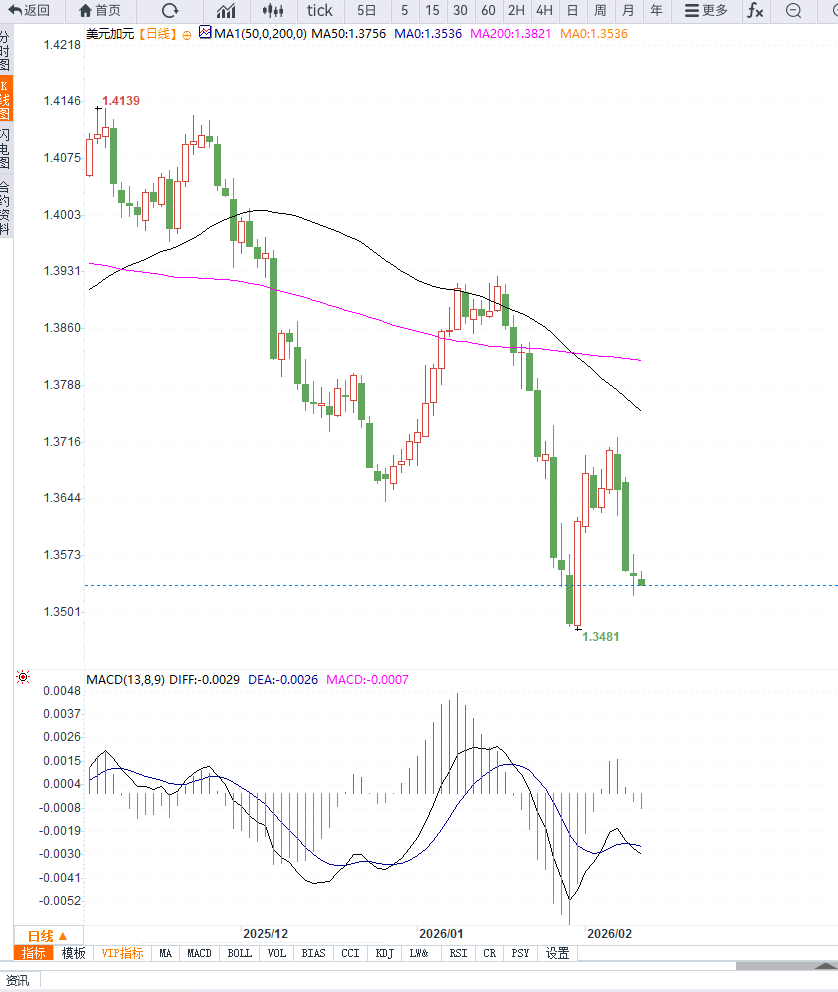
From a daily chart perspective, USD/CAD has fallen for four consecutive trading days, with the price center continuing to shift downwards, indicating a short-term bearish trend. The exchange rate is currently trading around 1.3550, close to the lower edge of the recent consolidation range. Technical patterns show that the exchange rate has broken below short-term moving average support, and the moving average system is beginning to diverge downwards, indicating that bearish momentum is gradually strengthening.
If the exchange rate breaks below the 1.3520 support area, it may further decline to the 1.3480 level, which is the previous low and also constitutes a key support level for this phase. On the upside, 1.3600 forms the first resistance level; if any rebound is limited by this area, the downtrend will continue.
A stronger resistance level lies around 1.3650, a previous consolidation zone and a cluster of moving averages. A break above this level could ease the short-term downtrend. Overall, the current technical structure leans towards a downward trend. Strong US employment data could trigger a technical rebound; however, given the continued strength of oil prices, the upside potential for the exchange rate may be limited.
Editor's Note:
The recent USD/CAD exchange rate movement reflects a typical "reversion to commodity currency logic." Rising oil prices and an improving Canadian job market have provided dual support, giving the Canadian dollar an advantage in the short term. However, the policy path differences between the Federal Reserve and the Bank of Canada will remain the determining factor for the medium-term trend.
If the US job market remains robust and the Federal Reserve slows its pace of interest rate cuts, the dollar may regain support; however, if data continues to weaken, the downside potential for the exchange rate could open up further. At this stage, market volatility is likely to amplify significantly with each data release.
First, from the perspective of the energy market, international oil prices remain volatile at high levels. Geopolitical risks in the Middle East persist, and the US has sent a tough signal towards Iran, raising market concerns about potential supply disruptions.
Oil prices remained relatively firm amid rising risk premiums. As Canada is one of the world's major crude oil exporters, higher oil prices typically improve its terms of trade and enhance the attractiveness of the Canadian dollar.
Secondly, Canadian domestic economic data exceeded expectations. Statistics Canada data showed that the unemployment rate, released last week, fell to 6.5%, the lowest level since September 2024, significantly better than the market expectation of 6.8%. The improvement in the job market eased market concerns about an economic slowdown and also weakened investors' bets on the Bank of Canada adopting aggressive easing policies.
Following the release of the employment data, market expectations for the Bank of Canada's future interest rate cuts have somewhat subsided, and interest rate differentials have begun to shift in favor of the Canadian dollar. This adjustment in policy expectations has become one of the key supports for the recent strengthening of the Canadian dollar.
On the other hand, market focus is shifting to the upcoming US January jobs report. The market widely expects US non-farm payrolls to increase by 70,000 in January, with the unemployment rate remaining at 4.4%. If the actual data is significantly stronger than expected, it could strengthen the Federal Reserve's case for maintaining high interest rates, thereby boosting the dollar in the short term.
Conversely, if the data is weak, the US dollar may face further downward pressure. The current USD/CAD movement is essentially a dynamic balance between oil price support for the Canadian dollar and expectations of Federal Reserve policy. In the short term, the data results will be a key variable determining the direction.
From a daily chart perspective, USD/CAD has fallen for four consecutive trading days, with the price center continuing to shift downwards, indicating a short-term bearish trend. The exchange rate is currently trading around 1.3550, close to the lower edge of the recent consolidation range. Technical patterns show that the exchange rate has broken below short-term moving average support, and the moving average system is beginning to diverge downwards, indicating that bearish momentum is gradually strengthening.
If the exchange rate breaks below the 1.3520 support area, it may further decline to the 1.3480 level, which is the previous low and also constitutes a key support level for this phase. On the upside, 1.3600 forms the first resistance level; if any rebound is limited by this area, the downtrend will continue.
A stronger resistance level lies around 1.3650, a previous consolidation zone and a cluster of moving averages. A break above this level could ease the short-term downtrend. Overall, the current technical structure leans towards a downward trend. Strong US employment data could trigger a technical rebound; however, given the continued strength of oil prices, the upside potential for the exchange rate may be limited.
Editor's Note:
The recent USD/CAD exchange rate movement reflects a typical "reversion to commodity currency logic." Rising oil prices and an improving Canadian job market have provided dual support, giving the Canadian dollar an advantage in the short term. However, the policy path differences between the Federal Reserve and the Bank of Canada will remain the determining factor for the medium-term trend.
If the US job market remains robust and the Federal Reserve slows its pace of interest rate cuts, the dollar may regain support; however, if data continues to weaken, the downside potential for the exchange rate could open up further. At this stage, market volatility is likely to amplify significantly with each data release.
- Risk Warning and Disclaimer
- The market involves risk, and trading may not be suitable for all investors. This article is for reference only and does not constitute personal investment advice, nor does it take into account certain users’ specific investment objectives, financial situation, or other needs. Any investment decisions made based on this information are at your own risk.