Ahead of Non-Farm Payrolls: Euro approaches 1.20, can it break through this time?
2026-02-11 17:39:39
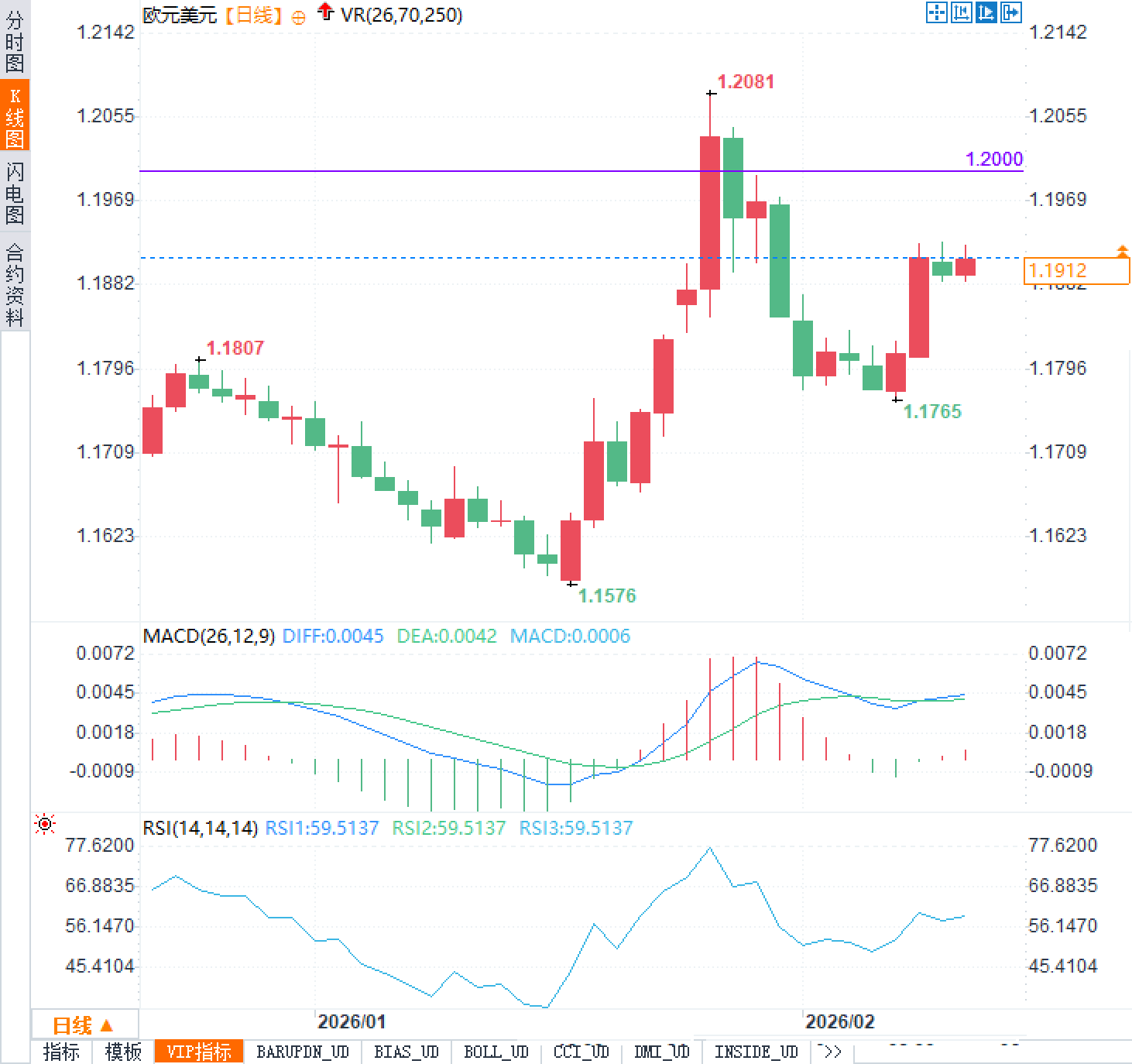
On Wednesday, February 11th, the euro traded around 1.1910 against the US dollar during the European session, within the range established over the past few days. While it hasn't broken through the key resistance level, it has risen more than 1% from last week's low, showing some resilience. The exchange rate previously surged to 1.2081 before retreating and entering a consolidation phase, with bulls and bears fiercely battling around 1.19. Technical charts show the daily MACD indicator with DIFF at 0.0045, DEA at 0.0042, and the histogram at only 0.0006, indicating that while the current trend is slightly bullish, the upward momentum is not strong, reflecting more of a high-level consolidation than a one-sided market movement. The RSI reading is approximately 59.5137, in a slightly bullish but not overheated zone, largely consistent with the sideways price movement.

The market's movement during this phase essentially reflects its anticipation of clearer directional guidance. On one hand, the European Central Bank's stance remains restrained; on the other hand, recent weak US economic data has fueled expectations of a Federal Reserve rate cut. The difference in policy paths between these two bodies is becoming the core variable driving exchange rate fluctuations. Analysts believe that in the absence of major breakthroughs, the euro may continue to trade between 1.1765 and 1.2081 in the short term, with the true directional choice likely to emerge only after key data releases.
The key factor influencing the euro's trajectory remains the European Central Bank's assessment of future monetary policy. Despite recent public speeches by several officials, the overall tone has been cautious and stable, emphasizing that current inflation trends remain within the forecast framework and that policy rates do not require easy adjustment. This "inaction" stance has effectively curbed excessive market speculation on interest rate cuts. In particular, the market is highly focused on whether ECB members Schnabel and Cipollone will release any new signals before their upcoming speeches.
It's worth noting that although the euro has recently been testing areas above 1.19, central bank officials have not shown a strong willingness to intervene, only stating that the appreciation of the exchange rate is "worthy of attention," but not yet sufficient to constitute a policy constraint. This moderate stance means that the euro's strength will not trigger policy retaliation in the short term; instead, it may be seen as a tool to further suppress inflation through import channels. Especially against the backdrop of global supply chain changes and potential tariff adjustments bringing inflationary pressures, a moderate strengthening of the euro may even provide room for future easing policies. Therefore, the ECB's narrative logic is more like "data dependence + scenario response," neither committing to tightening nor rushing to loosen, maintaining a high degree of flexibility.
In contrast to the Eurozone, the US dollar is facing increasing downward pressure. The latest US retail sales figures for December showed no change month-over-month, far below the expected 0.4% growth, and November's data was revised down from 0.6% to 0.5%, while October's was revised to a contraction of 0.2%. Given that consumption accounts for about 70% of US GDP, these weak figures have raised concerns about weakening economic growth momentum in the fourth quarter of 2025. The cooling demand not only undermines confidence in the dollar but also strengthens the likelihood of the Federal Reserve shifting towards easing.
More importantly, there are changes in labor costs. Data from the U.S. Bureau of Labor Statistics shows that the year-on-year growth rate of the employment cost index slowed to 0.7% in the fourth quarter, the slowest level since 2021. This means that wage-push inflation pressures are easing. Combined with weak retail data, the market is beginning to believe that the Federal Reserve will be more inclined to cut interest rates in future meetings. Currently, futures market pricing shows that investors have nearly a 75% implied probability of the first rate cut in June 2026, and expect two to three rate cuts before the end of the year. This is significantly more aggressive than the "cautious rate-cutting" path previously conveyed by the Federal Reserve. It is precisely this expectation gap that has repeatedly put pressure on the dollar when the interest rate outlook is revised downwards, indirectly supporting the euro's rebound.
The market's focus will now shift to the US January non-farm payrolls report. The market widely expects 70,000 new non-farm payrolls, higher than the previous month's 50,000; the unemployment rate is projected to remain at 4.4%; and the average hourly earnings annual growth rate is expected to slow to 3.6% from 3.8% in December. This report is important because it covers two core issues: employment resilience and wage inflation. If the data weakens across the board, it will further solidify market pricing in an earlier rate cut by the Federal Reserve, and the euro/dollar exchange rate could potentially retest the psychological level of 1.20. Conversely, if employment figures exceed expectations and wages rebound, it could quickly reverse the current atmosphere, causing the euro to face strong resistance below 1.20.
In addition, several Federal Reserve officials will speak on the same day, including Kansas City Fed President Jeffrey Schmid, Vice Chairman for Supervision Michelle Bowman, and Cleveland Fed President Beth Hammark. Coupled with media interactions by European Central Bank members during the US trading session, the news density is significantly increased, which could very likely trigger sharp short-term fluctuations. Analysts point out that the current exchange rate is at a critical juncture, and any unexpected comments or data could disrupt the existing balance. The 1.2000 level is a key psychological barrier; a successful hold above this level could lead to a renewed challenge of the previous high of 1.2081. On the other hand, 1.1765 is a crucial area for recent bullish defense; a breach of this level could risk a return to the 1.1576 low. A battle for monetary dominance is quietly intensifying.
The market's movement during this phase essentially reflects its anticipation of clearer directional guidance. On one hand, the European Central Bank's stance remains restrained; on the other hand, recent weak US economic data has fueled expectations of a Federal Reserve rate cut. The difference in policy paths between these two bodies is becoming the core variable driving exchange rate fluctuations. Analysts believe that in the absence of major breakthroughs, the euro may continue to trade between 1.1765 and 1.2081 in the short term, with the true directional choice likely to emerge only after key data releases.
The deeper meaning behind the European Central Bank's "silence"
The key factor influencing the euro's trajectory remains the European Central Bank's assessment of future monetary policy. Despite recent public speeches by several officials, the overall tone has been cautious and stable, emphasizing that current inflation trends remain within the forecast framework and that policy rates do not require easy adjustment. This "inaction" stance has effectively curbed excessive market speculation on interest rate cuts. In particular, the market is highly focused on whether ECB members Schnabel and Cipollone will release any new signals before their upcoming speeches.
It's worth noting that although the euro has recently been testing areas above 1.19, central bank officials have not shown a strong willingness to intervene, only stating that the appreciation of the exchange rate is "worthy of attention," but not yet sufficient to constitute a policy constraint. This moderate stance means that the euro's strength will not trigger policy retaliation in the short term; instead, it may be seen as a tool to further suppress inflation through import channels. Especially against the backdrop of global supply chain changes and potential tariff adjustments bringing inflationary pressures, a moderate strengthening of the euro may even provide room for future easing policies. Therefore, the ECB's narrative logic is more like "data dependence + scenario response," neither committing to tightening nor rushing to loosen, maintaining a high degree of flexibility.
A series of disappointing US data pushed the dollar higher.
In contrast to the Eurozone, the US dollar is facing increasing downward pressure. The latest US retail sales figures for December showed no change month-over-month, far below the expected 0.4% growth, and November's data was revised down from 0.6% to 0.5%, while October's was revised to a contraction of 0.2%. Given that consumption accounts for about 70% of US GDP, these weak figures have raised concerns about weakening economic growth momentum in the fourth quarter of 2025. The cooling demand not only undermines confidence in the dollar but also strengthens the likelihood of the Federal Reserve shifting towards easing.
More importantly, there are changes in labor costs. Data from the U.S. Bureau of Labor Statistics shows that the year-on-year growth rate of the employment cost index slowed to 0.7% in the fourth quarter, the slowest level since 2021. This means that wage-push inflation pressures are easing. Combined with weak retail data, the market is beginning to believe that the Federal Reserve will be more inclined to cut interest rates in future meetings. Currently, futures market pricing shows that investors have nearly a 75% implied probability of the first rate cut in June 2026, and expect two to three rate cuts before the end of the year. This is significantly more aggressive than the "cautious rate-cutting" path previously conveyed by the Federal Reserve. It is precisely this expectation gap that has repeatedly put pressure on the dollar when the interest rate outlook is revised downwards, indirectly supporting the euro's rebound.
Non-farm payrolls data is coming to an end, and the market may be about to explode.
The market's focus will now shift to the US January non-farm payrolls report. The market widely expects 70,000 new non-farm payrolls, higher than the previous month's 50,000; the unemployment rate is projected to remain at 4.4%; and the average hourly earnings annual growth rate is expected to slow to 3.6% from 3.8% in December. This report is important because it covers two core issues: employment resilience and wage inflation. If the data weakens across the board, it will further solidify market pricing in an earlier rate cut by the Federal Reserve, and the euro/dollar exchange rate could potentially retest the psychological level of 1.20. Conversely, if employment figures exceed expectations and wages rebound, it could quickly reverse the current atmosphere, causing the euro to face strong resistance below 1.20.
In addition, several Federal Reserve officials will speak on the same day, including Kansas City Fed President Jeffrey Schmid, Vice Chairman for Supervision Michelle Bowman, and Cleveland Fed President Beth Hammark. Coupled with media interactions by European Central Bank members during the US trading session, the news density is significantly increased, which could very likely trigger sharp short-term fluctuations. Analysts point out that the current exchange rate is at a critical juncture, and any unexpected comments or data could disrupt the existing balance. The 1.2000 level is a key psychological barrier; a successful hold above this level could lead to a renewed challenge of the previous high of 1.2081. On the other hand, 1.1765 is a crucial area for recent bullish defense; a breach of this level could risk a return to the 1.1576 low. A battle for monetary dominance is quietly intensifying.
- Risk Warning and Disclaimer
- The market involves risk, and trading may not be suitable for all investors. This article is for reference only and does not constitute personal investment advice, nor does it take into account certain users’ specific investment objectives, financial situation, or other needs. Any investment decisions made based on this information are at your own risk.