The non-farm payrolls report was phenomenal, so why didn't the dollar surge? Who's buying gold after this V-shaped recovery?
2026-02-11 21:48:13
On Wednesday (February 11), the U.S. Bureau of Labor Statistics released its January non-farm payroll report, which exceeded expectations across the board, rapidly cooling market expectations for a Federal Reserve interest rate cut. Following the data release, the dollar surged and then retreated, gold staged a "V"-shaped reversal, and U.S. Treasury yields rose across the board. This article analyzes the signals from this non-farm payroll data from three perspectives: market reaction, logical interpretation, and subsequent attention.

In January, non-farm payrolls increased by 130,000, significantly higher than the market expectation of 70,000; the unemployment rate fell to 4.3%, lower than the expected 4.4%; and average hourly earnings increased by 0.4% month-on-month and 3.7% year-on-year, both higher than expected.
The private sector added 172,000 jobs, with healthcare, social services, and construction being the main contributors, while manufacturing added a small 5,000. December and November figures were revised down to +48,000 and +41,000 respectively, and the full-year 2025 baseline revision was lowered by approximately 898,000. However, the January data was still interpreted by the market as indicating a resilient labor market.
After the data was released, the market quickly priced in a cooling of "interest rate cut expectations".
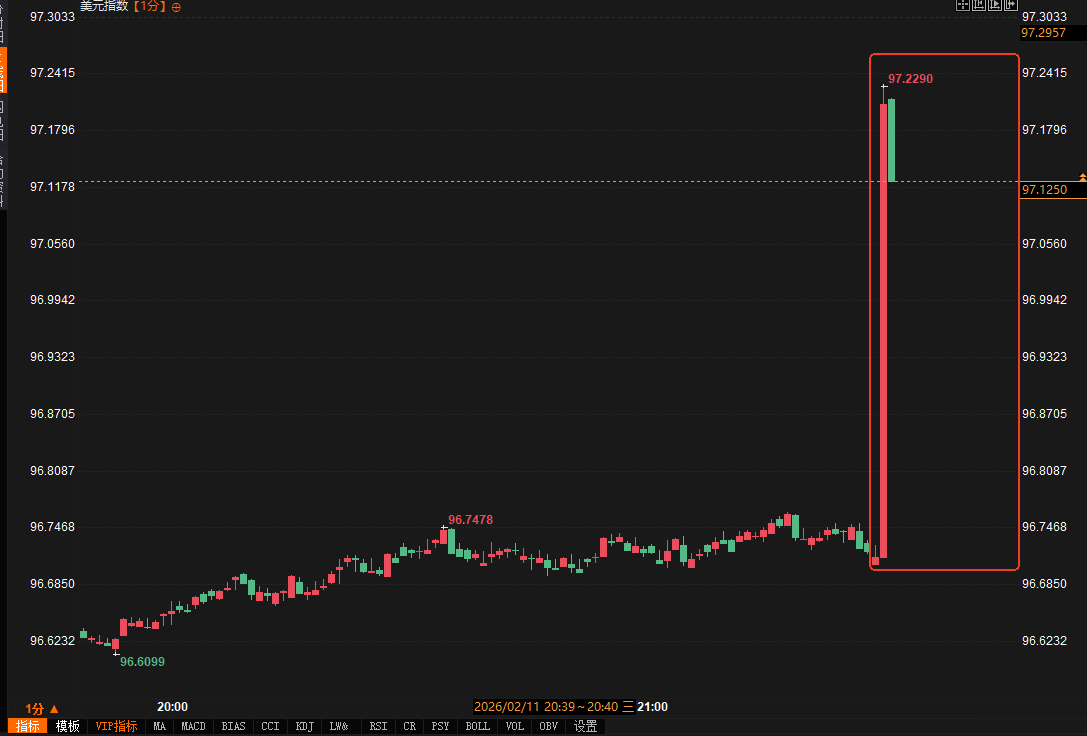
The US dollar index surged from 96.61 to 97.27 immediately after the announcement, breaking through the recent resistance level of 97.09, but failed to hold and subsequently fell back to around 97.00. The 1-minute candlestick chart showed a long upper shadow, indicating intense competition between bulls and bears.
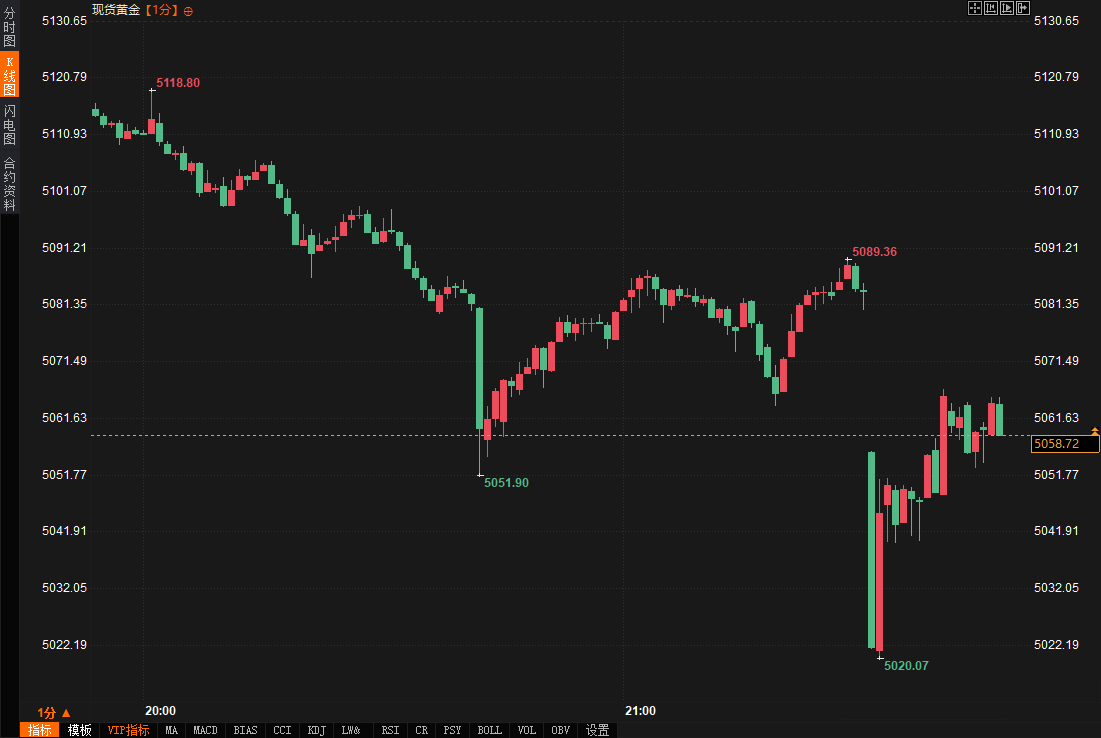
Spot gold staged a typical "V"-shaped reversal within one minute: it first quickly dropped to $5020.07, then rapidly rose to $5089.36, and is currently trading above the support level near $5056, with a fluctuation range of over $60.
The US Treasury market weakened in tandem, with the two-year Treasury yield touching 3.55%, a one-week high; the 10-year yield also rose rapidly, reflecting the market's repricing of the Federal Reserve's interest rate cut path.
Stock index futures rose slightly, indicating that the market remains somewhat optimistic about a soft landing for the economy, despite signals of "labor market resilience."
Before and after the data was released, market opinions presented a stark contrast.
Prior to the data release, the market generally expected employment growth to continue to slow, with institutional forecasts concentrated in the range of 50,000 to 75,000, and the market had priced in a rate cut in March.
Following the data release, institutional interpretations quickly shifted to "confirmation of resilience." Analysts believe that the 172,000 increase in private sector jobs in January is sufficient for the Federal Reserve to maintain its "stabilizing" stance, and the market needs to lower its expectations for the number of rate cuts throughout the year.
Among retail traders, the phrase "neither too cold nor too hot" frequently appeared, suggesting that "strong employment, sticky wages, and moderate downward revisions put the Fed in the middle, which is bullish for the dollar and bearish for gold in the short term." Some traders also pointed out that the dollar index failed to hold above 97.09 and may enter a short-term trading range of 97.00-97.50.
From a fundamental perspective, the January data eased market concerns about a "hard landing." The unemployment rate fell, the labor force participation rate rose slightly to 62.5%, and private sector employment grew steadily, reinforcing the Federal Reserve's assessment that the labor market is stabilizing. While the 3.7% year-on-year increase in hourly wages remains above the 2% inflation target, the modestly higher-than-expected 0.4% month-on-month increase did not trigger new inflation panic.
Market expectations for the number of interest rate cuts in 2025 have been lowered from 4-5 times to around 3 times, and the probability of a rate cut in March has fallen from over 60% before the announcement to below 40%.
From a technical perspective, the US dollar index encountered resistance near 97.27, with short-term focus on the 97.00-96.90 support zone; if it holds above this level, it may retest the 97.50-97.80 range. Spot gold rebounded after finding support at 5020, and currently focuses on the 5050-5060 support zone; if this level is breached, the next target is the 5000 psychological level; if it recovers the 5090-5100 range, it will resume its upward momentum.
The better-than-expected January non-farm payrolls data provided new evidence of the resilience of the US economy, but the downward revision of the full-year 2025 baseline suggests that the previous slowdown in growth has not yet been fully reversed. Going forward, close attention should be paid to February's employment data, CPI, and statements from Federal Reserve officials to verify whether the "stabilization" is sustainable.
In the short term, the US dollar index is likely to fluctuate between 96.80 and 97.50, while gold is seeking equilibrium between 5020 and 5100. Market sentiment has shifted from "interest rate cut trade" to "data validation," and overall risk appetite has improved somewhat, but volatility will remain high.
Data at a Glance: Overall Performance Exceeds Expectations, Benchmark Revisions Do Not Mask Resilience
In January, non-farm payrolls increased by 130,000, significantly higher than the market expectation of 70,000; the unemployment rate fell to 4.3%, lower than the expected 4.4%; and average hourly earnings increased by 0.4% month-on-month and 3.7% year-on-year, both higher than expected.
The private sector added 172,000 jobs, with healthcare, social services, and construction being the main contributors, while manufacturing added a small 5,000. December and November figures were revised down to +48,000 and +41,000 respectively, and the full-year 2025 baseline revision was lowered by approximately 898,000. However, the January data was still interpreted by the market as indicating a resilient labor market.
Market reaction: The dollar surged and then retreated, gold saw a V-shaped reversal, and US Treasury yields jumped.
After the data was released, the market quickly priced in a cooling of "interest rate cut expectations".
The US dollar index surged from 96.61 to 97.27 immediately after the announcement, breaking through the recent resistance level of 97.09, but failed to hold and subsequently fell back to around 97.00. The 1-minute candlestick chart showed a long upper shadow, indicating intense competition between bulls and bears.
Spot gold staged a typical "V"-shaped reversal within one minute: it first quickly dropped to $5020.07, then rapidly rose to $5089.36, and is currently trading above the support level near $5056, with a fluctuation range of over $60.
The US Treasury market weakened in tandem, with the two-year Treasury yield touching 3.55%, a one-week high; the 10-year yield also rose rapidly, reflecting the market's repricing of the Federal Reserve's interest rate cut path.
Stock index futures rose slightly, indicating that the market remains somewhat optimistic about a soft landing for the economy, despite signals of "labor market resilience."
Analysis: Institutional investors shift towards "repricing," while retail investor consensus remains "neither too cold nor too hot."
Before and after the data was released, market opinions presented a stark contrast.
Prior to the data release, the market generally expected employment growth to continue to slow, with institutional forecasts concentrated in the range of 50,000 to 75,000, and the market had priced in a rate cut in March.
Following the data release, institutional interpretations quickly shifted to "confirmation of resilience." Analysts believe that the 172,000 increase in private sector jobs in January is sufficient for the Federal Reserve to maintain its "stabilizing" stance, and the market needs to lower its expectations for the number of rate cuts throughout the year.
Among retail traders, the phrase "neither too cold nor too hot" frequently appeared, suggesting that "strong employment, sticky wages, and moderate downward revisions put the Fed in the middle, which is bullish for the dollar and bearish for gold in the short term." Some traders also pointed out that the dollar index failed to hold above 97.09 and may enter a short-term trading range of 97.00-97.50.
Logical Analysis and Short-Term Outlook
From a fundamental perspective, the January data eased market concerns about a "hard landing." The unemployment rate fell, the labor force participation rate rose slightly to 62.5%, and private sector employment grew steadily, reinforcing the Federal Reserve's assessment that the labor market is stabilizing. While the 3.7% year-on-year increase in hourly wages remains above the 2% inflation target, the modestly higher-than-expected 0.4% month-on-month increase did not trigger new inflation panic.
Market expectations for the number of interest rate cuts in 2025 have been lowered from 4-5 times to around 3 times, and the probability of a rate cut in March has fallen from over 60% before the announcement to below 40%.
From a technical perspective, the US dollar index encountered resistance near 97.27, with short-term focus on the 97.00-96.90 support zone; if it holds above this level, it may retest the 97.50-97.80 range. Spot gold rebounded after finding support at 5020, and currently focuses on the 5050-5060 support zone; if this level is breached, the next target is the 5000 psychological level; if it recovers the 5090-5100 range, it will resume its upward momentum.
Follow up
The better-than-expected January non-farm payrolls data provided new evidence of the resilience of the US economy, but the downward revision of the full-year 2025 baseline suggests that the previous slowdown in growth has not yet been fully reversed. Going forward, close attention should be paid to February's employment data, CPI, and statements from Federal Reserve officials to verify whether the "stabilization" is sustainable.
In the short term, the US dollar index is likely to fluctuate between 96.80 and 97.50, while gold is seeking equilibrium between 5020 and 5100. Market sentiment has shifted from "interest rate cut trade" to "data validation," and overall risk appetite has improved somewhat, but volatility will remain high.
- Risk Warning and Disclaimer
- The market involves risk, and trading may not be suitable for all investors. This article is for reference only and does not constitute personal investment advice, nor does it take into account certain users’ specific investment objectives, financial situation, or other needs. Any investment decisions made based on this information are at your own risk.