Unexpectedly strong non-farm payrolls data triggered a dramatic dollar rally, leaving euro bulls sleepless tonight.
2026-02-11 21:54:20
On Wednesday (February 11) during the New York session, the US January non-farm payrolls report was released as scheduled. The data showed a slight improvement over expectations, providing mild support for the US dollar. The euro fell back under short-term pressure against the US dollar and is currently trading in a range around 1.1910.
This report, whose release was delayed due to the partial government shutdown, not only reflects the resilience of the US labor market but also directly affects the short-term trend of the euro against the dollar, becoming a key variable before the direction of European currencies is chosen.

The core data in this non-farm payroll report were all slightly higher than the market's general expectations: non-farm payrolls increased by 130,000 in January, significantly exceeding the expected value of 70,000, and steadily rebounding from the 50,000 increase in December; the unemployment rate rose from the expected 4.4% to a stable level of 4.3%, better than the market's expectations.
The annual wage inflation rate, measured by average hourly earnings, came in at 3.7%, slightly higher than the expected 3.6%, and a modest decline from the 3.8% increase in December.
This data is largely consistent with TD Securities' previous forecast, which predicted that job growth would remain moderate in January.
The report shows that the private sector contributed the majority of new jobs, with the healthcare and construction industries being the main drivers of growth. The overall labor market continues to exhibit a balanced pattern of low layoffs and low hiring.
Meanwhile, the U.S. unadjusted annual employment baseline was revised down by 862,000, which also appears to be better than market expectations.
It is worth noting that although the data significantly exceeded expectations, whether there is a trend of reverting to the historical average remains to be seen and will depend on the next non-farm payroll data to determine whether there is an overall upward trend in the labor market.
The U.S. Bureau of Labor Statistics (BLS) announced early last week that the official employment report, originally scheduled for release on Friday, had to be postponed due to the partial government shutdown.
The agency confirmed the release date only after the U.S. House of Representatives passed a package on Tuesday to end the shutdown.
This unique release context, coupled with the data's better-than-expected performance, further heightened market sensitivity to the data, amplifying the volatility of the euro against the US dollar in the short term.
After the non-farm payroll data slightly exceeded expectations, the euro came under short-term pressure against the US dollar, falling from a high of 1.1927 in the early European session to around 1.1870 currently.
From a market perspective, this reaction is mainly due to a marginal adjustment in the Fed's policy expectations: the better-than-expected data strengthened the expectation that the Fed would maintain its policy unchanged next month. The CME FedWatch Tool shows that the pricing probability of a 25 basis point rate cut in March remains at around 15%, with no significant easing.
From a technical perspective, the euro/dollar pair is currently trading within a range of 1.1765 to 1.2081. The daily MACD indicator shows weak upward momentum, while the RSI reading is around 59.51, indicating a slightly bullish but not overheated position. Given that the recent non-farm payroll data only slightly exceeded expectations and did not signal a trend reversal, the upside potential for the dollar is limited, and the euro has not experienced a significant pullback. Therefore, the euro is expected to maintain its range-bound trading pattern in the short term.
Previous statements from Federal Reserve officials also provided guidance for exchange rate movements: Governor Lisa Cook emphasized that the labor market has stabilized and policymakers need to be wary of a rapid shift; Governor Philip Jefferson believes the current job market is in equilibrium with low layoffs and low hiring. These views echoed the performance of this non-farm payroll data, further solidifying expectations of a stable Fed policy and putting downward pressure on the euro.
While investors are paying close attention to the increase in non-farm payrolls, they are particularly sensitive to wage inflation data.
The average hourly wage growth of 3.7% year-on-year was slightly higher than the expected 3.6%, but it was still within a relatively moderate range.
Analysts at Danske Bank pointed out that the trend of slowing wage growth remains unchanged, which will directly suppress consumer activity and create conditions for future dovish policy adjustments by the Federal Reserve.
Summary and Technical Analysis:
For the euro, its future trajectory will still depend on the policy paths diverging between the European and American central banks. Currently, the market's implied probability of the Federal Reserve cutting rates for the first time in June 2026 is close to 75%, while recent statements from European Central Bank officials have been cautious, emphasizing that current inflation trends remain within the forecast framework and that policy rates do not need to be adjusted easily.
This policy expectation gap continues to provide some support for the euro, limiting its downside potential.
In the short term, the euro/dollar pair may lose its chance to contest the 1.19 level, with the psychological level of 1.19 acting as significant resistance, while the 50% Fibonacci retracement level of 1.828 is a key defensive area for the bulls. Going forward, close attention will be paid to speeches by Federal Reserve officials and statements from ECB members Schnabel and Cipollone, coupled with US inflation data this Friday. These factors will collectively determine the euro/dollar pair's next move.
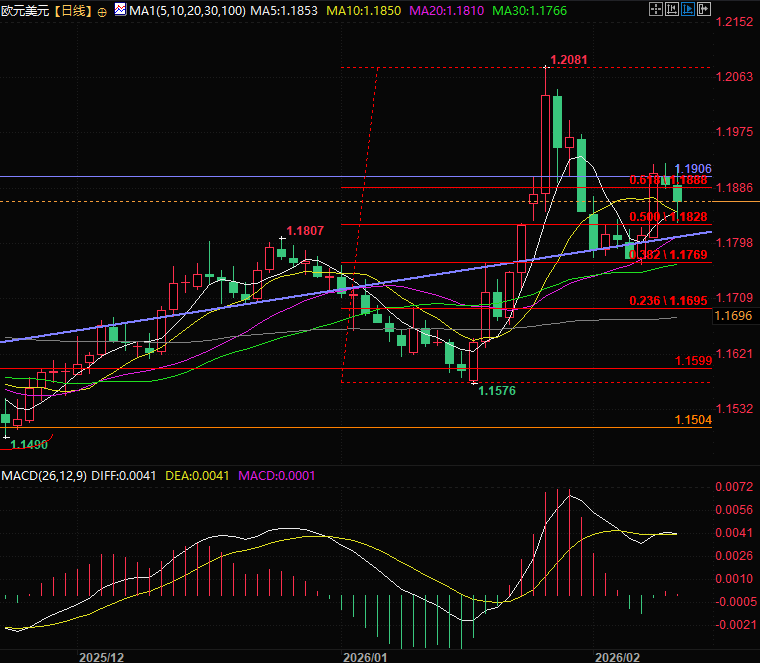
(Euro/USD daily chart, source: FX678)
At 21:53 Beijing time, the euro was trading at 1.1866/67 against the US dollar.
This report, whose release was delayed due to the partial government shutdown, not only reflects the resilience of the US labor market but also directly affects the short-term trend of the euro against the dollar, becoming a key variable before the direction of European currencies is chosen.
Non-farm payrolls slightly exceeded expectations; details of the data released a mild signal.
The core data in this non-farm payroll report were all slightly higher than the market's general expectations: non-farm payrolls increased by 130,000 in January, significantly exceeding the expected value of 70,000, and steadily rebounding from the 50,000 increase in December; the unemployment rate rose from the expected 4.4% to a stable level of 4.3%, better than the market's expectations.
The annual wage inflation rate, measured by average hourly earnings, came in at 3.7%, slightly higher than the expected 3.6%, and a modest decline from the 3.8% increase in December.
This data is largely consistent with TD Securities' previous forecast, which predicted that job growth would remain moderate in January.
The report shows that the private sector contributed the majority of new jobs, with the healthcare and construction industries being the main drivers of growth. The overall labor market continues to exhibit a balanced pattern of low layoffs and low hiring.
Meanwhile, the U.S. unadjusted annual employment baseline was revised down by 862,000, which also appears to be better than market expectations.
It is worth noting that although the data significantly exceeded expectations, whether there is a trend of reverting to the historical average remains to be seen and will depend on the next non-farm payroll data to determine whether there is an overall upward trend in the labor market.
Report Background: Significantly Enhanced Market Sensitivity
The U.S. Bureau of Labor Statistics (BLS) announced early last week that the official employment report, originally scheduled for release on Friday, had to be postponed due to the partial government shutdown.
The agency confirmed the release date only after the U.S. House of Representatives passed a package on Tuesday to end the shutdown.
This unique release context, coupled with the data's better-than-expected performance, further heightened market sensitivity to the data, amplifying the volatility of the euro against the US dollar in the short term.
The euro/dollar exchange rate remains under pressure and its volatile pattern is unlikely to change.
After the non-farm payroll data slightly exceeded expectations, the euro came under short-term pressure against the US dollar, falling from a high of 1.1927 in the early European session to around 1.1870 currently.
From a market perspective, this reaction is mainly due to a marginal adjustment in the Fed's policy expectations: the better-than-expected data strengthened the expectation that the Fed would maintain its policy unchanged next month. The CME FedWatch Tool shows that the pricing probability of a 25 basis point rate cut in March remains at around 15%, with no significant easing.
From a technical perspective, the euro/dollar pair is currently trading within a range of 1.1765 to 1.2081. The daily MACD indicator shows weak upward momentum, while the RSI reading is around 59.51, indicating a slightly bullish but not overheated position. Given that the recent non-farm payroll data only slightly exceeded expectations and did not signal a trend reversal, the upside potential for the dollar is limited, and the euro has not experienced a significant pullback. Therefore, the euro is expected to maintain its range-bound trading pattern in the short term.
Previous statements from Federal Reserve officials also provided guidance for exchange rate movements: Governor Lisa Cook emphasized that the labor market has stabilized and policymakers need to be wary of a rapid shift; Governor Philip Jefferson believes the current job market is in equilibrium with low layoffs and low hiring. These views echoed the performance of this non-farm payroll data, further solidifying expectations of a stable Fed policy and putting downward pressure on the euro.
Salary data is key; further attention should be paid to differences in policy approaches.
While investors are paying close attention to the increase in non-farm payrolls, they are particularly sensitive to wage inflation data.
The average hourly wage growth of 3.7% year-on-year was slightly higher than the expected 3.6%, but it was still within a relatively moderate range.
Analysts at Danske Bank pointed out that the trend of slowing wage growth remains unchanged, which will directly suppress consumer activity and create conditions for future dovish policy adjustments by the Federal Reserve.
Summary and Technical Analysis:
For the euro, its future trajectory will still depend on the policy paths diverging between the European and American central banks. Currently, the market's implied probability of the Federal Reserve cutting rates for the first time in June 2026 is close to 75%, while recent statements from European Central Bank officials have been cautious, emphasizing that current inflation trends remain within the forecast framework and that policy rates do not need to be adjusted easily.
This policy expectation gap continues to provide some support for the euro, limiting its downside potential.
In the short term, the euro/dollar pair may lose its chance to contest the 1.19 level, with the psychological level of 1.19 acting as significant resistance, while the 50% Fibonacci retracement level of 1.828 is a key defensive area for the bulls. Going forward, close attention will be paid to speeches by Federal Reserve officials and statements from ECB members Schnabel and Cipollone, coupled with US inflation data this Friday. These factors will collectively determine the euro/dollar pair's next move.
(Euro/USD daily chart, source: FX678)
At 21:53 Beijing time, the euro was trading at 1.1866/67 against the US dollar.
- Risk Warning and Disclaimer
- The market involves risk, and trading may not be suitable for all investors. This article is for reference only and does not constitute personal investment advice, nor does it take into account certain users’ specific investment objectives, financial situation, or other needs. Any investment decisions made based on this information are at your own risk.