The Australian dollar is soaring that people are afraid to chase it, yet they're worried about missing out if it falls: where is the Australian dollar headed?
2026-02-11 21:14:27
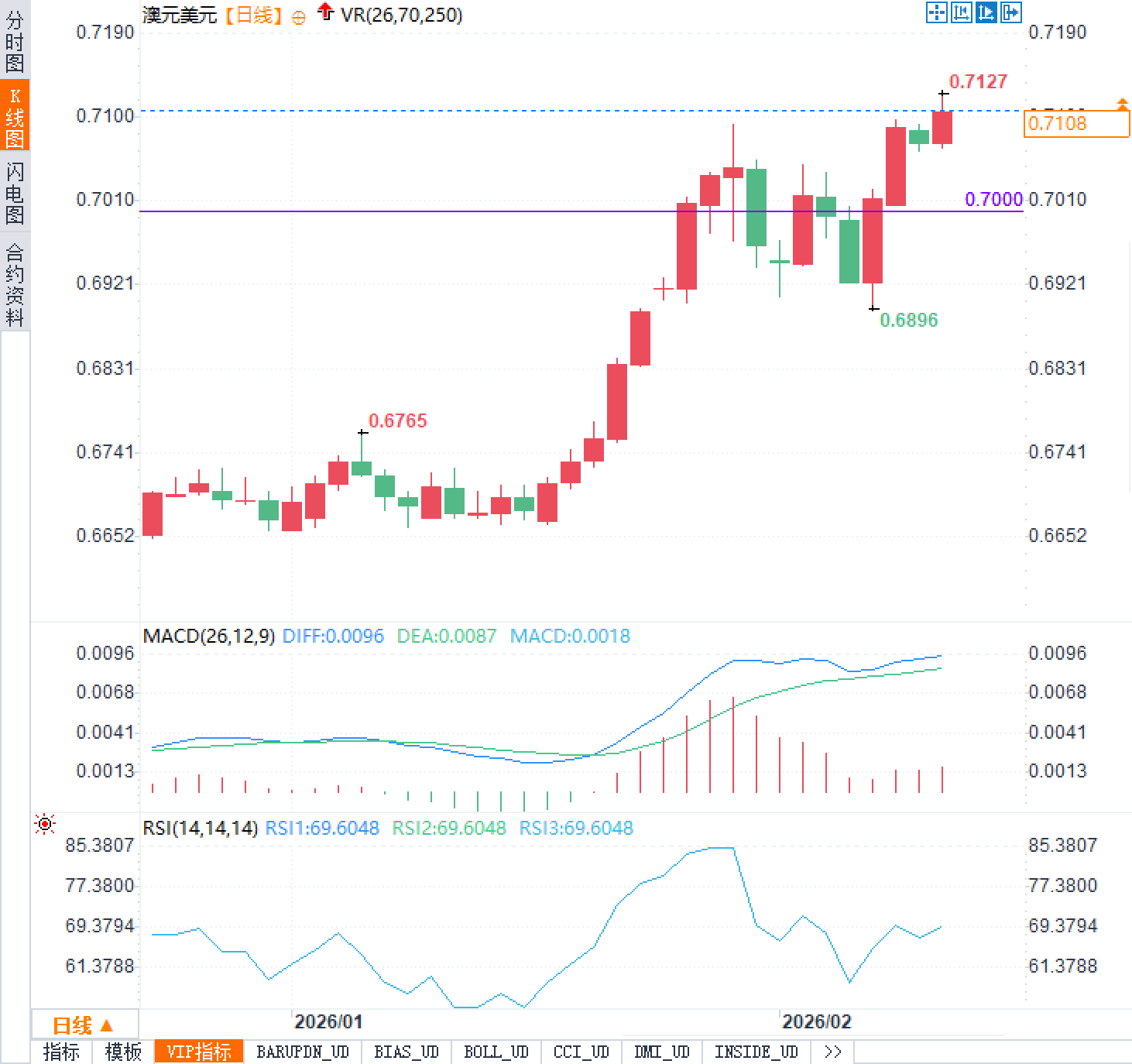
The Australian dollar has been strengthening against the US dollar recently, trading around 0.7100 during the North American session on Wednesday, February 11th, near a recent high. Since stabilizing at the previous low of 0.6896, the exchange rate has formed a clear upward structure, not only recovering the important psychological level of 0.7000 but also repeatedly confirming support above it, indicating gradually strengthening bullish confidence. Technically, the daily chart shows a clear upward trend, with the RSI indicator at 69.6048, approaching overbought territory but still maintaining upward momentum. The MACD indicator shows the DIFF at 0.0096, the DEA at 0.0087, and the histogram at 0.0018, all still within a bullish pattern. This suggests that current market sentiment is optimistic, and the upward trend has not yet shown any clear signs of exhaustion.

Despite a bullish technical pattern, prices have entered a sensitive zone in the short term, with 0.7127 forming a key resistance level. A successful breakout could lead to further gains; conversely, a failure to break through could trigger a pullback, raising concerns about a potential surge in selling pressure. Market volatility is often amplified around the release of major economic data, making rapid rallies followed by quick corrections more likely.
The recent rise in the Australian dollar is supported by both its own fundamentals and the cooperation of the US dollar. The US dollar weakened again in the previous trading day, mainly due to weaker-than-expected US retail sales data and a weak employment cost index. These two data points together indicate a slowdown in US economic momentum, prompting a slight increase in market expectations for future interest rate cuts by the Federal Reserve—currently priced in from 58 basis points to 60 basis points. Although this change seems small, in the current highly sensitive environment of interest rate path, any slight disturbance could trigger a sharp reaction in asset prices.
Currently, market focus is rapidly shifting to the upcoming US non-farm payrolls report. This data will be a key variable determining the short-term direction of the US dollar. If the non-farm payrolls are strong, indicating a still-solid labor market, the market may reassess the likelihood of the Federal Reserve maintaining high interest rates for an extended period, thus driving a dollar rebound and putting significant downward pressure on the Australian dollar against the US dollar. Conversely, if the non-farm payrolls data is weak, it will further strengthen the case for the Federal Reserve to cut interest rates sooner or more aggressively, potentially putting renewed pressure on the US dollar and opening a window for the Australian dollar to continue its upward trend.
It's worth noting that the market has already partially priced in expectations of further easing, meaning that even a slightly better-than-expected non-farm payroll report could trigger a "sell the fact" reversal. Therefore, even though the Australian dollar is currently strong, the potential for a US dollar rebound cannot be ignored.
Besides a favorable external environment, the Australian dollar's strength also benefits from the Reserve Bank of Australia's (RBA) consistently hawkish signals. At its most recent monetary policy meeting, the RBA decisively raised interest rates by 25 basis points, increasing the cash rate to 3.85%, and explicitly stated that there is still room for further tightening this year. This statement exceeded the market's previous expectation of "only one more rate hike," creating a significant expectation gap and directly boosting the Australian dollar's interest rate attractiveness.
Subsequently, Reserve Bank of Australia official Hauser reiterated that the policy stance remained hawkish, stating that the central bank was prepared to continue tightening monetary policy if necessary. While these remarks did not provide any new information, in the current market's extreme sensitivity to hawkish cues, any strong wording was amplified and interpreted, attracting funds to buy Australian dollar assets on dips. This "expectation-driven" trading pattern provided strong support for the Australian dollar during pullbacks, offering solid internal support for the current upward move.
In summary, the current strength of the Australian dollar against the US dollar is built on two pillars: firstly, the interest rate advantage and policy expectations supported by the Reserve Bank of Australia; and secondly, the US dollar's weakness due to weak data, leading to increased bets on interest rate cuts. These two factors combined have propelled the exchange rate steadily upward. However, as the price approaches key technical resistance, future movements will increasingly depend on external catalysts, particularly the performance of non-farm payroll data.
If the non-farm payroll data is strong, the market may correct its previously overly dovish pricing, and the US dollar is expected to rebound. In that case, the probability of the Australian dollar encountering resistance and falling back near 0.7127 against the US dollar increases, with the first support level to watch being 0.7000. A break below this level could lead to further testing of the previous support zone at 0.6896. Conversely, if the non-farm payroll data is weak, the US dollar will continue to be under pressure, and the Australian dollar has a chance to break through the resistance level and move towards higher targets.
Despite a bullish technical pattern, prices have entered a sensitive zone in the short term, with 0.7127 forming a key resistance level. A successful breakout could lead to further gains; conversely, a failure to break through could trigger a pullback, raising concerns about a potential surge in selling pressure. Market volatility is often amplified around the release of major economic data, making rapid rallies followed by quick corrections more likely.
A weaker US dollar boosted the Australian dollar; non-farm payrolls data became the biggest variable.
The recent rise in the Australian dollar is supported by both its own fundamentals and the cooperation of the US dollar. The US dollar weakened again in the previous trading day, mainly due to weaker-than-expected US retail sales data and a weak employment cost index. These two data points together indicate a slowdown in US economic momentum, prompting a slight increase in market expectations for future interest rate cuts by the Federal Reserve—currently priced in from 58 basis points to 60 basis points. Although this change seems small, in the current highly sensitive environment of interest rate path, any slight disturbance could trigger a sharp reaction in asset prices.
Currently, market focus is rapidly shifting to the upcoming US non-farm payrolls report. This data will be a key variable determining the short-term direction of the US dollar. If the non-farm payrolls are strong, indicating a still-solid labor market, the market may reassess the likelihood of the Federal Reserve maintaining high interest rates for an extended period, thus driving a dollar rebound and putting significant downward pressure on the Australian dollar against the US dollar. Conversely, if the non-farm payrolls data is weak, it will further strengthen the case for the Federal Reserve to cut interest rates sooner or more aggressively, potentially putting renewed pressure on the US dollar and opening a window for the Australian dollar to continue its upward trend.
It's worth noting that the market has already partially priced in expectations of further easing, meaning that even a slightly better-than-expected non-farm payroll report could trigger a "sell the fact" reversal. Therefore, even though the Australian dollar is currently strong, the potential for a US dollar rebound cannot be ignored.
The Reserve Bank of Australia's hawkish stance provides confidence.
Besides a favorable external environment, the Australian dollar's strength also benefits from the Reserve Bank of Australia's (RBA) consistently hawkish signals. At its most recent monetary policy meeting, the RBA decisively raised interest rates by 25 basis points, increasing the cash rate to 3.85%, and explicitly stated that there is still room for further tightening this year. This statement exceeded the market's previous expectation of "only one more rate hike," creating a significant expectation gap and directly boosting the Australian dollar's interest rate attractiveness.
Subsequently, Reserve Bank of Australia official Hauser reiterated that the policy stance remained hawkish, stating that the central bank was prepared to continue tightening monetary policy if necessary. While these remarks did not provide any new information, in the current market's extreme sensitivity to hawkish cues, any strong wording was amplified and interpreted, attracting funds to buy Australian dollar assets on dips. This "expectation-driven" trading pattern provided strong support for the Australian dollar during pullbacks, offering solid internal support for the current upward move.
In summary, the current strength of the Australian dollar against the US dollar is built on two pillars: firstly, the interest rate advantage and policy expectations supported by the Reserve Bank of Australia; and secondly, the US dollar's weakness due to weak data, leading to increased bets on interest rate cuts. These two factors combined have propelled the exchange rate steadily upward. However, as the price approaches key technical resistance, future movements will increasingly depend on external catalysts, particularly the performance of non-farm payroll data.
If the non-farm payroll data is strong, the market may correct its previously overly dovish pricing, and the US dollar is expected to rebound. In that case, the probability of the Australian dollar encountering resistance and falling back near 0.7127 against the US dollar increases, with the first support level to watch being 0.7000. A break below this level could lead to further testing of the previous support zone at 0.6896. Conversely, if the non-farm payroll data is weak, the US dollar will continue to be under pressure, and the Australian dollar has a chance to break through the resistance level and move towards higher targets.
- Risk Warning and Disclaimer
- The market involves risk, and trading may not be suitable for all investors. This article is for reference only and does not constitute personal investment advice, nor does it take into account certain users’ specific investment objectives, financial situation, or other needs. Any investment decisions made based on this information are at your own risk.