Geopolitical uncertainties coupled with strong employment data kept gold prices in a wide range of fluctuations.
2026-02-12 09:27:49
Gold prices remained around $5,060 per ounce during Thursday's Asian trading session, trading in a generally bullish range. Despite strong US jobs data that theoretically supported the dollar, rising safe-haven demand kept gold prices firm.
Geopolitical tensions have become a significant supporting factor for current gold prices. During his meeting with the Israeli Prime Minister, US President Trump stated his desire to continue negotiations with Iran, but also warned of potential further action should a nuclear agreement not be reached.
This stance of "diplomacy and pressure in tandem" exacerbated market concerns about the uncertainty of the Middle East situation, causing funds to flow back into safe-haven assets. From a macro perspective, the US labor market performed better than expected. Non-farm payrolls increased by 130,000 in January, significantly higher than the previous estimate of 70,000, and a substantial improvement from the revised 48,000 in December.

The unemployment rate fell from 4.4% to 4.3%, indicating that the job market remains relatively resilient. The improved employment data eased market concerns about an economic slowdown and provided support for the US dollar. Typically, a stronger dollar puts downward pressure on dollar-denominated gold.
However, gold prices did not fall significantly in this round, reflecting that safe-haven demand prevailed in the short term. Meanwhile, speeches by Federal Reserve officials released hawkish signals. The president of the Kansas City Fed stated that current interest rates need to be maintained at a restrictive level to continue suppressing inflationary pressures, and pointed out that economic data has not yet shown any significant signs of slowing down.
This statement reinforced market expectations that interest rates will remain high. The market's focus will now shift to Friday's US CPI inflation report. The market expects both overall and core CPI to rise by 2.5% year-on-year in January. If the inflation data is lower than expected, it could reignite market bets on a mid-year rate cut.
Conversely, if inflation remains sticky, it will reinforce expectations that high interest rates will persist for a longer period, thus putting temporary pressure on gold, a non-yielding asset.
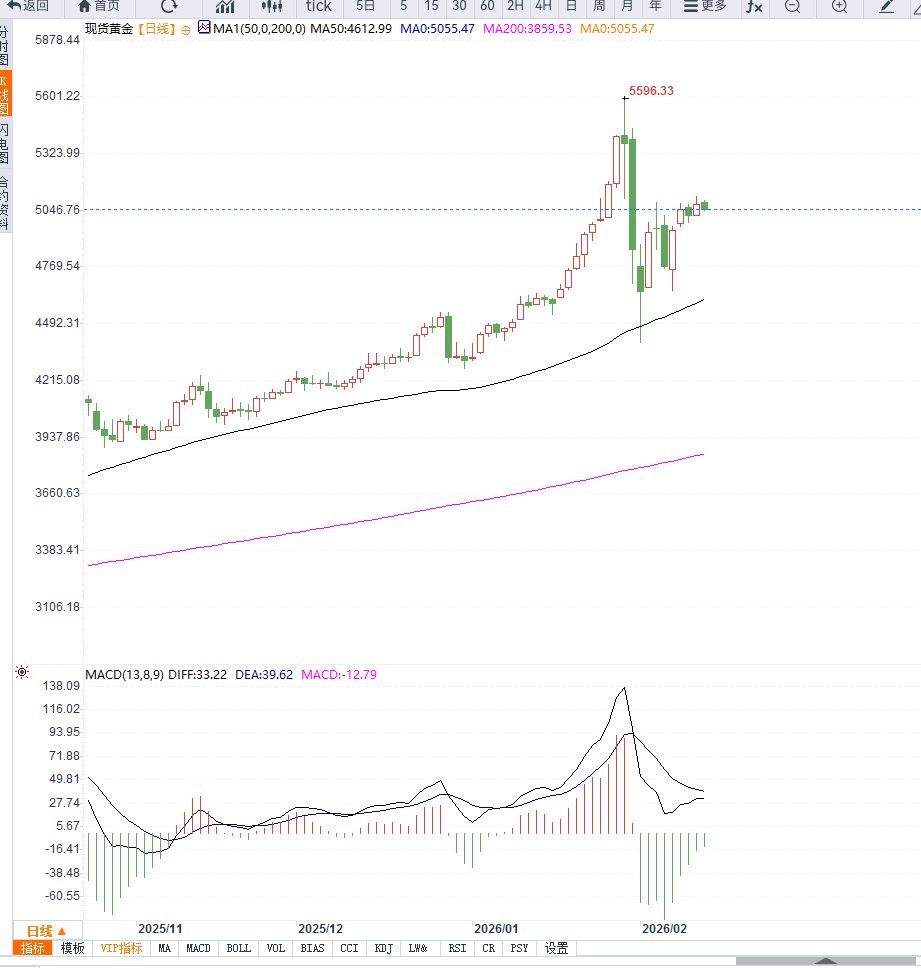
From a daily chart perspective, gold prices remain within an overall upward trend channel. Recently, after stabilizing above the $5000 level, prices have continued their rebound and are approaching previous highs again. The key short-term resistance level is around $5085, an area where previous highs and technical extension levels coincide.
If a breakout is successful, the price could test the $5,120 or even the psychological level of $5,200. If bullish momentum weakens, the first support level is at the psychological level of $5,000, followed by the $4,950 area, which coincides with the 20-day moving average and forms an important trend support.
In terms of momentum indicators, the daily RSI remains above 60 but has not entered severely overbought territory, indicating that the upward momentum has not yet completely exhausted. The MACD indicator is still running above the zero line, indicating that the overall trend remains bullish.
However, with prices near historical highs, short-term volatility may increase. Overall technical indicators suggest gold prices remain in a bullish trend, but the direction will heavily depend on the upcoming inflation data.
Editor's Note:
The gold market is currently in a typical phase of "a game between macroeconomic data and geopolitical risks." On the one hand, a strong job market and the Federal Reserve's hawkish stance are providing support for the US dollar; on the other hand, the uncertainty surrounding the situation in the Middle East continues to stimulate safe-haven demand.
In the short term, if CPI data is moderate, the market may repric its expectations for interest rate cuts, and gold has further upside potential. However, if inflation remains robust, the US dollar may strengthen again, putting technical downward pressure on gold prices.
Overall, gold is more likely to maintain a high-level consolidation pattern before the interest rate path becomes clear. Close attention needs to be paid to the impact of inflation data on policy expectations and whether geopolitical factors escalate further.
Geopolitical tensions have become a significant supporting factor for current gold prices. During his meeting with the Israeli Prime Minister, US President Trump stated his desire to continue negotiations with Iran, but also warned of potential further action should a nuclear agreement not be reached.
This stance of "diplomacy and pressure in tandem" exacerbated market concerns about the uncertainty of the Middle East situation, causing funds to flow back into safe-haven assets. From a macro perspective, the US labor market performed better than expected. Non-farm payrolls increased by 130,000 in January, significantly higher than the previous estimate of 70,000, and a substantial improvement from the revised 48,000 in December.
The unemployment rate fell from 4.4% to 4.3%, indicating that the job market remains relatively resilient. The improved employment data eased market concerns about an economic slowdown and provided support for the US dollar. Typically, a stronger dollar puts downward pressure on dollar-denominated gold.
However, gold prices did not fall significantly in this round, reflecting that safe-haven demand prevailed in the short term. Meanwhile, speeches by Federal Reserve officials released hawkish signals. The president of the Kansas City Fed stated that current interest rates need to be maintained at a restrictive level to continue suppressing inflationary pressures, and pointed out that economic data has not yet shown any significant signs of slowing down.
This statement reinforced market expectations that interest rates will remain high. The market's focus will now shift to Friday's US CPI inflation report. The market expects both overall and core CPI to rise by 2.5% year-on-year in January. If the inflation data is lower than expected, it could reignite market bets on a mid-year rate cut.
Conversely, if inflation remains sticky, it will reinforce expectations that high interest rates will persist for a longer period, thus putting temporary pressure on gold, a non-yielding asset.
From a daily chart perspective, gold prices remain within an overall upward trend channel. Recently, after stabilizing above the $5000 level, prices have continued their rebound and are approaching previous highs again. The key short-term resistance level is around $5085, an area where previous highs and technical extension levels coincide.
If a breakout is successful, the price could test the $5,120 or even the psychological level of $5,200. If bullish momentum weakens, the first support level is at the psychological level of $5,000, followed by the $4,950 area, which coincides with the 20-day moving average and forms an important trend support.
In terms of momentum indicators, the daily RSI remains above 60 but has not entered severely overbought territory, indicating that the upward momentum has not yet completely exhausted. The MACD indicator is still running above the zero line, indicating that the overall trend remains bullish.
However, with prices near historical highs, short-term volatility may increase. Overall technical indicators suggest gold prices remain in a bullish trend, but the direction will heavily depend on the upcoming inflation data.
Editor's Note:
The gold market is currently in a typical phase of "a game between macroeconomic data and geopolitical risks." On the one hand, a strong job market and the Federal Reserve's hawkish stance are providing support for the US dollar; on the other hand, the uncertainty surrounding the situation in the Middle East continues to stimulate safe-haven demand.
In the short term, if CPI data is moderate, the market may repric its expectations for interest rate cuts, and gold has further upside potential. However, if inflation remains robust, the US dollar may strengthen again, putting technical downward pressure on gold prices.
Overall, gold is more likely to maintain a high-level consolidation pattern before the interest rate path becomes clear. Close attention needs to be paid to the impact of inflation data on policy expectations and whether geopolitical factors escalate further.
- Risk Warning and Disclaimer
- The market involves risk, and trading may not be suitable for all investors. This article is for reference only and does not constitute personal investment advice, nor does it take into account certain users’ specific investment objectives, financial situation, or other needs. Any investment decisions made based on this information are at your own risk.