The US dollar rallied and then retreated, while the Canadian dollar's attempt to rebound was suppressed: traders await key data releases.
2026-02-12 18:17:57
On Thursday, February 12th, the USD/CAD pair traded around 1.3560 during the European session, near its lowest level since 2025. Although the latest US non-farm payroll data was better than expected, initially pushing the dollar higher, almost all gains were subsequently reversed, indicating a limited market reaction to the positive news. On the surface, strong employment data should have supported a stronger dollar and weakened expectations of a significant interest rate cut by the Federal Reserve this year, but the market's actual reaction was a "rise followed by a pullback," suggesting that traders did not fully capitalize on the news.
Analysts believe that this contradictory trend reflects the market's cautious sentiment ahead of key data releases. While the non-farm payroll data was strong, traders are more concerned about its sustainability, particularly its potential to translate into inflation. Currently, the market generally views stronger employment as a short-term fluctuation rather than a signal of overall economic overheating. Therefore, the dollar's rise is more of a short-term emotional release, lacking follow-through momentum. The real indicator will be the US Consumer Price Index (CPI) to be released on Friday—if inflation is strong, interest rate expectations may see a hawkish repricing, giving the dollar a chance to break out of its consolidation and begin a trend recovery; conversely, if inflation is weak, the dollar may continue to be under pressure and remain at low levels.
The recent weakness of the Canadian dollar is not due to a deterioration in the Canadian economy itself. In fact, the Canadian labor market is stabilizing, and core inflation is hovering around 2.5%, just above the midpoint of the central bank's 2%-3% target range, indicating that the fundamentals are not weak. However, the Canadian dollar has consistently failed to stage a significant rebound, and the problem lies in external risks—particularly the escalating uncertainty surrounding the USMCA (United States-Mexico-Canada Agreement).
Sources indicate that US President Trump has questioned the value of the agreement in internal discussions, even posing the question of "why we shouldn't withdraw." While no concrete policy action has been taken, such comments are enough to cause ripples in the market. Because Canada enjoys low tariffs on US goods under the agreement, a potential renegotiation or withdrawal would significantly worsen Canada's export environment and could dampen business confidence. The foreign exchange market is extremely sensitive to this; even the slightest disturbance will quickly be reflected in the Canadian dollar exchange rate, pushing up the risk premium for the US dollar against the Canadian dollar.
This also explains why the Canadian dollar has struggled to improve even if the US dollar fails to strengthen sustainably—it is being suppressed by the shadow of trade politics. No matter how stable the fundamentals are, they cannot withstand the panic brought about by the "divorce threat." As long as this uncertainty persists, the Canadian dollar will find it difficult to escape its passive position.
From a technical chart perspective, the USD/CAD pair remains in a range-bound trading pattern. The previous high was 1.3927, after which it fell back, reaching a new low of 1.3481. The most recent key resistance is around 1.3700, a significant psychological and technical level. Without a strong catalyst, prices touching this area are likely to encounter selling pressure following short covering. On the downside, the effectiveness of the support at 1.3481 needs close monitoring; a break below this level could open up further downside potential.
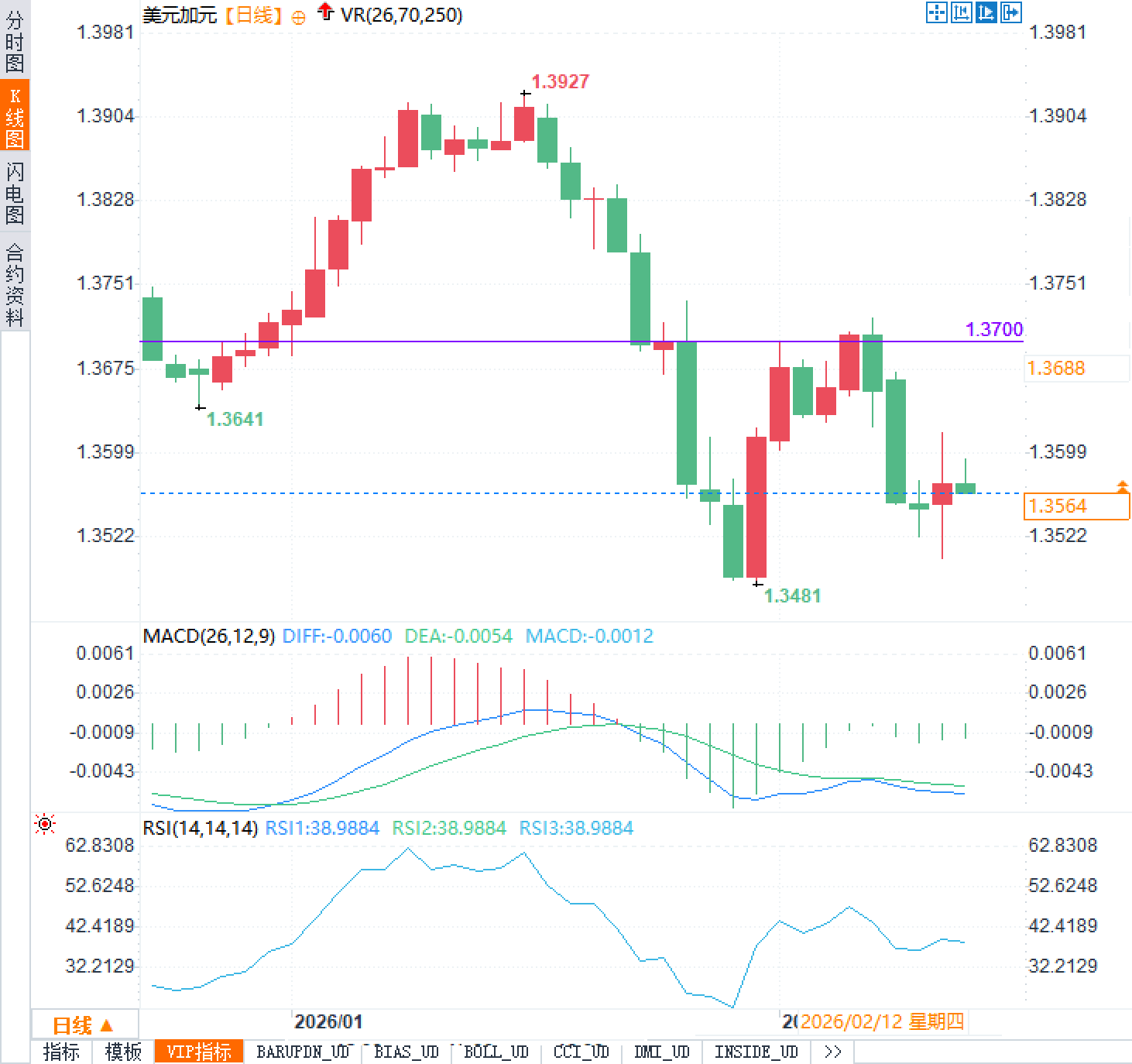
Technical indicators also show the market is in a weak, volatile state. The MACD currently shows a DIFF of -0.0060, a DEA of -0.0054, and a MACD histogram of -0.0012, all below the zero line, indicating that medium-term momentum remains bearish. However, it's worth noting that the MACD histogram is converging, suggesting that the downward momentum has not accelerated, but rather is a consolidation phase after the decline. The RSI is currently at 38, in the weak zone but not oversold, suggesting that short-term fluctuations are likely rather than a one-sided trend.
In summary, the current exchange rate lacks both the foundation for a strong upward surge and the momentum for an immediate downward breakout. It seems more like both bulls and bears are waiting for a new information anchor. The market is currently like a taut string, just waiting for a "trigger point"—which is very likely to be tomorrow's US CPI data release.
Going forward, the direction of the USD/CAD exchange rate will be determined by two main factors: first, whether the combination of US inflation and employment data continues to support the narrative that "the Fed does not need to rush to cut interest rates"; and second, whether political expectations related to the USMCA will further intensify, raising the risk discount of the Canadian dollar.
If US CPI data is strong, market expectations for higher interest rates to persist will strengthen, providing stronger support for the US dollar. The exchange rate may attempt to challenge 1.3700 or even higher, testing the effectiveness of previous resistance levels. Conversely, if inflation data is weak, the dollar's rebound momentum will be insufficient. Coupled with the possibility of easing trade tensions, the exchange rate may fall back to test the 1.3481 support area, continuing its low-level consolidation.
Analysts believe that this contradictory trend reflects the market's cautious sentiment ahead of key data releases. While the non-farm payroll data was strong, traders are more concerned about its sustainability, particularly its potential to translate into inflation. Currently, the market generally views stronger employment as a short-term fluctuation rather than a signal of overall economic overheating. Therefore, the dollar's rise is more of a short-term emotional release, lacking follow-through momentum. The real indicator will be the US Consumer Price Index (CPI) to be released on Friday—if inflation is strong, interest rate expectations may see a hawkish repricing, giving the dollar a chance to break out of its consolidation and begin a trend recovery; conversely, if inflation is weak, the dollar may continue to be under pressure and remain at low levels.
The Canadian dollar's predicament: It's not that the economy is bad, but that the "marriage" is unstable.
The recent weakness of the Canadian dollar is not due to a deterioration in the Canadian economy itself. In fact, the Canadian labor market is stabilizing, and core inflation is hovering around 2.5%, just above the midpoint of the central bank's 2%-3% target range, indicating that the fundamentals are not weak. However, the Canadian dollar has consistently failed to stage a significant rebound, and the problem lies in external risks—particularly the escalating uncertainty surrounding the USMCA (United States-Mexico-Canada Agreement).
Sources indicate that US President Trump has questioned the value of the agreement in internal discussions, even posing the question of "why we shouldn't withdraw." While no concrete policy action has been taken, such comments are enough to cause ripples in the market. Because Canada enjoys low tariffs on US goods under the agreement, a potential renegotiation or withdrawal would significantly worsen Canada's export environment and could dampen business confidence. The foreign exchange market is extremely sensitive to this; even the slightest disturbance will quickly be reflected in the Canadian dollar exchange rate, pushing up the risk premium for the US dollar against the Canadian dollar.
This also explains why the Canadian dollar has struggled to improve even if the US dollar fails to strengthen sustainably—it is being suppressed by the shadow of trade politics. No matter how stable the fundamentals are, they cannot withstand the panic brought about by the "divorce threat." As long as this uncertainty persists, the Canadian dollar will find it difficult to escape its passive position.
Technical indicators are deadlocked, and a directional move is just waiting for a catalyst.
From a technical chart perspective, the USD/CAD pair remains in a range-bound trading pattern. The previous high was 1.3927, after which it fell back, reaching a new low of 1.3481. The most recent key resistance is around 1.3700, a significant psychological and technical level. Without a strong catalyst, prices touching this area are likely to encounter selling pressure following short covering. On the downside, the effectiveness of the support at 1.3481 needs close monitoring; a break below this level could open up further downside potential.
Technical indicators also show the market is in a weak, volatile state. The MACD currently shows a DIFF of -0.0060, a DEA of -0.0054, and a MACD histogram of -0.0012, all below the zero line, indicating that medium-term momentum remains bearish. However, it's worth noting that the MACD histogram is converging, suggesting that the downward momentum has not accelerated, but rather is a consolidation phase after the decline. The RSI is currently at 38, in the weak zone but not oversold, suggesting that short-term fluctuations are likely rather than a one-sided trend.
In summary, the current exchange rate lacks both the foundation for a strong upward surge and the momentum for an immediate downward breakout. It seems more like both bulls and bears are waiting for a new information anchor. The market is currently like a taut string, just waiting for a "trigger point"—which is very likely to be tomorrow's US CPI data release.
Future trends depend on the interplay between two main themes.
Going forward, the direction of the USD/CAD exchange rate will be determined by two main factors: first, whether the combination of US inflation and employment data continues to support the narrative that "the Fed does not need to rush to cut interest rates"; and second, whether political expectations related to the USMCA will further intensify, raising the risk discount of the Canadian dollar.
If US CPI data is strong, market expectations for higher interest rates to persist will strengthen, providing stronger support for the US dollar. The exchange rate may attempt to challenge 1.3700 or even higher, testing the effectiveness of previous resistance levels. Conversely, if inflation data is weak, the dollar's rebound momentum will be insufficient. Coupled with the possibility of easing trade tensions, the exchange rate may fall back to test the 1.3481 support area, continuing its low-level consolidation.
- Risk Warning and Disclaimer
- The market involves risk, and trading may not be suitable for all investors. This article is for reference only and does not constitute personal investment advice, nor does it take into account certain users’ specific investment objectives, financial situation, or other needs. Any investment decisions made based on this information are at your own risk.