A Love-Hate Relationship Between Gold and Silver, From Industrial Poison
2026-02-12 18:36:33
As we enter 2026, the trajectory of this "devil metal" becomes even more unpredictable—JPMorgan Global Research predicts an annual average price of $81 per ounce, which is expected to more than double the average price in 2025, but achieving this goal still requires overcoming multiple variables.
Silver has long been overshadowed by gold in the precious metals market and has always been regarded as a "supporting role" to gold, but the surge in 2025 completely rewrote market perception.
Historically, the gold-silver ratio has exceeded an extreme level of 100:1, but it has now converged to a 15-year low. This indicates that silver is significantly overvalued relative to gold in the traditional sense, and also represents a shift in the perception of silver prices under a new narrative.
In early 2026, gold and silver experienced violent fluctuations in tandem. After spot silver broke through $90/ounce in January to reach a record high, it plummeted by 27% in a single day due to the change in the nomination of the Federal Reserve Chairman. In just one month, it completed a rapid switch between "madness and fear". Its historical volatility of 33% is 1.7 times that of gold, which fully demonstrates the high-risk and high-return characteristics of "poor man's gold".
The core driving logic for silver prices in 2026 will continue the fundamental support from 2025, but will also face the impact of new policy variables.
In terms of upward momentum, the surge in industrial demand is the key pillar – industrial applications account for about 60% of total silver demand (excluding ETF fund flows), with the demand growth in the photovoltaic industry being particularly prominent. As high-efficiency battery technology iterates, the silver consumption per module has increased significantly, and the global photovoltaic installation boom led by China continues to drive silver demand.
Policy changes also profoundly affect silver prices. Since 2025, the U.S. Department of Commerce has been reviewing critical minerals under Section 232 of the Trade Expansion Act of 1962. This policy uncertainty has become an important factor driving up silver prices.
Until mid-January 2026, Trump shelved his plan to impose new tariffs on imports of key minerals such as silver, and instead secured supply chain stability through bilateral agreements. Silver prices recovered quickly after a brief correction.
However, the news on January 30 that Kevin Warsh was nominated as the next Federal Reserve Chairman triggered market concerns about a shift in monetary policy. Coupled with a recovery in confidence in the US dollar, this directly led to a sharp drop in silver prices, while gold also fell by 10%, highlighting the sensitive impact of policy expectations on the precious metals market.
Silver is mostly produced as a by-product of base metals such as copper, lead, and zinc. This characteristic determines that its output has a relatively limited elasticity to the rise in silver prices, making it difficult to meet explosive demand through rapid expansion. This is the logic of the double elasticity triggering price surge mentioned in the previous article on silver. That is, the price elasticity of silver mine production is low, coupled with the demand elasticity of electrical and photovoltaic manufacturers' prices, forming a double elasticity pattern, which makes the spot price of silver greatly affected by the physical demand for silver.
As of February 2026, London silver was trading at $83.59 per ounce, and the Shanghai silver futures contract was priced at 20,626 yuan per kilogram, remaining at historically high levels, reflecting the market's recognition of the tight supply situation.
Behind the explosive growth in silver demand lie long-term risks that cannot be ignored.
Gregory Shiller, head of base and precious metals strategy at JPMorgan Chase, warned that the surge in silver prices has begun to force downstream industries to seek alternatives, especially as photovoltaic manufacturers are accelerating the development of "silver-free" technologies.
On the one hand, companies are reducing the amount of silver paste used per module by optimizing processes; on the other hand, they are actively developing silver-free technologies such as cadmium telluride thin films. This substantial acceleration of the substitution trend will have a structural impact on the silver supply and demand balance in the coming quarters.
Industry feedback indicates that high silver prices have already had a significant impact.
When the price of silver on the Shanghai Futures Exchange broke through 30,000 yuan/kg, silver accounted for more than 30% of the cost of photovoltaic raw materials, far exceeding the 9% level in 2024.
Several photovoltaic companies, including LONGi Green Energy, have listed the "rising silver price" as a key factor in their expected losses in 2025. Downstream module manufacturers have seen a sharp decrease of about 50% in their orders for silver paste. If silver prices remain high for an extended period, the photovoltaic industry may face pressure to reduce its production capacity.
However, Shiller also admitted that technological substitution takes several years, and in the short term, fluctuations in investment demand and changes in market risk appetite remain the core variables driving silver price trends.
Unlike gold, which has global central banks as a structural force to buy on dips, silver lacks such benchmark demand support, and its pricing depends more on the interplay between speculative funds and industrial demand.
The market conditions at the beginning of 2026 have clearly shown that overseas traders hoarding physical silver creates a short squeeze, coupled with speculative funds rushing to buy, which can easily drive silver prices to surge away from fundamentals; and when market sentiment shifts, silver, lacking central bank support, will face an even more severe correction.
Furthermore, concerns about delivery defaults triggered by the abnormal increase in COMEX silver delivery applications could also become a catalyst for exacerbating market volatility.
The market is cautiously optimistic about the overall trend of silver prices in 2026.
From a support level perspective, investment demand from major markets such as China and India has become an important pillar. In particular, China's strong investment demand has had a significant impact on the pricing of the entire metals market and has become a key catalyst to be monitored in the coming weeks.
The continuation of the Fed's easing cycle has also provided macro support for silver prices. Although the nomination of the new chairman has caused short-term fluctuations, the market still expects at least two 25-basis-point rate cuts in 2026. In a low-interest-rate environment, the attractiveness of silver, which has the attribute of being a non-interest-bearing asset, is expected to continue to increase.
However, upside potential remains constrained by multiple factors. Shiller predicts that due to the lack of central banks as structural buyers, there is a potential risk of further appreciation in the gold-silver ratio, which means that silver's gains may lag behind gold's.
Meanwhile, the promotion of industrial substitution technologies, the uncertainty of the pace of global economic recovery, and profit-taking by speculative funds may all limit the extent of silver price increases.
As of February 2026, market opinions on silver have diverged: bulls adhere to the logic of tight supply and demand balance, while bears worry about the bursting of the price bubble. JPMorgan Chase has clearly stated that it is cautious about re-entering the silver market in the short term and needs to wait for a clear signal that the recent price bubble has been fully squeezed out.
Overall, the bottom of silver prices in 2026 has risen significantly compared to previous years, but the characteristics of "high volatility and high elasticity" will not change.
The core logic behind the price increase is the rigid support of industrial demand and the structural constraints on the supply side, while the risks of technological substitution and market sentiment fluctuations bring downward pressure.
For investors, it is necessary to closely monitor the technological iteration of the photovoltaic industry, the policy direction of the Federal Reserve, and the evolution of global geopolitical risks. While grasping long-term trends, investors should be wary of trading risks brought about by short-term fluctuations.
The key price for silver is also easy to grasp; it fluctuates around the initial 30, 70, 90, and 110 levels, and currently around the round numbers 70, 80, and 90.
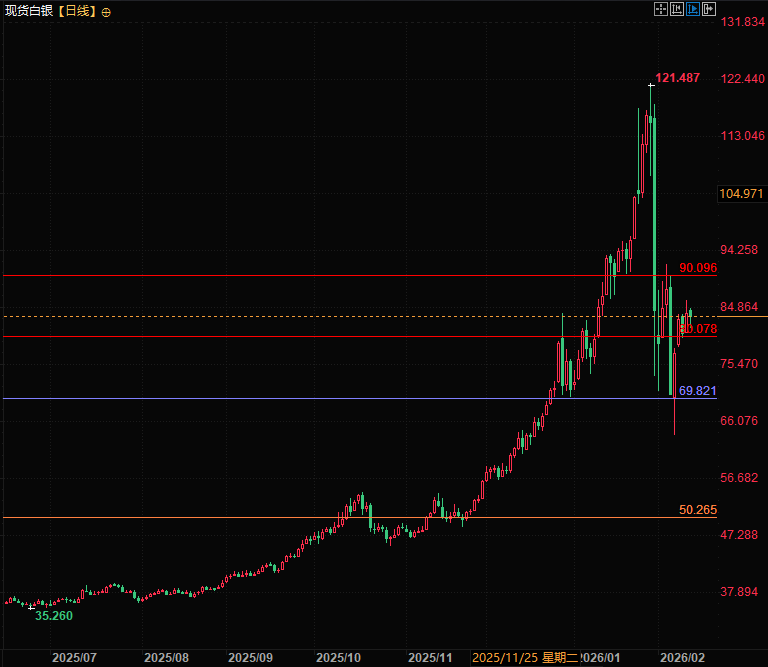
(Spot silver daily chart, source: EasyForex)
At 18:29 Beijing time, spot silver is currently trading at 83.40/41.
Silver has long been overshadowed by gold in the precious metals market and has always been regarded as a "supporting role" to gold, but the surge in 2025 completely rewrote market perception.
Historically, the gold-silver ratio has exceeded an extreme level of 100:1, but it has now converged to a 15-year low. This indicates that silver is significantly overvalued relative to gold in the traditional sense, and also represents a shift in the perception of silver prices under a new narrative.
In early 2026, gold and silver experienced violent fluctuations in tandem. After spot silver broke through $90/ounce in January to reach a record high, it plummeted by 27% in a single day due to the change in the nomination of the Federal Reserve Chairman. In just one month, it completed a rapid switch between "madness and fear". Its historical volatility of 33% is 1.7 times that of gold, which fully demonstrates the high-risk and high-return characteristics of "poor man's gold".
Core Drivers: Supported by both policy changes and supply and demand dynamics
The core driving logic for silver prices in 2026 will continue the fundamental support from 2025, but will also face the impact of new policy variables.
In terms of upward momentum, the surge in industrial demand is the key pillar – industrial applications account for about 60% of total silver demand (excluding ETF fund flows), with the demand growth in the photovoltaic industry being particularly prominent. As high-efficiency battery technology iterates, the silver consumption per module has increased significantly, and the global photovoltaic installation boom led by China continues to drive silver demand.
Policy changes also profoundly affect silver prices. Since 2025, the U.S. Department of Commerce has been reviewing critical minerals under Section 232 of the Trade Expansion Act of 1962. This policy uncertainty has become an important factor driving up silver prices.
Until mid-January 2026, Trump shelved his plan to impose new tariffs on imports of key minerals such as silver, and instead secured supply chain stability through bilateral agreements. Silver prices recovered quickly after a brief correction.
However, the news on January 30 that Kevin Warsh was nominated as the next Federal Reserve Chairman triggered market concerns about a shift in monetary policy. Coupled with a recovery in confidence in the US dollar, this directly led to a sharp drop in silver prices, while gold also fell by 10%, highlighting the sensitive impact of policy expectations on the precious metals market.
Structural constraints on the supply side: long-term support for silver prices
Silver is mostly produced as a by-product of base metals such as copper, lead, and zinc. This characteristic determines that its output has a relatively limited elasticity to the rise in silver prices, making it difficult to meet explosive demand through rapid expansion. This is the logic of the double elasticity triggering price surge mentioned in the previous article on silver. That is, the price elasticity of silver mine production is low, coupled with the demand elasticity of electrical and photovoltaic manufacturers' prices, forming a double elasticity pattern, which makes the spot price of silver greatly affected by the physical demand for silver.
As of February 2026, London silver was trading at $83.59 per ounce, and the Shanghai silver futures contract was priced at 20,626 yuan per kilogram, remaining at historically high levels, reflecting the market's recognition of the tight supply situation.
Potential concerns: The dual risks of industrial substitution and market sentiment.
Behind the explosive growth in silver demand lie long-term risks that cannot be ignored.
Gregory Shiller, head of base and precious metals strategy at JPMorgan Chase, warned that the surge in silver prices has begun to force downstream industries to seek alternatives, especially as photovoltaic manufacturers are accelerating the development of "silver-free" technologies.
On the one hand, companies are reducing the amount of silver paste used per module by optimizing processes; on the other hand, they are actively developing silver-free technologies such as cadmium telluride thin films. This substantial acceleration of the substitution trend will have a structural impact on the silver supply and demand balance in the coming quarters.
Industry feedback indicates that high silver prices have already had a significant impact.
When the price of silver on the Shanghai Futures Exchange broke through 30,000 yuan/kg, silver accounted for more than 30% of the cost of photovoltaic raw materials, far exceeding the 9% level in 2024.
Several photovoltaic companies, including LONGi Green Energy, have listed the "rising silver price" as a key factor in their expected losses in 2025. Downstream module manufacturers have seen a sharp decrease of about 50% in their orders for silver paste. If silver prices remain high for an extended period, the photovoltaic industry may face pressure to reduce its production capacity.
However, Shiller also admitted that technological substitution takes several years, and in the short term, fluctuations in investment demand and changes in market risk appetite remain the core variables driving silver price trends.
The unique nature of the market structure also exacerbates the risk of silver price volatility.
Unlike gold, which has global central banks as a structural force to buy on dips, silver lacks such benchmark demand support, and its pricing depends more on the interplay between speculative funds and industrial demand.
The market conditions at the beginning of 2026 have clearly shown that overseas traders hoarding physical silver creates a short squeeze, coupled with speculative funds rushing to buy, which can easily drive silver prices to surge away from fundamentals; and when market sentiment shifts, silver, lacking central bank support, will face an even more severe correction.
Furthermore, concerns about delivery defaults triggered by the abnormal increase in COMEX silver delivery applications could also become a catalyst for exacerbating market volatility.
Market Outlook: Bottom Rising but Upside Potential Uncertain
The market is cautiously optimistic about the overall trend of silver prices in 2026.
From a support level perspective, investment demand from major markets such as China and India has become an important pillar. In particular, China's strong investment demand has had a significant impact on the pricing of the entire metals market and has become a key catalyst to be monitored in the coming weeks.
The continuation of the Fed's easing cycle has also provided macro support for silver prices. Although the nomination of the new chairman has caused short-term fluctuations, the market still expects at least two 25-basis-point rate cuts in 2026. In a low-interest-rate environment, the attractiveness of silver, which has the attribute of being a non-interest-bearing asset, is expected to continue to increase.
However, upside potential remains constrained by multiple factors. Shiller predicts that due to the lack of central banks as structural buyers, there is a potential risk of further appreciation in the gold-silver ratio, which means that silver's gains may lag behind gold's.
Meanwhile, the promotion of industrial substitution technologies, the uncertainty of the pace of global economic recovery, and profit-taking by speculative funds may all limit the extent of silver price increases.
As of February 2026, market opinions on silver have diverged: bulls adhere to the logic of tight supply and demand balance, while bears worry about the bursting of the price bubble. JPMorgan Chase has clearly stated that it is cautious about re-entering the silver market in the short term and needs to wait for a clear signal that the recent price bubble has been fully squeezed out.
Summary and Technical Analysis:
Overall, the bottom of silver prices in 2026 has risen significantly compared to previous years, but the characteristics of "high volatility and high elasticity" will not change.
The core logic behind the price increase is the rigid support of industrial demand and the structural constraints on the supply side, while the risks of technological substitution and market sentiment fluctuations bring downward pressure.
For investors, it is necessary to closely monitor the technological iteration of the photovoltaic industry, the policy direction of the Federal Reserve, and the evolution of global geopolitical risks. While grasping long-term trends, investors should be wary of trading risks brought about by short-term fluctuations.
The key price for silver is also easy to grasp; it fluctuates around the initial 30, 70, 90, and 110 levels, and currently around the round numbers 70, 80, and 90.
(Spot silver daily chart, source: EasyForex)
At 18:29 Beijing time, spot silver is currently trading at 83.40/41.
- Risk Warning and Disclaimer
- The market involves risk, and trading may not be suitable for all investors. This article is for reference only and does not constitute personal investment advice, nor does it take into account certain users’ specific investment objectives, financial situation, or other needs. Any investment decisions made based on this information are at your own risk.