Silver Forecast: CPI Data Imminent, Silver Market Outlook Turns Cautious
2026-02-13 01:17:08
On Thursday (February 12), spot silver prices fell sharply during the US trading session, reaching $76.373 per ounce, a drop of 9.13%. Traders are continuing to assess the impact of yesterday's US non-farm payroll report—which showed employment data far exceeding market expectations, prompting a reassessment of the Federal Reserve's monetary policy direction. The core question in the market now is how the Fed will use this employment data to determine the specific timing of its next interest rate cut.
Looking back at the Federal Reserve's statements in January, it clearly indicated that the main contradiction in the current US economy is no longer the tight labor market, but rather the persistently high inflation level. This also explains why the market reacted relatively mildly to the better-than-expected non-farm payroll report: for silver traders, inflation data has become far more important than employment data, and Friday's upcoming consumer inflation report may become the key variable breaking the current narrow trading range of silver.
Silver Analysis: The narrower the trading range, the greater the price volatility.
The current market's core characteristic is that silver prices are compressed into an extremely narrow trading range. The longer the consolidation period and the tighter the range, the stronger the impact of subsequent inflation reports on its short-term trend will be. This "ready to strike" pattern means that once the CPI data exceeds market expectations, silver prices are highly likely to experience sharp directional fluctuations.
Different CPI data results will lead to drastically different market trends: if the inflation data far exceeds market expectations (i.e., "inflation explodes"), silver prices will not only experience a sharp sell-off during the day, but may also break through the key technical support level of the 50-day moving average and further test the Fibonacci retracement support level; if the inflation data is significantly higher than expected and shows a "feverish" trend, silver prices may even fall sharply to the multi-month low of $64.06 per ounce reached last week.
Conversely, if inflation data falls short of market expectations, it will significantly boost market expectations for a Federal Reserve rate cut, thereby pushing silver prices out of their current trading range and initiating a rebound. Key resistance levels to watch are the $92.20 to $92.87 range. Essentially, the market will likely maintain a range-bound trading pattern in the short term, but the release of CPI data will significantly widen its volatility.
50-day moving average: A key watershed in the battle between bulls and bears.
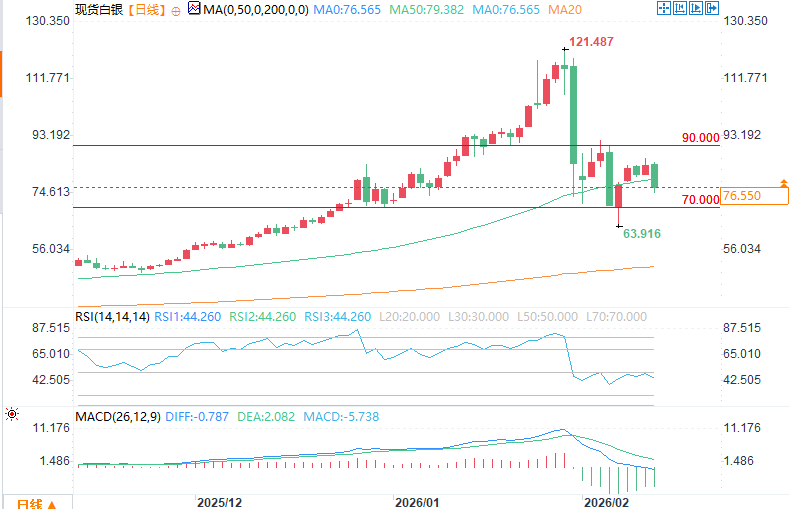
(Spot gold daily chart source: FX678)
In the current market, the 50-day moving average has become a "lifeline" for measuring the balance of power between bulls and bears in silver, and its performance directly determines the short-term trend of silver. For short-term traders, the 50-day moving average is both an important technical support level and a potential breakout trigger point—once the price effectively breaks below this moving average, it may trigger a new round of stop-loss selling. For long-term traders, the 50-day moving average, together with the 200-day moving average, constitutes a medium- to long-term value buying range for silver, and many long-term funds will position themselves around this range.
For short-term traders, the core logic of the current market revolves entirely around the expectation of a Fed rate cut: data that could push the Fed to cut rates as early as March would be a clear positive for silver, driving prices upward; if the data maintains the current market expectation of a June rate cut, silver prices will likely continue to fluctuate within the existing range; however, if the data shows persistently high inflationary pressures (i.e., "overheated data"), it could lead the Fed to postpone the rate cut until September, at which point silver prices would be suppressed to the lower end of the current trading range, or even break below the range to create new lows.
The Warsh Factor and Chinese Demand: Two Major Uncertainties
Looking back at the performance of the silver market last year, it experienced a strong upward trend: at the beginning of the year, the price of silver was only around $29 per ounce, but it soared to nearly $100 per ounce by the end of the year, and by the end of January 2026, the price even broke through $120 per ounce, a remarkable increase. However, after President Trump announced on January 30 that he was nominating Kevin Warsh as the next chairman of the Federal Reserve, the upward trend in the silver market reversed instantly, with the price plummeting by more than 30% in a single day, giving back a significant portion of the previous gains, and the upward trend completely stalled.
It is reported that Kevin Warsh will officially take office in June, coinciding with the Federal Reserve's June monetary policy meeting. His policy stance will be a key variable influencing the future trend of silver. Currently, the market remains uncertain about Warsh's policy position: Will he comply with President Trump's demands for interest rate cuts and push the Fed to ease monetary policy? Or will he adhere to the core objective of curbing inflation and maintain the current high interest rate level? This uncertainty will continue to disrupt short-term sentiment in the silver market.
Besides the uncertainty surrounding the Federal Reserve's policies, changes in silver demand in the Chinese market are another major uncertainty. As a major global consumer and importer of silver, whether China's investment and industrial demand for silver will accelerate its recovery will directly affect the global supply and demand pattern for silver, thus providing significant support or suppression for prices.
In summary, the medium- to long-term support provided by central banks around the world's continued silver purchases remains solid—this is one of the core logics behind the long-term positive outlook for silver. However, the short-term volatility and trend of silver will gradually become clearer after the uncertainty of the Federal Reserve's policies is eliminated.
Looking back at the Federal Reserve's statements in January, it clearly indicated that the main contradiction in the current US economy is no longer the tight labor market, but rather the persistently high inflation level. This also explains why the market reacted relatively mildly to the better-than-expected non-farm payroll report: for silver traders, inflation data has become far more important than employment data, and Friday's upcoming consumer inflation report may become the key variable breaking the current narrow trading range of silver.
Silver Analysis: The narrower the trading range, the greater the price volatility.
The current market's core characteristic is that silver prices are compressed into an extremely narrow trading range. The longer the consolidation period and the tighter the range, the stronger the impact of subsequent inflation reports on its short-term trend will be. This "ready to strike" pattern means that once the CPI data exceeds market expectations, silver prices are highly likely to experience sharp directional fluctuations.
Different CPI data results will lead to drastically different market trends: if the inflation data far exceeds market expectations (i.e., "inflation explodes"), silver prices will not only experience a sharp sell-off during the day, but may also break through the key technical support level of the 50-day moving average and further test the Fibonacci retracement support level; if the inflation data is significantly higher than expected and shows a "feverish" trend, silver prices may even fall sharply to the multi-month low of $64.06 per ounce reached last week.
Conversely, if inflation data falls short of market expectations, it will significantly boost market expectations for a Federal Reserve rate cut, thereby pushing silver prices out of their current trading range and initiating a rebound. Key resistance levels to watch are the $92.20 to $92.87 range. Essentially, the market will likely maintain a range-bound trading pattern in the short term, but the release of CPI data will significantly widen its volatility.
50-day moving average: A key watershed in the battle between bulls and bears.
(Spot gold daily chart source: FX678)
In the current market, the 50-day moving average has become a "lifeline" for measuring the balance of power between bulls and bears in silver, and its performance directly determines the short-term trend of silver. For short-term traders, the 50-day moving average is both an important technical support level and a potential breakout trigger point—once the price effectively breaks below this moving average, it may trigger a new round of stop-loss selling. For long-term traders, the 50-day moving average, together with the 200-day moving average, constitutes a medium- to long-term value buying range for silver, and many long-term funds will position themselves around this range.
For short-term traders, the core logic of the current market revolves entirely around the expectation of a Fed rate cut: data that could push the Fed to cut rates as early as March would be a clear positive for silver, driving prices upward; if the data maintains the current market expectation of a June rate cut, silver prices will likely continue to fluctuate within the existing range; however, if the data shows persistently high inflationary pressures (i.e., "overheated data"), it could lead the Fed to postpone the rate cut until September, at which point silver prices would be suppressed to the lower end of the current trading range, or even break below the range to create new lows.
The Warsh Factor and Chinese Demand: Two Major Uncertainties
Looking back at the performance of the silver market last year, it experienced a strong upward trend: at the beginning of the year, the price of silver was only around $29 per ounce, but it soared to nearly $100 per ounce by the end of the year, and by the end of January 2026, the price even broke through $120 per ounce, a remarkable increase. However, after President Trump announced on January 30 that he was nominating Kevin Warsh as the next chairman of the Federal Reserve, the upward trend in the silver market reversed instantly, with the price plummeting by more than 30% in a single day, giving back a significant portion of the previous gains, and the upward trend completely stalled.
It is reported that Kevin Warsh will officially take office in June, coinciding with the Federal Reserve's June monetary policy meeting. His policy stance will be a key variable influencing the future trend of silver. Currently, the market remains uncertain about Warsh's policy position: Will he comply with President Trump's demands for interest rate cuts and push the Fed to ease monetary policy? Or will he adhere to the core objective of curbing inflation and maintain the current high interest rate level? This uncertainty will continue to disrupt short-term sentiment in the silver market.
Besides the uncertainty surrounding the Federal Reserve's policies, changes in silver demand in the Chinese market are another major uncertainty. As a major global consumer and importer of silver, whether China's investment and industrial demand for silver will accelerate its recovery will directly affect the global supply and demand pattern for silver, thus providing significant support or suppression for prices.
In summary, the medium- to long-term support provided by central banks around the world's continued silver purchases remains solid—this is one of the core logics behind the long-term positive outlook for silver. However, the short-term volatility and trend of silver will gradually become clearer after the uncertainty of the Federal Reserve's policies is eliminated.
- Risk Warning and Disclaimer
- The market involves risk, and trading may not be suitable for all investors. This article is for reference only and does not constitute personal investment advice, nor does it take into account certain users’ specific investment objectives, financial situation, or other needs. Any investment decisions made based on this information are at your own risk.