Gold Trading Alert: Cooling inflation and US-Iran tensions boost safe-haven demand, but why aren't gold prices rising? This week's PCE will determine the outcome.
2026-02-16 08:36:19
On Monday (February 16) in early Asian trading, spot gold prices fluctuated downwards due to selling pressure following the previous day's gains, currently trading around $5,010 per ounce, down about 0.55% on the day. The previous trading day saw a reversal in gold prices, recovering some of Thursday's losses after rising nearly 2% following a weaker-than-expected US inflation report. This increased market speculation about a possible interest rate cut by the Federal Reserve, helping gold prices regain the $5,000 mark. On Monday, gold prices were under pressure from selling and are testing the $5,000 support level.
Data from the U.S. Bureau of Labor Statistics showed that the Consumer Price Index (CPI) rose 2.4% year-on-year in January, lower than the expected 2.5% and the previous reading of 2.7%. While this data provides a positive signal for the economy, the core CPI remained at a sticky level of 2.5% year-on-year, in line with market expectations but slightly lower than the previous reading of 2.6%.
Gold prices initially fell back after hitting the $5,000 mark on Friday, but buying power emerged and bargain hunters bought near $4,950, pushing gold prices back to their intraday high.
However, the overall U.S. economic data released this week was robust. The January non-farm payroll report was strong, with over 130,000 new jobs added and the unemployment rate remaining at 4.4%, easing the pressure on the Federal Reserve regarding the labor market.
The question then arises: Will the Federal Reserve cut interest rates? They typically seek more data to confirm a resumption of the deflationary process. Following a peak inflation rate of 3% in September 2025, the three most recent readings were 2.7% in November and December 2025, and 2.4% in January 2026. Therefore, the initial conditions are in place, but the current stance of most Fed officials, led by Chairman Jerome Powell, suggests they may remain on hold until Kevin Warsh succeeds Powell in May.
Money markets have increased their expectations for a June rate cut. According to data from Prime Market Terminal, the probability of a 25 basis point rate cut by the Federal Reserve is 55%.
Meanwhile, U.S. Treasury yields continued to decline last week, providing support for gold prices. The yield on the 10-year U.S. Treasury note touched a two-and-a-half-month low (4.05%) on Friday.
The US dollar index fluctuated narrowly around 96.90 during the Asian session on Monday, maintaining its previous sideways trend, which is expected to reduce the volatility of gold.
Last Sunday, Ibrahim Rezaei, spokesman for the Iranian parliament’s National Security and Foreign Policy Committee, said that the current negotiations did not discuss Iran’s cessation or abandonment of uranium enrichment activities, nor did they involve the removal of Iranian nuclear materials from the country; these issues have been accepted by the United States.
Rezaei emphasized that the Geneva negotiations were unrelated to the missile issue or regional problems. Iran believes that Israel is the primary issue in the region, and the Israeli threat should be excluded from the Geneva negotiations and discussed with other countries in the region through other means to ensure their development, peace, and common interests. Rezaei pointed out that the Iranian negotiating team has prepared a negotiating plan, "but considering the US's past record, we are not very optimistic about the outcome of the negotiations." The ongoing US-Iran tensions continue to support safe-haven gold, which is expected to limit the downside potential of gold prices.
Looking ahead to this week, the U.S. economic calendar will be packed with events, with a focus on durable goods orders, housing data, a series of speeches by Federal Reserve officials, and the release of the Federal Open Market Committee (FOMC) meeting minutes. Later in the week, traders will focus on initial jobless claims, the revised Q4 2025 GDP figure, and the release of the Fed's preferred inflation gauge—the core personal consumption expenditures (PCE) price index.
The daily chart shows that gold remains above key technical levels. Although it experienced brief downward pressure, the bullish tone remains intact, with the bulls still holding above the 20-day exponential moving average (EMA, 4926.67). The 14-day Relative Strength Index (RSI) is above the 50 midline, indicating that buying momentum is continuing to build.
However, gold prices must decisively break through $5,100 to open up further upside potential. Once this resistance level is breached, the next target will be $5,200, followed by the historical high near $5,600. Conversely, if gold prices fail to hold the $5,000 mark, they may face downward pressure.
On the downside, key support lies around $4926, where the 20-day EMA is located. A break below this level would test the $4900 mark. If the decline continues, the next support level to watch is $4800, with the ultimate target at $4692.35, where the 50-day EMA is located.
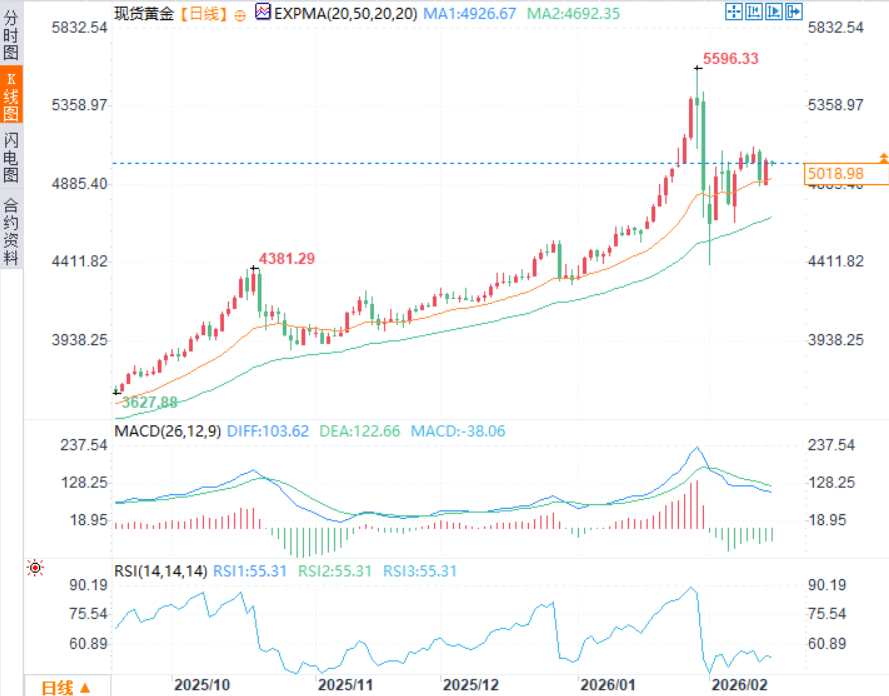
(Spot gold daily chart, source: FX678)
At 8:31 Beijing time, spot gold was trading at $5,012.68 per ounce.
Gold prices rose on Friday as weaker-than-expected US inflation data rekindled hopes for a June rate cut.
Data from the U.S. Bureau of Labor Statistics showed that the Consumer Price Index (CPI) rose 2.4% year-on-year in January, lower than the expected 2.5% and the previous reading of 2.7%. While this data provides a positive signal for the economy, the core CPI remained at a sticky level of 2.5% year-on-year, in line with market expectations but slightly lower than the previous reading of 2.6%.
Gold prices initially fell back after hitting the $5,000 mark on Friday, but buying power emerged and bargain hunters bought near $4,950, pushing gold prices back to their intraday high.
However, the overall U.S. economic data released this week was robust. The January non-farm payroll report was strong, with over 130,000 new jobs added and the unemployment rate remaining at 4.4%, easing the pressure on the Federal Reserve regarding the labor market.
The question then arises: Will the Federal Reserve cut interest rates? They typically seek more data to confirm a resumption of the deflationary process. Following a peak inflation rate of 3% in September 2025, the three most recent readings were 2.7% in November and December 2025, and 2.4% in January 2026. Therefore, the initial conditions are in place, but the current stance of most Fed officials, led by Chairman Jerome Powell, suggests they may remain on hold until Kevin Warsh succeeds Powell in May.
Money markets have increased their expectations for a June rate cut. According to data from Prime Market Terminal, the probability of a 25 basis point rate cut by the Federal Reserve is 55%.
Gold prices rose last week as lower U.S. Treasury yields helped push prices higher, with trading expected to resume this week.
Meanwhile, U.S. Treasury yields continued to decline last week, providing support for gold prices. The yield on the 10-year U.S. Treasury note touched a two-and-a-half-month low (4.05%) on Friday.
The US dollar index fluctuated narrowly around 96.90 during the Asian session on Monday, maintaining its previous sideways trend, which is expected to reduce the volatility of gold.
US and Iranian officials expressed pessimism about the outcome of the negotiations, which continued to support safe-haven gold prices.
Last Sunday, Ibrahim Rezaei, spokesman for the Iranian parliament’s National Security and Foreign Policy Committee, said that the current negotiations did not discuss Iran’s cessation or abandonment of uranium enrichment activities, nor did they involve the removal of Iranian nuclear materials from the country; these issues have been accepted by the United States.
Rezaei emphasized that the Geneva negotiations were unrelated to the missile issue or regional problems. Iran believes that Israel is the primary issue in the region, and the Israeli threat should be excluded from the Geneva negotiations and discussed with other countries in the region through other means to ensure their development, peace, and common interests. Rezaei pointed out that the Iranian negotiating team has prepared a negotiating plan, "but considering the US's past record, we are not very optimistic about the outcome of the negotiations." The ongoing US-Iran tensions continue to support safe-haven gold, which is expected to limit the downside potential of gold prices.
Market focus shifts to the FOMC meeting minutes, speeches by Federal Reserve officials, and PCE data.
Looking ahead to this week, the U.S. economic calendar will be packed with events, with a focus on durable goods orders, housing data, a series of speeches by Federal Reserve officials, and the release of the Federal Open Market Committee (FOMC) meeting minutes. Later in the week, traders will focus on initial jobless claims, the revised Q4 2025 GDP figure, and the release of the Fed's preferred inflation gauge—the core personal consumption expenditures (PCE) price index.
Gold Technical Outlook: Gold Prices Test $5,000 Support Level
The daily chart shows that gold remains above key technical levels. Although it experienced brief downward pressure, the bullish tone remains intact, with the bulls still holding above the 20-day exponential moving average (EMA, 4926.67). The 14-day Relative Strength Index (RSI) is above the 50 midline, indicating that buying momentum is continuing to build.
However, gold prices must decisively break through $5,100 to open up further upside potential. Once this resistance level is breached, the next target will be $5,200, followed by the historical high near $5,600. Conversely, if gold prices fail to hold the $5,000 mark, they may face downward pressure.
On the downside, key support lies around $4926, where the 20-day EMA is located. A break below this level would test the $4900 mark. If the decline continues, the next support level to watch is $4800, with the ultimate target at $4692.35, where the 50-day EMA is located.
(Spot gold daily chart, source: FX678)
At 8:31 Beijing time, spot gold was trading at $5,012.68 per ounce.
- Risk Warning and Disclaimer
- The market involves risk, and trading may not be suitable for all investors. This article is for reference only and does not constitute personal investment advice, nor does it take into account certain users’ specific investment objectives, financial situation, or other needs. Any investment decisions made based on this information are at your own risk.