Tehran offers a "reciprocal" bargaining chip: nuclear concessions are acceptable, but the US must be on the table first, putting pressure on oil prices.
2026-02-16 10:25:53
Iranian diplomats revealed on Sunday (February 15) that Iran is seeking a nuclear agreement with the United States that would bring economic benefits to both sides. This statement, coming on the eve of the second round of negotiations between Tehran and Washington, highlights Iran's flexibility on the nuclear issue and its attempt to incorporate economic incentives into the core of the agreement to enhance its sustainability.
On Monday during Asian trading hours, US crude oil prices fluctuated narrowly around $62.80 per barrel, with the market appearing cautious and awaiting progress in US-Iran negotiations.
According to reports, Hamid Gambari, Deputy Director of Economic Diplomacy at the Iranian Foreign Ministry, stated, "To ensure the sustainability of the agreement, the United States must also gain benefits in high-return, quick-return economic sectors." He specifically pointed out that the negotiation topics cover cooperation in the oil and gas sector, joint development of oil and gas fields, mining investment, and even aircraft procurement. Gambari emphasized that while the 2015 Iran nuclear deal (JCPOA) eased some sanctions, it failed to fully guarantee US economic interests, which is a key lesson learned in the current negotiations.
Iran and the United States resumed talks earlier this month in an effort to resolve the decades-long dispute over Iran's nuclear program and avert a potential escalation of military conflict. The United States has deployed a second aircraft carrier to the Middle East and is preparing for prolonged military action should negotiations fail.
U.S. Secretary of State Marco Rubio stated that President Trump clearly favors resolving differences through diplomatic means and negotiations, but warned that this will not be easy. Rubio said, "No one in history has ever successfully reached an agreement with Iran, but we will still try."
The negotiations, brokered by Oman, are currently in an indirect bilateral format between the US and Iran, rather than the multilateral framework established in 2015. Iranian Foreign Minister Abbas Araqchi has left Tehran for Geneva to participate in indirect nuclear negotiations with the US and will meet with the head of the International Atomic Energy Agency (IAEA) and others. A US delegation—including special envoys Steve Witkov and Jared Kushner—is expected to meet with Iranian officials in Geneva on Tuesday (February 17).
Iranian Deputy Foreign Minister Majid Takht-Ravanchi stated that Iran is prepared to compromise on its nuclear program in exchange for the lifting of sanctions. He emphasized, "The ball is in the US's court; they need to prove they genuinely want an agreement." As an example of flexibility, he cited a statement last week by the head of the Atomic Energy Organization of Iran: Iran could agree to dilute its highly enriched uranium stockpile in exchange for sanctions relief. However, he reiterated that Tehran will never accept a "zero enrichment" requirement—a long-standing red line for the US, which views uranium enrichment in Iran as a potential path to nuclear weapons, while Iran denies pursuing nuclear weapons.
The Trump administration continues to increase economic pressure on Iran. Reports indicate that Trump and Israeli Prime Minister Netanyahu agreed during a meeting at the White House this week to jointly reduce Iranian oil exports to China. China accounts for over 80% of Iran's oil exports; if this trade is disrupted, Iran's oil revenues will shrink significantly.
Speaking at a meeting of major U.S. Jewish organizations on Sunday, Netanyahu said he had emphasized to Trump last week that any U.S.-Iran agreement must include the complete dismantling of Iran's nuclear infrastructure, not just a halt to enrichment activities. He expressed skepticism about such an agreement but stressed that enriched materials must leave Iran: "It can't just be a suspension of the enrichment process; it's about dismantling the equipment and infrastructure, eliminating enrichment capabilities at the source."
The resumption of US-Iran negotiations has the market closely watching the stability of Middle Eastern energy supplies. If an agreement is reached and sanctions are eased, the release of Iranian oil production capacity could put downward pressure on global oil prices; conversely, if negotiations break down and trigger military escalation, the risk of oil price volatility will increase significantly. Iran's proposed model of "mutually beneficial economic cooperation"—ranging from joint energy development to aircraft procurement—reflects its attempt to transform the nuclear agreement into a broader opportunity for economic thawing. However, the US has so far emphasized the nuclear issue as the core issue, attaching conditions including missile programs and regional proxy forces, indicating significant differences between the two sides.
The outcome of the second round of negotiations in Geneva may become a key juncture in determining the geopolitical landscape of the Middle East and the short-term direction of the global energy market, and the market needs to pay close attention.
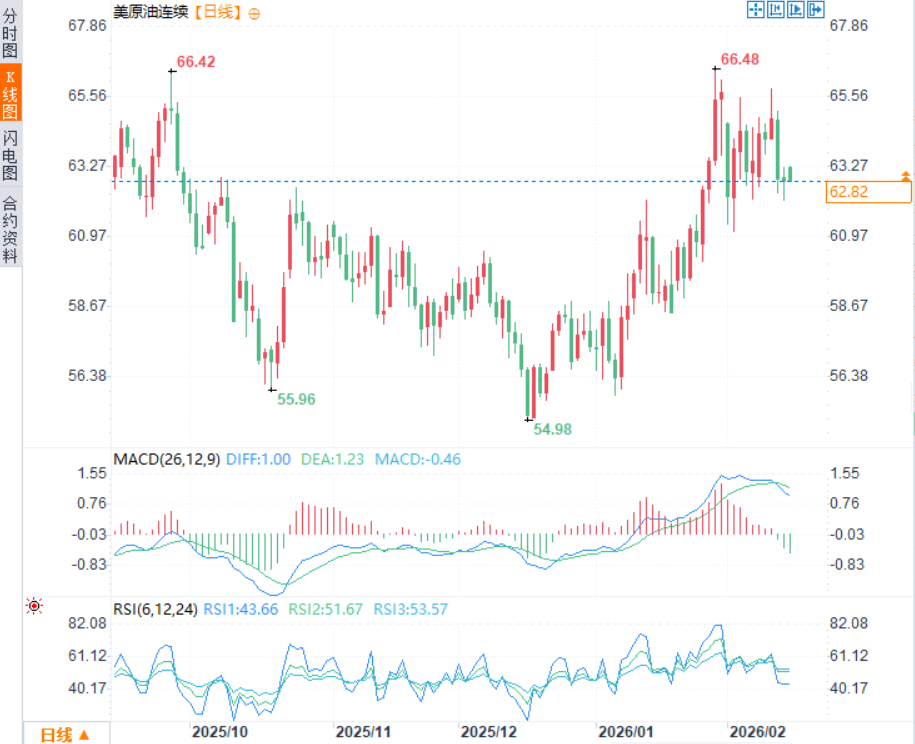
(US crude oil daily chart, source: FX678)
At 10:20 Beijing time, US crude oil futures were trading at $62.82 per barrel.
On Monday during Asian trading hours, US crude oil prices fluctuated narrowly around $62.80 per barrel, with the market appearing cautious and awaiting progress in US-Iran negotiations.
According to reports, Hamid Gambari, Deputy Director of Economic Diplomacy at the Iranian Foreign Ministry, stated, "To ensure the sustainability of the agreement, the United States must also gain benefits in high-return, quick-return economic sectors." He specifically pointed out that the negotiation topics cover cooperation in the oil and gas sector, joint development of oil and gas fields, mining investment, and even aircraft procurement. Gambari emphasized that while the 2015 Iran nuclear deal (JCPOA) eased some sanctions, it failed to fully guarantee US economic interests, which is a key lesson learned in the current negotiations.
Negotiation Background and Latest Developments
Iran and the United States resumed talks earlier this month in an effort to resolve the decades-long dispute over Iran's nuclear program and avert a potential escalation of military conflict. The United States has deployed a second aircraft carrier to the Middle East and is preparing for prolonged military action should negotiations fail.
U.S. Secretary of State Marco Rubio stated that President Trump clearly favors resolving differences through diplomatic means and negotiations, but warned that this will not be easy. Rubio said, "No one in history has ever successfully reached an agreement with Iran, but we will still try."
The negotiations, brokered by Oman, are currently in an indirect bilateral format between the US and Iran, rather than the multilateral framework established in 2015. Iranian Foreign Minister Abbas Araqchi has left Tehran for Geneva to participate in indirect nuclear negotiations with the US and will meet with the head of the International Atomic Energy Agency (IAEA) and others. A US delegation—including special envoys Steve Witkov and Jared Kushner—is expected to meet with Iranian officials in Geneva on Tuesday (February 17).
Iranian Deputy Foreign Minister Majid Takht-Ravanchi stated that Iran is prepared to compromise on its nuclear program in exchange for the lifting of sanctions. He emphasized, "The ball is in the US's court; they need to prove they genuinely want an agreement." As an example of flexibility, he cited a statement last week by the head of the Atomic Energy Organization of Iran: Iran could agree to dilute its highly enriched uranium stockpile in exchange for sanctions relief. However, he reiterated that Tehran will never accept a "zero enrichment" requirement—a long-standing red line for the US, which views uranium enrichment in Iran as a potential path to nuclear weapons, while Iran denies pursuing nuclear weapons.
Economic pressure and geopolitical competition
The Trump administration continues to increase economic pressure on Iran. Reports indicate that Trump and Israeli Prime Minister Netanyahu agreed during a meeting at the White House this week to jointly reduce Iranian oil exports to China. China accounts for over 80% of Iran's oil exports; if this trade is disrupted, Iran's oil revenues will shrink significantly.
Speaking at a meeting of major U.S. Jewish organizations on Sunday, Netanyahu said he had emphasized to Trump last week that any U.S.-Iran agreement must include the complete dismantling of Iran's nuclear infrastructure, not just a halt to enrichment activities. He expressed skepticism about such an agreement but stressed that enriched materials must leave Iran: "It can't just be a suspension of the enrichment process; it's about dismantling the equipment and infrastructure, eliminating enrichment capabilities at the source."
Market and Geopolitical Impact Outlook
The resumption of US-Iran negotiations has the market closely watching the stability of Middle Eastern energy supplies. If an agreement is reached and sanctions are eased, the release of Iranian oil production capacity could put downward pressure on global oil prices; conversely, if negotiations break down and trigger military escalation, the risk of oil price volatility will increase significantly. Iran's proposed model of "mutually beneficial economic cooperation"—ranging from joint energy development to aircraft procurement—reflects its attempt to transform the nuclear agreement into a broader opportunity for economic thawing. However, the US has so far emphasized the nuclear issue as the core issue, attaching conditions including missile programs and regional proxy forces, indicating significant differences between the two sides.
The outcome of the second round of negotiations in Geneva may become a key juncture in determining the geopolitical landscape of the Middle East and the short-term direction of the global energy market, and the market needs to pay close attention.
(US crude oil daily chart, source: FX678)
At 10:20 Beijing time, US crude oil futures were trading at $62.82 per barrel.
- Risk Warning and Disclaimer
- The market involves risk, and trading may not be suitable for all investors. This article is for reference only and does not constitute personal investment advice, nor does it take into account certain users’ specific investment objectives, financial situation, or other needs. Any investment decisions made based on this information are at your own risk.