Geopolitical conflicts failed to reverse the downward trend, and downward revisions to demand expectations suppressed the rebound in oil prices.
2026-02-16 18:19:33
On Monday (February 16), WTI crude oil was trading at $62.67 per barrel during the European session, down 0.35%.

Light crude oil futures prices showed a clear downward trend last week, ultimately closing lower. This sharp price fluctuation fully reflects the current dilemma in the crude oil market, a continuous struggle between safe-haven buying driven by geopolitical risks and increasing pressure from oversupply, with the forces of bulls and bears currently in a stalemate.
Trump dispatches a second fleet, escalating tensions between the US and Iran.
At the beginning of this week, global oil traders focused on the progress of US-Iran negotiations and the risk of Middle Eastern oil supply disruptions that could result from a breakdown in talks, an expectation that initially provided some support for oil prices. However, as negotiations continued, the two sides failed to reach a consensus on core issues, and the negotiations made no substantial progress. This stalemate gradually dampened market sentiment, and the optimistic expectations that had accumulated due to geopolitical risks gradually faded.
US President Trump has publicly expressed clear concerns about the prospects of a US-Iran agreement, revealing in a public speech that he is considering sending an additional naval fleet to the Middle East to increase pressure on Iran and push negotiations in a direction favorable to the US. This weekend, this military deployment plan was officially implemented, with the second US naval fleet successfully arriving in relevant waters in the Middle East. This move has been interpreted by the market as a strong statement from the US towards Iran, further escalating the tense standoff between the two countries.
From a geographical perspective, the core area of high market attention is the Strait of Hormuz, one of the world's most important oil transportation routes. Approximately 20% of global oil consumption needs are transported through this strait, and its security directly impacts the stability of global crude oil supply. Therefore, the simultaneous deployment of two US naval fleets within Iran's strike range creates a powerful military deterrent. This is the main reason why current crude oil prices still retain a certain war premium, which has, to some extent, curbed a significant drop in oil prices.
Oversupply has returned, hindering the rebound in oil prices.
Although the anticipated supply disruptions caused by geopolitical conflicts, and the resulting war premium, provided some support for crude oil prices and prevented a collapse, a new round of concerns about oversupply has gradually emerged and has significantly suppressed the upside potential of oil prices, causing recent attempts to rebound to repeatedly fail.
Last Wednesday, the U.S. Energy Information Administration (EIA) released its weekly crude oil inventory report as scheduled. The core data in the report exceeded market expectations, unexpectedly showing a surge of 8.5 million barrels in crude oil inventories. This figure not only far exceeded the expected 793,000 barrels but also represented a significant increase compared to the previous week's inventory levels. This crucial data release serves as a stark reminder to the global market that the crude oil market is currently facing persistent and severe oversupply pressure. The imbalance between supply and demand has not improved but rather shows a tendency to worsen. This negative news directly stifled the rebound in crude oil prices that week, pushing prices back into a downward trend.
The IEA's downward revision of demand forecasts was the "final blow" that crushed oil prices.
It's worth noting that after the release of the bearish EIA inventory data, the crude oil market did not immediately show a significant weakening trend. Traders were still observing further developments in the geopolitical situation, and market sentiment remained in a state of temporary stalemate. It wasn't until last Thursday, when the International Energy Agency (IEA) released its latest global oil demand outlook report, officially lowering its forecast for global oil demand growth in 2026, that this news truly triggered the market decline, becoming the "final blow" that crushed oil prices.
The IEA report indicated that, influenced by multiple factors including a slowdown in the global economic recovery, accelerated substitution of new energy sources, and adjustments in the energy consumption structure of major economies, global oil demand growth in 2026 will be lower than previously expected. This adjustment directly altered market sentiment regarding the future supply and demand pattern of oil, causing the overall sentiment in the oil market to shift from optimistic to pessimistic this week. The negative impact of this news was significant enough to offset, to some extent, the war premium included in oil prices, but it did not completely eliminate this premium. Therefore, oil prices did not experience a collapse, but rather exhibited a fluctuating downward trend.
Market Outlook: Barring any major news, oil prices are expected to remain range-bound.
From the current market perspective, as long as the focus of the global crude oil market remains on the core issue of oversupply, crude oil prices will continue to face downward pressure this week, and are likely to maintain a weak and volatile trend. However, the crude oil market is highly uncertain. If the US-Iran negotiations completely break down and the confrontation between the two sides escalates further, the market focus will quickly shift from oversupply to the risk of supply disruption. The US fleet deployed in the Strait of Hormuz may launch a military strike against Iran, which would severely affect global crude oil supply and drive a rapid rebound in oil prices.
In addition, global crude oil traders will continue to closely monitor the weekly inventory data released by the U.S. Energy Information Administration (EIA), which directly reflects changes in domestic crude oil supply in the United States and has a significant impact on short-term oil price trends. At the same time, key economic data such as U.S. GDP will also be a focus of market attention, as these data will reflect the state of the U.S. economic recovery and thus affect crude oil demand expectations, indirectly impacting crude oil price trends.
Technical Analysis: War premium supports key price levels
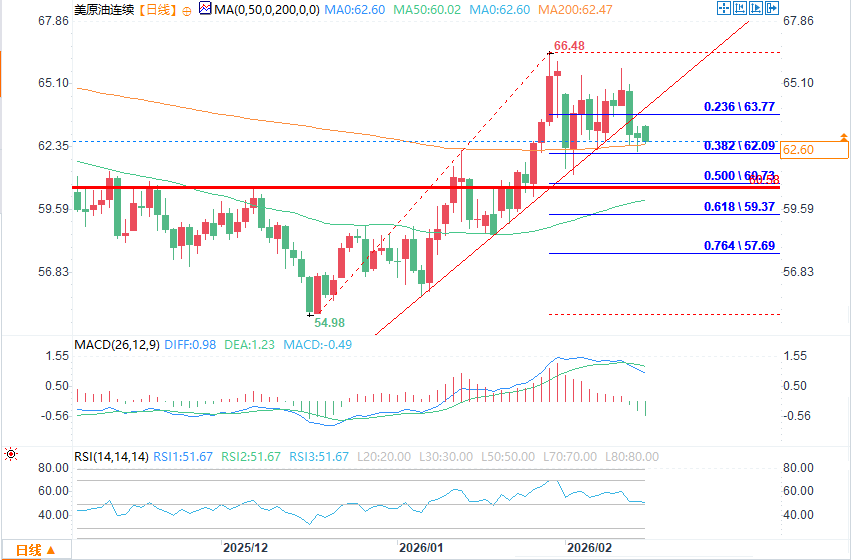
(WTI crude oil daily chart source: FX678)
From a technical perspective, crude oil prices are currently holding above the 52-week moving average of $60.58 per barrel. This price level has become an important support level for oil prices, mainly due to the support from the war premium. Market concerns about supply disruptions caused by geopolitical conflicts have led traders to form some buying support near this price level, preventing oil prices from falling below this key technical level.
Despite technical support and the war premium, the upside potential for crude oil prices is currently significantly limited: the long-term key level is $63.62 per barrel, which has become a significant resistance level; meanwhile, the short-term pullback resistance range is $64.91 to $67.32 per barrel, a range with a large number of trapped positions and profit-taking, creating significant pressure. Looking back at historical trends, a month ago, crude oil prices encountered resistance and fell back after reaching $66.48 per barrel within this range, failing to break through effectively, demonstrating the strength of this resistance level.
Considering the current fundamentals, geopolitical situation, and technical factors, unless there are significant positive or negative news to reverse the current bullish or bearish trend, crude oil prices are likely to maintain a range-bound trading pattern in the near future. The bulls and bears will continue to fight around key support and resistance levels, and market sentiment will fluctuate in stages mainly due to the influence of geopolitical situation and inventory data.
Light crude oil futures prices showed a clear downward trend last week, ultimately closing lower. This sharp price fluctuation fully reflects the current dilemma in the crude oil market, a continuous struggle between safe-haven buying driven by geopolitical risks and increasing pressure from oversupply, with the forces of bulls and bears currently in a stalemate.
Trump dispatches a second fleet, escalating tensions between the US and Iran.
At the beginning of this week, global oil traders focused on the progress of US-Iran negotiations and the risk of Middle Eastern oil supply disruptions that could result from a breakdown in talks, an expectation that initially provided some support for oil prices. However, as negotiations continued, the two sides failed to reach a consensus on core issues, and the negotiations made no substantial progress. This stalemate gradually dampened market sentiment, and the optimistic expectations that had accumulated due to geopolitical risks gradually faded.
US President Trump has publicly expressed clear concerns about the prospects of a US-Iran agreement, revealing in a public speech that he is considering sending an additional naval fleet to the Middle East to increase pressure on Iran and push negotiations in a direction favorable to the US. This weekend, this military deployment plan was officially implemented, with the second US naval fleet successfully arriving in relevant waters in the Middle East. This move has been interpreted by the market as a strong statement from the US towards Iran, further escalating the tense standoff between the two countries.
From a geographical perspective, the core area of high market attention is the Strait of Hormuz, one of the world's most important oil transportation routes. Approximately 20% of global oil consumption needs are transported through this strait, and its security directly impacts the stability of global crude oil supply. Therefore, the simultaneous deployment of two US naval fleets within Iran's strike range creates a powerful military deterrent. This is the main reason why current crude oil prices still retain a certain war premium, which has, to some extent, curbed a significant drop in oil prices.
Oversupply has returned, hindering the rebound in oil prices.
Although the anticipated supply disruptions caused by geopolitical conflicts, and the resulting war premium, provided some support for crude oil prices and prevented a collapse, a new round of concerns about oversupply has gradually emerged and has significantly suppressed the upside potential of oil prices, causing recent attempts to rebound to repeatedly fail.
Last Wednesday, the U.S. Energy Information Administration (EIA) released its weekly crude oil inventory report as scheduled. The core data in the report exceeded market expectations, unexpectedly showing a surge of 8.5 million barrels in crude oil inventories. This figure not only far exceeded the expected 793,000 barrels but also represented a significant increase compared to the previous week's inventory levels. This crucial data release serves as a stark reminder to the global market that the crude oil market is currently facing persistent and severe oversupply pressure. The imbalance between supply and demand has not improved but rather shows a tendency to worsen. This negative news directly stifled the rebound in crude oil prices that week, pushing prices back into a downward trend.
The IEA's downward revision of demand forecasts was the "final blow" that crushed oil prices.
It's worth noting that after the release of the bearish EIA inventory data, the crude oil market did not immediately show a significant weakening trend. Traders were still observing further developments in the geopolitical situation, and market sentiment remained in a state of temporary stalemate. It wasn't until last Thursday, when the International Energy Agency (IEA) released its latest global oil demand outlook report, officially lowering its forecast for global oil demand growth in 2026, that this news truly triggered the market decline, becoming the "final blow" that crushed oil prices.
The IEA report indicated that, influenced by multiple factors including a slowdown in the global economic recovery, accelerated substitution of new energy sources, and adjustments in the energy consumption structure of major economies, global oil demand growth in 2026 will be lower than previously expected. This adjustment directly altered market sentiment regarding the future supply and demand pattern of oil, causing the overall sentiment in the oil market to shift from optimistic to pessimistic this week. The negative impact of this news was significant enough to offset, to some extent, the war premium included in oil prices, but it did not completely eliminate this premium. Therefore, oil prices did not experience a collapse, but rather exhibited a fluctuating downward trend.
Market Outlook: Barring any major news, oil prices are expected to remain range-bound.
From the current market perspective, as long as the focus of the global crude oil market remains on the core issue of oversupply, crude oil prices will continue to face downward pressure this week, and are likely to maintain a weak and volatile trend. However, the crude oil market is highly uncertain. If the US-Iran negotiations completely break down and the confrontation between the two sides escalates further, the market focus will quickly shift from oversupply to the risk of supply disruption. The US fleet deployed in the Strait of Hormuz may launch a military strike against Iran, which would severely affect global crude oil supply and drive a rapid rebound in oil prices.
In addition, global crude oil traders will continue to closely monitor the weekly inventory data released by the U.S. Energy Information Administration (EIA), which directly reflects changes in domestic crude oil supply in the United States and has a significant impact on short-term oil price trends. At the same time, key economic data such as U.S. GDP will also be a focus of market attention, as these data will reflect the state of the U.S. economic recovery and thus affect crude oil demand expectations, indirectly impacting crude oil price trends.
Technical Analysis: War premium supports key price levels
(WTI crude oil daily chart source: FX678)
From a technical perspective, crude oil prices are currently holding above the 52-week moving average of $60.58 per barrel. This price level has become an important support level for oil prices, mainly due to the support from the war premium. Market concerns about supply disruptions caused by geopolitical conflicts have led traders to form some buying support near this price level, preventing oil prices from falling below this key technical level.
Despite technical support and the war premium, the upside potential for crude oil prices is currently significantly limited: the long-term key level is $63.62 per barrel, which has become a significant resistance level; meanwhile, the short-term pullback resistance range is $64.91 to $67.32 per barrel, a range with a large number of trapped positions and profit-taking, creating significant pressure. Looking back at historical trends, a month ago, crude oil prices encountered resistance and fell back after reaching $66.48 per barrel within this range, failing to break through effectively, demonstrating the strength of this resistance level.
Considering the current fundamentals, geopolitical situation, and technical factors, unless there are significant positive or negative news to reverse the current bullish or bearish trend, crude oil prices are likely to maintain a range-bound trading pattern in the near future. The bulls and bears will continue to fight around key support and resistance levels, and market sentiment will fluctuate in stages mainly due to the influence of geopolitical situation and inventory data.
- Risk Warning and Disclaimer
- The market involves risk, and trading may not be suitable for all investors. This article is for reference only and does not constitute personal investment advice, nor does it take into account certain users’ specific investment objectives, financial situation, or other needs. Any investment decisions made based on this information are at your own risk.