The Bank of Japan's interest rate hike signal is clear; a closed-door meeting between Kaohsiung City and Ueda.
2026-02-17 20:49:10
This high-level interaction in Tokyo has long transcended the framework of academic debate, directly addressing key issues at the practical level: how to control the pace of interest rate hikes to achieve a balance between "curbing inflation" and "stabilizing demand," and the strength of the yen's exchange rate influencing political decisions, which has become the core focus of market competition.
For the trading community, the market significance of this meeting far exceeds that of a mere courtesy meeting; it is essentially a crucial "test of policy sentiment."
Although no formal decision will be made, the policy priorities, key risk concerns, and policy coordination between the elected government and the central bank will directly translate into the core driving force for short-term yen fluctuations.
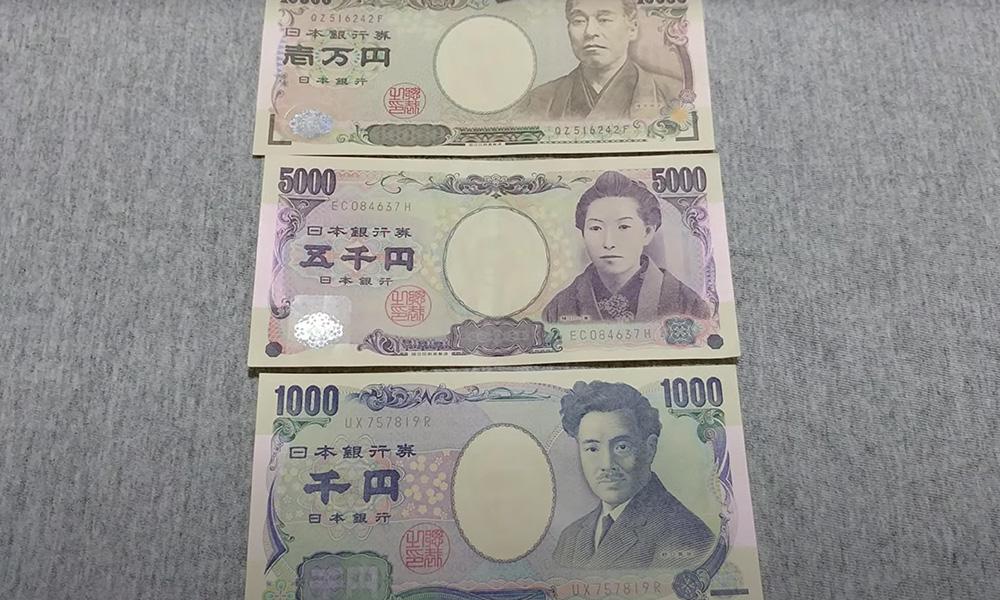
The timing of the move is significant. Japan is currently mired in the dual predicament of high cost of living and a persistently weak currency, and market bets on the Bank of Japan raising interest rates as early as March or April have reached a fever pitch.
The Japanese yen itself has been a "traffic driver" in the market recently: after touching the key psychological level of 160 in January, the yen began a strong rebound, with a weekly increase of nearly 3% last week, marking the largest weekly gain since the end of 2024.
The USD/JPY exchange rate is currently around 153. While this level has partially alleviated the pressure on import costs, it has not fundamentally reversed the core logic of the inflation game. This also further highlights the policy signal value of this high-level meeting – investors see it as a key window for predicting the timing of the Bank of Japan's interest rate hike, especially since the next policy decision window is just around the corner.
This is not the first time the market has experienced a similar scenario; rather, it is a continuation of the normalization process of Japan's monetary policy.
Kaohsiung City and Ueda last met face-to-face in November of last year. That meeting was widely regarded as a "stepping stone" for the Bank of Japan's December interest rate hike—at that time, the central bank raised its short-term policy rate to 0.75%, a new high in nearly 30 years.
The core signal released at that time was "cautious and gradual normalization": to ensure that the pace of interest rate hikes is controllable, to help the economy achieve a soft landing, and to avoid shocking the lending market or causing a surge in bond market volatility.
The policy context of this meeting has been completely changed by the election results.
Sanae Kaoichi has always been a staunch supporter of Abenomics' expansionary fiscal and monetary policies, and the market has long been speculating whether she will restrain herself from tightening policies too early in order to maintain economic growth.
During the campaign, her statements, which were interpreted as "acknowledging the benefits of a weak yen," put foreign exchange traders on edge—after all, even if exporters could profit from a weak yen, the economic pressure this trend would cause domestically was a political risk that could not be ignored.
For the Bank of Japan, its policy operations have always faced a framework that is "easier said than done."
Inflation has exceeded the central bank's 2% target for nearly four consecutive years, and policymakers have repeatedly signaled a hawkish stance of "continuous interest rate hikes if conditions permit." However, Japan's interest rate decision-making is not driven by a single variable:
It needs to simultaneously weigh wage growth momentum, consumer confidence, government debt sustainability, and the transmission effect of the yen on import prices.
A stronger yen can quickly suppress imported inflation, while a weaker yen could trigger inflationary pressures in sectors such as energy and food, creating a backlash that puts the Bank of Japan in a dilemma regarding its policy choices.
So what might the actual output of this meeting be? The answer isn't a clear policy resolution, but rather a "market sensitivity guideline."
Traders will focus on two key signals: the government's weighting of cost pressures on people's livelihoods versus support for economic growth, and whether a stronger yen will reduce the need for the Bank of Japan to raise interest rates urgently.
Analysts also cautioned about the timing window: the market has already priced in an 80% probability of an interest rate hike before April, and expectations are already at a high level.
When market expectations exceed official guidance, even subtle changes in the wording of policy statements can trigger sharp short-term fluctuations in exchange rates and interest rates.
However, the macroeconomic data released on Monday highlighted the real challenges facing the Sanae Takaichi government – Japan's economic growth momentum remains weak, with the annualized economic growth rate in the fourth quarter of last year (October-December) recording a meager expansion of only 0.2%.
This economic fundamentals may introduce uncertainty into the Bank of Japan's monetary policy tightening path.
The Bank of Japan will hold a monetary policy meeting in March, and traders are currently pricing in only a 20% probability of an interest rate hike at that meeting.
From the key dimensions of market competition, four factors deserve close attention:
Firstly, regarding the interest rate path, March and April are the Bank of Japan's "policy window period," and there is still room for flexible adjustments before the overall policy framework for this year is solidified.
Secondly, regarding the sensitivity of the yen, the yen has fallen from a high of 160 to around 152, which, while not completely alleviating the pain of inflation for households,
However, it has significantly improved the intuitive feeling of inflation expectations;
Third, regarding the boundaries of political maneuvering, Japanese law grants the Bank of Japan independence, but historical experience shows that when the market experiences extreme volatility, implicit political pressures may still infiltrate.
Fourth, the personnel changes on the Board of Governors can be described as "hidden clues to power"—two vacancies will appear on the Board of Governors this year, and the Prime Minister's appointments will marginally influence the bias of policy debates.
Even without direct policy intervention, personnel appointments can still influence policy direction: if the Kaohsiung City Government appoints members who favor a "growth-first" or "reflation" stance, the market may revise its expectations for interest rate hikes upward.
If the market chooses to endorse the pragmatic centrist approach of gradual tightening, it will reinforce the perception that the Bank of Japan's policy trajectory is "stability-oriented and not politically manipulated."
For the transaction side, the chain of impact of this meeting is very clear: interest rate hikes will directly push up borrowing costs, leading to higher mortgage and corporate loan rates, and reshaping the pricing logic of bank loans;
On the other hand, raising interest rates can also suppress imported inflation by boosting the yen—which is the most sensitive inflation transmission path for end-consumer markets.
The core point of contention in the current market is not "whether to control inflation," but rather "whether the economy can withstand policy tightening without falling into recession," and "whether the next round of fluctuations in the yen will force the policy to be implemented ahead of schedule."
When the talks conclude, there's no need to expect earth-shattering policy declarations, but the market will gain a clearer understanding of the tolerance boundaries of the three parties: the government's tolerance threshold for inflation, the political red line for yen depreciation, and the Bank of Japan's confidence in balancing "raising interest rates to control inflation" and "stabilizing growth."
In the current interconnected global market landscape, policy adjustments by Japan can trigger a chain reaction in the global bond market and arbitrage trading. Even a seemingly "routine" Tokyo meeting could become a catalyst for market volatility.
Foreign exchange trading veteran Brent Donnelly pointed out: "Previously, most market participants believed that the Liberal Democratic Party's acquisition of an absolute majority of seats would be a negative factor for Japanese government bonds and the yen, but the actual market performance was quite the opposite: both experienced a strong rebound."
He further added: The elimination of political uncertainty has created conditions for the long-term return of funds.
With the market landscape stabilizing, Japan's more attractive yield levels continue to draw in new funds, with both the Nikkei index and the yen gaining popularity. This market trend is defined as a buy-Japan trading strategy.
However, most analysts predict that the yen will soon return to a depreciation trend.
OCBC Bank maintains its target exchange rate of 149 yen to the US dollar by the end of 2026. The bank believes that unless the Bank of Japan's policy shift is stronger than currently expected (i.e., two interest rate hikes this year), the yen will find it difficult to transform from a funding currency to an investment currency.
Previous articles have repeatedly pointed out that the yen has a solid foundation for a rebound. Major Japanese banks have been accelerating their purchases of Japanese government bonds, reducing the expectation of a Bank of Japan interest rate hike that would lead to a rise in Japanese government bond yields. This means that the Japanese government can increase fiscal spending to stimulate the economy while controlling the cost of issuing bonds. The difference between GDP and government bond yields is an important indicator of the government's debt repayment capacity. Fiscal spending is beneficial to GDP, while capital inflows into Japanese government bonds help to lower government bond yields. When this difference narrows, it is generally beneficial to Japan's debt repayment capacity and will accelerate the inflow of yen.
From a technical perspective, the area around 154.37 is a significant resistance level and also the upper boundary of the previous trading range. If the USD/JPY exchange rate fails to rise above this level, the yen has the potential to continue appreciating.
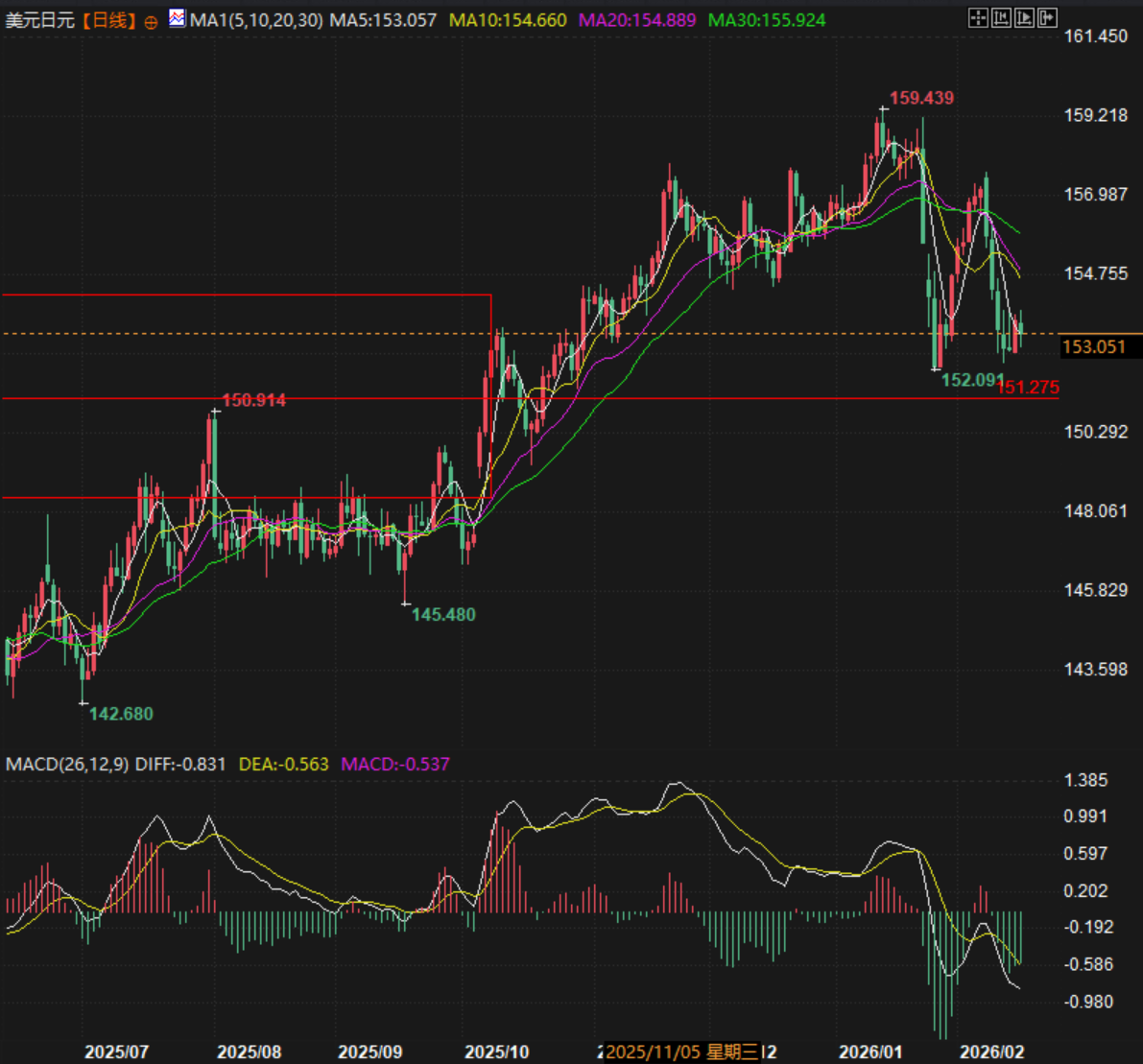
(USD/JPY daily chart, source: FX678)
At 20:47 Beijing time, the USD/JPY exchange rate is currently at 153.10/11.
For the trading community, the market significance of this meeting far exceeds that of a mere courtesy meeting; it is essentially a crucial "test of policy sentiment."
Although no formal decision will be made, the policy priorities, key risk concerns, and policy coordination between the elected government and the central bank will directly translate into the core driving force for short-term yen fluctuations.
Timing Holds Profound Significance: Yen Rebound and Interest Rate Hike Bets Heat Up
The timing of the move is significant. Japan is currently mired in the dual predicament of high cost of living and a persistently weak currency, and market bets on the Bank of Japan raising interest rates as early as March or April have reached a fever pitch.
The Japanese yen itself has been a "traffic driver" in the market recently: after touching the key psychological level of 160 in January, the yen began a strong rebound, with a weekly increase of nearly 3% last week, marking the largest weekly gain since the end of 2024.
The USD/JPY exchange rate is currently around 153. While this level has partially alleviated the pressure on import costs, it has not fundamentally reversed the core logic of the inflation game. This also further highlights the policy signal value of this high-level meeting – investors see it as a key window for predicting the timing of the Bank of Japan's interest rate hike, especially since the next policy decision window is just around the corner.
Policy Continuity: November Talks Pave the Way for a December Rate Hike
This is not the first time the market has experienced a similar scenario; rather, it is a continuation of the normalization process of Japan's monetary policy.
Kaohsiung City and Ueda last met face-to-face in November of last year. That meeting was widely regarded as a "stepping stone" for the Bank of Japan's December interest rate hike—at that time, the central bank raised its short-term policy rate to 0.75%, a new high in nearly 30 years.
The core signal released at that time was "cautious and gradual normalization": to ensure that the pace of interest rate hikes is controllable, to help the economy achieve a soft landing, and to avoid shocking the lending market or causing a surge in bond market volatility.
Dramatic Changes in Policy Context: Election Results and Kaohsiung's Policy Inclinations
The policy context of this meeting has been completely changed by the election results.
Sanae Kaoichi has always been a staunch supporter of Abenomics' expansionary fiscal and monetary policies, and the market has long been speculating whether she will restrain herself from tightening policies too early in order to maintain economic growth.
During the campaign, her statements, which were interpreted as "acknowledging the benefits of a weak yen," put foreign exchange traders on edge—after all, even if exporters could profit from a weak yen, the economic pressure this trend would cause domestically was a political risk that could not be ignored.
Bank of Japan's policy dilemma: The difficulty of raising interest rates under multiple constraints
For the Bank of Japan, its policy operations have always faced a framework that is "easier said than done."
Inflation has exceeded the central bank's 2% target for nearly four consecutive years, and policymakers have repeatedly signaled a hawkish stance of "continuous interest rate hikes if conditions permit." However, Japan's interest rate decision-making is not driven by a single variable:
It needs to simultaneously weigh wage growth momentum, consumer confidence, government debt sustainability, and the transmission effect of the yen on import prices.
A stronger yen can quickly suppress imported inflation, while a weaker yen could trigger inflationary pressures in sectors such as energy and food, creating a backlash that puts the Bank of Japan in a dilemma regarding its policy choices.
Key deliverables of the talks: Market sensitivity guidance and key signals
So what might the actual output of this meeting be? The answer isn't a clear policy resolution, but rather a "market sensitivity guideline."
Traders will focus on two key signals: the government's weighting of cost pressures on people's livelihoods versus support for economic growth, and whether a stronger yen will reduce the need for the Bank of Japan to raise interest rates urgently.
Analysts also cautioned about the timing window: the market has already priced in an 80% probability of an interest rate hike before April, and expectations are already at a high level.
When market expectations exceed official guidance, even subtle changes in the wording of policy statements can trigger sharp short-term fluctuations in exchange rates and interest rates.
However, the macroeconomic data released on Monday highlighted the real challenges facing the Sanae Takaichi government – Japan's economic growth momentum remains weak, with the annualized economic growth rate in the fourth quarter of last year (October-December) recording a meager expansion of only 0.2%.
This economic fundamentals may introduce uncertainty into the Bank of Japan's monetary policy tightening path.
The Bank of Japan will hold a monetary policy meeting in March, and traders are currently pricing in only a 20% probability of an interest rate hike at that meeting.
Four key dimensions: the core variables that influence market dynamics.
From the key dimensions of market competition, four factors deserve close attention:
Firstly, regarding the interest rate path, March and April are the Bank of Japan's "policy window period," and there is still room for flexible adjustments before the overall policy framework for this year is solidified.
Secondly, regarding the sensitivity of the yen, the yen has fallen from a high of 160 to around 152, which, while not completely alleviating the pain of inflation for households,
However, it has significantly improved the intuitive feeling of inflation expectations;
Third, regarding the boundaries of political maneuvering, Japanese law grants the Bank of Japan independence, but historical experience shows that when the market experiences extreme volatility, implicit political pressures may still infiltrate.
Fourth, the personnel changes on the Board of Governors can be described as "hidden clues to power"—two vacancies will appear on the Board of Governors this year, and the Prime Minister's appointments will marginally influence the bias of policy debates.
Even without direct policy intervention, personnel appointments can still influence policy direction: if the Kaohsiung City Government appoints members who favor a "growth-first" or "reflation" stance, the market may revise its expectations for interest rate hikes upward.
If the market chooses to endorse the pragmatic centrist approach of gradual tightening, it will reinforce the perception that the Bank of Japan's policy trajectory is "stability-oriented and not politically manipulated."
Impact on the transaction chain: The dual effects of interest rate hikes on costs and inflation.
For the transaction side, the chain of impact of this meeting is very clear: interest rate hikes will directly push up borrowing costs, leading to higher mortgage and corporate loan rates, and reshaping the pricing logic of bank loans;
On the other hand, raising interest rates can also suppress imported inflation by boosting the yen—which is the most sensitive inflation transmission path for end-consumer markets.
The core point of contention in the current market is not "whether to control inflation," but rather "whether the economy can withstand policy tightening without falling into recession," and "whether the next round of fluctuations in the yen will force the policy to be implemented ahead of schedule."
When the talks conclude, there's no need to expect earth-shattering policy declarations, but the market will gain a clearer understanding of the tolerance boundaries of the three parties: the government's tolerance threshold for inflation, the political red line for yen depreciation, and the Bank of Japan's confidence in balancing "raising interest rates to control inflation" and "stabilizing growth."
In the current interconnected global market landscape, policy adjustments by Japan can trigger a chain reaction in the global bond market and arbitrage trading. Even a seemingly "routine" Tokyo meeting could become a catalyst for market volatility.
Institutional View: The Logical Support for the "Buy Japan" Strategy
Foreign exchange trading veteran Brent Donnelly pointed out: "Previously, most market participants believed that the Liberal Democratic Party's acquisition of an absolute majority of seats would be a negative factor for Japanese government bonds and the yen, but the actual market performance was quite the opposite: both experienced a strong rebound."
He further added: The elimination of political uncertainty has created conditions for the long-term return of funds.
With the market landscape stabilizing, Japan's more attractive yield levels continue to draw in new funds, with both the Nikkei index and the yen gaining popularity. This market trend is defined as a buy-Japan trading strategy.
However, most analysts predict that the yen will soon return to a depreciation trend.
OCBC Bank maintains its target exchange rate of 149 yen to the US dollar by the end of 2026. The bank believes that unless the Bank of Japan's policy shift is stronger than currently expected (i.e., two interest rate hikes this year), the yen will find it difficult to transform from a funding currency to an investment currency.
Summary and Technical Analysis:
Previous articles have repeatedly pointed out that the yen has a solid foundation for a rebound. Major Japanese banks have been accelerating their purchases of Japanese government bonds, reducing the expectation of a Bank of Japan interest rate hike that would lead to a rise in Japanese government bond yields. This means that the Japanese government can increase fiscal spending to stimulate the economy while controlling the cost of issuing bonds. The difference between GDP and government bond yields is an important indicator of the government's debt repayment capacity. Fiscal spending is beneficial to GDP, while capital inflows into Japanese government bonds help to lower government bond yields. When this difference narrows, it is generally beneficial to Japan's debt repayment capacity and will accelerate the inflow of yen.
From a technical perspective, the area around 154.37 is a significant resistance level and also the upper boundary of the previous trading range. If the USD/JPY exchange rate fails to rise above this level, the yen has the potential to continue appreciating.
(USD/JPY daily chart, source: FX678)
At 20:47 Beijing time, the USD/JPY exchange rate is currently at 153.10/11.
- Risk Warning and Disclaimer
- The market involves risk, and trading may not be suitable for all investors. This article is for reference only and does not constitute personal investment advice, nor does it take into account certain users’ specific investment objectives, financial situation, or other needs. Any investment decisions made based on this information are at your own risk.