Gold Trading Alert: Gold Prices Plunge Over 2%! Dramatic Reversal in US-Iran Nuclear Negotiations Causes Safe-Haven Assets to Fall Out of Favor? Focus on the Fed Meeting Minutes
2026-02-18 07:40:37
On Tuesday, spot gold prices plunged more than 2%, briefly falling below the key psychological level of $4,900 per ounce, hitting a low of around $4,842 per ounce, a more than one-week low, before closing at $4,878.51 per ounce. This was due to a breakthrough in US-Iran nuclear negotiations and the start of peace talks between Russia and Ukraine, which significantly eased geopolitical risks and severely impacted demand for gold as a safe haven. The strengthening of the US dollar further exacerbated the selling pressure. The market is closely watching the upcoming release of the Federal Reserve meeting minutes for further clues about the interest rate path. On Wednesday (February 18) in early Asian trading, spot gold traded in a narrow range, currently hovering around $4,874 per ounce.
Gold, as a traditional safe-haven asset, often exhibits a positive correlation with international tensions. However, Tuesday's biggest turning point in market sentiment came precisely from signals of peace talks coming from the Middle East. Iranian Foreign Minister Araqchi stated explicitly in Geneva that negotiations between Iran and the United States to resolve the long-standing nuclear dispute had made "good progress," and that the two sides had reached a consensus on key "guiding principles." Although he cautiously added that "this does not mean an agreement is imminent," the statement itself, "the path has been opened," was enough to significantly ease market tensions.
It is worth noting that the backdrop to these negotiations was far from calm. Just before the talks, the Iranian Revolutionary Guard conducted military exercises in the Strait of Hormuz and temporarily closed sections of the strait as a "security precaution." At the same time, the United States deployed additional troops to the Middle East, and Vice President Vance explicitly drew a "red line" for Iran, emphasizing that the US "does not want Iran to possess nuclear weapons." This breakthrough in dialogue amidst heightened tensions has ironically given the market hope for a de-escalation of the conflict.
Jim Wyckoff, a senior analyst at Kitco Metals, pointed out that if the United States can avoid launching an attack on Iran, market anxiety will be greatly alleviated, which is undoubtedly a direct negative factor for safe-haven assets such as gold and silver.
If progress in nuclear negotiations weakened gold's safe-haven appeal, then the simultaneous strengthening of the US dollar directly exacerbated the selling pressure on gold prices. On Tuesday, the US dollar index rose slightly by 0.3%. For gold priced in US dollars, the appreciation of the dollar means that buyers in other countries will have to pay higher costs, which naturally suppresses demand and creates a direct downward pressure on prices.
However, the underlying logic behind this dollar strengthening is particularly intriguing. Normally, both the dollar and gold are considered safe-haven assets, but in specific market conditions, investors tend to choose one over the other. Eugene Epstein, Head of Trading and Structured Products at Moneycorp, offers a insightful interpretation of the current market dynamics. He points out that under the shadow of a potential conflict between the US and Iran, the market is returning to a "traditional safe-haven mentality." Despite a significant drop in US Treasury yields, the dollar has strengthened in tandem, reflecting investors following a classic strategy: buy dollars, purchase US Treasuries, and simultaneously sell stocks.
This phenomenon has disrupted the conventional wisdom of some investors. Previously, a weakening dollar was often seen as fertile ground for a gold bull market, but this time, the market has demonstrated that the dollar's ultimate safe-haven status as the global reserve currency remains robust in the face of specific geopolitical uncertainties. Investors are choosing to withdraw funds from risky assets such as stocks and flow into the dollar and US Treasury bonds, rather than gold. This shift in capital flows has directly put downward pressure on gold prices.
Beyond the situation in the Middle East, the glimmer of peace in Europe is also cooling the safe-haven demand for gold. Under US mediation, representatives from Ukraine and Russia began two days of peace talks in Geneva. Although the fighting on the battlefield has not completely ceased—Russian forces launched large-scale attacks on Ukrainian energy facilities, and Ukrainian forces destroyed Russian helicopters and attacked targets within Russia—the very fact that the talks are taking place provides the market with a positive expectation that the conflict may be resolved through diplomatic means.
Analyst Wyckoff added that the Russia-Ukraine negotiations are also a factor highlighting the bearish outlook for gold. Any event that could alleviate geopolitical anxieties at this juncture would be a reason for investors to reduce their safe-haven positions.
Furthermore, the market trading structure cannot be ignored. On Tuesday, many Asian markets, including China, South Korea, and Singapore, were closed for the Lunar New Year holiday. Asian buyers, especially Chinese investors, have been a significant pillar of physical gold demand in recent years. The market closure meant a temporary absence of some buying power, which amplified the impact of selling on prices to some extent, making gold prices more susceptible to sharp declines in the face of negative news.
While digesting geopolitical news, market participants haven't forgotten another core factor influencing the long-term trend of gold: the Federal Reserve's monetary policy. Currently, all eyes are on the upcoming release of the Fed's January meeting minutes on Wednesday and the US December Personal Consumption Expenditures Price Index on Friday. This key information will provide the market with the latest clues about the inflation outlook and interest rate path.
Currently, market expectations for interest rates present a complex picture. On the one hand, last week's January employment data showed a slight slowdown, and consumer inflation data also fell short of expectations. This has led traders to increase their bets that the Federal Reserve will keep interest rates unchanged in the coming months and begin its first rate cut in June. Federal funds futures indicate that traders expect a 60 basis point rate cut by the end of the year, bringing the benchmark interest rate close to 3%.
On the other hand, opinions within the Federal Reserve are not entirely unified. Governor Barr believes that the inflation outlook remains risky, and the next rate cut may have to wait "a considerable amount of time"; while Chicago Fed President Goolsby believes that if inflation falls back to 2%, there could be "multiple" rate cuts this year. This divergence itself adds uncertainty to the market. Meanwhile, Warsh, nominated as the next Fed chairman, with his hawkish stance advocating further reduction of the balance sheet, has also foreshadowed the future direction of monetary policy. The market is struggling to find a balance amidst these intertwined signals. The view of Will Compernolle, macro strategist at FHN Financial, perhaps represents the mainstream opinion: the Fed will not rush to ease policy, but will begin cutting rates in the middle of this year.
U.S. stocks struggled to close slightly higher on Tuesday, supported by technology and financial stocks. The stabilization and even rebound in the market reflects that funds are not entirely gripped by panic, but rather selectively rotating between different sectors. The S&P 500 financial sector led the gains, while the consumer staples sector performed the worst, indicating a complex market outlook on the economy.
Within the precious metals sector, silver's decline even outpaced gold, with spot silver falling 4% on Tuesday, hitting a low of $71.92. This indicates that when market risk appetite cools, silver, with its dual industrial and safe-haven attributes, tends to experience more volatile price fluctuations.
In conclusion, Tuesday's more than 2% drop in gold prices was a significant correction triggered by a confluence of factors, including easing geopolitical risks (progress in US-Iran nuclear talks and the start of Russia-Ukraine peace talks) as a catalyst, the strengthening of the US dollar's traditional safe-haven status as a core driving force, and a temporary lack of demand in Asian markets. For investors, this event serves as a reminder that in an era of significant global macroeconomic uncertainty, the logic behind asset prices is not static.
For the bullish story in gold to continue, as analysts have pointed out, it needs a constant stream of fresh fundamental support. Currently, the market's focus has temporarily shifted from the battlefields of war to the negotiating table in Geneva and the interest rate decision in Washington. The future direction of gold prices will depend on how far these glimmers of peace can extend, and what kind of trade-off the Federal Reserve will ultimately make between inflation and the economy.
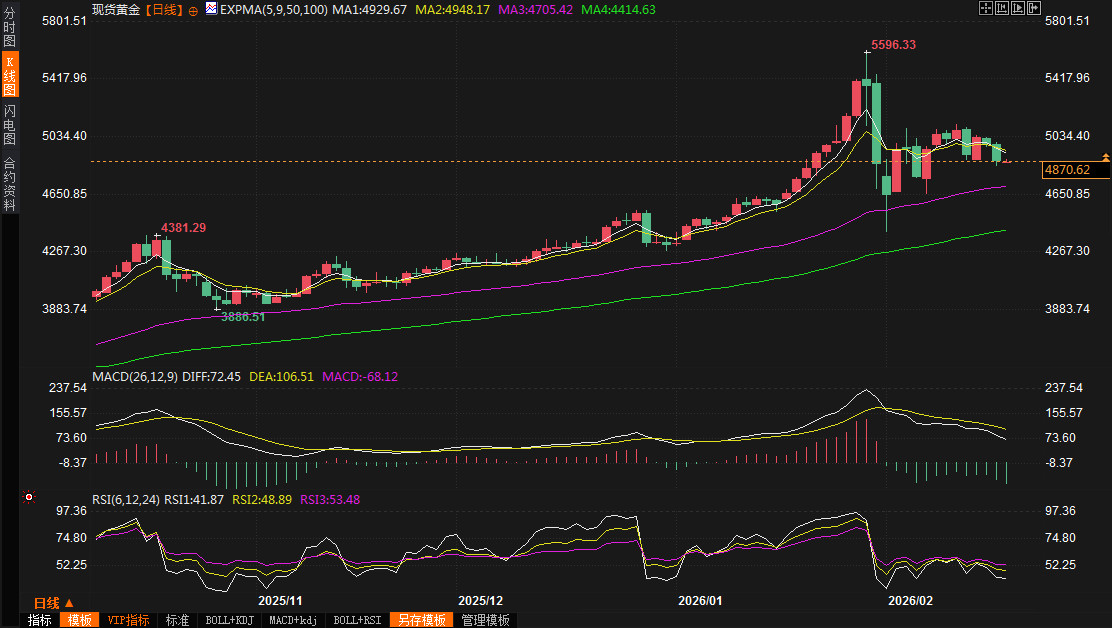
(Spot gold daily chart, source: FX678)
At 07:39 Beijing time, spot gold was trading at $4,870.54 per ounce.
I. A turning point in nuclear talks has led to a sudden cooling of risk aversion.
Gold, as a traditional safe-haven asset, often exhibits a positive correlation with international tensions. However, Tuesday's biggest turning point in market sentiment came precisely from signals of peace talks coming from the Middle East. Iranian Foreign Minister Araqchi stated explicitly in Geneva that negotiations between Iran and the United States to resolve the long-standing nuclear dispute had made "good progress," and that the two sides had reached a consensus on key "guiding principles." Although he cautiously added that "this does not mean an agreement is imminent," the statement itself, "the path has been opened," was enough to significantly ease market tensions.
It is worth noting that the backdrop to these negotiations was far from calm. Just before the talks, the Iranian Revolutionary Guard conducted military exercises in the Strait of Hormuz and temporarily closed sections of the strait as a "security precaution." At the same time, the United States deployed additional troops to the Middle East, and Vice President Vance explicitly drew a "red line" for Iran, emphasizing that the US "does not want Iran to possess nuclear weapons." This breakthrough in dialogue amidst heightened tensions has ironically given the market hope for a de-escalation of the conflict.
Jim Wyckoff, a senior analyst at Kitco Metals, pointed out that if the United States can avoid launching an attack on Iran, market anxiety will be greatly alleviated, which is undoubtedly a direct negative factor for safe-haven assets such as gold and silver.
II. The US Dollar and US Treasuries: The Return of the Traditional Safe-Haven Portfolio
If progress in nuclear negotiations weakened gold's safe-haven appeal, then the simultaneous strengthening of the US dollar directly exacerbated the selling pressure on gold prices. On Tuesday, the US dollar index rose slightly by 0.3%. For gold priced in US dollars, the appreciation of the dollar means that buyers in other countries will have to pay higher costs, which naturally suppresses demand and creates a direct downward pressure on prices.
However, the underlying logic behind this dollar strengthening is particularly intriguing. Normally, both the dollar and gold are considered safe-haven assets, but in specific market conditions, investors tend to choose one over the other. Eugene Epstein, Head of Trading and Structured Products at Moneycorp, offers a insightful interpretation of the current market dynamics. He points out that under the shadow of a potential conflict between the US and Iran, the market is returning to a "traditional safe-haven mentality." Despite a significant drop in US Treasury yields, the dollar has strengthened in tandem, reflecting investors following a classic strategy: buy dollars, purchase US Treasuries, and simultaneously sell stocks.
This phenomenon has disrupted the conventional wisdom of some investors. Previously, a weakening dollar was often seen as fertile ground for a gold bull market, but this time, the market has demonstrated that the dollar's ultimate safe-haven status as the global reserve currency remains robust in the face of specific geopolitical uncertainties. Investors are choosing to withdraw funds from risky assets such as stocks and flow into the dollar and US Treasury bonds, rather than gold. This shift in capital flows has directly put downward pressure on gold prices.
III. Russia-Ukraine peace talks and market absence: a confluence of multiple factors
Beyond the situation in the Middle East, the glimmer of peace in Europe is also cooling the safe-haven demand for gold. Under US mediation, representatives from Ukraine and Russia began two days of peace talks in Geneva. Although the fighting on the battlefield has not completely ceased—Russian forces launched large-scale attacks on Ukrainian energy facilities, and Ukrainian forces destroyed Russian helicopters and attacked targets within Russia—the very fact that the talks are taking place provides the market with a positive expectation that the conflict may be resolved through diplomatic means.
Analyst Wyckoff added that the Russia-Ukraine negotiations are also a factor highlighting the bearish outlook for gold. Any event that could alleviate geopolitical anxieties at this juncture would be a reason for investors to reduce their safe-haven positions.
Furthermore, the market trading structure cannot be ignored. On Tuesday, many Asian markets, including China, South Korea, and Singapore, were closed for the Lunar New Year holiday. Asian buyers, especially Chinese investors, have been a significant pillar of physical gold demand in recent years. The market closure meant a temporary absence of some buying power, which amplified the impact of selling on prices to some extent, making gold prices more susceptible to sharp declines in the face of negative news.
IV. The Interest Rate Path in the Fog: Awaiting Guidance from the Federal Reserve
While digesting geopolitical news, market participants haven't forgotten another core factor influencing the long-term trend of gold: the Federal Reserve's monetary policy. Currently, all eyes are on the upcoming release of the Fed's January meeting minutes on Wednesday and the US December Personal Consumption Expenditures Price Index on Friday. This key information will provide the market with the latest clues about the inflation outlook and interest rate path.
Currently, market expectations for interest rates present a complex picture. On the one hand, last week's January employment data showed a slight slowdown, and consumer inflation data also fell short of expectations. This has led traders to increase their bets that the Federal Reserve will keep interest rates unchanged in the coming months and begin its first rate cut in June. Federal funds futures indicate that traders expect a 60 basis point rate cut by the end of the year, bringing the benchmark interest rate close to 3%.
On the other hand, opinions within the Federal Reserve are not entirely unified. Governor Barr believes that the inflation outlook remains risky, and the next rate cut may have to wait "a considerable amount of time"; while Chicago Fed President Goolsby believes that if inflation falls back to 2%, there could be "multiple" rate cuts this year. This divergence itself adds uncertainty to the market. Meanwhile, Warsh, nominated as the next Fed chairman, with his hawkish stance advocating further reduction of the balance sheet, has also foreshadowed the future direction of monetary policy. The market is struggling to find a balance amidst these intertwined signals. The view of Will Compernolle, macro strategist at FHN Financial, perhaps represents the mainstream opinion: the Fed will not rush to ease policy, but will begin cutting rates in the middle of this year.
V. Market Interaction: The Resilience of the Stock Market and its Following Role in Other Commodities
U.S. stocks struggled to close slightly higher on Tuesday, supported by technology and financial stocks. The stabilization and even rebound in the market reflects that funds are not entirely gripped by panic, but rather selectively rotating between different sectors. The S&P 500 financial sector led the gains, while the consumer staples sector performed the worst, indicating a complex market outlook on the economy.
Within the precious metals sector, silver's decline even outpaced gold, with spot silver falling 4% on Tuesday, hitting a low of $71.92. This indicates that when market risk appetite cools, silver, with its dual industrial and safe-haven attributes, tends to experience more volatile price fluctuations.
In conclusion, Tuesday's more than 2% drop in gold prices was a significant correction triggered by a confluence of factors, including easing geopolitical risks (progress in US-Iran nuclear talks and the start of Russia-Ukraine peace talks) as a catalyst, the strengthening of the US dollar's traditional safe-haven status as a core driving force, and a temporary lack of demand in Asian markets. For investors, this event serves as a reminder that in an era of significant global macroeconomic uncertainty, the logic behind asset prices is not static.
For the bullish story in gold to continue, as analysts have pointed out, it needs a constant stream of fresh fundamental support. Currently, the market's focus has temporarily shifted from the battlefields of war to the negotiating table in Geneva and the interest rate decision in Washington. The future direction of gold prices will depend on how far these glimmers of peace can extend, and what kind of trade-off the Federal Reserve will ultimately make between inflation and the economy.
(Spot gold daily chart, source: FX678)
At 07:39 Beijing time, spot gold was trading at $4,870.54 per ounce.
- Risk Warning and Disclaimer
- The market involves risk, and trading may not be suitable for all investors. This article is for reference only and does not constitute personal investment advice, nor does it take into account certain users’ specific investment objectives, financial situation, or other needs. Any investment decisions made based on this information are at your own risk.