Is the Yen's surge unstoppable? Three driving forces at play.
2026-02-18 16:33:15
On Wednesday (February 18), during the Asian and European sessions, the USD/JPY pair rebounded, trading around 153.67, up 0.27%. The USD/JPY exchange rate has seen a significant decline in recent weeks, and technical signals indicate a clear downward trend for the USD/JPY currency pair, with a target of the 150 level.
The yen has now retreated nearly 4% from its year-to-date high. The market is digesting speculative sentiment regarding the continued weakening of the dollar, while also being boosted by better-than-expected Japanese export data. Meanwhile, the market is holding its breath awaiting the final release of Japanese inflation data this Friday. These multiple factors have allowed the yen to maintain its short-term strength.

Key data released by Japan's Ministry of Finance on Wednesday became a major driver of the yen's strength: January exports climbed 16.8% year-on-year, significantly exceeding the market's median expectation of 13%, marking the fastest growth since November 2022 and completely reversing the sluggish 3.1% growth target for 2025 (6.2% growth in 2024).
The core driver of this remarkable performance comes from the explosive growth in semiconductor chip exports. Driven by the global AI industry boom, Japan's chip exports surged by 40% year-on-year in January, with the majority flowing to the Chinese market, effectively offsetting the sluggish growth of traditional industries such as automobiles.
Looking at different regions and product categories, the foreign trade structure shows a clear divergence: As Japan's largest trading partner, exports to China surged by 32% year-on-year, a leapfrog growth from 5.6% in December. Even though China and Japan were locked in a diplomatic deadlock during the same period due to inappropriate remarks by Prime Minister Sanae Takaichi, the significant divergence between trade data and the diplomatic atmosphere still highlights the key support that the Chinese market provides for Japan's exports.
Exports to Asia surged by nearly 26% and to Western Europe by over 25%, with these two major markets collectively offsetting the 3.3% decline in exports to North America. However, exports to the United States, Japan's second-largest trading partner, remained weak, declining by 5% year-on-year, continuing the downward trend of 11.1% in December (due to the pressure from US tariff policies, Japan's exports of automobiles and auto parts to the US continued to be under pressure).
In terms of product categories, food, machinery, and electrical machinery, including chips, were the main drivers of growth, with year-on-year increases of 31.3%, 14.3%, and 27.3%, respectively. However, transportation equipment, which accounts for more than 20% of exports, only saw a slight increase of 0.8%, indicating insufficient growth momentum.
It is worth noting that imports in January fell by 2.5% year-on-year, which was lower than the expected 3% growth and a significant drop from the 5.1% growth rate in the previous month. The improvement in the trade balance further strengthened the fundamental support for the yen.
More importantly, the continued expansion of global AI demand is expected to extend this export dividend – the four tech giants, Amazon, Microsoft, Google, and Meta, have planned to spend more than $650 billion this year, which will continue to drive Japan’s chip and related equipment exports.
Another key driver of the USD/JPY exchange rate will be the inflation data for Japan and the US to be released this Friday.
Surveys show that economists generally expect Japan's overall inflation rate to fall from 2.1% to 1.9% in January, while core inflation, excluding fluctuations in food and energy prices, is expected to decline slightly to 2.3%, but will still remain above the Bank of Japan's policy target of 2%.
This level of inflation provides ample justification for the Bank of Japan to raise interest rates. Market analysts generally predict that the Bank of Japan is highly likely to initiate an interest rate hike within the year, raising the benchmark interest rate to 1%, a new high in decades.
Despite the Bank of Japan's decision to hold rates steady at its January policy meeting (influenced by political factors such as the House of Representatives election), pressure to raise interest rates continues to accumulate. Since ending negative interest rates in March 2024, the Bank of Japan has raised interest rates four times. Furthermore, the minutes of the monetary policy meetings show that committee members believe that the current real interest rate is still at an extremely low level and that the policy may be flexibly adjusted at intervals of "a few months" in the future.
On February 17, the International Monetary Fund (IMF) also released a report recommending that the Bank of Japan "continue to exit monetary easing and bring the policy rate to a neutral level by 2027," and emphasizing the need to maintain the central bank's independence to stabilize inflation expectations.
The yen's strength also benefits from the continued weakness of the dollar. A Bank of America report shows that hedge funds' short dollar bets have surged to a more than decade-old peak, signaling a clear expectation of dollar weakness.
Chicago Fed President Goolsby recently stated that if US inflation data continues to decline, the Fed will have the conditions to implement multiple interest rate cuts in 2026. Previously, data from the US Department of Labor showed that the overall US CPI fell to 2.4% year-on-year in January, while the core CPI remained stable at 2.5%, and the cooling inflation opened up room for the Fed to cut interest rates.
In the coming period, the upcoming release of key data such as the Federal Reserve meeting minutes, the preliminary estimate of US Q4 GDP, and the core PCE price index will further clarify the path of US dollar policy. If dovish signals are released, it is expected to further suppress the USD/JPY exchange rate.
Furthermore, the advancement of US-Japan trade cooperation has also boosted market confidence. On Tuesday, the US officially announced a list of $36 billion in investment projects, covering oil export facilities in Texas, an industrial diamond factory in Georgia, and a natural gas power plant in Ohio. These projects are all funded by Japan and are part of the implementation of its $550 billion US investment commitment.
US President Trump confirmed the agreement's entry into force on a "real social" platform, while Japanese Minister of Economy, Trade and Industry Akazawa Ryosuke previously stated that he hoped the first batch of investment projects could be finalized before the meeting between Sanae Takaichi and Trump. This meeting is planned to proceed after the House of Representatives election on February 8. Takaichi has led the Liberal Democratic Party to an overwhelming victory, and political stability is expected to provide support for US-Japan economic cooperation and the stability of the yen exchange rate.
In summary, the better-than-expected surge in Japanese export data (especially the strong growth in chip exports), the expectation of interest rate hikes fueled by core inflation remaining above the target, and the high level of short positions in the US dollar coupled with rising expectations of a Federal Reserve rate cut, have combined to provide solid support for the yen-dollar exchange rate.
In the short term, the focus should be on the release of Japan's inflation data and the Fed's meeting minutes this Friday. If the inflation data exceeds expectations or the Fed releases a clearer signal of interest rate cuts, it could accelerate the appreciation of the yen.
In the medium to long term, the chip export dividends brought about by the expansion of the global AI industry, the Bank of Japan's policy path of continuous interest rate hikes, and the trend of weakening US dollar index will jointly constitute the core logic for the strengthening of the yen, and a breakthrough of the 150 mark is likely to be a high-probability event.
From a technical perspective, let's revise the consolidation range for the Japanese yen. The current resistance level is at 155.25, and the support level is at 152.65.
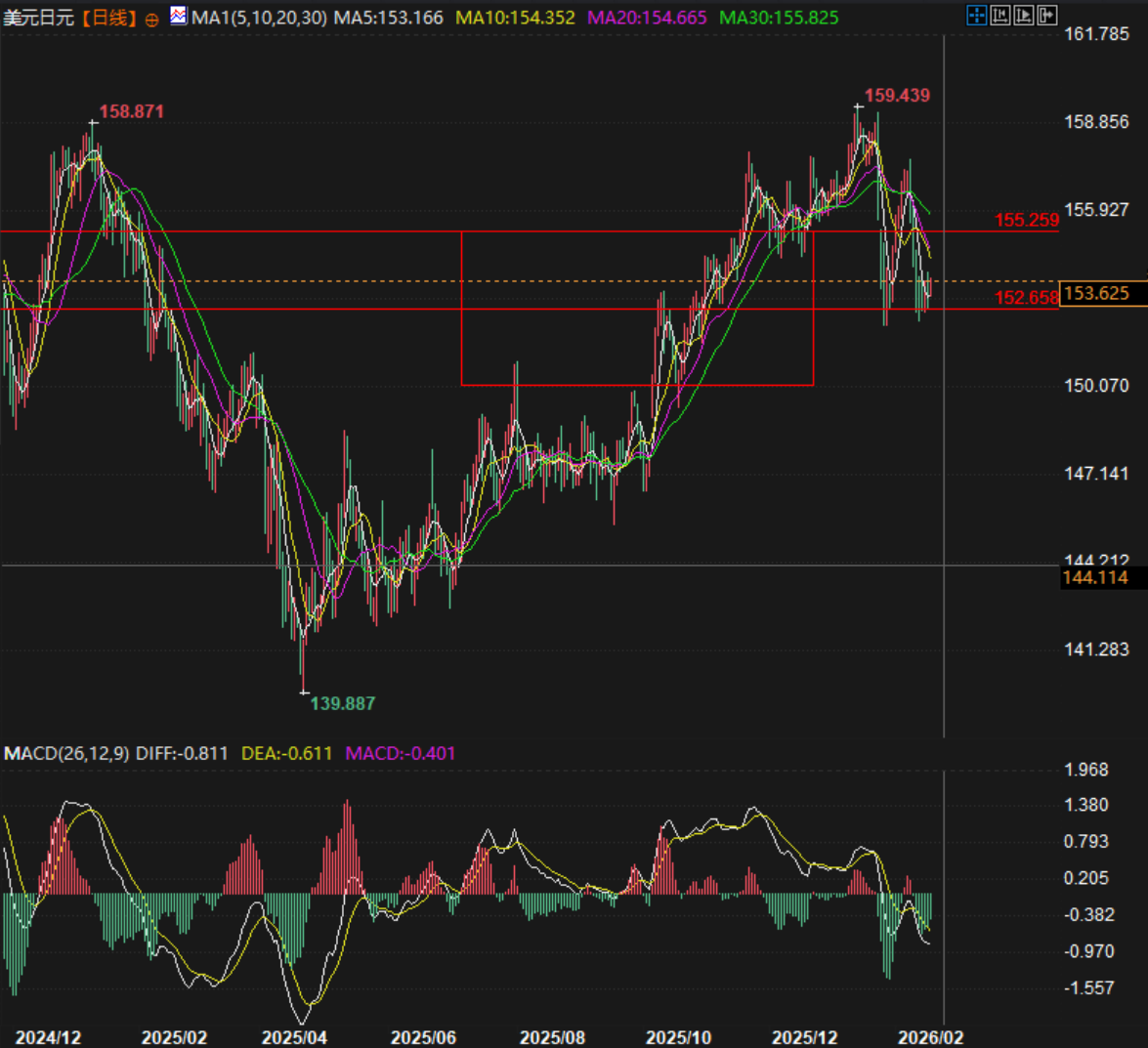
(USD/JPY daily chart, source: FX678)
At 16:31 Beijing time, the USD/JPY exchange rate was 153.67/68.
The yen has now retreated nearly 4% from its year-to-date high. The market is digesting speculative sentiment regarding the continued weakening of the dollar, while also being boosted by better-than-expected Japanese export data. Meanwhile, the market is holding its breath awaiting the final release of Japanese inflation data this Friday. These multiple factors have allowed the yen to maintain its short-term strength.
Chip exports become the engine of foreign trade, and better-than-expected export data supports the yen.
Key data released by Japan's Ministry of Finance on Wednesday became a major driver of the yen's strength: January exports climbed 16.8% year-on-year, significantly exceeding the market's median expectation of 13%, marking the fastest growth since November 2022 and completely reversing the sluggish 3.1% growth target for 2025 (6.2% growth in 2024).
The core driver of this remarkable performance comes from the explosive growth in semiconductor chip exports. Driven by the global AI industry boom, Japan's chip exports surged by 40% year-on-year in January, with the majority flowing to the Chinese market, effectively offsetting the sluggish growth of traditional industries such as automobiles.
Looking at different regions and product categories, the foreign trade structure shows a clear divergence: As Japan's largest trading partner, exports to China surged by 32% year-on-year, a leapfrog growth from 5.6% in December. Even though China and Japan were locked in a diplomatic deadlock during the same period due to inappropriate remarks by Prime Minister Sanae Takaichi, the significant divergence between trade data and the diplomatic atmosphere still highlights the key support that the Chinese market provides for Japan's exports.
Exports to Asia surged by nearly 26% and to Western Europe by over 25%, with these two major markets collectively offsetting the 3.3% decline in exports to North America. However, exports to the United States, Japan's second-largest trading partner, remained weak, declining by 5% year-on-year, continuing the downward trend of 11.1% in December (due to the pressure from US tariff policies, Japan's exports of automobiles and auto parts to the US continued to be under pressure).
In terms of product categories, food, machinery, and electrical machinery, including chips, were the main drivers of growth, with year-on-year increases of 31.3%, 14.3%, and 27.3%, respectively. However, transportation equipment, which accounts for more than 20% of exports, only saw a slight increase of 0.8%, indicating insufficient growth momentum.
It is worth noting that imports in January fell by 2.5% year-on-year, which was lower than the expected 3% growth and a significant drop from the 5.1% growth rate in the previous month. The improvement in the trade balance further strengthened the fundamental support for the yen.
More importantly, the continued expansion of global AI demand is expected to extend this export dividend – the four tech giants, Amazon, Microsoft, Google, and Meta, have planned to spend more than $650 billion this year, which will continue to drive Japan’s chip and related equipment exports.
Inflation and interest rate hike expectations are key factors, with continued positive policy support.
Another key driver of the USD/JPY exchange rate will be the inflation data for Japan and the US to be released this Friday.
Surveys show that economists generally expect Japan's overall inflation rate to fall from 2.1% to 1.9% in January, while core inflation, excluding fluctuations in food and energy prices, is expected to decline slightly to 2.3%, but will still remain above the Bank of Japan's policy target of 2%.
This level of inflation provides ample justification for the Bank of Japan to raise interest rates. Market analysts generally predict that the Bank of Japan is highly likely to initiate an interest rate hike within the year, raising the benchmark interest rate to 1%, a new high in decades.
Despite the Bank of Japan's decision to hold rates steady at its January policy meeting (influenced by political factors such as the House of Representatives election), pressure to raise interest rates continues to accumulate. Since ending negative interest rates in March 2024, the Bank of Japan has raised interest rates four times. Furthermore, the minutes of the monetary policy meetings show that committee members believe that the current real interest rate is still at an extremely low level and that the policy may be flexibly adjusted at intervals of "a few months" in the future.
On February 17, the International Monetary Fund (IMF) also released a report recommending that the Bank of Japan "continue to exit monetary easing and bring the policy rate to a neutral level by 2027," and emphasizing the need to maintain the central bank's independence to stabilize inflation expectations.
A weaker dollar coupled with US-Japan cooperation has further boosted the yen's upward momentum.
The yen's strength also benefits from the continued weakness of the dollar. A Bank of America report shows that hedge funds' short dollar bets have surged to a more than decade-old peak, signaling a clear expectation of dollar weakness.
Chicago Fed President Goolsby recently stated that if US inflation data continues to decline, the Fed will have the conditions to implement multiple interest rate cuts in 2026. Previously, data from the US Department of Labor showed that the overall US CPI fell to 2.4% year-on-year in January, while the core CPI remained stable at 2.5%, and the cooling inflation opened up room for the Fed to cut interest rates.
In the coming period, the upcoming release of key data such as the Federal Reserve meeting minutes, the preliminary estimate of US Q4 GDP, and the core PCE price index will further clarify the path of US dollar policy. If dovish signals are released, it is expected to further suppress the USD/JPY exchange rate.
Furthermore, the advancement of US-Japan trade cooperation has also boosted market confidence. On Tuesday, the US officially announced a list of $36 billion in investment projects, covering oil export facilities in Texas, an industrial diamond factory in Georgia, and a natural gas power plant in Ohio. These projects are all funded by Japan and are part of the implementation of its $550 billion US investment commitment.
US President Trump confirmed the agreement's entry into force on a "real social" platform, while Japanese Minister of Economy, Trade and Industry Akazawa Ryosuke previously stated that he hoped the first batch of investment projects could be finalized before the meeting between Sanae Takaichi and Trump. This meeting is planned to proceed after the House of Representatives election on February 8. Takaichi has led the Liberal Democratic Party to an overwhelming victory, and political stability is expected to provide support for US-Japan economic cooperation and the stability of the yen exchange rate.
Summary and Technical Analysis:
In summary, the better-than-expected surge in Japanese export data (especially the strong growth in chip exports), the expectation of interest rate hikes fueled by core inflation remaining above the target, and the high level of short positions in the US dollar coupled with rising expectations of a Federal Reserve rate cut, have combined to provide solid support for the yen-dollar exchange rate.
In the short term, the focus should be on the release of Japan's inflation data and the Fed's meeting minutes this Friday. If the inflation data exceeds expectations or the Fed releases a clearer signal of interest rate cuts, it could accelerate the appreciation of the yen.
In the medium to long term, the chip export dividends brought about by the expansion of the global AI industry, the Bank of Japan's policy path of continuous interest rate hikes, and the trend of weakening US dollar index will jointly constitute the core logic for the strengthening of the yen, and a breakthrough of the 150 mark is likely to be a high-probability event.
From a technical perspective, let's revise the consolidation range for the Japanese yen. The current resistance level is at 155.25, and the support level is at 152.65.
(USD/JPY daily chart, source: FX678)
At 16:31 Beijing time, the USD/JPY exchange rate was 153.67/68.
- Risk Warning and Disclaimer
- The market involves risk, and trading may not be suitable for all investors. This article is for reference only and does not constitute personal investment advice, nor does it take into account certain users’ specific investment objectives, financial situation, or other needs. Any investment decisions made based on this information are at your own risk.