The medium-term bullish trend for EUR/USD remains unchanged; short-term fluctuations await data guidance.
2026-02-18 19:39:11
On Wednesday (February 18), during the European session, the EUR/USD pair traded within a range of 1.1833-1.1846, with significantly narrowed fluctuations. Asian markets were closed, and a lack of data releases from Europe and the US resulted in a typical "liquidity-compressed consolidation" environment. The overall structure exhibited characteristics of "weak consolidation with slowing bearish momentum"—the price remained within a short-term downward channel, but the slope of the decline was gentler, and the balance between bullish and bearish forces was becoming more even.

Since falling from the previous high of 1.2081, the exchange rate broke below 1.1900 and entered a mid-term consolidation range, currently converging between 1.1800 and 1.1900. The short-term trend has not yet completely reversed the upward pattern since the beginning of the year, and is more likely to be a phase of correction within the upward movement.
Fundamentals: Medium-term support remains, short-term data pressure persists.
Institutional investors maintain a consensus of "bullish in the medium term, with short-term volatility." Scotiabank's FX strategy team believes the euro's short-term weakness is mainly due to technical corrections and data disruptions, but the US-EU interest rate differential still provides bottom support for the euro. Caution is advised until a break above 1.20 is achieved, but the medium-term trend has not yet reversed.
A weakening German ZEW economic sentiment index exerted temporary downward pressure on the euro. This indicator typically leads industrial production by 12-18 months, and its decline suggests a cooling of expectations for a manufacturing recovery. However, the negative impact did not translate into sustained selling pressure, primarily because yield differentials remain favorable for the euro, limiting its downside.
Furthermore, the current euro's performance is highly correlated with risk sentiment indicators. During data lulls, market sentiment, rather than a single macroeconomic data point, drives short-term price fluctuations.
Policy and Events: Rumors have limited impact; PMI becomes the key to breaking the deadlock.
Regarding monetary policy, recent speeches by European Central Bank officials have maintained a data-dependent stance, without releasing any unexpectedly hawkish or dovish signals. Market focus is on the upcoming release of preliminary PMI figures for the Eurozone and the United States, which will directly influence assessments of growth momentum and the path of interest rates, making them the true directional trigger this week.
In terms of personnel, according to the Financial Times, Christine Lagarde may step down before her term expires. Potential successors include Spanish central bank governor Decos and Bundesbank president Nagel. However, this is still some time away and will not change the ECB's policy framework, which focuses on inflation and data; therefore, its impact on short-term exchange rates is limited.
Technical Analysis: 1.1856 and 1.1831 form a short-term support/resistance level.
As of February 18, 2026, the EUR/USD pair has been fluctuating within a narrow range of 1.1830-1.1850. Since falling from the previous high of 1.2081, the exchange rate broke below 1.1900 and entered a mid-term consolidation phase. Currently, it is trading within the core range of 1.1800-1.1900. The trend has not yet completely turned bearish and is closer to a phase correction within an upward structure.
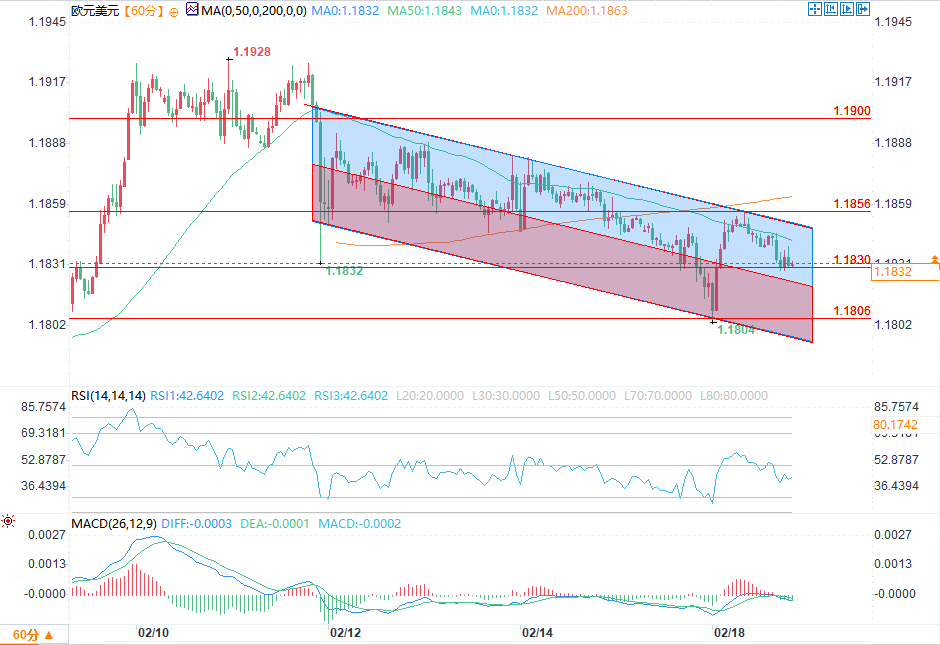
(EUR/USD daily chart source: FX678)
The short-term direction is determined by two key pivots:
1.1856: Bull-Bear Reversal Point
1.1831: Multi-front defense
If the price effectively holds above 1.1856 on the hourly chart, the short-term bearish structure will be broken, and the bulls may resume their upward trend, targeting 1.1887 and 1.1900. If the rebound is met with resistance, the probability of a continuation of the bearish trend increases. Conversely, if the price breaks below 1.1831, the downside potential will open up to 1.1806 and even 1.1766.
Structurally, prices remain within a short-term downward channel, but the rate of decline has slowed significantly, and momentum is weakening. The bears have failed to break through resistance, and the bulls lack the strength to push higher, exhibiting a typical "trend-decelerating consolidation." In a low-volatility environment, it is more appropriate to wait for clear price action signals around the pivot point rather than betting on the direction in advance.
IV. Conclusion and Short-Term Logic
The current core structure of the EUR/USD exchange rate can be summarized as follows:
Medium-term trend: Bullish bias remains intact.
Short-term trend: Range-bound trading awaiting data.
Key region: 1.1831–1.1856
Before the PMI release, the exchange rate is likely to remain within the 1.1800-1.1900 range. If it breaks through and holds above 1.1856, the bulls may test 1.1900; if it falls below 1.1831, the correction will deepen, and attention should be paid to the support area around 1.1800.
In a low-liquidity environment, it's unwise to chase highs and sell lows. True trending markets are likely to only emerge after data releases. The core strategy at this stage is to rely on key pivot points and wait for confirmation, rather than making predictions.
Since falling from the previous high of 1.2081, the exchange rate broke below 1.1900 and entered a mid-term consolidation range, currently converging between 1.1800 and 1.1900. The short-term trend has not yet completely reversed the upward pattern since the beginning of the year, and is more likely to be a phase of correction within the upward movement.
Fundamentals: Medium-term support remains, short-term data pressure persists.
Institutional investors maintain a consensus of "bullish in the medium term, with short-term volatility." Scotiabank's FX strategy team believes the euro's short-term weakness is mainly due to technical corrections and data disruptions, but the US-EU interest rate differential still provides bottom support for the euro. Caution is advised until a break above 1.20 is achieved, but the medium-term trend has not yet reversed.
A weakening German ZEW economic sentiment index exerted temporary downward pressure on the euro. This indicator typically leads industrial production by 12-18 months, and its decline suggests a cooling of expectations for a manufacturing recovery. However, the negative impact did not translate into sustained selling pressure, primarily because yield differentials remain favorable for the euro, limiting its downside.
Furthermore, the current euro's performance is highly correlated with risk sentiment indicators. During data lulls, market sentiment, rather than a single macroeconomic data point, drives short-term price fluctuations.
Policy and Events: Rumors have limited impact; PMI becomes the key to breaking the deadlock.
Regarding monetary policy, recent speeches by European Central Bank officials have maintained a data-dependent stance, without releasing any unexpectedly hawkish or dovish signals. Market focus is on the upcoming release of preliminary PMI figures for the Eurozone and the United States, which will directly influence assessments of growth momentum and the path of interest rates, making them the true directional trigger this week.
In terms of personnel, according to the Financial Times, Christine Lagarde may step down before her term expires. Potential successors include Spanish central bank governor Decos and Bundesbank president Nagel. However, this is still some time away and will not change the ECB's policy framework, which focuses on inflation and data; therefore, its impact on short-term exchange rates is limited.
Technical Analysis: 1.1856 and 1.1831 form a short-term support/resistance level.
As of February 18, 2026, the EUR/USD pair has been fluctuating within a narrow range of 1.1830-1.1850. Since falling from the previous high of 1.2081, the exchange rate broke below 1.1900 and entered a mid-term consolidation phase. Currently, it is trading within the core range of 1.1800-1.1900. The trend has not yet completely turned bearish and is closer to a phase correction within an upward structure.
(EUR/USD daily chart source: FX678)
The short-term direction is determined by two key pivots:
1.1856: Bull-Bear Reversal Point
1.1831: Multi-front defense
If the price effectively holds above 1.1856 on the hourly chart, the short-term bearish structure will be broken, and the bulls may resume their upward trend, targeting 1.1887 and 1.1900. If the rebound is met with resistance, the probability of a continuation of the bearish trend increases. Conversely, if the price breaks below 1.1831, the downside potential will open up to 1.1806 and even 1.1766.
Structurally, prices remain within a short-term downward channel, but the rate of decline has slowed significantly, and momentum is weakening. The bears have failed to break through resistance, and the bulls lack the strength to push higher, exhibiting a typical "trend-decelerating consolidation." In a low-volatility environment, it is more appropriate to wait for clear price action signals around the pivot point rather than betting on the direction in advance.
IV. Conclusion and Short-Term Logic
The current core structure of the EUR/USD exchange rate can be summarized as follows:
Medium-term trend: Bullish bias remains intact.
Short-term trend: Range-bound trading awaiting data.
Key region: 1.1831–1.1856
Before the PMI release, the exchange rate is likely to remain within the 1.1800-1.1900 range. If it breaks through and holds above 1.1856, the bulls may test 1.1900; if it falls below 1.1831, the correction will deepen, and attention should be paid to the support area around 1.1800.
In a low-liquidity environment, it's unwise to chase highs and sell lows. True trending markets are likely to only emerge after data releases. The core strategy at this stage is to rely on key pivot points and wait for confirmation, rather than making predictions.
- Risk Warning and Disclaimer
- The market involves risk, and trading may not be suitable for all investors. This article is for reference only and does not constitute personal investment advice, nor does it take into account certain users’ specific investment objectives, financial situation, or other needs. Any investment decisions made based on this information are at your own risk.