Accounting magic or a delaying tactic? Unveiling the "hidden bomb" behind the yen's exchange rate.
2026-02-19 17:57:28
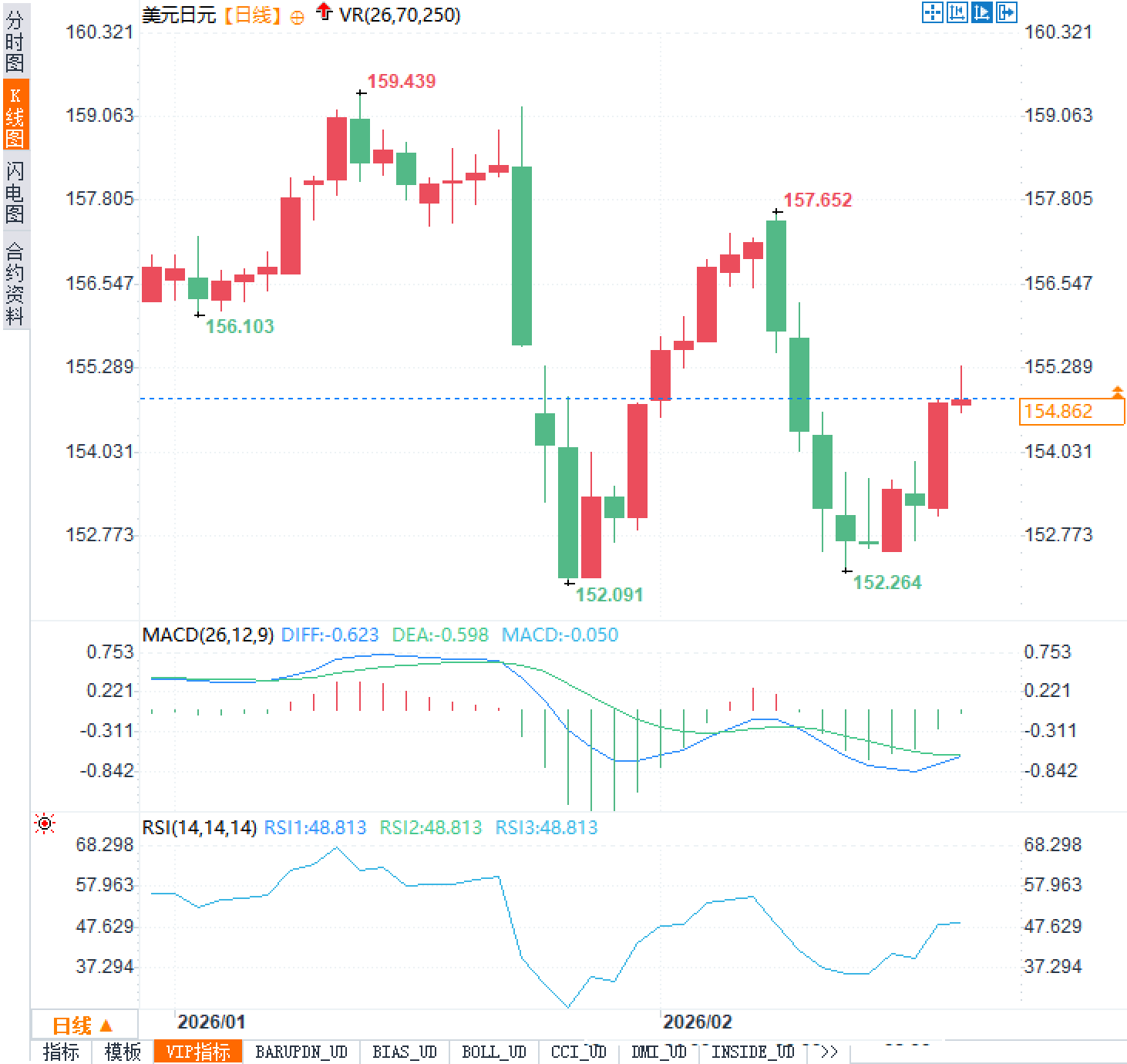
On Thursday, February 19th, the USD/JPY pair traded around 154.80 during the European session, consolidating within a range. Looking back at previous price action, the pair had previously reached a high of 159.439 before encountering a strong sell-off, quickly breaking through key support and falling to a low of 152.091. Although bulls attempted a counterattack to push the price back to around 157.652, heavy selling pressure caused the price to fall again.

From a technical perspective, the MACD is still hovering near the zero line. Although the narrowing momentum bars suggest a weakening of the downward momentum, the signal for a trend reversal is not yet sufficient. The RSI reading is in the neutral zone around 48.813, neither overheated nor oversold, suggesting it is accumulating energy for the next breakout. Analysts believe this stalemate is not accidental; it hides a deeper macroeconomic logic, particularly the structural changes in Japanese interest rates, which are quietly reshaping the market's pricing foundation.
The core logic driving exchange rate movements has always revolved around the US-Japan interest rate differential and risk appetite. However, the most concerning variable recently is the chain reaction triggered by rising Japanese government bond yields. The surge in Japanese government bond yields at the beginning of the year was not simply trading noise; it directly touched the most sensitive nerve in the Japanese financial system—the balance sheets of large life insurance institutions. These institutions hold massive amounts of long-term Japanese government bonds. Once interest rates rise and bond prices fall, the duration losses on their assets will accumulate rapidly, and unrealized losses amounting to trillions of yen are not an exaggeration.
Even more devastating is the highly sensitive "death line" in Japanese accounting rules: when the market value of bonds falls below 50% of the purchase cost and there is no clear path to recovery, institutions must make impairment provisions. In stable times, this rule acts as a safety net for investors; however, during periods of soaring interest rates, it can become a trigger for systemic risk. If long-term government bond prices continue to fall and approach this red line, life insurance companies will be forced to recognize massive impairments. Under pressure on their capital, they will be forced to sell bonds to maintain their solvency ratios. This selling will further push up interest rates and depress bond prices, creating a death spiral of "rising interest rates - falling bond prices - forced selling - rising interest rates again." Since life insurance plays a central role in Japanese household savings and long-term asset allocation, such deleveraging will not only completely alter the structure of government bond purchases but also cause the dramatic fluctuations in the yen yield curve to spill over into the foreign exchange market, significantly impacting the USD/JPY exchange rate through widening interest rate differentials and heightened risk aversion.
Faced with imminent systemic risks, Japanese regulators have chosen a pragmatic yet controversial path: instead of directly confronting market interest rates, they are first removing the most dangerous accounting trigger. According to reports, the Japan Institute of Certified Public Accountants has proposed adjusting the treatment of bonds used to match insurance reserve liabilities, making it closer to the "held-to-maturity" approach. This means that even if market prices plummet, as long as there is no intention to sell, losses can be recognized immediately without adhering to impairment rules. Coupled with the Financial Services Agency's early health checks on large life insurance companies, the focus is directly on the approximately 11.3 trillion yen in domestic bond losses.
The intention behind this policy adjustment is quite clear: by changing accounting treatment, life insurance companies are spared the need to sell off assets during the most vulnerable market periods to avoid impairment thresholds, thus cutting off the interest rate spiral risk caused by passive selling. The market reacted immediately to this change, with a significant recovery in sentiment within the insurance sector. When potential losses don't need to be reflected in financial statements in the short term, sharp fluctuations in profits are smoothed out, and the pressure on the balance sheet shifts from an "explicit outbreak" to an "implicit postponement." However, analysis points out that this does not mean the problem has disappeared. The accounting treatment only changes how losses are presented and the timing of recognition; it neither improves cash flow out of thin air nor automatically shortens duration risk. This approach is equivalent to weakening the system's self-regulating braking force, building short-term stability on the basis of delayed long-term adjustments.
Returning to the trading aspect of USD/JPY, whether the exchange rate can escape the quagmire around 154 in the short term depends on the interplay of two key variables. First, the trend of Japanese government bond yields. If interest rate fluctuations are controlled and the risk of passive selling by life insurance companies decreases, the panic premium on yen interest rates will lessen, and the exchange rate may choose to move downwards after struggling around 155.30, retesting the 154 or even 152.70 area. Second, external interest rate differentials and global risk sentiment. If the market reprices the interest rate differential path or risk appetite weakens, the pressure on yen depreciation will ease in stages. Conversely, if interest rates rise rapidly again and trigger repricing, the exchange rate could very well retest the 156.50 to 157.80 range.
Overall, Japan has bought valuable time by adjusting its rules, reducing the probability of a short-term forced sell-off triggering a chain reaction and providing a smoother interest rate transmission environment for the foreign exchange market. However, time does not equate to a solution; the risk has simply shifted from an immediate balance sheet shock to a longer-term structural test. For USD/JPY, the current level of 154.80 is not the end of the trend, but rather a relay point where interest rate policy and market narratives intersect.
From a technical perspective, the MACD is still hovering near the zero line. Although the narrowing momentum bars suggest a weakening of the downward momentum, the signal for a trend reversal is not yet sufficient. The RSI reading is in the neutral zone around 48.813, neither overheated nor oversold, suggesting it is accumulating energy for the next breakout. Analysts believe this stalemate is not accidental; it hides a deeper macroeconomic logic, particularly the structural changes in Japanese interest rates, which are quietly reshaping the market's pricing foundation.
Hidden Bomb: The Balance Sheet Crisis of a Life Insurance Giant
The core logic driving exchange rate movements has always revolved around the US-Japan interest rate differential and risk appetite. However, the most concerning variable recently is the chain reaction triggered by rising Japanese government bond yields. The surge in Japanese government bond yields at the beginning of the year was not simply trading noise; it directly touched the most sensitive nerve in the Japanese financial system—the balance sheets of large life insurance institutions. These institutions hold massive amounts of long-term Japanese government bonds. Once interest rates rise and bond prices fall, the duration losses on their assets will accumulate rapidly, and unrealized losses amounting to trillions of yen are not an exaggeration.
Even more devastating is the highly sensitive "death line" in Japanese accounting rules: when the market value of bonds falls below 50% of the purchase cost and there is no clear path to recovery, institutions must make impairment provisions. In stable times, this rule acts as a safety net for investors; however, during periods of soaring interest rates, it can become a trigger for systemic risk. If long-term government bond prices continue to fall and approach this red line, life insurance companies will be forced to recognize massive impairments. Under pressure on their capital, they will be forced to sell bonds to maintain their solvency ratios. This selling will further push up interest rates and depress bond prices, creating a death spiral of "rising interest rates - falling bond prices - forced selling - rising interest rates again." Since life insurance plays a central role in Japanese household savings and long-term asset allocation, such deleveraging will not only completely alter the structure of government bond purchases but also cause the dramatic fluctuations in the yen yield curve to spill over into the foreign exchange market, significantly impacting the USD/JPY exchange rate through widening interest rate differentials and heightened risk aversion.
Delaying tactics: Regulators' "accounting magic" and the game of time
Faced with imminent systemic risks, Japanese regulators have chosen a pragmatic yet controversial path: instead of directly confronting market interest rates, they are first removing the most dangerous accounting trigger. According to reports, the Japan Institute of Certified Public Accountants has proposed adjusting the treatment of bonds used to match insurance reserve liabilities, making it closer to the "held-to-maturity" approach. This means that even if market prices plummet, as long as there is no intention to sell, losses can be recognized immediately without adhering to impairment rules. Coupled with the Financial Services Agency's early health checks on large life insurance companies, the focus is directly on the approximately 11.3 trillion yen in domestic bond losses.
The intention behind this policy adjustment is quite clear: by changing accounting treatment, life insurance companies are spared the need to sell off assets during the most vulnerable market periods to avoid impairment thresholds, thus cutting off the interest rate spiral risk caused by passive selling. The market reacted immediately to this change, with a significant recovery in sentiment within the insurance sector. When potential losses don't need to be reflected in financial statements in the short term, sharp fluctuations in profits are smoothed out, and the pressure on the balance sheet shifts from an "explicit outbreak" to an "implicit postponement." However, analysis points out that this does not mean the problem has disappeared. The accounting treatment only changes how losses are presented and the timing of recognition; it neither improves cash flow out of thin air nor automatically shortens duration risk. This approach is equivalent to weakening the system's self-regulating braking force, building short-term stability on the basis of delayed long-term adjustments.
Future projections: 154 is not the end point, but a relay station.
Returning to the trading aspect of USD/JPY, whether the exchange rate can escape the quagmire around 154 in the short term depends on the interplay of two key variables. First, the trend of Japanese government bond yields. If interest rate fluctuations are controlled and the risk of passive selling by life insurance companies decreases, the panic premium on yen interest rates will lessen, and the exchange rate may choose to move downwards after struggling around 155.30, retesting the 154 or even 152.70 area. Second, external interest rate differentials and global risk sentiment. If the market reprices the interest rate differential path or risk appetite weakens, the pressure on yen depreciation will ease in stages. Conversely, if interest rates rise rapidly again and trigger repricing, the exchange rate could very well retest the 156.50 to 157.80 range.
Overall, Japan has bought valuable time by adjusting its rules, reducing the probability of a short-term forced sell-off triggering a chain reaction and providing a smoother interest rate transmission environment for the foreign exchange market. However, time does not equate to a solution; the risk has simply shifted from an immediate balance sheet shock to a longer-term structural test. For USD/JPY, the current level of 154.80 is not the end of the trend, but rather a relay point where interest rate policy and market narratives intersect.
- Risk Warning and Disclaimer
- The market involves risk, and trading may not be suitable for all investors. This article is for reference only and does not constitute personal investment advice, nor does it take into account certain users’ specific investment objectives, financial situation, or other needs. Any investment decisions made based on this information are at your own risk.