Analysis of the three major currency pairs: US dollar under pressure, Australian dollar leads gains, Japanese yen fluctuates.
2026-02-19 19:08:14
In 2026, influenced by factors such as the expectation of interest rate cuts by the Federal Reserve and the divergence of global central bank policies, the US dollar will continue to be under pressure, the Australian dollar will perform strongly, and the Japanese yen will fluctuate. The following is an analysis of the three currency pairs based on the core driving factors of the three major currency exchange rates.
Key drivers of the US dollar exchange rate
The US dollar continued its downward trend, with the US Dollar Index (DXY) falling 0.8% last week. Although the index rebounded sharply after hitting a four-year low of 95.57 in January (when President Trump expressed his support for a weaker dollar), the dollar is still down 1.2% against a basket of major currencies year-to-date. The following analysis will delve into the core drivers influencing the dollar's outlook.
I. Monetary Policy Landscape (Neutral/Bearish)
Current market pricing indicates that the Federal Reserve will implement two more 25-basis-point rate cuts in 2026, most likely in June and September, and will end the current easing cycle after another rate cut in January 2027.
This path contrasts sharply with that of several major central banks: the Bank of Japan and the Reserve Bank of Australia have already entered a rate hike cycle, while the European Central Bank is expected to keep rates unchanged in the short term. This divergence in monetary policy stances may continue to weigh on the dollar for the remainder of the year.
The biggest variable lies with the new Federal Reserve Chairman, Kevin Warsh. Compared to other candidates, he is more hawkish, and the market will closely watch whether he will proceed with the pace of interest rate cuts as currently expected, whether he will begin quantitative tightening, and whether he can maintain the Fed's policy independence.
II. Economic Fundamentals (Slightly Positive)
Both the Federal Reserve and the International Monetary Fund (IMF) have raised their forecasts, expecting the U.S. real economy to grow by 2.3%–2.4% in 2026.
According to Bloomberg data, the combined earnings growth rate of S&P 500 companies that have released financial reports for the fourth quarter of 2025 reached 14.4%, the highest level in four years. While the labor market has slowed somewhat, January employment data suggests that the most severe phase of the employment downturn may have passed.
III. Political and Market Stability (Bearish)
One of the core factors contributing to the dollar's weakening over the past year has been the unpredictability of US policy, particularly in the trade arena, where there has been a significant discrepancy between policy announcements and their actual implementation. The prolonged government shutdown has further exacerbated investor concerns about dollar assets.
From a macro perspective, the global "de-dollarization" trade is heating up, with investors and central banks around the world continuing to reduce their holdings of fiat currencies and turn to safe-haven assets such as gold, and market concerns about the sustainability of US fiscal policy are intensifying.
IV. Trade Landscape (Neutral/Bearish)
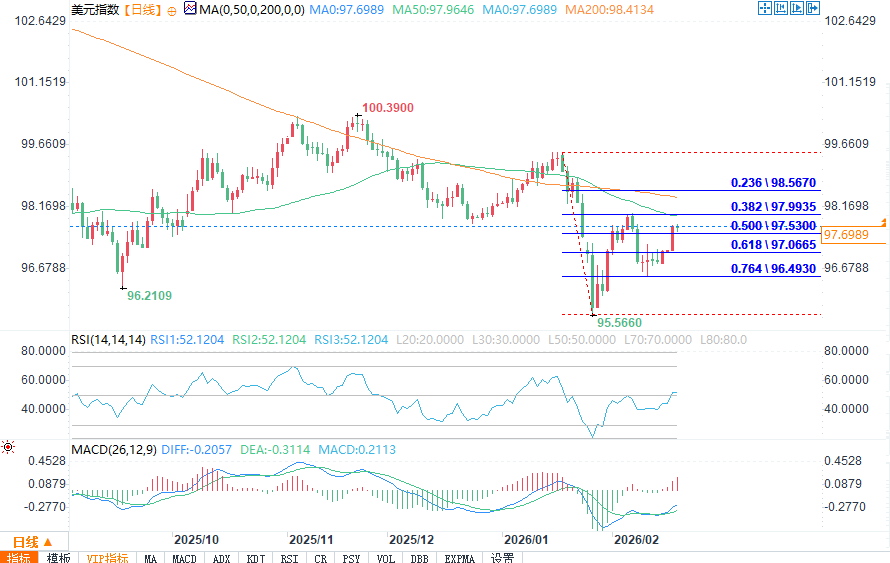
(US Dollar Index Daily Chart Source: FX678)
A weaker dollar aligns with the Trump administration's core objectives of stimulating exports and narrowing the trade deficit. It's worth noting that during Trump's first term, even with the Federal Reserve's continued interest rate hikes, the dollar index averaged around 95, suggesting further downside potential for the dollar.
However, the pace and magnitude of the decline are equally crucial: a disorderly, one-sided depreciation trend could damage the credibility of the US dollar as the world's main reserve currency, and stability is the core prerequisite for a reserve currency.
V. Hedging demand (slightly bearish)
During the period of dollar strength in the past few years, a large number of foreign institutional investors held unhedged dollar assets, and the appreciation of the dollar directly amplified their returns in their local currencies. As the trend reversed, foreign investors established dollar depreciation hedging positions, creating structural selling pressure on the dollar.
AUD/USD
Year-to-date, the Australian dollar has been the best-performing major currency, appreciating by 6.2% against the US dollar. Stronger prices for industrial and precious metals have provided robust support for this commodity currency.
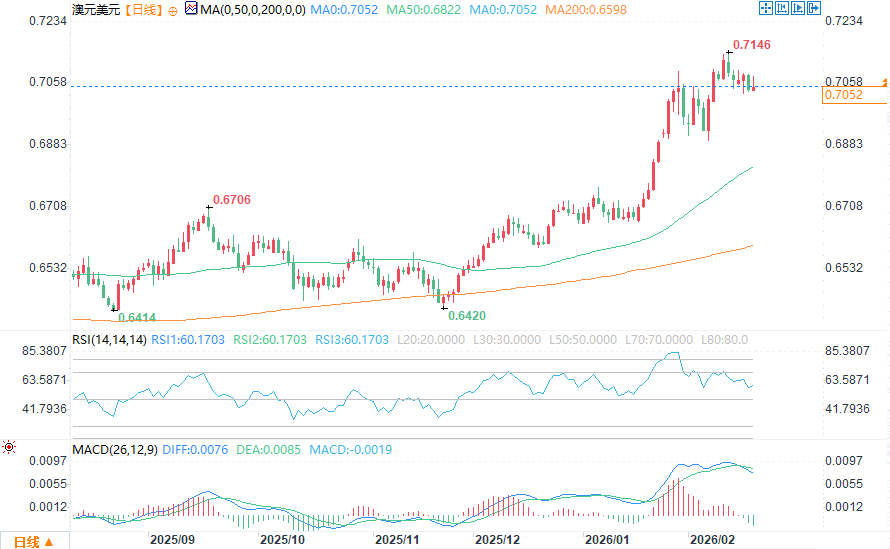
(AUD/USD daily chart source: FX678)
Inflation in Australia is picking up again: the Reserve Bank of Australia's (RBA) core monitoring indicator—the cut-off average CPI—has remained above 3% since July 2025. The RBA is expected to be the first major central bank to raise interest rates in 2026 and has stated that it will continue to tighten policy if inflation remains high and the labor market remains tight.
Implied interest rates in bond futures suggest that year-end rates may reach 4.2%, corresponding to one or two rate hikes of 25 basis points each.
Looking ahead, in addition to metal prices and domestic monetary policy, the evolution of Sino-US trade relations and the pace of China's domestic demand recovery will have a significant impact on the Australian dollar, given that China is Australia's largest trading partner.
From a technical perspective, the AUD/USD pair broke through the moderate uptrend that began in May 2025 on January 22, subsequently establishing a new range above 0.69. The pair recently encountered resistance at the February 2023 high of 0.7157, but short-term bullish momentum remains, and it is expected to retest this resistance level.
The key upside target in the medium term is the March 2022 high of 0.7540; the initial support level is the 20-day moving average at 0.7013, with secondary support at the lower end of the range at 0.69.
USD/JPY
The Bank of Japan is another major central bank that has entered a tightening cycle. Japanese inflation has been above the 2% target for 44 consecutive months, but the central bank remains extremely cautious about normalizing policy, requiring clear evidence of a sustained domestic economic recovery before taking action.
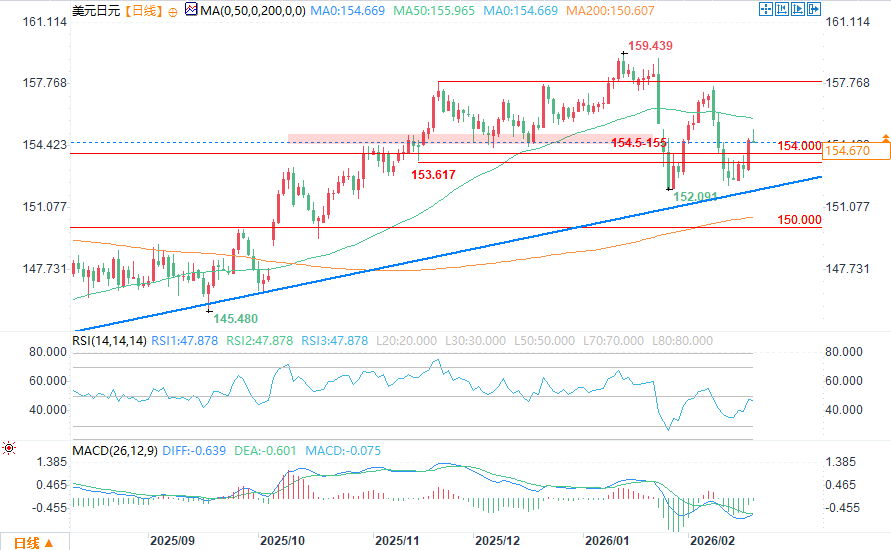
(USD/JPY daily chart source: EasyForex)
Japan's GDP is projected to grow at an annualized rate of only 0.2% in the fourth quarter of 2025, reflecting a policy dilemma: high living costs are suppressing consumption, and real wage growth is lagging behind inflation; too rapid an interest rate hike could also impact small and medium-sized enterprises. While the impact of US tariffs has been largely absorbed, continued tensions in Sino-Japanese relations are dragging down Japan's tourism industry and net exports.
The ruling coalition led by Japanese Prime Minister Sanae Takaichi won a majority of seats in the snap election, and its fiscal agenda has become the focus of the market. The market has partially priced in a 122.3 trillion yen budget for fiscal year 2026, as well as a two-year exemption from the food consumption tax (approximately 5 trillion yen).
Since Sanae Takaichi took office as president of the Liberal Democratic Party, the USD/JPY exchange rate rose from a high of 147.5 to 159.4. Although it fell back after suspected government intervention, it still accumulated a gain of 4.1% during the period.
Based on fundamental calculations using the yield spread between US Treasury bonds and purchasing power parity, the fair value of the yen is far below the 125 level. However, constrained by the aforementioned structural contradictions, the yen's return to a fair level may be a gradual process spanning multiple years.
From a technical perspective, USD/JPY entered a consolidation phase after hitting an 18-month high in January. The 20-day moving average has crossed below the 50-day moving average, signaling a short-term bearish outlook. The pair is currently testing the key support zone of 152.1–153.3.
If the price breaks below this level, it may test the 200-day moving average at 150.6; if it firmly holds above 156.3, it would mean that the yen has weakened again.
Key drivers of the US dollar exchange rate
The US dollar continued its downward trend, with the US Dollar Index (DXY) falling 0.8% last week. Although the index rebounded sharply after hitting a four-year low of 95.57 in January (when President Trump expressed his support for a weaker dollar), the dollar is still down 1.2% against a basket of major currencies year-to-date. The following analysis will delve into the core drivers influencing the dollar's outlook.
I. Monetary Policy Landscape (Neutral/Bearish)
Current market pricing indicates that the Federal Reserve will implement two more 25-basis-point rate cuts in 2026, most likely in June and September, and will end the current easing cycle after another rate cut in January 2027.
This path contrasts sharply with that of several major central banks: the Bank of Japan and the Reserve Bank of Australia have already entered a rate hike cycle, while the European Central Bank is expected to keep rates unchanged in the short term. This divergence in monetary policy stances may continue to weigh on the dollar for the remainder of the year.
The biggest variable lies with the new Federal Reserve Chairman, Kevin Warsh. Compared to other candidates, he is more hawkish, and the market will closely watch whether he will proceed with the pace of interest rate cuts as currently expected, whether he will begin quantitative tightening, and whether he can maintain the Fed's policy independence.
II. Economic Fundamentals (Slightly Positive)
Both the Federal Reserve and the International Monetary Fund (IMF) have raised their forecasts, expecting the U.S. real economy to grow by 2.3%–2.4% in 2026.
According to Bloomberg data, the combined earnings growth rate of S&P 500 companies that have released financial reports for the fourth quarter of 2025 reached 14.4%, the highest level in four years. While the labor market has slowed somewhat, January employment data suggests that the most severe phase of the employment downturn may have passed.
III. Political and Market Stability (Bearish)
One of the core factors contributing to the dollar's weakening over the past year has been the unpredictability of US policy, particularly in the trade arena, where there has been a significant discrepancy between policy announcements and their actual implementation. The prolonged government shutdown has further exacerbated investor concerns about dollar assets.
From a macro perspective, the global "de-dollarization" trade is heating up, with investors and central banks around the world continuing to reduce their holdings of fiat currencies and turn to safe-haven assets such as gold, and market concerns about the sustainability of US fiscal policy are intensifying.
IV. Trade Landscape (Neutral/Bearish)
(US Dollar Index Daily Chart Source: FX678)
A weaker dollar aligns with the Trump administration's core objectives of stimulating exports and narrowing the trade deficit. It's worth noting that during Trump's first term, even with the Federal Reserve's continued interest rate hikes, the dollar index averaged around 95, suggesting further downside potential for the dollar.
However, the pace and magnitude of the decline are equally crucial: a disorderly, one-sided depreciation trend could damage the credibility of the US dollar as the world's main reserve currency, and stability is the core prerequisite for a reserve currency.
V. Hedging demand (slightly bearish)
During the period of dollar strength in the past few years, a large number of foreign institutional investors held unhedged dollar assets, and the appreciation of the dollar directly amplified their returns in their local currencies. As the trend reversed, foreign investors established dollar depreciation hedging positions, creating structural selling pressure on the dollar.
AUD/USD
Year-to-date, the Australian dollar has been the best-performing major currency, appreciating by 6.2% against the US dollar. Stronger prices for industrial and precious metals have provided robust support for this commodity currency.
(AUD/USD daily chart source: FX678)
Inflation in Australia is picking up again: the Reserve Bank of Australia's (RBA) core monitoring indicator—the cut-off average CPI—has remained above 3% since July 2025. The RBA is expected to be the first major central bank to raise interest rates in 2026 and has stated that it will continue to tighten policy if inflation remains high and the labor market remains tight.
Implied interest rates in bond futures suggest that year-end rates may reach 4.2%, corresponding to one or two rate hikes of 25 basis points each.
Looking ahead, in addition to metal prices and domestic monetary policy, the evolution of Sino-US trade relations and the pace of China's domestic demand recovery will have a significant impact on the Australian dollar, given that China is Australia's largest trading partner.
From a technical perspective, the AUD/USD pair broke through the moderate uptrend that began in May 2025 on January 22, subsequently establishing a new range above 0.69. The pair recently encountered resistance at the February 2023 high of 0.7157, but short-term bullish momentum remains, and it is expected to retest this resistance level.
The key upside target in the medium term is the March 2022 high of 0.7540; the initial support level is the 20-day moving average at 0.7013, with secondary support at the lower end of the range at 0.69.
USD/JPY
The Bank of Japan is another major central bank that has entered a tightening cycle. Japanese inflation has been above the 2% target for 44 consecutive months, but the central bank remains extremely cautious about normalizing policy, requiring clear evidence of a sustained domestic economic recovery before taking action.
(USD/JPY daily chart source: EasyForex)
Japan's GDP is projected to grow at an annualized rate of only 0.2% in the fourth quarter of 2025, reflecting a policy dilemma: high living costs are suppressing consumption, and real wage growth is lagging behind inflation; too rapid an interest rate hike could also impact small and medium-sized enterprises. While the impact of US tariffs has been largely absorbed, continued tensions in Sino-Japanese relations are dragging down Japan's tourism industry and net exports.
The ruling coalition led by Japanese Prime Minister Sanae Takaichi won a majority of seats in the snap election, and its fiscal agenda has become the focus of the market. The market has partially priced in a 122.3 trillion yen budget for fiscal year 2026, as well as a two-year exemption from the food consumption tax (approximately 5 trillion yen).
Since Sanae Takaichi took office as president of the Liberal Democratic Party, the USD/JPY exchange rate rose from a high of 147.5 to 159.4. Although it fell back after suspected government intervention, it still accumulated a gain of 4.1% during the period.
Based on fundamental calculations using the yield spread between US Treasury bonds and purchasing power parity, the fair value of the yen is far below the 125 level. However, constrained by the aforementioned structural contradictions, the yen's return to a fair level may be a gradual process spanning multiple years.
From a technical perspective, USD/JPY entered a consolidation phase after hitting an 18-month high in January. The 20-day moving average has crossed below the 50-day moving average, signaling a short-term bearish outlook. The pair is currently testing the key support zone of 152.1–153.3.
If the price breaks below this level, it may test the 200-day moving average at 150.6; if it firmly holds above 156.3, it would mean that the yen has weakened again.
- Risk Warning and Disclaimer
- The market involves risk, and trading may not be suitable for all investors. This article is for reference only and does not constitute personal investment advice, nor does it take into account certain users’ specific investment objectives, financial situation, or other needs. Any investment decisions made based on this information are at your own risk.