The euro/dollar pair has likely bottomed out in the short term, and a recovery is expected.
2026-02-19 20:08:13
On Thursday (February 19), during the European trading session, the euro/dollar pair gradually leveled off after an initial rise followed by a decline. Although the price initially surged in the morning, bullish momentum subsequently weakened, and the pair retreated to around 1.1777 by the close. Despite short-term pressure, oversold technical signals and the resilience of the Eurozone are jointly brewing a recovery.
Euro Fundamentals: Balancing Resilient Growth and Falling Inflation
The euro's current performance is being supported by the European Central Bank's (ECB) "data-dependent" stance.
Inflation Enters the "1 Era": Latest data shows that the Eurozone's preliminary harmonized CPI for January has fallen to 1.7%, not only lower than the previous value but also remaining below the ECB's 2% target. This provides the Eurozone with room to alleviate cost-of-living pressures. However, the ECB maintained interest rates at its February meeting, suggesting it is not in a hurry to follow the global wave of interest rate cuts. This "policy resolve" has, to some extent, limited the euro's downside potential.
Moderate economic recovery: Eurozone GDP grew 0.3% quarter-on-quarter in the fourth quarter of 2025, demonstrating stronger resilience than expected. Despite a slight decline in industrial output, domestic demand is replacing external demand as the growth engine, supported by a tight labor market and wage growth.
Trade surplus support: The Eurozone recorded a trade surplus of €12.6 billion in December. The improvement in the current account provided a fundamental "foundation" for the euro, making it more resilient to the impact of a strong dollar than currencies such as the pound.
Dollar Drivers: Strong Data and Policy Uncertainty
The US dollar has recently been boosted primarily by better-than-expected US macroeconomic data and uncertainty stemming from personnel changes at the Federal Reserve.
The Fed minutes released hawkish undertones: The minutes showed that FOMC officials were cautious about cutting interest rates due to persistently high inflation. With the policy leanings of potential new chair nominees (such as Kevin Warsh) becoming the focus of the market, the market is reassessing the interest rate path for the next two years.
Economic data remains hot: US industrial output saw its biggest increase in nearly a year, coupled with better-than-expected core capital goods orders, reflecting signs of a recovery in US manufacturing. This "economic exceptionalism" has once again injected bullish momentum into the US dollar.
Market Expectations Revised: The market has slightly lowered its expectations for easing this year. Although it is still pricing in two 25 basis point rate cuts before the end of the year, the option of raising rates may return if inflation subsequently rebounds.
Going forward guidance: A dual test of GDP and PMI
Looking ahead to Friday, the main driver for the dollar's movement will be the release of the preliminary US fourth-quarter GDP data. The market expects year-on-year growth of 3%, and if the data meets or exceeds expectations, it will further solidify the dollar's strength. In addition, the preliminary February PMI figures for the Eurozone and the US will reveal the difference in the pace of business activity expansion between the two regions.
Technical Analysis
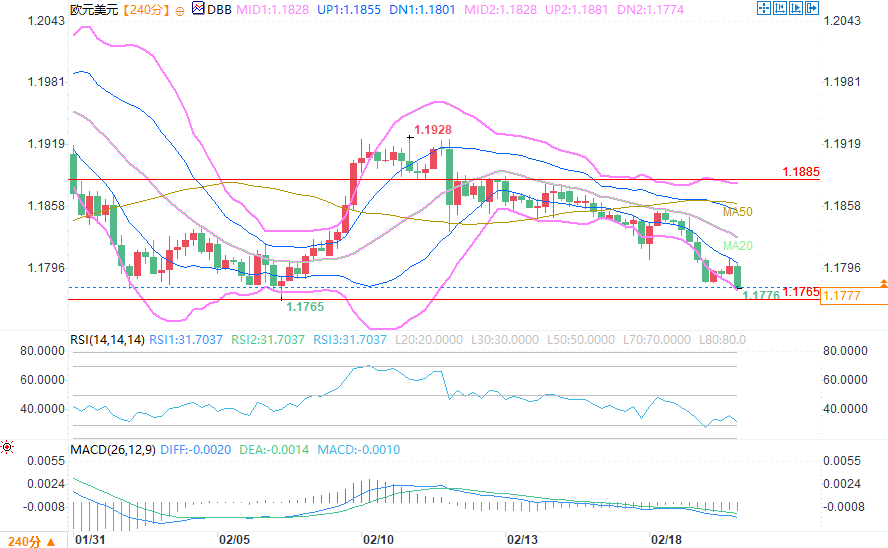
(EUR/USD 4-hour chart source: EasyForex)
From the perspective of the Double Bollinger Bands structure, on the EUR/USD 4-hour chart:
Oversold Resonance: The current price (approximately 1.1765) has pierced the lower band of the inner Bollinger Band and is approaching the lower band of the outer band, with an RSI (14) reading of approximately 31.7. This deep oversold condition means that the bearish momentum has approached a stage extreme, and the probability of a technical rebound has significantly increased.
Indicator divergence: The MACD histogram is shortening, indicating weakening bearish momentum. If the price can stabilize above 1.1765, a daily-level "bear trap" will form.
Key resistance: The moving average system (MA20/MA50) remains in a bearish alignment. The first target for a short-term rebound is the inner middle band (around 1.1828). Only a decisive break above 1.1885 can confirm a bullish counterattack and fundamentally alleviate downward pressure.
Overall Recommendations:
In the short term, pay attention to the effectiveness of the 1.1765 support level. If it breaks below this level, the downside will target the psychological level of 1.1700; if it stabilizes here, a rebound from oversold conditions could be expected.
Euro Fundamentals: Balancing Resilient Growth and Falling Inflation
The euro's current performance is being supported by the European Central Bank's (ECB) "data-dependent" stance.
Inflation Enters the "1 Era": Latest data shows that the Eurozone's preliminary harmonized CPI for January has fallen to 1.7%, not only lower than the previous value but also remaining below the ECB's 2% target. This provides the Eurozone with room to alleviate cost-of-living pressures. However, the ECB maintained interest rates at its February meeting, suggesting it is not in a hurry to follow the global wave of interest rate cuts. This "policy resolve" has, to some extent, limited the euro's downside potential.
Moderate economic recovery: Eurozone GDP grew 0.3% quarter-on-quarter in the fourth quarter of 2025, demonstrating stronger resilience than expected. Despite a slight decline in industrial output, domestic demand is replacing external demand as the growth engine, supported by a tight labor market and wage growth.
Trade surplus support: The Eurozone recorded a trade surplus of €12.6 billion in December. The improvement in the current account provided a fundamental "foundation" for the euro, making it more resilient to the impact of a strong dollar than currencies such as the pound.
Dollar Drivers: Strong Data and Policy Uncertainty
The US dollar has recently been boosted primarily by better-than-expected US macroeconomic data and uncertainty stemming from personnel changes at the Federal Reserve.
The Fed minutes released hawkish undertones: The minutes showed that FOMC officials were cautious about cutting interest rates due to persistently high inflation. With the policy leanings of potential new chair nominees (such as Kevin Warsh) becoming the focus of the market, the market is reassessing the interest rate path for the next two years.
Economic data remains hot: US industrial output saw its biggest increase in nearly a year, coupled with better-than-expected core capital goods orders, reflecting signs of a recovery in US manufacturing. This "economic exceptionalism" has once again injected bullish momentum into the US dollar.
Market Expectations Revised: The market has slightly lowered its expectations for easing this year. Although it is still pricing in two 25 basis point rate cuts before the end of the year, the option of raising rates may return if inflation subsequently rebounds.
Going forward guidance: A dual test of GDP and PMI
Looking ahead to Friday, the main driver for the dollar's movement will be the release of the preliminary US fourth-quarter GDP data. The market expects year-on-year growth of 3%, and if the data meets or exceeds expectations, it will further solidify the dollar's strength. In addition, the preliminary February PMI figures for the Eurozone and the US will reveal the difference in the pace of business activity expansion between the two regions.
Technical Analysis
(EUR/USD 4-hour chart source: EasyForex)
From the perspective of the Double Bollinger Bands structure, on the EUR/USD 4-hour chart:
Oversold Resonance: The current price (approximately 1.1765) has pierced the lower band of the inner Bollinger Band and is approaching the lower band of the outer band, with an RSI (14) reading of approximately 31.7. This deep oversold condition means that the bearish momentum has approached a stage extreme, and the probability of a technical rebound has significantly increased.
Indicator divergence: The MACD histogram is shortening, indicating weakening bearish momentum. If the price can stabilize above 1.1765, a daily-level "bear trap" will form.
Key resistance: The moving average system (MA20/MA50) remains in a bearish alignment. The first target for a short-term rebound is the inner middle band (around 1.1828). Only a decisive break above 1.1885 can confirm a bullish counterattack and fundamentally alleviate downward pressure.
Overall Recommendations:
In the short term, pay attention to the effectiveness of the 1.1765 support level. If it breaks below this level, the downside will target the psychological level of 1.1700; if it stabilizes here, a rebound from oversold conditions could be expected.
- Risk Warning and Disclaimer
- The market involves risk, and trading may not be suitable for all investors. This article is for reference only and does not constitute personal investment advice, nor does it take into account certain users’ specific investment objectives, financial situation, or other needs. Any investment decisions made based on this information are at your own risk.