0.7 Life-or-death crisis: Is the Australian dollar making a desperate comeback or on the eve of a collapse?
2026-02-19 20:58:48
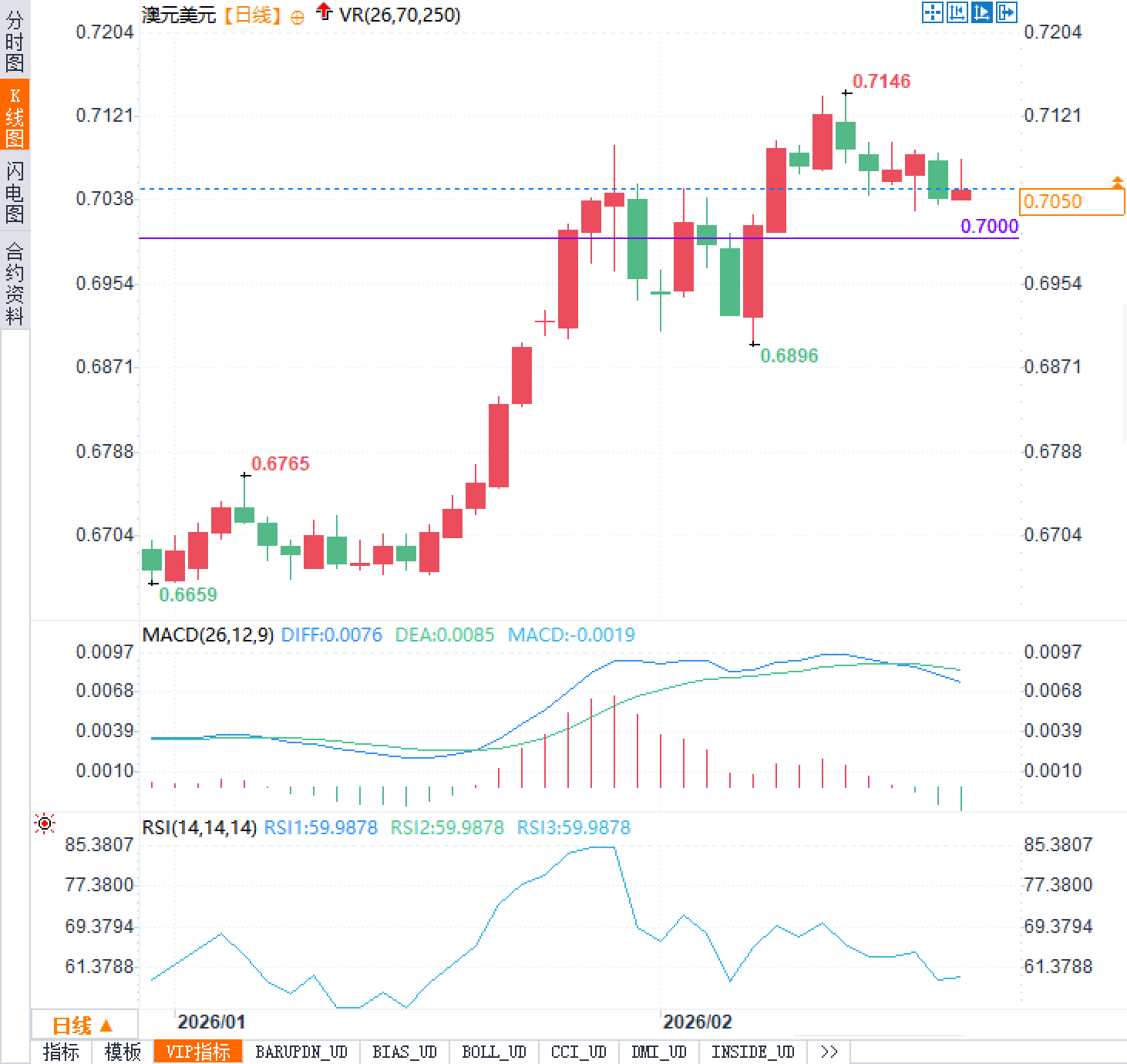
On Thursday, February 19th, the Australian dollar traded around 0.7050 against the US dollar in pre-market trading, undergoing a delicate consolidation at high levels. The exchange rate had previously surged to around 0.7146, but momentum subsequently weakened, and the price retreated, fluctuating around the upward trend line. This movement clearly indicates that both bulls and bears in the market are holding their breath, awaiting a new macroeconomic catalyst to break the deadlock.

From a daily chart perspective, the 0.7000 level has become a repeatedly tested "lifeline" recently. As long as the exchange rate can hold this level, the overall pattern remains one of slightly bullish consolidation; however, a decisive break below this level could easily trigger large-scale profit-taking, leading to a sharp increase in the pullback. Technical indicators are also subtly issuing warning signals. The MACD fast line has crossed below the slow line, with a value of -0.0019, indicating that the upward momentum after the short-term surge is significantly cooling. At the same time, the RSI indicator is hovering in the neutral-to-strong range of 60, neither entering extreme overbought territory nor turning fully bearish, reflecting that the market is shifting from a one-sided upward trend to a high-level consolidation phase. If the price continues to consolidate around 0.7050 with lower highs, the market is likely to evolve into a "time-for-space" consolidation; only by regaining a foothold above 0.7100 and launching an attack on 0.7146 can the bulls be declared to have regained control.
The core driver of recent exchange rate volatility remains the rebalancing of US economic data and policy expectations. Although previous inflation data was somewhat moderate, leading the market to price in approximately 58 basis points of interest rate cuts before the end of the year, a strong non-farm payroll report quickly reversed course, strengthening the dollar against most major currencies. Analysts point out that because short positions in the dollar were previously too crowded, a stronger and more consistent bearish reason is needed for the dollar to continue its downward trend, and currently, such a reason is insufficient.
Conversely, frequent better-than-expected US data has put significant pressure on short sellers to cover their positions. Statements from Federal Reserve officials have further reinforced the perception that the threshold for interest rate cuts is too high; they have explicitly stated that they will only consider further action after seeing a very clear improvement in inflation. This cautious stance has increased market sensitivity to data, and each stronger-than-expected employment and economic indicators more easily translates into solid support for the US dollar.
Conversely, the Australian dollar's fundamentals are facing a situation where "all the good news has been priced in." The recent strong Australian employment report failed to help the Australian dollar maintain its upward momentum, a point particularly noteworthy. Typically, strong employment data would increase expectations of a tighter policy from the Reserve Bank of Australia (RBA), but market pricing has not followed suit. Traders' year-end policy path is still priced in at around 42 basis points of tightening. This suggests that the market may believe the repricing of hawkish expectations has reached a near-term high, and is concerned about a significant pullback after the positive factors have been fully priced in. In other words, the Australian dollar urgently needs new and more impactful evidence of inflation to open up further upside potential.
Looking at the policy front, although the Reserve Bank of Australia (RBA) raised the cash rate by 25 basis points to 3.85% and hinted at two more rate hikes before the end of the year, the exchange rate failed to reach new highs despite continued strong employment, suggesting the market is awaiting more direct confirmation of inflation. If subsequent inflation data is positive, the market's belief in "two rate hikes" will be strengthened, and the Australian dollar is expected to challenge its previous highs. Conversely, if inflation fails to pick up, coupled with a strengthening US dollar and risk aversion, the Australian dollar could easily reverse its upward trend and enter a downward trend. Furthermore, as a high-beta currency, the Australian dollar is extremely sensitive to global risk appetite; escalating geopolitical tensions often lead to capital flows to more liquid safe-haven assets, thus negatively impacting the Australian dollar.
In summary, the consolidation of the Australian dollar against the US dollar around 0.7050 is both a necessary digestion after the previous rapid rise and a crucial process for both bulls and bears to repric their expectations regarding the policies of the two countries. The key to short-term trading lies in whether the 0.7000 level holds, as this will determine whether a pullback will be significant; on the upside, close attention should be paid to the resistance levels around 0.7100 and 0.7146.
In terms of driving factors, the US dollar is more focused on the combination of US economic growth and inflation, with the Federal Reserve's cautious stance providing stronger support for data. The Australian dollar, on the other hand, relies on further inflation to maintain its hawkish narrative; otherwise, with the expectation of a 42bps tightening rate unlikely to be revised upwards further, a pullback is more in line with the inherent logic of the financial markets. Overall, if US data is strong and risk appetite weakens, the Australian dollar is more likely to experience a significant technical pullback; only with the dual benefits of weaker US data and rising Australian inflation will the Australian dollar have the potential to rise again after consolidation.
From a daily chart perspective, the 0.7000 level has become a repeatedly tested "lifeline" recently. As long as the exchange rate can hold this level, the overall pattern remains one of slightly bullish consolidation; however, a decisive break below this level could easily trigger large-scale profit-taking, leading to a sharp increase in the pullback. Technical indicators are also subtly issuing warning signals. The MACD fast line has crossed below the slow line, with a value of -0.0019, indicating that the upward momentum after the short-term surge is significantly cooling. At the same time, the RSI indicator is hovering in the neutral-to-strong range of 60, neither entering extreme overbought territory nor turning fully bearish, reflecting that the market is shifting from a one-sided upward trend to a high-level consolidation phase. If the price continues to consolidate around 0.7050 with lower highs, the market is likely to evolve into a "time-for-space" consolidation; only by regaining a foothold above 0.7100 and launching an attack on 0.7146 can the bulls be declared to have regained control.
The rationale behind the strong US dollar: a tug-of-war between better-than-expected data and expectations of interest rate cuts.
The core driver of recent exchange rate volatility remains the rebalancing of US economic data and policy expectations. Although previous inflation data was somewhat moderate, leading the market to price in approximately 58 basis points of interest rate cuts before the end of the year, a strong non-farm payroll report quickly reversed course, strengthening the dollar against most major currencies. Analysts point out that because short positions in the dollar were previously too crowded, a stronger and more consistent bearish reason is needed for the dollar to continue its downward trend, and currently, such a reason is insufficient.
Conversely, frequent better-than-expected US data has put significant pressure on short sellers to cover their positions. Statements from Federal Reserve officials have further reinforced the perception that the threshold for interest rate cuts is too high; they have explicitly stated that they will only consider further action after seeing a very clear improvement in inflation. This cautious stance has increased market sensitivity to data, and each stronger-than-expected employment and economic indicators more easily translates into solid support for the US dollar.
The Australian Dollar's Fundamental Dilemma: All the Positive Factors Expired and the Inflation Conundrum
Conversely, the Australian dollar's fundamentals are facing a situation where "all the good news has been priced in." The recent strong Australian employment report failed to help the Australian dollar maintain its upward momentum, a point particularly noteworthy. Typically, strong employment data would increase expectations of a tighter policy from the Reserve Bank of Australia (RBA), but market pricing has not followed suit. Traders' year-end policy path is still priced in at around 42 basis points of tightening. This suggests that the market may believe the repricing of hawkish expectations has reached a near-term high, and is concerned about a significant pullback after the positive factors have been fully priced in. In other words, the Australian dollar urgently needs new and more impactful evidence of inflation to open up further upside potential.
Looking at the policy front, although the Reserve Bank of Australia (RBA) raised the cash rate by 25 basis points to 3.85% and hinted at two more rate hikes before the end of the year, the exchange rate failed to reach new highs despite continued strong employment, suggesting the market is awaiting more direct confirmation of inflation. If subsequent inflation data is positive, the market's belief in "two rate hikes" will be strengthened, and the Australian dollar is expected to challenge its previous highs. Conversely, if inflation fails to pick up, coupled with a strengthening US dollar and risk aversion, the Australian dollar could easily reverse its upward trend and enter a downward trend. Furthermore, as a high-beta currency, the Australian dollar is extremely sensitive to global risk appetite; escalating geopolitical tensions often lead to capital flows to more liquid safe-haven assets, thus negatively impacting the Australian dollar.
Conclusion: Choices at the Crossroads
In summary, the consolidation of the Australian dollar against the US dollar around 0.7050 is both a necessary digestion after the previous rapid rise and a crucial process for both bulls and bears to repric their expectations regarding the policies of the two countries. The key to short-term trading lies in whether the 0.7000 level holds, as this will determine whether a pullback will be significant; on the upside, close attention should be paid to the resistance levels around 0.7100 and 0.7146.
In terms of driving factors, the US dollar is more focused on the combination of US economic growth and inflation, with the Federal Reserve's cautious stance providing stronger support for data. The Australian dollar, on the other hand, relies on further inflation to maintain its hawkish narrative; otherwise, with the expectation of a 42bps tightening rate unlikely to be revised upwards further, a pullback is more in line with the inherent logic of the financial markets. Overall, if US data is strong and risk appetite weakens, the Australian dollar is more likely to experience a significant technical pullback; only with the dual benefits of weaker US data and rising Australian inflation will the Australian dollar have the potential to rise again after consolidation.
- Risk Warning and Disclaimer
- The market involves risk, and trading may not be suitable for all investors. This article is for reference only and does not constitute personal investment advice, nor does it take into account certain users’ specific investment objectives, financial situation, or other needs. Any investment decisions made based on this information are at your own risk.