The Strait of Hormuz: If it is blocked, will oil prices plummet instantly?
2026-02-23 19:58:00
On Monday, February 23, Brent crude oil traded around $71.50 during the European session. This price level is not solely determined by supply and demand fundamentals, but is also heavily influenced by geopolitical tensions. The recent significant rise in oil prices is essentially a "precautionary pricing" by the market in anticipation of potential contingencies between the US and Iran ahead of the weekend. Traders, fearing uncontrollable black swan events during the holiday, bought in advance to hedge, driving a rapid rebound in oil prices and pushing them above previous key resistance levels.
However, this surge was highly speculative, a typical example of a risk event-driven market. When the expected escalation of the situation did not occur over the weekend, but instead signals of easing emerged, oil prices immediately retreated after the market opened. This clearly demonstrates that sentiment and expectations dominate short-term fluctuations, and any slight disturbance can trigger violent price swings.
The market's heightened tension stems from its extreme sensitivity to tail risks. Although Oman's foreign ministry confirmed that the US and Iran will begin their third round of talks in Geneva this Thursday, reducing the probability of the most extreme scenario unfolding in the short term and causing a temporary easing of the risk premium, the premium has not completely disappeared. This is because market participants do not need to be certain that conflict will occur; as long as they perceive an increased probability of conflict, they will demand higher risk compensation. Even without a substantial gap in the spot market, the futures curve and volatility have already reflected this, resulting in oil prices exhibiting a "difficult to fall deeply" characteristic, consistently remaining in a high range.
If geopolitical conflicts were to escalate into military confrontation, the most sensitive transmission channel for the market would be the shipping security of the Strait of Hormuz. As a vital artery of global oil trade, any disruption to this crucial waterway would quickly translate into panic over deliverable supply, thereby driving up risk premiums for both near- and far-month contracts. Especially given the recent increase in related drills and frequent strong verbal statements, the pricing of worst-case scenarios in the market exhibits a clear "non-linear" characteristic: once a critical point is triggered, the price increase could be both rapid and extreme, far exceeding the scope of conventional fundamental analysis. This potential explosive force means that oil prices possess significant upward elasticity at any given time.
Conversely, for oil prices to return to their lows near $60, clearer and more actionable evidence of easing tensions is needed. Logically, the most effective signals fall into two categories: first, a substantial withdrawal or de-escalation of military tensions, directly reducing the tail risk of supply disruptions; and second, binding agreements reached through negotiations, convincing the market that risk premiums should be "more actively eroded." However, reality is often far more challenging than ideals, and reaching concrete arrangements is far more difficult than simply expressing goodwill. Furthermore, any minor disagreements during negotiations can be amplified in terms of price. Institutional views reinforce this framework, noting that prices showed signs of softening at the beginning of the week following the US-Iran talks on Thursday, but persistent external uncertainty means that oil prices are unlikely to break out of a one-sided trend in the short term, instead fluctuating within a tug-of-war driven by news events.
From a micro perspective of position data, speculators' net long positions in Brent crude oil decreased by 17,876 contracts in the latest week, falling to 263,186 contracts. This change reveals a subtle shift in market sentiment: some funds chose to take profits or reduce risk exposure after a significant rise, indicating that longs were not blindly chasing the rally; however, at the same time, net long positions remain at a relatively high level, suggesting that the market as a whole is still paying for geopolitical risk premiums, only the marginal sentiment has shifted from "frenzied buying" to "caution at high levels." Under this funding structure, positive news may still trigger price surges, but negative or easing news is also more likely to trigger large-scale profit-taking, resulting in a volatile market rhythm of "rapid rise followed by rapid fall."
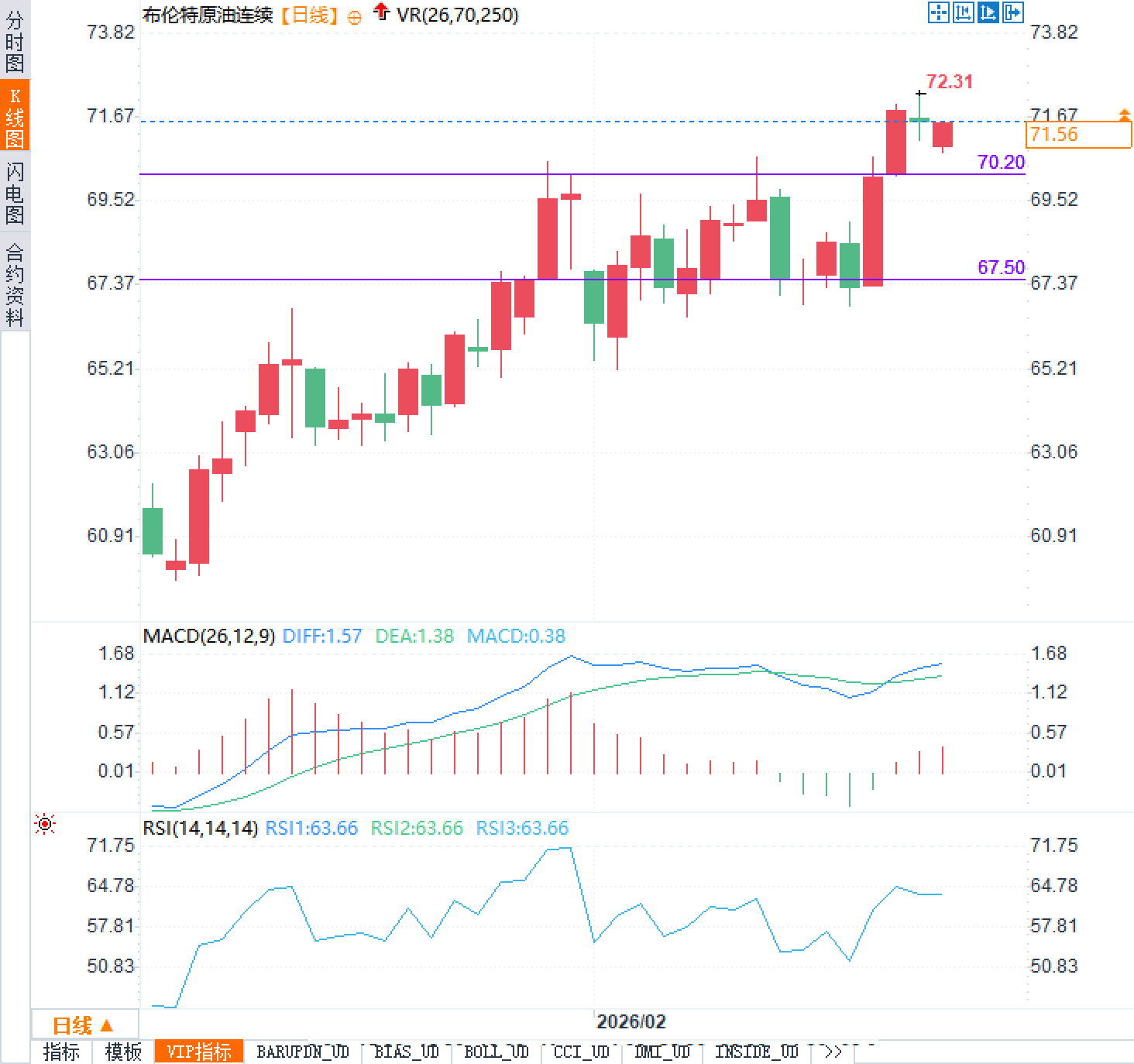
From a technical perspective, the daily chart shows that the price is currently consolidating in a high-level range after the previous rise. The area around $72.31 forms a strong resistance level; a significant breakout would typically require a new, strong stimulus to further increase the risk premium or attract trend-following funds. On the downside, the key level to watch is the support around $70.20, while the more crucial support lies around $67.50, which is closer to the center of the previous consolidation zone. A break below this level could prompt the market to reassess whether the current premium level is too high. In terms of indicators, the MACD parameters show DIFF at 1.57, DEA at 1.38, and MACD at 0.38. While this indicates a bullish structure, the momentum is not extremely strong, resembling a high-level correction after the rise. The RSI is 63.66, in a slightly bullish but not overheated range, consistent with "strong consolidation" rather than "unilateral acceleration." In summary, Brent crude oil is currently likely using time to consolidate, awaiting the outcome of the US-Iran talks on Thursday—the ultimate variable.
However, this surge was highly speculative, a typical example of a risk event-driven market. When the expected escalation of the situation did not occur over the weekend, but instead signals of easing emerged, oil prices immediately retreated after the market opened. This clearly demonstrates that sentiment and expectations dominate short-term fluctuations, and any slight disturbance can trigger violent price swings.
The market's heightened tension stems from its extreme sensitivity to tail risks. Although Oman's foreign ministry confirmed that the US and Iran will begin their third round of talks in Geneva this Thursday, reducing the probability of the most extreme scenario unfolding in the short term and causing a temporary easing of the risk premium, the premium has not completely disappeared. This is because market participants do not need to be certain that conflict will occur; as long as they perceive an increased probability of conflict, they will demand higher risk compensation. Even without a substantial gap in the spot market, the futures curve and volatility have already reflected this, resulting in oil prices exhibiting a "difficult to fall deeply" characteristic, consistently remaining in a high range.
The shadow of the Strait of Hormuz and bargaining chips at the negotiating table
If geopolitical conflicts were to escalate into military confrontation, the most sensitive transmission channel for the market would be the shipping security of the Strait of Hormuz. As a vital artery of global oil trade, any disruption to this crucial waterway would quickly translate into panic over deliverable supply, thereby driving up risk premiums for both near- and far-month contracts. Especially given the recent increase in related drills and frequent strong verbal statements, the pricing of worst-case scenarios in the market exhibits a clear "non-linear" characteristic: once a critical point is triggered, the price increase could be both rapid and extreme, far exceeding the scope of conventional fundamental analysis. This potential explosive force means that oil prices possess significant upward elasticity at any given time.
Conversely, for oil prices to return to their lows near $60, clearer and more actionable evidence of easing tensions is needed. Logically, the most effective signals fall into two categories: first, a substantial withdrawal or de-escalation of military tensions, directly reducing the tail risk of supply disruptions; and second, binding agreements reached through negotiations, convincing the market that risk premiums should be "more actively eroded." However, reality is often far more challenging than ideals, and reaching concrete arrangements is far more difficult than simply expressing goodwill. Furthermore, any minor disagreements during negotiations can be amplified in terms of price. Institutional views reinforce this framework, noting that prices showed signs of softening at the beginning of the week following the US-Iran talks on Thursday, but persistent external uncertainty means that oil prices are unlikely to break out of a one-sided trend in the short term, instead fluctuating within a tug-of-war driven by news events.
Funds in a dilemma and technical consolidation at high levels
From a micro perspective of position data, speculators' net long positions in Brent crude oil decreased by 17,876 contracts in the latest week, falling to 263,186 contracts. This change reveals a subtle shift in market sentiment: some funds chose to take profits or reduce risk exposure after a significant rise, indicating that longs were not blindly chasing the rally; however, at the same time, net long positions remain at a relatively high level, suggesting that the market as a whole is still paying for geopolitical risk premiums, only the marginal sentiment has shifted from "frenzied buying" to "caution at high levels." Under this funding structure, positive news may still trigger price surges, but negative or easing news is also more likely to trigger large-scale profit-taking, resulting in a volatile market rhythm of "rapid rise followed by rapid fall."
From a technical perspective, the daily chart shows that the price is currently consolidating in a high-level range after the previous rise. The area around $72.31 forms a strong resistance level; a significant breakout would typically require a new, strong stimulus to further increase the risk premium or attract trend-following funds. On the downside, the key level to watch is the support around $70.20, while the more crucial support lies around $67.50, which is closer to the center of the previous consolidation zone. A break below this level could prompt the market to reassess whether the current premium level is too high. In terms of indicators, the MACD parameters show DIFF at 1.57, DEA at 1.38, and MACD at 0.38. While this indicates a bullish structure, the momentum is not extremely strong, resembling a high-level correction after the rise. The RSI is 63.66, in a slightly bullish but not overheated range, consistent with "strong consolidation" rather than "unilateral acceleration." In summary, Brent crude oil is currently likely using time to consolidate, awaiting the outcome of the US-Iran talks on Thursday—the ultimate variable.
- Risk Warning and Disclaimer
- The market involves risk, and trading may not be suitable for all investors. This article is for reference only and does not constitute personal investment advice, nor does it take into account certain users’ specific investment objectives, financial situation, or other needs. Any investment decisions made based on this information are at your own risk.