Fiscal Blueprint and Interest Rate Hike Expectations: Amidst Policy Shifts in Japan, Currency Game Enters a New Stage
2026-02-23 21:37:45
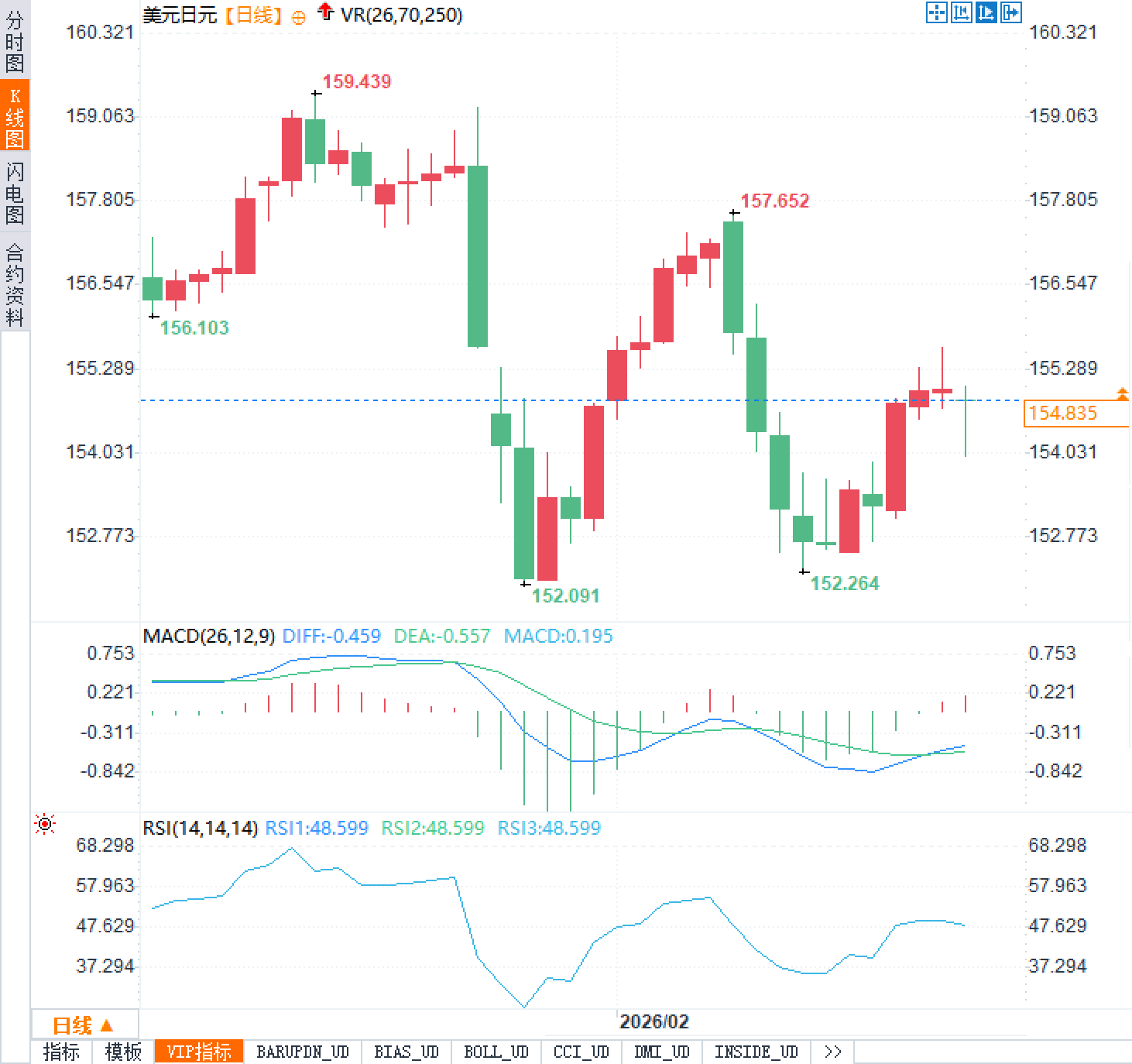
On Monday, February 23, the USD/JPY pair traded around 154.80 during the North American session. This price level falls within a recovery range following a previous rapid decline, making market sentiment quite delicate. Looking back at the daily chart, the pair had previously tested a high of around 159.439, but subsequently encountered resistance and fell back, establishing temporary support around 152.091 and 152.264.

From a technical perspective, the MACD currently shows a DIFF of -0.459, a DEA of -0.557, and a MACD histogram of 0.195. These data indicate that the indicators are still in a recovery phase below the zero line. Although bearish momentum has weakened compared to the previous period, a trend reversal has not yet been fully confirmed. Meanwhile, the RSI reading is 48.6, close to a neutral level, meaning that the forces of bulls and bears are currently in equilibrium. In this context, future price movements are more easily driven by unexpected events and changes in market expectations, and a directional choice could occur at any time.
The core logic driving changes in yen expectations has always revolved around Japan's policy and fiscal framework. Recently, the market has closely watched the Japanese government's increased emphasis on defense, economic security, and growth driven by investment, and its explicit statement of reducing reliance on supplementary budgets and transitioning to a more stable fiscal arrangement. This statement is undoubtedly reassuring for government bond investors, as a clearer budget path makes interest rate and supply expectations easier to price, and market volatility may subsequently decrease. Once the 2026 fiscal year budget is approved and its details finalized, uncertainty will be significantly reduced, giving the Bank of Japan greater room for maneuver in its policy choices. Based on this logic, some believe there is a 70% probability that the Bank of Japan will raise policy rates at its April 28 meeting. If the budget is successfully passed and the USD/JPY exchange rate remains near its current level, market pressure for the Bank of Japan to take action will increase significantly, and expectations of a stronger yen will become more concentrated.
Furthermore, changes in the selection of members of the Policy Committee are also a variable that cannot be ignored. The market expects the government to announce the successors of two Bank of Japan policy committee members next week: Asahi Noguchi and Junko Nakagawa. Although these two are considered dovish, if the successors' overall stance leans more towards tightening, the balance within the committee may shift slightly towards hawkishness, thereby reinforcing market pricing in action at the April meeting or subsequent meetings. For the foreign exchange market, the transmission of such changes in expectations is often first reflected in interest rate differential expectations, and then in exchange rate movements. Especially against the backdrop of fluctuating US dollar interest rates, any signal of policy normalization from the yen side could amplify the marginal support for the yen, thereby changing the market's game dynamics.
From a trading structure perspective, the area around 154.80 represents a consolidation zone following the previous decline, a focal point of contention between bulls and bears. On the upside, the first resistance level to watch is around 155.30. A break above this level would target a dense resistance zone between 156.50 and 157.80. Only a decisive break and hold above this area would allow the price to retest higher levels. Conversely, on the downside, key support levels to watch are around 154 and 152.70. Overall, the market is currently awaiting clear direction, with various forces repricing the yen's path based on the progress of the fiscal year 2026 budget, expectations for the April 28th meeting, and changes in committee members.
If the pace of the Bank of Japan's policy normalization becomes clearer, the yen may receive more sustained fundamental support, which will limit the upside potential of the USD/JPY pair and increase the risk of a pullback. Analysts believe that in an environment where inflation is declining but still resilient, the Bank of Japan may need to continue moving towards a tighter monetary policy stance to avoid excessively low real interest rates leading to a resurgence of inflation expectations. Although recent national consumer price data was slightly weaker than expected, a single instance of weakness is not enough to immediately change the discussion surrounding an interest rate hike at the April meeting; the key lies in whether subsequent data can continue to weaken. At the current stage, the market generally believes that the Bank of Japan's stance still needs to be further tightened, and this tug-of-war over the exchange rate is far from over.
From a technical perspective, the MACD currently shows a DIFF of -0.459, a DEA of -0.557, and a MACD histogram of 0.195. These data indicate that the indicators are still in a recovery phase below the zero line. Although bearish momentum has weakened compared to the previous period, a trend reversal has not yet been fully confirmed. Meanwhile, the RSI reading is 48.6, close to a neutral level, meaning that the forces of bulls and bears are currently in equilibrium. In this context, future price movements are more easily driven by unexpected events and changes in market expectations, and a directional choice could occur at any time.
Policy Dynamics: The Game Between Fiscal Blueprint and Interest Rate Hike Expectations
The core logic driving changes in yen expectations has always revolved around Japan's policy and fiscal framework. Recently, the market has closely watched the Japanese government's increased emphasis on defense, economic security, and growth driven by investment, and its explicit statement of reducing reliance on supplementary budgets and transitioning to a more stable fiscal arrangement. This statement is undoubtedly reassuring for government bond investors, as a clearer budget path makes interest rate and supply expectations easier to price, and market volatility may subsequently decrease. Once the 2026 fiscal year budget is approved and its details finalized, uncertainty will be significantly reduced, giving the Bank of Japan greater room for maneuver in its policy choices. Based on this logic, some believe there is a 70% probability that the Bank of Japan will raise policy rates at its April 28 meeting. If the budget is successfully passed and the USD/JPY exchange rate remains near its current level, market pressure for the Bank of Japan to take action will increase significantly, and expectations of a stronger yen will become more concentrated.
Furthermore, changes in the selection of members of the Policy Committee are also a variable that cannot be ignored. The market expects the government to announce the successors of two Bank of Japan policy committee members next week: Asahi Noguchi and Junko Nakagawa. Although these two are considered dovish, if the successors' overall stance leans more towards tightening, the balance within the committee may shift slightly towards hawkishness, thereby reinforcing market pricing in action at the April meeting or subsequent meetings. For the foreign exchange market, the transmission of such changes in expectations is often first reflected in interest rate differential expectations, and then in exchange rate movements. Especially against the backdrop of fluctuating US dollar interest rates, any signal of policy normalization from the yen side could amplify the marginal support for the yen, thereby changing the market's game dynamics.
Key level: Awaiting a breakthrough or a return to the abyss?
From a trading structure perspective, the area around 154.80 represents a consolidation zone following the previous decline, a focal point of contention between bulls and bears. On the upside, the first resistance level to watch is around 155.30. A break above this level would target a dense resistance zone between 156.50 and 157.80. Only a decisive break and hold above this area would allow the price to retest higher levels. Conversely, on the downside, key support levels to watch are around 154 and 152.70. Overall, the market is currently awaiting clear direction, with various forces repricing the yen's path based on the progress of the fiscal year 2026 budget, expectations for the April 28th meeting, and changes in committee members.
If the pace of the Bank of Japan's policy normalization becomes clearer, the yen may receive more sustained fundamental support, which will limit the upside potential of the USD/JPY pair and increase the risk of a pullback. Analysts believe that in an environment where inflation is declining but still resilient, the Bank of Japan may need to continue moving towards a tighter monetary policy stance to avoid excessively low real interest rates leading to a resurgence of inflation expectations. Although recent national consumer price data was slightly weaker than expected, a single instance of weakness is not enough to immediately change the discussion surrounding an interest rate hike at the April meeting; the key lies in whether subsequent data can continue to weaken. At the current stage, the market generally believes that the Bank of Japan's stance still needs to be further tightened, and this tug-of-war over the exchange rate is far from over.
- Risk Warning and Disclaimer
- The market involves risk, and trading may not be suitable for all investors. This article is for reference only and does not constitute personal investment advice, nor does it take into account certain users’ specific investment objectives, financial situation, or other needs. Any investment decisions made based on this information are at your own risk.