Gold Trading Alert: With Trump's tariff nuclear bombs and looming war clouds in the Middle East, gold prices have risen for four consecutive days, approaching $5,250, with bulls targeting $6,200.
2026-02-24 07:55:43
On Monday (February 22), spot gold prices surged 2.5%, marking their fourth consecutive day of gains. On Tuesday (February 23) in early Asian trading, gold prices continued their upward trend, reaching near the $5250 mark by 7:35 AM, a new high since January 30. US gold futures for April delivery also jumped 2.8%, settling at $5225.60 per ounce. This surge was driven by a concentrated surge in safe-haven demand triggered by multiple uncertainties, particularly the global trade uncertainty stemming from the repeated tariff policies of US President Trump, which became the most direct catalyst for igniting gold prices.
The story begins with President Trump, who is never short of topics. Last Friday, the U.S. Supreme Court ruled against Trump's power to unilaterally impose tariffs under the International Emergency Economic Powers Act, finding that he had exceeded the scope of presidential authority. This was undoubtedly a major legal blow to Trump's trade policies. However, this did not deter the president, who prides himself on the "art of the deal," but instead spurred an even fiercer counterattack.
Trump swiftly posted several messages on social media, issuing a scathing warning to countries attempting to manipulate court rulings that they would face "higher, even harsher" tariffs. He immediately invoked another legal weapon—Section 122 of the Trade Act of 1974—threatening to impose temporary tariffs of up to 15% on imports from all countries. This was like a nuclear bomb detonating in the trade arena, instantly plunging the future of global trade into a quagmire of immense uncertainty, despite previous agreements reached with numerous trading partners.
Even more problematic is that this is just the beginning. According to US media reports, the Trump administration is considering broader "national security tariffs" targeting six key industries, including large batteries, pig iron and iron fittings, plastic pipes, industrial chemicals, and power grids and telecommunications equipment. Once implemented, these measures will disrupt the global supply chain at a much deeper level.
This tariff drama, orchestrated by Trump, has had a profound and contradictory impact. On the one hand, aggressive tariff policies are bound to drive up the prices of imported goods in the United States, thereby exacerbating inflationary pressures. This puts the Federal Reserve in a dilemma: to curb inflation, it needs to maintain high interest rates or even raise them further, but high interest rates will also damage the already sluggish economy. Sarah Ying, head of foreign exchange strategy at CIBC Capital Markets, astutely pointed out the core dilemma of the market: are more tariffs ultimately good or bad for the dollar? It may push up the dollar by increasing inflation and reducing expectations of interest rate cuts, but it may also depress the dollar by increasing uncertainty and triggering the risk of de-dollarization. It is precisely this contradiction and chaos that makes the certainty of gold's value all the more precious.
If Trump's tariff policies are a "gray rhino" for the global economy, then the escalating tensions in the Middle East are undoubtedly another "black swan" hurtling towards us.
Just as markets are grappling with trade policy, the risk of a military conflict between the United States and Iran is escalating at an unprecedented rate. The Pentagon has issued a rare and stern warning to President Trump, clearly stating that a protracted military operation against Iran would carry incalculable risks, including heavy casualties among U.S. troops and allies, depletion of air defense systems, and overwhelming forces. Reports indicate that a wide range of strike options are being considered, from limited strikes to multi-day air campaigns aimed at regime change, each option carrying significant costs.
Almost simultaneously, the U.S. State Department ordered the evacuation of non-essential personnel and their families from the U.S. Embassy in Beirut. This move is often seen as a harbinger of impending escalation, like swallows flying low before a storm, instantly freezing the atmosphere across the region. Iranian Supreme Leader Khamenei has issued a strong statement, claiming his forces are capable of sinking U.S. warships. The hardline stances of both sides have further intensified the shadow of war over the Persian Gulf.
In distant Eastern Europe, the smoke of the Russia-Ukraine conflict has never dissipated. Russia continues its attacks on Ukraine's energy infrastructure, while Ukraine launches counter-offensives in certain areas. Geopolitical rifts are widening, and each hotspot could become a trigger for a larger-scale conflict. In this environment, gold, as the ultimate safe-haven asset, has become infinitely attractive. As Jeffrey Christian, managing partner of CPM Group, stated, the numerous economic and political problems existing globally are the core driving force behind the rise in gold prices.
Faced with such dense and significant uncertainty, Wall Street's reaction was swift and brutal. U.S. stocks suffered a sharp decline on Monday, with the Dow Jones Industrial Average, S&P 500, and Nasdaq all falling by more than 1%. Investors panicked and sold off risky assets, from airlines and travel and leisure stocks to financial and software stocks—nothing was spared. A "sell first, then reassess" mentality permeated the market. The potential disruptive impact of artificial intelligence, coupled with uncertainty surrounding tariff policies, prompted investors to comprehensively reassess the risks they were taking.
In stark contrast to the dismal performance of the stock market, the gold market shone brightly. Spot gold rose more than 2% on Monday, firmly establishing itself above $5,200, and surged directly to the $5,250 mark in early Asian trading on Tuesday. Four consecutive days of gains have charted a steep and powerful upward curve. Funds are flowing out of risky assets like a tidal wave into gold, a safe haven that has remained resilient through storms.
It's not just retail investors' risk aversion; broader macroeconomic forces are also quietly driving this trend. Data released last Friday showed that US core inflation rose more than expected in December, while fourth-quarter economic growth slowed significantly. This shadow of "stagflation" has put the Federal Reserve in a policy dilemma. Although the market expects the Fed to keep interest rates unchanged until at least June, the suppression of real interest rates by inflation expectations is actually beneficial to non-interest-bearing gold. At the same time, the continued strong gold purchases by global central banks have also provided solid support for gold prices. UBS Group has reiterated its positive stance on gold, raising its target price for international spot gold to $6,200 per ounce in the coming months, against the backdrop of expectations of Fed rate cuts and escalating geopolitical risks.
From the supply side, gold's growth potential is also extremely limited. Consulting firm Wood Mackenzie estimates that by 2028, approximately 80 mines globally will have exhausted their current production capacity, indicating that the elasticity of gold supply is extremely limited in the short term. Against the backdrop of persistently strong demand and tight supply, the long-term upward trend in gold prices seems increasingly solidified.
The current strong rebound in gold prices is essentially a concentrated release of the "premium" priced in on global uncertainty. Trump's tariff storm, US-Iran tensions, the uncertainty surrounding the Federal Reserve's policy path, and concerns about stagflation... these intertwined risks have made gold the most favored safe haven for capital. From a technical perspective, gold prices have broken through key resistance levels and still have upward momentum in the short term; from a fundamental perspective, safe-haven demand and declining real interest rates are driving the market, and the medium- to long-term trend remains upward. For investors, this may be another rare opportunity in the 2026 gold bull market. In turbulent times, holding gold is never gambling, but rather the most rational response to uncertainty. In the coming months, gold prices are poised to reach even higher peaks, with historical highs and even $6200 not being unattainable fantasies.
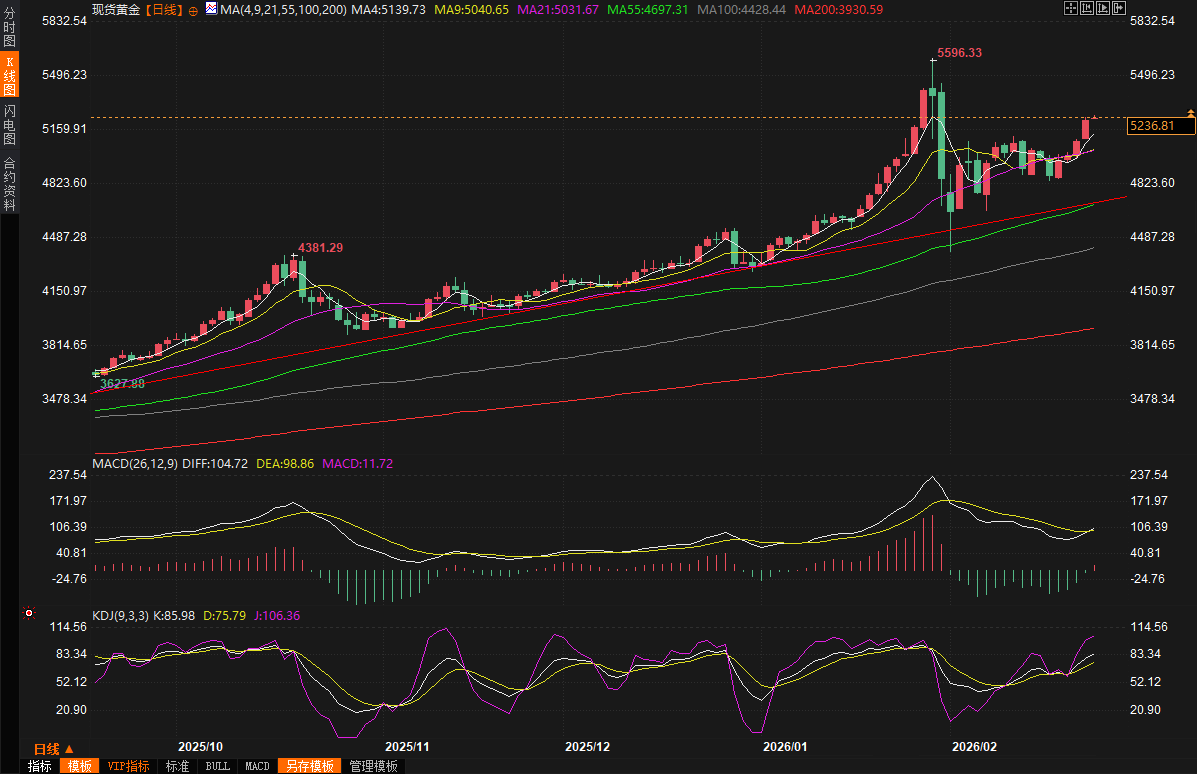
(Spot gold daily chart, source: FX678)
At 07:53 Beijing time, spot gold was trading at $5237.28 per ounce.
Trump's tariff weapon: old wounds not yet healed, new pains arise.
The story begins with President Trump, who is never short of topics. Last Friday, the U.S. Supreme Court ruled against Trump's power to unilaterally impose tariffs under the International Emergency Economic Powers Act, finding that he had exceeded the scope of presidential authority. This was undoubtedly a major legal blow to Trump's trade policies. However, this did not deter the president, who prides himself on the "art of the deal," but instead spurred an even fiercer counterattack.
Trump swiftly posted several messages on social media, issuing a scathing warning to countries attempting to manipulate court rulings that they would face "higher, even harsher" tariffs. He immediately invoked another legal weapon—Section 122 of the Trade Act of 1974—threatening to impose temporary tariffs of up to 15% on imports from all countries. This was like a nuclear bomb detonating in the trade arena, instantly plunging the future of global trade into a quagmire of immense uncertainty, despite previous agreements reached with numerous trading partners.
Even more problematic is that this is just the beginning. According to US media reports, the Trump administration is considering broader "national security tariffs" targeting six key industries, including large batteries, pig iron and iron fittings, plastic pipes, industrial chemicals, and power grids and telecommunications equipment. Once implemented, these measures will disrupt the global supply chain at a much deeper level.
This tariff drama, orchestrated by Trump, has had a profound and contradictory impact. On the one hand, aggressive tariff policies are bound to drive up the prices of imported goods in the United States, thereby exacerbating inflationary pressures. This puts the Federal Reserve in a dilemma: to curb inflation, it needs to maintain high interest rates or even raise them further, but high interest rates will also damage the already sluggish economy. Sarah Ying, head of foreign exchange strategy at CIBC Capital Markets, astutely pointed out the core dilemma of the market: are more tariffs ultimately good or bad for the dollar? It may push up the dollar by increasing inflation and reducing expectations of interest rate cuts, but it may also depress the dollar by increasing uncertainty and triggering the risk of de-dollarization. It is precisely this contradiction and chaos that makes the certainty of gold's value all the more precious.
The Middle East Powder Keg: The Shadow of War from Tehran to Beirut
If Trump's tariff policies are a "gray rhino" for the global economy, then the escalating tensions in the Middle East are undoubtedly another "black swan" hurtling towards us.
Just as markets are grappling with trade policy, the risk of a military conflict between the United States and Iran is escalating at an unprecedented rate. The Pentagon has issued a rare and stern warning to President Trump, clearly stating that a protracted military operation against Iran would carry incalculable risks, including heavy casualties among U.S. troops and allies, depletion of air defense systems, and overwhelming forces. Reports indicate that a wide range of strike options are being considered, from limited strikes to multi-day air campaigns aimed at regime change, each option carrying significant costs.
Almost simultaneously, the U.S. State Department ordered the evacuation of non-essential personnel and their families from the U.S. Embassy in Beirut. This move is often seen as a harbinger of impending escalation, like swallows flying low before a storm, instantly freezing the atmosphere across the region. Iranian Supreme Leader Khamenei has issued a strong statement, claiming his forces are capable of sinking U.S. warships. The hardline stances of both sides have further intensified the shadow of war over the Persian Gulf.
In distant Eastern Europe, the smoke of the Russia-Ukraine conflict has never dissipated. Russia continues its attacks on Ukraine's energy infrastructure, while Ukraine launches counter-offensives in certain areas. Geopolitical rifts are widening, and each hotspot could become a trigger for a larger-scale conflict. In this environment, gold, as the ultimate safe-haven asset, has become infinitely attractive. As Jeffrey Christian, managing partner of CPM Group, stated, the numerous economic and political problems existing globally are the core driving force behind the rise in gold prices.
Market Reaction: Stock Market Surges, Gold Market Stands Out
Faced with such dense and significant uncertainty, Wall Street's reaction was swift and brutal. U.S. stocks suffered a sharp decline on Monday, with the Dow Jones Industrial Average, S&P 500, and Nasdaq all falling by more than 1%. Investors panicked and sold off risky assets, from airlines and travel and leisure stocks to financial and software stocks—nothing was spared. A "sell first, then reassess" mentality permeated the market. The potential disruptive impact of artificial intelligence, coupled with uncertainty surrounding tariff policies, prompted investors to comprehensively reassess the risks they were taking.
In stark contrast to the dismal performance of the stock market, the gold market shone brightly. Spot gold rose more than 2% on Monday, firmly establishing itself above $5,200, and surged directly to the $5,250 mark in early Asian trading on Tuesday. Four consecutive days of gains have charted a steep and powerful upward curve. Funds are flowing out of risky assets like a tidal wave into gold, a safe haven that has remained resilient through storms.
It's not just retail investors' risk aversion; broader macroeconomic forces are also quietly driving this trend. Data released last Friday showed that US core inflation rose more than expected in December, while fourth-quarter economic growth slowed significantly. This shadow of "stagflation" has put the Federal Reserve in a policy dilemma. Although the market expects the Fed to keep interest rates unchanged until at least June, the suppression of real interest rates by inflation expectations is actually beneficial to non-interest-bearing gold. At the same time, the continued strong gold purchases by global central banks have also provided solid support for gold prices. UBS Group has reiterated its positive stance on gold, raising its target price for international spot gold to $6,200 per ounce in the coming months, against the backdrop of expectations of Fed rate cuts and escalating geopolitical risks.
From the supply side, gold's growth potential is also extremely limited. Consulting firm Wood Mackenzie estimates that by 2028, approximately 80 mines globally will have exhausted their current production capacity, indicating that the elasticity of gold supply is extremely limited in the short term. Against the backdrop of persistently strong demand and tight supply, the long-term upward trend in gold prices seems increasingly solidified.
Conclusion: The gold bull market is far from over, and the window for investment is opening.
The current strong rebound in gold prices is essentially a concentrated release of the "premium" priced in on global uncertainty. Trump's tariff storm, US-Iran tensions, the uncertainty surrounding the Federal Reserve's policy path, and concerns about stagflation... these intertwined risks have made gold the most favored safe haven for capital. From a technical perspective, gold prices have broken through key resistance levels and still have upward momentum in the short term; from a fundamental perspective, safe-haven demand and declining real interest rates are driving the market, and the medium- to long-term trend remains upward. For investors, this may be another rare opportunity in the 2026 gold bull market. In turbulent times, holding gold is never gambling, but rather the most rational response to uncertainty. In the coming months, gold prices are poised to reach even higher peaks, with historical highs and even $6200 not being unattainable fantasies.
(Spot gold daily chart, source: FX678)
At 07:53 Beijing time, spot gold was trading at $5237.28 per ounce.
- Risk Warning and Disclaimer
- The market involves risk, and trading may not be suitable for all investors. This article is for reference only and does not constitute personal investment advice, nor does it take into account certain users’ specific investment objectives, financial situation, or other needs. Any investment decisions made based on this information are at your own risk.