Lagarde's composure vs. Trump's radicalism: How long can the euro survive in this predicament?
2026-02-24 19:56:51
On Tuesday, February 24th, during the European trading session, the foreign exchange market witnessed a seemingly calm but actually turbulent game. The euro/dollar exchange rate consolidated narrowly around 1.1780, resembling the calm before a storm. A noteworthy phenomenon was that although the dollar index rose 0.16% to around 97.85, demonstrating resilience, this dollar surge failed to significantly suppress the euro. This divergence—a strong dollar and a relatively strong euro—clearly reveals a delicate balance between bullish and bearish forces in the current market. Analysts believe this is not accidental, but rather a result of the market repricing the complex macroeconomic environment.

The core driver of the dollar's strength stems from deep market anxiety over tariff uncertainty. Although news emerged that the US Supreme Court blocked some tariff policies, traders generally remained cautious, believing this might only be a short-term disturbance, as there are still various means to maintain additional import tariffs. Coupled with Trump's startling remarks about imposing a 15% global tariff and threatening even higher tariffs on countries that haven't fulfilled trade agreements, market concerns about a resurgence of trade frictions continued to intensify. Against this backdrop, the resonance between risk aversion and interest rate expectations provided buying support for the dollar. However, the euro did not collapse, indicating its considerable resilience, with both sides reaching a stalemate around 1.1780.
The market's future direction will largely depend on the convergence of two key variables. For the US dollar, the immediate catalysts are primarily a series of speeches by Federal Reserve officials. The market is trying to glean the latest clues about the interest rate path from these statements, particularly regarding the pace of inflation decline, the resilience of the labor market, and the tightness of financial conditions. If Fed officials adopt a cautious stance, emphasizing vigilance against recurring inflation, the dollar is likely to maintain its strength, thus limiting the euro's upside potential. Conversely, if officials focus more on the risks of an economic slowdown or express greater confidence in a decline in inflation, the dollar's upward momentum may weaken marginally, opening a window for further upward testing. Currently, traders are generally betting that the Fed will hold rates steady at its March and April meetings, meaning that the dollar's strength is more driven by events and expectation gaps than by simply rising interest rates.
Meanwhile, the fate of the euro hinges on the upcoming release this week of Germany's preliminary Harmonized Index of Consumer Prices (HICP) for February. The market expects the index to rise 0.5% month-on-month, a significant recovery from January's 0.1% decline; the year-on-year reading is projected to steadily climb to 2.1%. Logically, if the month-on-month increase meets expectations, it would indicate a recovery in short-term price momentum. However, since the year-on-year level remains near the 2% target, this data is unlikely to have a significant impact on the ECB's medium-term policy stance. The prevailing market view is that Eurozone inflation is gradually converging towards the target, and unless the data deviates significantly, it is unlikely to drastically alter policy expectations. Furthermore, ECB President Lagarde's previously neutral signals, emphasizing the need for monetary policy adjustments and her confidence in the current favorable situation, have also provided reassurance for the euro and reduced market volatility premiums.
Turning our attention to the short-term chart, the technical charts are telling a story about a "critical point." Looking at the 30-minute chart, the previous highs are densely distributed around 1.1792 to 1.1800. The price has repeatedly attempted to approach this area but failed, indicating clear resistance at this level. On the downside, the price briefly dipped to 1.1767 before rebounding quickly, proving strong support at that level. In terms of technical indicators, while the MACD is still below the zero line, the green histogram has turned from weak to strong, suggesting that downward momentum is quietly cooling. The RSI reading is around 46.6, in the neutral-to-weak range, reflecting that the bulls have not yet formed a strong upward trend, but the bears also lack the conditions for sustained momentum.
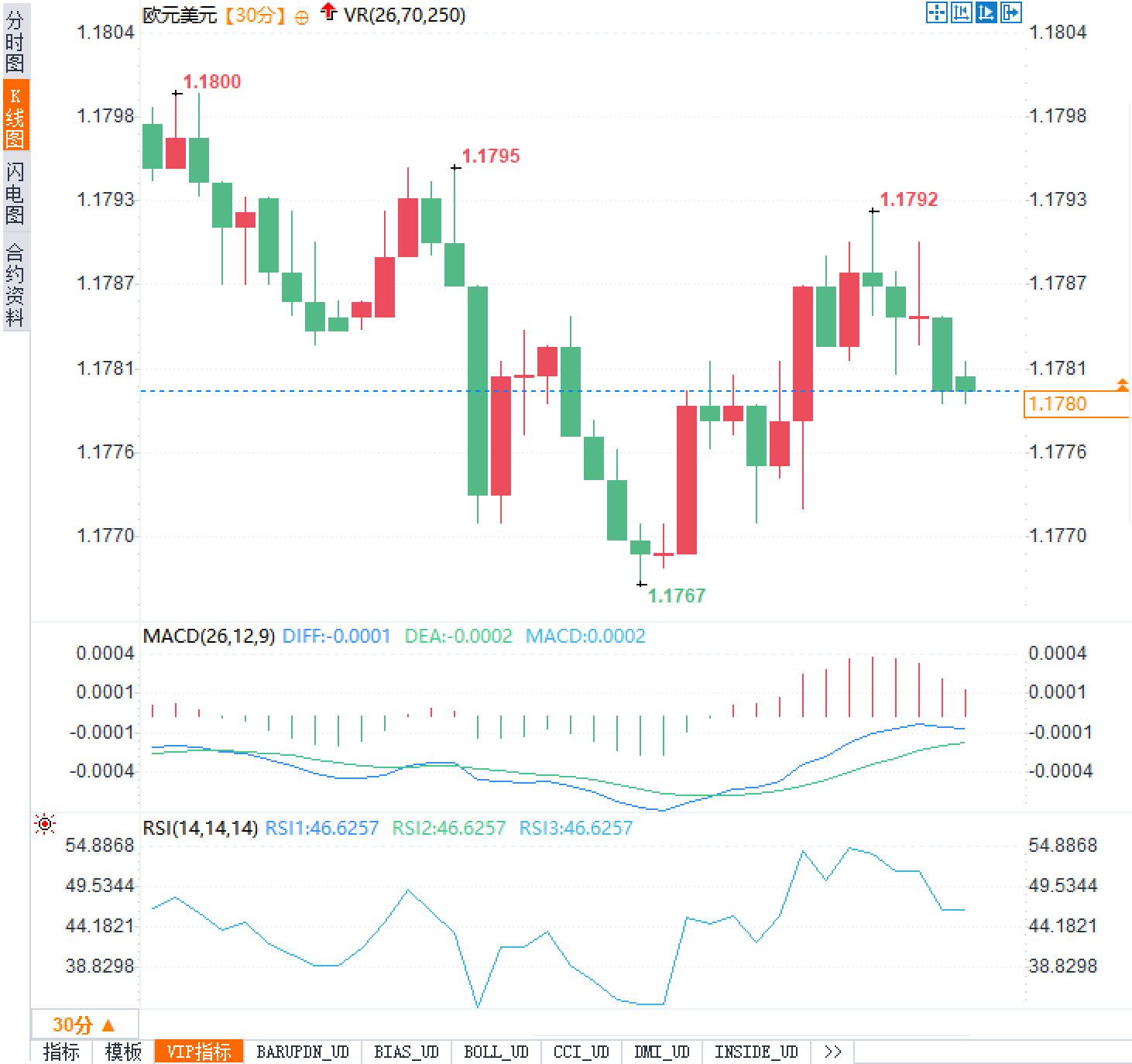
In summary, the euro/dollar exchange rate is currently at a crossroads. If it can effectively hold above and break through the resistance level near 1.1800, it may open up further room for recovery in the short term, initiating a rebound. Conversely, if the exchange rate turns downward and decisively breaks below 1.1767, the risk of accelerated decline after the lower edge of the trading range is high. Overall, the core characteristic of the euro/dollar exchange rate at present is range-bound trading and waiting for event-driven catalysts. As long as the Fed's speech does not change market confidence in maintaining interest rates unchanged in the spring, and German inflation data does not significantly deviate from the expected 0.5% month-on-month and 2.1% year-on-year, this narrow range-bound fluctuation around 1.1780 is likely to continue.
The core driver of the dollar's strength stems from deep market anxiety over tariff uncertainty. Although news emerged that the US Supreme Court blocked some tariff policies, traders generally remained cautious, believing this might only be a short-term disturbance, as there are still various means to maintain additional import tariffs. Coupled with Trump's startling remarks about imposing a 15% global tariff and threatening even higher tariffs on countries that haven't fulfilled trade agreements, market concerns about a resurgence of trade frictions continued to intensify. Against this backdrop, the resonance between risk aversion and interest rate expectations provided buying support for the dollar. However, the euro did not collapse, indicating its considerable resilience, with both sides reaching a stalemate around 1.1780.
Policy Indicator: The Ultimate Showdown Between Fed Speeches and German Inflation Data
The market's future direction will largely depend on the convergence of two key variables. For the US dollar, the immediate catalysts are primarily a series of speeches by Federal Reserve officials. The market is trying to glean the latest clues about the interest rate path from these statements, particularly regarding the pace of inflation decline, the resilience of the labor market, and the tightness of financial conditions. If Fed officials adopt a cautious stance, emphasizing vigilance against recurring inflation, the dollar is likely to maintain its strength, thus limiting the euro's upside potential. Conversely, if officials focus more on the risks of an economic slowdown or express greater confidence in a decline in inflation, the dollar's upward momentum may weaken marginally, opening a window for further upward testing. Currently, traders are generally betting that the Fed will hold rates steady at its March and April meetings, meaning that the dollar's strength is more driven by events and expectation gaps than by simply rising interest rates.
Meanwhile, the fate of the euro hinges on the upcoming release this week of Germany's preliminary Harmonized Index of Consumer Prices (HICP) for February. The market expects the index to rise 0.5% month-on-month, a significant recovery from January's 0.1% decline; the year-on-year reading is projected to steadily climb to 2.1%. Logically, if the month-on-month increase meets expectations, it would indicate a recovery in short-term price momentum. However, since the year-on-year level remains near the 2% target, this data is unlikely to have a significant impact on the ECB's medium-term policy stance. The prevailing market view is that Eurozone inflation is gradually converging towards the target, and unless the data deviates significantly, it is unlikely to drastically alter policy expectations. Furthermore, ECB President Lagarde's previously neutral signals, emphasizing the need for monetary policy adjustments and her confidence in the current favorable situation, have also provided reassurance for the euro and reduced market volatility premiums.
Technical aspects
Turning our attention to the short-term chart, the technical charts are telling a story about a "critical point." Looking at the 30-minute chart, the previous highs are densely distributed around 1.1792 to 1.1800. The price has repeatedly attempted to approach this area but failed, indicating clear resistance at this level. On the downside, the price briefly dipped to 1.1767 before rebounding quickly, proving strong support at that level. In terms of technical indicators, while the MACD is still below the zero line, the green histogram has turned from weak to strong, suggesting that downward momentum is quietly cooling. The RSI reading is around 46.6, in the neutral-to-weak range, reflecting that the bulls have not yet formed a strong upward trend, but the bears also lack the conditions for sustained momentum.
In summary, the euro/dollar exchange rate is currently at a crossroads. If it can effectively hold above and break through the resistance level near 1.1800, it may open up further room for recovery in the short term, initiating a rebound. Conversely, if the exchange rate turns downward and decisively breaks below 1.1767, the risk of accelerated decline after the lower edge of the trading range is high. Overall, the core characteristic of the euro/dollar exchange rate at present is range-bound trading and waiting for event-driven catalysts. As long as the Fed's speech does not change market confidence in maintaining interest rates unchanged in the spring, and German inflation data does not significantly deviate from the expected 0.5% month-on-month and 2.1% year-on-year, this narrow range-bound fluctuation around 1.1780 is likely to continue.
- Risk Warning and Disclaimer
- The market involves risk, and trading may not be suitable for all investors. This article is for reference only and does not constitute personal investment advice, nor does it take into account certain users’ specific investment objectives, financial situation, or other needs. Any investment decisions made based on this information are at your own risk.