A chart shows the Baltic Dry Index declining due to lower Capesize freight rates.
2026-02-26 01:33:56
The latest data shows that on February 25, 2026, the Baltic Dry Index (BDI) was 2121 points, down 0.38% from the previous day, marking the largest drop in four days. Looking at the short-term charts, the BDI saw positive growth 6 times, negative growth 5 times, and zero growth in the last 11 BDI readings. Specifically, the Panamax Freight Index (BPI) was 1890 points, up 1.29% from the previous day; the Capesize Freight Index (BCI) was 3128 points, down 2.46%; and the Supramax Freight Index (BSI) was 1255 points, up 3.12%. For detailed 720-day and 10-year trend charts of the Baltic Dry Index and its three main sub-indices, please refer to the specially designed charts.
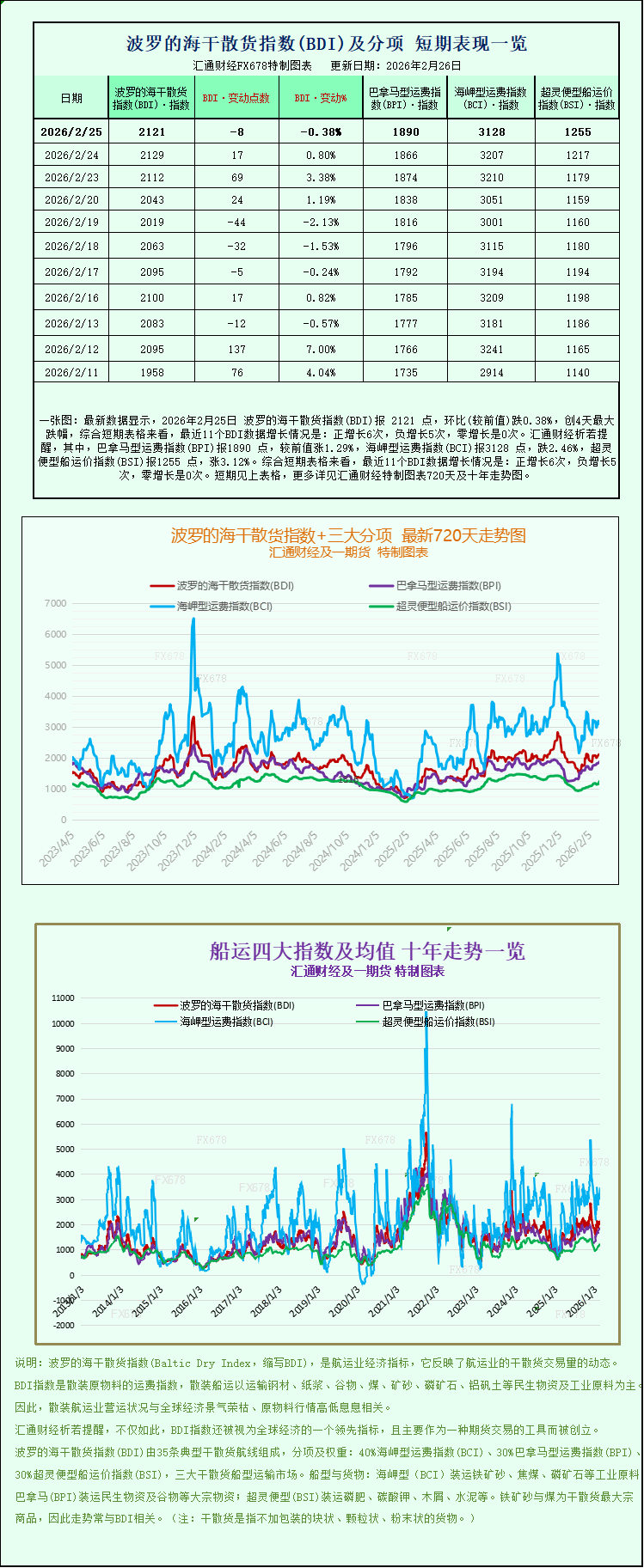
The Baltic Exchange's Baltic Dry Bulk Freight Index fell on Wednesday, primarily due to declining demand for Capesize vessels, which dragged down the overall index performance. This index is a key indicator of the global dry bulk shipping market, tracking freight rates for vessels transporting dry bulk commodities such as iron ore, coal, and grains worldwide. Its fluctuations directly reflect the activity of global dry bulk trade and changes in market supply and demand.
The Baltic Dry Index—which comprehensively covers freight rates for the three major dry bulk carrier types—Capesize, Panamax, and Supramax, fell 8 points, or 0.4%, to close at 2121 points. It's worth noting that the index had just reached its highest point in over three weeks on the previous trading day (Tuesday). This pullback is a short-term fluctuation and does not change the overall recent upward trend.
The Capesize freight rate index—a core sub-index influencing the main index—performed weakly on the day, falling 79 points, a drop of 2.5%, to close at 3128 points. Capesize vessels are among the largest tonnage vessels in global dry bulk shipping, primarily undertaking long-haul transoceanic dry bulk transport missions. Their freight rate fluctuations are highly sensitive to global commodity trade, especially iron ore and coal trade.
Capesize vessels, typically with a capacity of 150,000 tons, primarily transport bulk commodities such as iron ore and coal, serving as the core carriers for raw material transportation in the global steel and energy industries. On that day, their average daily earnings decreased by $722 to $24,863 per day. This decline in earnings mirrored the drop in freight rate indices, reflecting the current short-term imbalance between supply and demand in the Capesize vessel market.
Iron ore futures market performance – As the Chinese Lunar New Year holiday ended and domestic market liquidity gradually recovered, market expectations for demand for raw materials such as iron ore rose, driving up iron ore futures prices. However, industry analysts point out that global iron ore arrivals are gradually increasing, potentially increasing supply pressure in the future. This could limit further price increases and indirectly affect the transportation demand and freight rates for Capesize vessels.
The Panamax freight index – In contrast to the weak performance of Capesize vessels, the Panamax freight index bucked the trend, rising 24 points, or 1.3%, to close at 1890 points. Panamax vessels are the "backbone" of global dry bulk shipping, with tonnage between Capesize and Supramax, suitable for navigation conditions in most major ports worldwide.
Panamax vessels' average daily earnings – These vessels typically have a capacity of 60,000 to 70,000 tons and primarily transport dry bulk cargoes such as coal and grain. They are widely used for short- and medium-haul dry bulk shipping within and across regions. On that day, their average daily earnings increased by $221 to $17,014 per day. This increase was mainly due to the steady recovery in global grain trade demand and increased regional coal shipping demand.
Supramax Freight Index – Among small and medium-sized dry bulk carriers, Supramax vessels performed exceptionally well, with the freight index rising 38 points, or 3.1%, to close at 1255 points. Supramax vessels are smaller and more maneuverable, capable of berthing at small and medium-sized ports, and primarily transport various types of loose dry bulk cargo such as cement, fertilizer, and steel. The increase in their freight rates reflects the growing activity in global regional dry bulk trade.
The Baltic Exchange's Baltic Dry Bulk Freight Index fell on Wednesday, primarily due to declining demand for Capesize vessels, which dragged down the overall index performance. This index is a key indicator of the global dry bulk shipping market, tracking freight rates for vessels transporting dry bulk commodities such as iron ore, coal, and grains worldwide. Its fluctuations directly reflect the activity of global dry bulk trade and changes in market supply and demand.
The Baltic Dry Index—which comprehensively covers freight rates for the three major dry bulk carrier types—Capesize, Panamax, and Supramax, fell 8 points, or 0.4%, to close at 2121 points. It's worth noting that the index had just reached its highest point in over three weeks on the previous trading day (Tuesday). This pullback is a short-term fluctuation and does not change the overall recent upward trend.
The Capesize freight rate index—a core sub-index influencing the main index—performed weakly on the day, falling 79 points, a drop of 2.5%, to close at 3128 points. Capesize vessels are among the largest tonnage vessels in global dry bulk shipping, primarily undertaking long-haul transoceanic dry bulk transport missions. Their freight rate fluctuations are highly sensitive to global commodity trade, especially iron ore and coal trade.
Capesize vessels, typically with a capacity of 150,000 tons, primarily transport bulk commodities such as iron ore and coal, serving as the core carriers for raw material transportation in the global steel and energy industries. On that day, their average daily earnings decreased by $722 to $24,863 per day. This decline in earnings mirrored the drop in freight rate indices, reflecting the current short-term imbalance between supply and demand in the Capesize vessel market.
Iron ore futures market performance – As the Chinese Lunar New Year holiday ended and domestic market liquidity gradually recovered, market expectations for demand for raw materials such as iron ore rose, driving up iron ore futures prices. However, industry analysts point out that global iron ore arrivals are gradually increasing, potentially increasing supply pressure in the future. This could limit further price increases and indirectly affect the transportation demand and freight rates for Capesize vessels.
The Panamax freight index – In contrast to the weak performance of Capesize vessels, the Panamax freight index bucked the trend, rising 24 points, or 1.3%, to close at 1890 points. Panamax vessels are the "backbone" of global dry bulk shipping, with tonnage between Capesize and Supramax, suitable for navigation conditions in most major ports worldwide.
Panamax vessels' average daily earnings – These vessels typically have a capacity of 60,000 to 70,000 tons and primarily transport dry bulk cargoes such as coal and grain. They are widely used for short- and medium-haul dry bulk shipping within and across regions. On that day, their average daily earnings increased by $221 to $17,014 per day. This increase was mainly due to the steady recovery in global grain trade demand and increased regional coal shipping demand.
Supramax Freight Index – Among small and medium-sized dry bulk carriers, Supramax vessels performed exceptionally well, with the freight index rising 38 points, or 3.1%, to close at 1255 points. Supramax vessels are smaller and more maneuverable, capable of berthing at small and medium-sized ports, and primarily transport various types of loose dry bulk cargo such as cement, fertilizer, and steel. The increase in their freight rates reflects the growing activity in global regional dry bulk trade.
- Risk Warning and Disclaimer
- The market involves risk, and trading may not be suitable for all investors. This article is for reference only and does not constitute personal investment advice, nor does it take into account certain users’ specific investment objectives, financial situation, or other needs. Any investment decisions made based on this information are at your own risk.