Gold Trading Alert: With the double storm of Trump's tariff war and the Iranian nuclear crisis looming, can gold prices still break through the $6,000 mark?
2026-02-26 07:59:34
On Wednesday, spot gold prices rose 0.4% to close near $5,164 per ounce, after surging as much as 1.5% to a high of $5,217.63 during the session. US gold futures for April delivery also rose by about 1%, settling at $5,226.20. The combined effects of tariff inflationary pressures and geopolitical uncertainty led investors to flock to gold, a traditional safe-haven asset, seeking protection against uncertainty. In early Asian trading on Thursday (February 26), spot gold traded in a narrow range, currently hovering around $5,167 per ounce.
On Tuesday, the U.S. government officially imposed a temporary 10% tariff on global imports, and White House officials revealed that the Trump team is actively pushing for the tariff rate to be raised to 15%. This move instantly ignited alarm bells in the market regarding inflation.
Bart Melek, global head of commodities strategy at TD Securities, stated that tariffs and high oil prices will bring significant inflationary pressures, especially given the looming risk of war, which will naturally lead investors to turn to gold as an effective hedge.
In his State of the Union address, Trump emphasized that almost all countries and businesses want to maintain existing tariff and investment agreements with Washington, but in reality, the volatility of policy implementation has created a great deal of uncertainty in the trade arena.
After the U.S. Supreme Court overturned Trump's emergency tariff policy last Friday, the president quickly invoked Section 122 to implement new tariffs, which allows for tariffs of up to 15%, but requires congressional approval after 150 days to extend.
Traders are closely assessing the impact of this new mechanism, and U.S. Trade Representative Greer further revealed on Wednesday that tariffs on some countries could rise from 10% to 15% or even higher. While specific trading partners have not yet been identified, this policy shift has already injected new uncertainty into the market.
Kourkafas's analysis points out that the volatility following the court ruling has made the trade sector and government responses highly unpredictable.
Meanwhile, while the US economy is showing resilience and may achieve above-trend growth and productivity gains, concerns about persistently high inflation are enough to make gold a "stabilizing force" for investors.
Alongside the tariff storm, there is an undercurrent of geopolitical tension in the Middle East. Iran and the United States are scheduled to hold their third round of nuclear talks in Geneva on Thursday, but just before the talks, the U.S. Treasury Department on Wednesday imposed severe sanctions on more than 30 individuals, entities, and a "shadow fleet" of ships, accusing them of assisting Iran in illicit oil sales, ballistic missile and weapons production.
These sanctions target 12 shadow fleet vessels and their operators, which have transported hundreds of millions of dollars worth of Iranian oil and petrochemical products. In a statement, U.S. Treasury Secretary Bessenter condemned Iran for using the financial system to launder money, purchase nuclear weapons components, and finance terrorist proxies.
In his State of the Union address, Trump clearly outlined the reasons for taking military action against Iran, emphasizing that the world’s largest financier of terrorism would never be allowed to possess nuclear weapons.
U.S. Vice President Vance reiterated on Fox News Wednesday that Trump still prefers to resolve the Iran issue through diplomatic means, but "has other options at his disposal."
Vance revealed that the United States has evidence that Iran attempted to rebuild its nuclear program after the U.S. attack on its nuclear facilities in June of this year, although Iranian Foreign Ministry spokesman Bagaei denounced it as a "monumental lie".
U.S. Presidential Envoy Witkov took an even tougher stance, stating that if a nuclear agreement is reached, it must be "indefinite" and rejecting any "sunset clauses," which implies that the U.S. is seeking permanent restrictions on Iran's nuclear capabilities.
Secretary of State Rubio pointed out that the Iranian issue is a major concern for the United States, and the negotiations will focus on the nuclear program, while Iran has refused to discuss the ballistic missile issue.
This tense situation has undoubtedly maintained safe-haven buying of gold. Investors are concerned that if negotiations break down or military conflict escalates, soaring oil prices and disruptions to global supply chains will further drive up inflation, solidifying gold's status as the "ultimate safe-haven asset."
On the monetary policy front, the Federal Reserve's cautious stance has also provided strong support for gold. Given policymakers' concerns about persistently high inflation in the United States, the market widely expects the Federal Reserve to keep interest rates unchanged until at least June, while the European Central Bank may keep interest rates unchanged throughout 2026.
Kansas City Fed President Schmid emphasized that excessive inflation remains a core challenge for central banks; St. Louis Fed President Musaleem believes that current policy rates have just balanced economic risks. The federal funds futures market projects only about 53 basis points of rate cuts this year, equivalent to two 25-basis-point cuts, with the first cut likely not occurring until July or September.
Meanwhile, the dollar index, which measures the dollar against a basket of currencies, fell 0.2% to 97.66 on Wednesday, further reducing the opportunity cost of holding gold. Australian consumer prices rose more than expected in January, also pushing the Australian dollar up 0.96% against the US dollar, reflecting the pervasive global inflationary pressures. These factors combined to allow gold to continue strengthening in a weak dollar environment.
The confidence of major institutions in gold is evident. Bank of America, in its latest report, pointed out that while the pace of investors increasing their gold exposure has slowed, gold prices are expected to soften in the spring, but tariff uncertainty will limit the decline. The bank optimistically predicts that gold prices will break through the $6,000 per ounce mark in the next 12 months.
Data from the PDR Gold ETF shows that as of February 25, the holdings of the world's largest gold ETF, SPDR Gold Trust, increased to 1,097.62 tons, an increase of 3.43 tons from the previous trading day, reaching a new high since February 2021. This increase in holdings fully demonstrates institutional funds' strong optimism about the long-term value of gold.
Gold's strength also boosted the entire precious metals sector. Spot silver surged 2.5% to $89.08 on Wednesday, hitting a three-week high of $91.12 during the session. Bank of America predicts that silver may break the $100 mark again this year. Spot platinum once soared 8%, reaching $2,347, its highest level since January 29; spot palladium, although giving back its gains at the end of the session, still recorded an intraday gain of 4.7%. This interconnected effect further confirms the widespread spread of risk aversion in the precious metals market.
It's worth noting that the dynamics of the bond and stock markets have added complexity to gold's price movement. U.S. Treasury prices fell for the second consecutive day on Wednesday, as rising stock markets boosted risk appetite. Demand was weak at the five-year Treasury auction, with a winning yield of 3.615% and a bid-to-cover ratio of only 2.32, below recent averages. The 10-year Treasury yield rose to 4.05%, slightly steepening the yield curve. Analysts pointed out that ample corporate bond supply, expected to reach $52 billion to $57 billion this week, also weighed on Treasury prices. Nvidia's after-hours earnings report became the market focus, with investors watching to see if its profits could match the tech giant's $630 billion capital expenditure plan.
Despite a slight recovery in risk appetite, the "double whammy" effect of tariffs and geopolitical risks has kept gold resilient. Zachary Griffiths of CreditSights observed that the correlation between the stock and bond markets has rebounded to a recent high of 0.72, with increased linkages across various markets, and AI concerns are permeating a wider range of areas.
In conclusion, the gold market at the start of 2026 is in a window of opportunity amidst the intertwined challenges of tariff inflation and the Iranian nuclear crisis. In the short term, consolidation is possible in the spring, but institutions like Bank of America have clearly pointed out that any declines will be quickly offset by uncertainty. In the long term, with the Federal Reserve maintaining high policy levels, the dollar fluctuating within a range, and geopolitical risks unlikely to completely subside in the short term, predictions of gold breaking through $6,000 are not unfounded.
Investors should closely monitor the outcome of Thursday's US-Iran Geneva talks and Nvidia's earnings report for its impact on risk sentiment—regardless of the outcome, gold has firmly secured its position as a safe-haven asset. Additionally, representatives from Russia and Ukraine held separate bilateral talks with US representatives in Geneva, Switzerland on Thursday, which investors should also pay attention to.
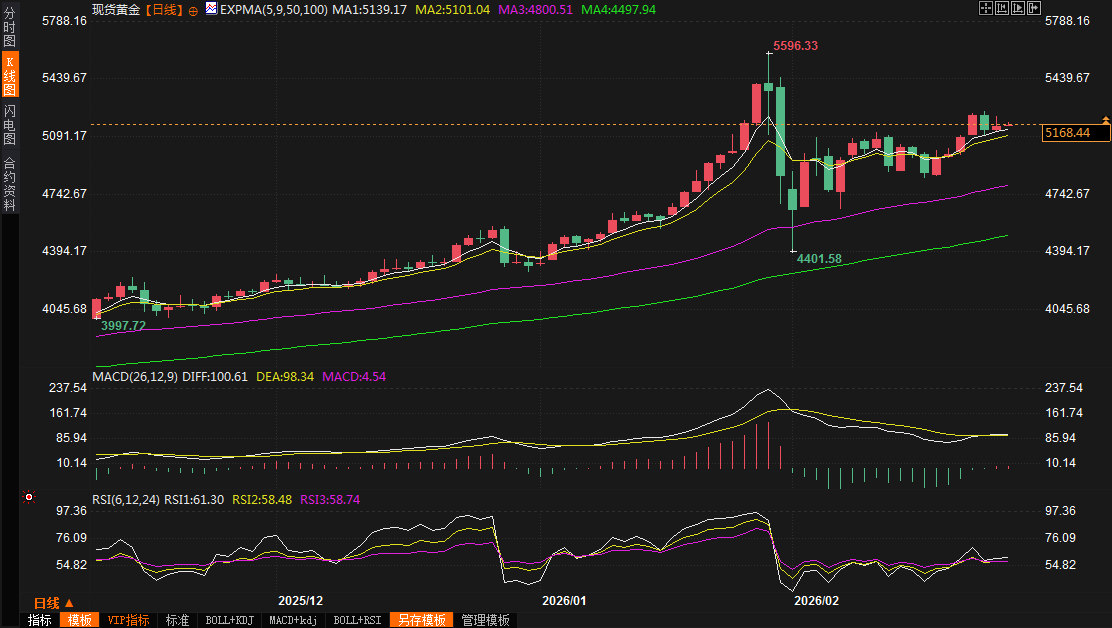
(Spot gold daily chart, source: FX678)
At 07:57 Beijing time, spot gold was trading at $5166.56 per ounce.
Tariff policies are adding fuel to the fire, and inflation concerns are increasing the attractiveness of gold.
On Tuesday, the U.S. government officially imposed a temporary 10% tariff on global imports, and White House officials revealed that the Trump team is actively pushing for the tariff rate to be raised to 15%. This move instantly ignited alarm bells in the market regarding inflation.
Bart Melek, global head of commodities strategy at TD Securities, stated that tariffs and high oil prices will bring significant inflationary pressures, especially given the looming risk of war, which will naturally lead investors to turn to gold as an effective hedge.
In his State of the Union address, Trump emphasized that almost all countries and businesses want to maintain existing tariff and investment agreements with Washington, but in reality, the volatility of policy implementation has created a great deal of uncertainty in the trade arena.
After the U.S. Supreme Court overturned Trump's emergency tariff policy last Friday, the president quickly invoked Section 122 to implement new tariffs, which allows for tariffs of up to 15%, but requires congressional approval after 150 days to extend.
Traders are closely assessing the impact of this new mechanism, and U.S. Trade Representative Greer further revealed on Wednesday that tariffs on some countries could rise from 10% to 15% or even higher. While specific trading partners have not yet been identified, this policy shift has already injected new uncertainty into the market.
Kourkafas's analysis points out that the volatility following the court ruling has made the trade sector and government responses highly unpredictable.
Meanwhile, while the US economy is showing resilience and may achieve above-trend growth and productivity gains, concerns about persistently high inflation are enough to make gold a "stabilizing force" for investors.
Iranian nuclear talks are on the verge of resuming, and geopolitical risks continue to stimulate safe-haven buying.
Alongside the tariff storm, there is an undercurrent of geopolitical tension in the Middle East. Iran and the United States are scheduled to hold their third round of nuclear talks in Geneva on Thursday, but just before the talks, the U.S. Treasury Department on Wednesday imposed severe sanctions on more than 30 individuals, entities, and a "shadow fleet" of ships, accusing them of assisting Iran in illicit oil sales, ballistic missile and weapons production.
These sanctions target 12 shadow fleet vessels and their operators, which have transported hundreds of millions of dollars worth of Iranian oil and petrochemical products. In a statement, U.S. Treasury Secretary Bessenter condemned Iran for using the financial system to launder money, purchase nuclear weapons components, and finance terrorist proxies.
In his State of the Union address, Trump clearly outlined the reasons for taking military action against Iran, emphasizing that the world’s largest financier of terrorism would never be allowed to possess nuclear weapons.
U.S. Vice President Vance reiterated on Fox News Wednesday that Trump still prefers to resolve the Iran issue through diplomatic means, but "has other options at his disposal."
Vance revealed that the United States has evidence that Iran attempted to rebuild its nuclear program after the U.S. attack on its nuclear facilities in June of this year, although Iranian Foreign Ministry spokesman Bagaei denounced it as a "monumental lie".
U.S. Presidential Envoy Witkov took an even tougher stance, stating that if a nuclear agreement is reached, it must be "indefinite" and rejecting any "sunset clauses," which implies that the U.S. is seeking permanent restrictions on Iran's nuclear capabilities.
Secretary of State Rubio pointed out that the Iranian issue is a major concern for the United States, and the negotiations will focus on the nuclear program, while Iran has refused to discuss the ballistic missile issue.
This tense situation has undoubtedly maintained safe-haven buying of gold. Investors are concerned that if negotiations break down or military conflict escalates, soaring oil prices and disruptions to global supply chains will further drive up inflation, solidifying gold's status as the "ultimate safe-haven asset."
With the Federal Reserve's interest rate path becoming clearer, a weaker dollar is providing support for gold prices.
On the monetary policy front, the Federal Reserve's cautious stance has also provided strong support for gold. Given policymakers' concerns about persistently high inflation in the United States, the market widely expects the Federal Reserve to keep interest rates unchanged until at least June, while the European Central Bank may keep interest rates unchanged throughout 2026.
Kansas City Fed President Schmid emphasized that excessive inflation remains a core challenge for central banks; St. Louis Fed President Musaleem believes that current policy rates have just balanced economic risks. The federal funds futures market projects only about 53 basis points of rate cuts this year, equivalent to two 25-basis-point cuts, with the first cut likely not occurring until July or September.
Meanwhile, the dollar index, which measures the dollar against a basket of currencies, fell 0.2% to 97.66 on Wednesday, further reducing the opportunity cost of holding gold. Australian consumer prices rose more than expected in January, also pushing the Australian dollar up 0.96% against the US dollar, reflecting the pervasive global inflationary pressures. These factors combined to allow gold to continue strengthening in a weak dollar environment.
Institutions are optimistic about the long-term prospects, and ETF holdings have reached a new high since 2021.
The confidence of major institutions in gold is evident. Bank of America, in its latest report, pointed out that while the pace of investors increasing their gold exposure has slowed, gold prices are expected to soften in the spring, but tariff uncertainty will limit the decline. The bank optimistically predicts that gold prices will break through the $6,000 per ounce mark in the next 12 months.
Data from the PDR Gold ETF shows that as of February 25, the holdings of the world's largest gold ETF, SPDR Gold Trust, increased to 1,097.62 tons, an increase of 3.43 tons from the previous trading day, reaching a new high since February 2021. This increase in holdings fully demonstrates institutional funds' strong optimism about the long-term value of gold.
The precious metals market moved in tandem, with silver and platinum both hitting three-week highs.
Gold's strength also boosted the entire precious metals sector. Spot silver surged 2.5% to $89.08 on Wednesday, hitting a three-week high of $91.12 during the session. Bank of America predicts that silver may break the $100 mark again this year. Spot platinum once soared 8%, reaching $2,347, its highest level since January 29; spot palladium, although giving back its gains at the end of the session, still recorded an intraday gain of 4.7%. This interconnected effect further confirms the widespread spread of risk aversion in the precious metals market.
The divergence between the bond and stock markets highlights a recovery in risk appetite, while gold's resilience remains to be tested.
It's worth noting that the dynamics of the bond and stock markets have added complexity to gold's price movement. U.S. Treasury prices fell for the second consecutive day on Wednesday, as rising stock markets boosted risk appetite. Demand was weak at the five-year Treasury auction, with a winning yield of 3.615% and a bid-to-cover ratio of only 2.32, below recent averages. The 10-year Treasury yield rose to 4.05%, slightly steepening the yield curve. Analysts pointed out that ample corporate bond supply, expected to reach $52 billion to $57 billion this week, also weighed on Treasury prices. Nvidia's after-hours earnings report became the market focus, with investors watching to see if its profits could match the tech giant's $630 billion capital expenditure plan.
Despite a slight recovery in risk appetite, the "double whammy" effect of tariffs and geopolitical risks has kept gold resilient. Zachary Griffiths of CreditSights observed that the correlation between the stock and bond markets has rebounded to a recent high of 0.72, with increased linkages across various markets, and AI concerns are permeating a wider range of areas.
The gold bull market has begun, and the target of $6,000 is just around the corner.
In conclusion, the gold market at the start of 2026 is in a window of opportunity amidst the intertwined challenges of tariff inflation and the Iranian nuclear crisis. In the short term, consolidation is possible in the spring, but institutions like Bank of America have clearly pointed out that any declines will be quickly offset by uncertainty. In the long term, with the Federal Reserve maintaining high policy levels, the dollar fluctuating within a range, and geopolitical risks unlikely to completely subside in the short term, predictions of gold breaking through $6,000 are not unfounded.
Investors should closely monitor the outcome of Thursday's US-Iran Geneva talks and Nvidia's earnings report for its impact on risk sentiment—regardless of the outcome, gold has firmly secured its position as a safe-haven asset. Additionally, representatives from Russia and Ukraine held separate bilateral talks with US representatives in Geneva, Switzerland on Thursday, which investors should also pay attention to.
(Spot gold daily chart, source: FX678)
At 07:57 Beijing time, spot gold was trading at $5166.56 per ounce.
- Risk Warning and Disclaimer
- The market involves risk, and trading may not be suitable for all investors. This article is for reference only and does not constitute personal investment advice, nor does it take into account certain users’ specific investment objectives, financial situation, or other needs. Any investment decisions made based on this information are at your own risk.