Analysts make a significant statement: The gold bull market is only halfway up! October target price is set at $6750.
2026-02-26 09:14:57
The international precious metals market continues to be hot. Nicky Shiels, head of research and metals strategy at MKS PAMP, pointed out in his latest report that the current gold bull market is far from over. Based on historical cycle patterns, gold prices are expected to climb to $6,750 per ounce around October 2026—around the time of the US midterm elections.
On Thursday (February 26) during the Asian session, spot gold fluctuated upwards and is currently trading around $5,185 per ounce, with a daily increase of about 0.45%. This is significantly lower than the historical peak of $5,596.33 per ounce reached in January 2026, and some investors are beginning to worry whether this indicates a weakening of long-term momentum.
However, Shiels emphasizes that, looking at the five major gold bull market cycles over the past 50 years, this round of rise lasted only 39 months, with gold prices rising by more than 200% and silver by about 350%, while the US dollar index fell by 13% during the same period. Overall, the performance is consistent with the typical characteristics of a "medium-term cycle".
In its report, Shiels wrote, "If gold prices continue to follow the historical average cycle length and rate of increase pattern, they could reach $6,750 per ounce by the time of the US midterm elections in October."
Traditional supporting factors remain strong, including declining global interest rates, geopolitical instability, increased economic uncertainty, and a weakening dollar. However, Shiels points out that this cycle is more structurally different, with gold gradually breaking free from its traditional negative correlation with real interest rates and evolving into a comprehensive hedge against the entire "financial system."
The current macroeconomic environment is undergoing several profound changes: global fiscal vulnerability is far greater than ever before, with high debt and persistent deficits creating a "fiscal-driven" landscape; political polarization in the United States is deepening; and global wealth inequality is widening. These factors collectively strengthen gold's safe-haven and asset allocation value.
Central bank gold purchases remain a core supporting force. Shiels specifically emphasized that emerging market central banks' "stockpiling" is still substantial: the world's top 20 emerging market central banks hold approximately 7,500 tons of gold. To approach the level of developed countries (G10 average), they would need to add approximately 22,000 tons, equivalent to six years of global annual mineral supply. Continued net purchases by central banks have effectively raised the floor for gold prices.
Investment demand is also diversified. Besides traditional central banks and institutions, the retail market is expanding rapidly: physical gold sales are booming through channels like Costco, interest in gold-standard tokens is rising on digital exchanges, and fractional ownership is allowing more retail capital to participate. Furthermore, institutional investors still have significantly insufficient gold allocations, leaving room for future increases.
Looking ahead, Shiels believes that further weakening of the US dollar will be a significant catalyst. "The current dollar decline of only 13% is the mildest in history, and if new catalysts emerge, the dollar still has considerable room for depreciation."
It is worth noting that silver's performance is closer to the 2008-2011 cycle (a 360% increase in 33 months), and the current increase and pace suggest that it is nearing the end of the cycle, and gold prices may continue to outperform silver.
Of course, risks remain. A significant easing of geopolitical tensions, a rebound in the US dollar, and a major shift in US fiscal policy (such as a substantial reduction in the deficit) could all put significant pressure on gold prices.
Overall, Shiels maintains a structurally bullish view, believing that gold is entering a long-term upward channel driven by "de-dollarization, fiscal dominance, and geopolitical restructuring," and that the current fluctuations around $5,200 may be building momentum for the next wave of gains.
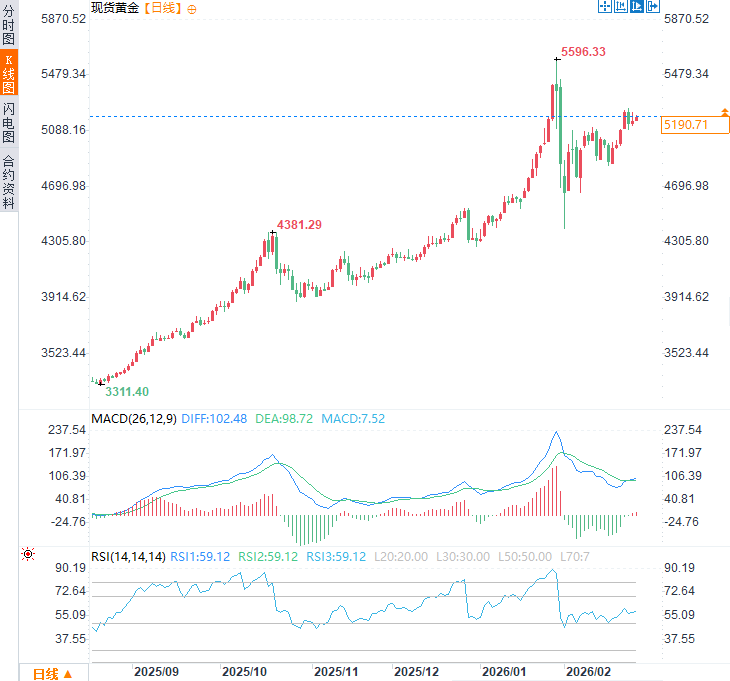
(Spot gold daily chart, source: FX678)
At 9:14 AM Beijing time, spot gold was trading at $5188.12 per ounce.
Current gold price cycle positioning
On Thursday (February 26) during the Asian session, spot gold fluctuated upwards and is currently trading around $5,185 per ounce, with a daily increase of about 0.45%. This is significantly lower than the historical peak of $5,596.33 per ounce reached in January 2026, and some investors are beginning to worry whether this indicates a weakening of long-term momentum.
However, Shiels emphasizes that, looking at the five major gold bull market cycles over the past 50 years, this round of rise lasted only 39 months, with gold prices rising by more than 200% and silver by about 350%, while the US dollar index fell by 13% during the same period. Overall, the performance is consistent with the typical characteristics of a "medium-term cycle".
In its report, Shiels wrote, "If gold prices continue to follow the historical average cycle length and rate of increase pattern, they could reach $6,750 per ounce by the time of the US midterm elections in October."
Structural differences in this cycle
Traditional supporting factors remain strong, including declining global interest rates, geopolitical instability, increased economic uncertainty, and a weakening dollar. However, Shiels points out that this cycle is more structurally different, with gold gradually breaking free from its traditional negative correlation with real interest rates and evolving into a comprehensive hedge against the entire "financial system."
The current macroeconomic environment is undergoing several profound changes: global fiscal vulnerability is far greater than ever before, with high debt and persistent deficits creating a "fiscal-driven" landscape; political polarization in the United States is deepening; and global wealth inequality is widening. These factors collectively strengthen gold's safe-haven and asset allocation value.
Central bank gold purchases and investment demand diversification
Central bank gold purchases remain a core supporting force. Shiels specifically emphasized that emerging market central banks' "stockpiling" is still substantial: the world's top 20 emerging market central banks hold approximately 7,500 tons of gold. To approach the level of developed countries (G10 average), they would need to add approximately 22,000 tons, equivalent to six years of global annual mineral supply. Continued net purchases by central banks have effectively raised the floor for gold prices.
Investment demand is also diversified. Besides traditional central banks and institutions, the retail market is expanding rapidly: physical gold sales are booming through channels like Costco, interest in gold-standard tokens is rising on digital exchanges, and fractional ownership is allowing more retail capital to participate. Furthermore, institutional investors still have significantly insufficient gold allocations, leaving room for future increases.
Outlook for the US Dollar's Performance and the Relative Performance of Gold and Silver
Looking ahead, Shiels believes that further weakening of the US dollar will be a significant catalyst. "The current dollar decline of only 13% is the mildest in history, and if new catalysts emerge, the dollar still has considerable room for depreciation."
It is worth noting that silver's performance is closer to the 2008-2011 cycle (a 360% increase in 33 months), and the current increase and pace suggest that it is nearing the end of the cycle, and gold prices may continue to outperform silver.
Potential risks and overall assessment
Of course, risks remain. A significant easing of geopolitical tensions, a rebound in the US dollar, and a major shift in US fiscal policy (such as a substantial reduction in the deficit) could all put significant pressure on gold prices.
Overall, Shiels maintains a structurally bullish view, believing that gold is entering a long-term upward channel driven by "de-dollarization, fiscal dominance, and geopolitical restructuring," and that the current fluctuations around $5,200 may be building momentum for the next wave of gains.
(Spot gold daily chart, source: FX678)
At 9:14 AM Beijing time, spot gold was trading at $5188.12 per ounce.
- Risk Warning and Disclaimer
- The market involves risk, and trading may not be suitable for all investors. This article is for reference only and does not constitute personal investment advice, nor does it take into account certain users’ specific investment objectives, financial situation, or other needs. Any investment decisions made based on this information are at your own risk.