Crude oil trading alert: Oversupply concerns are putting downward pressure on oil prices, which are fluctuating at high levels and awaiting stabilization.
2026-02-26 09:30:26
During Thursday's Asian trading session, US crude oil continued its downward trend, trading around $65.60. On the fundamental front, data released by the US Energy Information Administration (EIA) showed that US commercial crude oil inventories increased sharply by 16 million barrels last week, bringing total inventories to 435.8 million barrels, the largest weekly increase since February 2023, far exceeding market expectations.
The sharp increase in inventories stemmed primarily from the combined effects of a rebound in imports and a decline in refinery processing volumes: crude oil imports increased by 136,000 barrels per day, exports decreased by 277,000 barrels per day, while refinery crude oil processing volumes decreased by 416,000 barrels per day month-on-month. Supply-side pressures have increased significantly in the short term.

Refined product inventories showed a divergence, with gasoline inventories decreasing by 1 million barrels, indicating that end-user consumption remained relatively resilient, while distillate fuel inventories increased by 252,000 barrels, reflecting limited recovery in industrial and transportation demand. Despite the significantly bearish inventory data, oil prices did not experience a sharp decline, as geopolitical uncertainties continued to support risk premiums.
A new round of nuclear talks is set to be held in Geneva, and US President Donald Trump's reiteration that he will not allow Iran to acquire nuclear weapons has fueled market concerns about supply disruptions in the Middle East. Meanwhile, Saudi Arabia is reportedly preparing a contingency plan to increase production in the short term in case a potential conflict affects exports. There are also reports that OPEC+ may increase production by 137,000 barrels per day in April.
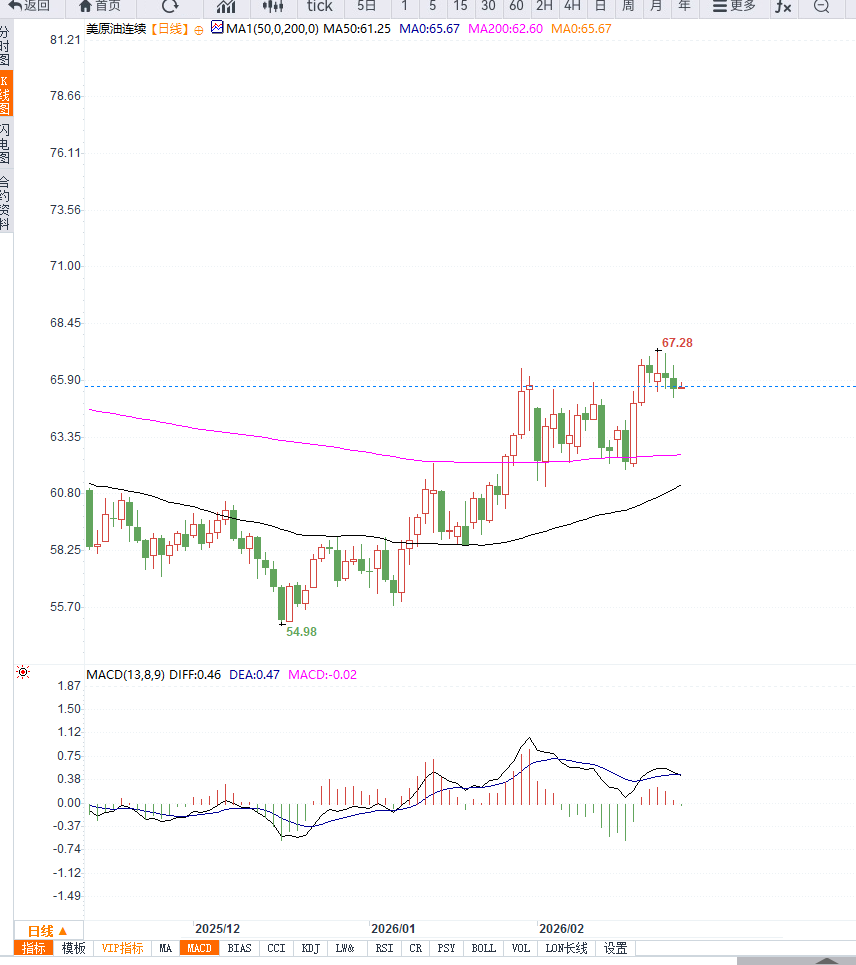
From a daily chart perspective, WTI crude oil is currently still trading within a medium-term consolidation range, with the core price fluctuation range remaining between $60 and $72. The recent decline in oil prices, though limited, indicates that support levels are still in place.
The 20-day moving average is flat, and the price is oscillating around it, indicating a lack of directional breakout in the short-term trend. The 50-day moving average is around $63, providing medium-term dynamic support. The RSI momentum indicator is near the 50 midline, neither in the overbought nor oversold zone, reflecting a balanced market sentiment.
The current price of $65 is in the middle of the trading range, where bullish and bearish forces are relatively balanced. If inventory pressure continues to ease and OPEC+ production increases materialize, oil prices may test the $63 level, with further support at the $60 psychological level.
If escalating geopolitical risks push the price above $67.50, the upside target would be $70 or even $72. Overall, the technical pattern has not yet formed a clear trend breakout, and a range-bound trading pattern remains the dominant theme.
Editor's Note:
The current oil price movement is essentially a tug-of-war between actual inventory levels and risk expectations. A weekly inventory increase of 16 million barrels is a significant bearish signal from a fundamental perspective, implying a temporary easing of supply in the US market. However, the market has not experienced panic selling, indicating that funds are more concerned about potential supply disruption risks than weekly inventory fluctuations.
Geopolitical factors currently carry significantly more weight than inventory data in pricing, and this risk premium has created a relatively stable equilibrium for oil prices around $65. Structurally, oil prices remain within a medium-term fluctuation cycle, lacking a clear trend driver. Upward movement lacks strong demand growth support, while downward movement is supported by uncertainty in the Middle East.
The future direction will depend on two key variables: first, whether inventories continue to accumulate, leading to a trend of oversupply; and second, whether the situation in the Middle East truly evolves into a substantial supply shock. Until these two factors become clear, oil prices are more likely to remain range-bound, awaiting a clear breakout signal from the fundamentals.
The sharp increase in inventories stemmed primarily from the combined effects of a rebound in imports and a decline in refinery processing volumes: crude oil imports increased by 136,000 barrels per day, exports decreased by 277,000 barrels per day, while refinery crude oil processing volumes decreased by 416,000 barrels per day month-on-month. Supply-side pressures have increased significantly in the short term.
Refined product inventories showed a divergence, with gasoline inventories decreasing by 1 million barrels, indicating that end-user consumption remained relatively resilient, while distillate fuel inventories increased by 252,000 barrels, reflecting limited recovery in industrial and transportation demand. Despite the significantly bearish inventory data, oil prices did not experience a sharp decline, as geopolitical uncertainties continued to support risk premiums.
A new round of nuclear talks is set to be held in Geneva, and US President Donald Trump's reiteration that he will not allow Iran to acquire nuclear weapons has fueled market concerns about supply disruptions in the Middle East. Meanwhile, Saudi Arabia is reportedly preparing a contingency plan to increase production in the short term in case a potential conflict affects exports. There are also reports that OPEC+ may increase production by 137,000 barrels per day in April.
From a daily chart perspective, WTI crude oil is currently still trading within a medium-term consolidation range, with the core price fluctuation range remaining between $60 and $72. The recent decline in oil prices, though limited, indicates that support levels are still in place.
The 20-day moving average is flat, and the price is oscillating around it, indicating a lack of directional breakout in the short-term trend. The 50-day moving average is around $63, providing medium-term dynamic support. The RSI momentum indicator is near the 50 midline, neither in the overbought nor oversold zone, reflecting a balanced market sentiment.
The current price of $65 is in the middle of the trading range, where bullish and bearish forces are relatively balanced. If inventory pressure continues to ease and OPEC+ production increases materialize, oil prices may test the $63 level, with further support at the $60 psychological level.
If escalating geopolitical risks push the price above $67.50, the upside target would be $70 or even $72. Overall, the technical pattern has not yet formed a clear trend breakout, and a range-bound trading pattern remains the dominant theme.
Editor's Note:
The current oil price movement is essentially a tug-of-war between actual inventory levels and risk expectations. A weekly inventory increase of 16 million barrels is a significant bearish signal from a fundamental perspective, implying a temporary easing of supply in the US market. However, the market has not experienced panic selling, indicating that funds are more concerned about potential supply disruption risks than weekly inventory fluctuations.
Geopolitical factors currently carry significantly more weight than inventory data in pricing, and this risk premium has created a relatively stable equilibrium for oil prices around $65. Structurally, oil prices remain within a medium-term fluctuation cycle, lacking a clear trend driver. Upward movement lacks strong demand growth support, while downward movement is supported by uncertainty in the Middle East.
The future direction will depend on two key variables: first, whether inventories continue to accumulate, leading to a trend of oversupply; and second, whether the situation in the Middle East truly evolves into a substantial supply shock. Until these two factors become clear, oil prices are more likely to remain range-bound, awaiting a clear breakout signal from the fundamentals.
- Risk Warning and Disclaimer
- The market involves risk, and trading may not be suitable for all investors. This article is for reference only and does not constitute personal investment advice, nor does it take into account certain users’ specific investment objectives, financial situation, or other needs. Any investment decisions made based on this information are at your own risk.