Gold Trading Alert: "Major Progress" in Geneva Nuclear Talks a Negative Factor? Analysts Say $5400 Still Within Reach
2026-02-27 08:10:30
As global investors hold their breath, the gold market is undergoing a delicate balancing act. Spot gold maintained a narrow range on Thursday (February 26), closing up slightly by 0.4% at $5183.88 per ounce, after briefly dipping to around $5130 but quickly finding support with bargain hunting; while US gold futures closed slightly lower at $5194.20. Behind this near-static price movement lies the market's heightened vigilance regarding the indirect nuclear talks between the US and Iran in Geneva—any slight tilt in the geopolitical balance could trigger significant volatility in gold prices. On Friday (February 27) in early Asian trading, spot gold traded in a narrow range, currently hovering around $5184.42 per ounce.

The third round of indirect US-Iran talks on the shores of Lake Geneva became the focus of global financial markets. Oman's Foreign Minister, acting as mediator, released positive signals after the talks, announcing "significant progress" and plans to hold technical discussions in Vienna next week. This statement eased market tensions slightly, but also temporarily dampened safe-haven buying of gold.
Iran's negotiating strategy is quite intriguing. A senior Iranian official revealed that Tehran hopes Washington can separate the "nuclear issue from the non-nuclear issue," hinting that if this can be done, a framework agreement is possible. This statement is actually a subtle response to the Trump administration's previous hardline stance—the US has consistently insisted that Iran's ballistic missile program and its support for regional armed groups must be included in the negotiations. By separating the nuclear issue from other contentious topics, Iran clearly hopes to lower the negotiation threshold and pave the way for a preliminary agreement.
In a post-meeting interview with state television, Iranian Foreign Minister Araqchi described the talks as "the most serious," while acknowledging that while both sides reached consensus on some issues, differences remained on others. This cautiously optimistic attitude has put the market in a dilemma: if the negotiations achieve a substantial breakthrough, the geopolitical risk premium will be significantly compressed, and gold may face downward pressure; however, if the negotiations break down, the 10-15 day deadline set by the Trump administration will soon expire, and the shadow of a large-scale military buildup in the Middle East will instantly trigger safe-haven demand.
Technical analysis by FOREX market analyst Razan Hilal reveals the current predicament of the gold market. He points out that gold is attempting to break through the $5,200 resistance level, but has failed to hold its gains this week. This "failed to break through" situation precisely reflects the market's lack of a clear directional catalyst—both bulls and bears are awaiting the outcome of the Geneva negotiations.
Peter Grant, Vice President and Senior Metals Strategist at Zaner Metals, offers a more forward-looking perspective. He believes that regardless of the outcome of the negotiations, the current uncertainty already permeates the market. In the short term, if a geopolitical agreement is reached, gold prices may indeed experience a correction; however, from a medium-term perspective, Grant maintains a bullish stance, expecting gold prices to climb to $5340.72 and further challenge the $5400 mark. This seemingly contradictory view actually reveals the dual nature of gold: it is both a geopolitical safe-haven asset and a store of value against monetary easing and fiscal expansion.
The Trump administration's 10-15 day ultimatum issued on February 19th hung like a Damocles' sword over the markets. The US president made it clear that an agreement with Iran must be reached within the deadline, or "very bad things" would happen. Meanwhile, the US had completed a large-scale military buildup in the Middle East, and this "combination of negotiation and force" strategy undoubtedly added enormous pressure to the talks.
While Iran's stance has shown flexibility, its bottom line remains clear. Iranian President Peskov emphasized that Supreme Leader Khamenei has banned the development of nuclear weapons through Islamic decrees, which "clearly means Tehran will not develop nuclear weapons." The Iranian Foreign Minister also explicitly expressed his desire for the lifting of US sanctions. If this core exchange logic of "abandoning nuclear weapons in exchange for lifting sanctions" can be realized, it will be a key breakthrough in easing tensions between the US and Iran.
While gold prices lingered, the US bond market sent a clear risk-averse signal. The yield on the 10-year US Treasury note fell to a three-month low of 4.016%, and the yield on the 30-year Treasury note also slipped to a more than one-week low. Kevin Flanagan, head of fixed income strategy at WisdomTree, pointed out that market concerns about the situation in Iran, coupled with anxieties that artificial intelligence could disrupt existing business models, jointly drove safe-haven funds into the bond market.
It is worth noting that the spread between the two-year and 10-year Treasury yields has narrowed for 10 consecutive trading days, marking the longest narrowing period since November 2015. This flattening yield curve reflects the market's repricing of expectations for a Federal Reserve rate cut—although Thursday's initial jobless claims data showed the labor market remains stable, the market still expects two rate cuts this year, with the first likely not occurring until July or September.
The dollar index edged up 0.14% to 97.79 on Thursday, with the market's directional trend unclear amid a complex interplay of factors including tariff prospects, risk sentiment, and economic conditions. While U.S. Trade Representative Greer did not name specific countries, his statement that tariffs on some goods and services would be raised to 15% or higher added new uncertainty to the global trade outlook.
TD Securities analysts' assessment of the dollar's trajectory in the coming quarters is noteworthy. They believe the risk of a weakening dollar remains, and the US's "exceptionalism" is unlikely to reach market expectations. Against a backdrop of robust global growth, low interest rates, and fiscal buffers, risk assets will benefit, while the dollar will come under pressure. If this macroeconomic assessment holds true, it will provide additional support for dollar-denominated gold.
Geneva is not only the stage for US-Iran negotiations, but also for discussions between the US and Ukraine regarding post-war reconstruction. Ukraine's chief negotiator, Umerov, revealed that participants hope the next trilateral meeting involving the US and Russia will be as substantive as possible. The latest World Bank assessment indicates that Ukraine's reconstruction is expected to require $588 billion, and Kyiv hopes to attract approximately $800 billion in public and private funding over the next 10 years.
While the Ukraine issue has a limited direct impact on the gold market, the evolution of the Ukraine-Russia conflict, a significant source of geopolitical risk in recent years, is also closely watched by the market. If the trilateral meeting can be held as scheduled in early March and achieve substantial progress, it will help ease tensions in the European security landscape, thereby reducing some of the safe-haven demand for gold.
In summary, the gold market is currently in a typical "calm before the storm." The tug-of-war between bulls and bears around the $5,200 level reflects the market's high degree of uncertainty regarding the outcome of the US-Iran negotiations. From a technical perspective, if the negotiations achieve a breakthrough, gold prices may quickly test the $5,100 or even the psychological level of $5,000; conversely, if the negotiations break down and lead to an escalation of regional conflict, gold prices will easily break through the $5,200 resistance and quickly challenge the previous high of $5,340.
It's worth noting for investors that even if gold prices experience a short-term pullback due to easing geopolitical risks, the downside potential may be relatively limited. Expectations of a Fed rate cut, declining US Treasury yields, and a weakening dollar in the medium term will all provide solid support for gold. As senior strategist Grant stated, a short-term pullback does not alter the medium-term bullish outlook, and targets of $5340 and even $5400 remain achievable.
Ahead of next week's Vienna talks, a cautious wait-and-see approach is undoubtedly the prevailing sentiment in the market. However, for investors with a long-term perspective, every pullback triggered by the easing of geopolitical risks may present a good opportunity to position themselves in gold. After all, with the Fed's interest rate cut cycle approaching, the reshaping of the global geopolitical landscape, and the economic uncertainties brought about by the artificial intelligence wave, gold's safe-haven appeal and value preservation function will become increasingly prominent.
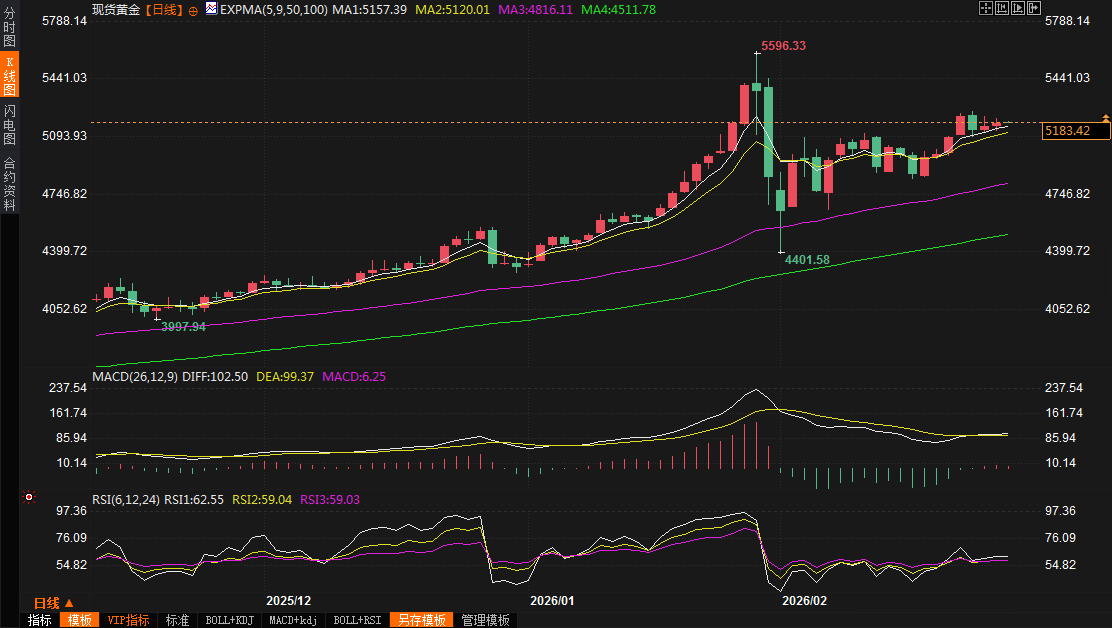
(Spot gold daily chart, source: FX678)
At 08:07 Beijing time, spot gold was trading at $5183.10 per ounce.
Negotiation at the Table: The Art of Separating Nuclear and Non-Nuclear Issues
The third round of indirect US-Iran talks on the shores of Lake Geneva became the focus of global financial markets. Oman's Foreign Minister, acting as mediator, released positive signals after the talks, announcing "significant progress" and plans to hold technical discussions in Vienna next week. This statement eased market tensions slightly, but also temporarily dampened safe-haven buying of gold.
Iran's negotiating strategy is quite intriguing. A senior Iranian official revealed that Tehran hopes Washington can separate the "nuclear issue from the non-nuclear issue," hinting that if this can be done, a framework agreement is possible. This statement is actually a subtle response to the Trump administration's previous hardline stance—the US has consistently insisted that Iran's ballistic missile program and its support for regional armed groups must be included in the negotiations. By separating the nuclear issue from other contentious topics, Iran clearly hopes to lower the negotiation threshold and pave the way for a preliminary agreement.
In a post-meeting interview with state television, Iranian Foreign Minister Araqchi described the talks as "the most serious," while acknowledging that while both sides reached consensus on some issues, differences remained on others. This cautiously optimistic attitude has put the market in a dilemma: if the negotiations achieve a substantial breakthrough, the geopolitical risk premium will be significantly compressed, and gold may face downward pressure; however, if the negotiations break down, the 10-15 day deadline set by the Trump administration will soon expire, and the shadow of a large-scale military buildup in the Middle East will instantly trigger safe-haven demand.
Gold Price Dilemma Amidst Mixed Bullish and Bearish Factors
Technical analysis by FOREX market analyst Razan Hilal reveals the current predicament of the gold market. He points out that gold is attempting to break through the $5,200 resistance level, but has failed to hold its gains this week. This "failed to break through" situation precisely reflects the market's lack of a clear directional catalyst—both bulls and bears are awaiting the outcome of the Geneva negotiations.
Peter Grant, Vice President and Senior Metals Strategist at Zaner Metals, offers a more forward-looking perspective. He believes that regardless of the outcome of the negotiations, the current uncertainty already permeates the market. In the short term, if a geopolitical agreement is reached, gold prices may indeed experience a correction; however, from a medium-term perspective, Grant maintains a bullish stance, expecting gold prices to climb to $5340.72 and further challenge the $5400 mark. This seemingly contradictory view actually reveals the dual nature of gold: it is both a geopolitical safe-haven asset and a store of value against monetary easing and fiscal expansion.
The military shadow of the US-Iran standoff
The Trump administration's 10-15 day ultimatum issued on February 19th hung like a Damocles' sword over the markets. The US president made it clear that an agreement with Iran must be reached within the deadline, or "very bad things" would happen. Meanwhile, the US had completed a large-scale military buildup in the Middle East, and this "combination of negotiation and force" strategy undoubtedly added enormous pressure to the talks.
While Iran's stance has shown flexibility, its bottom line remains clear. Iranian President Peskov emphasized that Supreme Leader Khamenei has banned the development of nuclear weapons through Islamic decrees, which "clearly means Tehran will not develop nuclear weapons." The Iranian Foreign Minister also explicitly expressed his desire for the lifting of US sanctions. If this core exchange logic of "abandoning nuclear weapons in exchange for lifting sanctions" can be realized, it will be a key breakthrough in easing tensions between the US and Iran.
Risk aversion signals in the bond market
While gold prices lingered, the US bond market sent a clear risk-averse signal. The yield on the 10-year US Treasury note fell to a three-month low of 4.016%, and the yield on the 30-year Treasury note also slipped to a more than one-week low. Kevin Flanagan, head of fixed income strategy at WisdomTree, pointed out that market concerns about the situation in Iran, coupled with anxieties that artificial intelligence could disrupt existing business models, jointly drove safe-haven funds into the bond market.
It is worth noting that the spread between the two-year and 10-year Treasury yields has narrowed for 10 consecutive trading days, marking the longest narrowing period since November 2015. This flattening yield curve reflects the market's repricing of expectations for a Federal Reserve rate cut—although Thursday's initial jobless claims data showed the labor market remains stable, the market still expects two rate cuts this year, with the first likely not occurring until July or September.
Variables of the US dollar and tariffs
The dollar index edged up 0.14% to 97.79 on Thursday, with the market's directional trend unclear amid a complex interplay of factors including tariff prospects, risk sentiment, and economic conditions. While U.S. Trade Representative Greer did not name specific countries, his statement that tariffs on some goods and services would be raised to 15% or higher added new uncertainty to the global trade outlook.
TD Securities analysts' assessment of the dollar's trajectory in the coming quarters is noteworthy. They believe the risk of a weakening dollar remains, and the US's "exceptionalism" is unlikely to reach market expectations. Against a backdrop of robust global growth, low interest rates, and fiscal buffers, risk assets will benefit, while the dollar will come under pressure. If this macroeconomic assessment holds true, it will provide additional support for dollar-denominated gold.
Reconstruction Issues and Variables in Ukraine
Geneva is not only the stage for US-Iran negotiations, but also for discussions between the US and Ukraine regarding post-war reconstruction. Ukraine's chief negotiator, Umerov, revealed that participants hope the next trilateral meeting involving the US and Russia will be as substantive as possible. The latest World Bank assessment indicates that Ukraine's reconstruction is expected to require $588 billion, and Kyiv hopes to attract approximately $800 billion in public and private funding over the next 10 years.
While the Ukraine issue has a limited direct impact on the gold market, the evolution of the Ukraine-Russia conflict, a significant source of geopolitical risk in recent years, is also closely watched by the market. If the trilateral meeting can be held as scheduled in early March and achieve substantial progress, it will help ease tensions in the European security landscape, thereby reducing some of the safe-haven demand for gold.
Waiting for a breakthrough
In summary, the gold market is currently in a typical "calm before the storm." The tug-of-war between bulls and bears around the $5,200 level reflects the market's high degree of uncertainty regarding the outcome of the US-Iran negotiations. From a technical perspective, if the negotiations achieve a breakthrough, gold prices may quickly test the $5,100 or even the psychological level of $5,000; conversely, if the negotiations break down and lead to an escalation of regional conflict, gold prices will easily break through the $5,200 resistance and quickly challenge the previous high of $5,340.
It's worth noting for investors that even if gold prices experience a short-term pullback due to easing geopolitical risks, the downside potential may be relatively limited. Expectations of a Fed rate cut, declining US Treasury yields, and a weakening dollar in the medium term will all provide solid support for gold. As senior strategist Grant stated, a short-term pullback does not alter the medium-term bullish outlook, and targets of $5340 and even $5400 remain achievable.
Ahead of next week's Vienna talks, a cautious wait-and-see approach is undoubtedly the prevailing sentiment in the market. However, for investors with a long-term perspective, every pullback triggered by the easing of geopolitical risks may present a good opportunity to position themselves in gold. After all, with the Fed's interest rate cut cycle approaching, the reshaping of the global geopolitical landscape, and the economic uncertainties brought about by the artificial intelligence wave, gold's safe-haven appeal and value preservation function will become increasingly prominent.
(Spot gold daily chart, source: FX678)
At 08:07 Beijing time, spot gold was trading at $5183.10 per ounce.
- Risk Warning and Disclaimer
- The market involves risk, and trading may not be suitable for all investors. This article is for reference only and does not constitute personal investment advice, nor does it take into account certain users’ specific investment objectives, financial situation, or other needs. Any investment decisions made based on this information are at your own risk.